
There were thirty of them in the tanks of a park closed to the public since 2024. Thirteen belugas from Marineland Canada, at Niagara Falls, flew to the United States this summer, in two convoys of six and then seven animals. Nine arrived at SeaWorld San Antonio, four at the Shedd Aquarium in Chicago. The operation is presented as the largest transport of captive cetaceans ever carried out in North America. It settles an emergency without closing the debate it opens.
Two convoys, two thousand miles
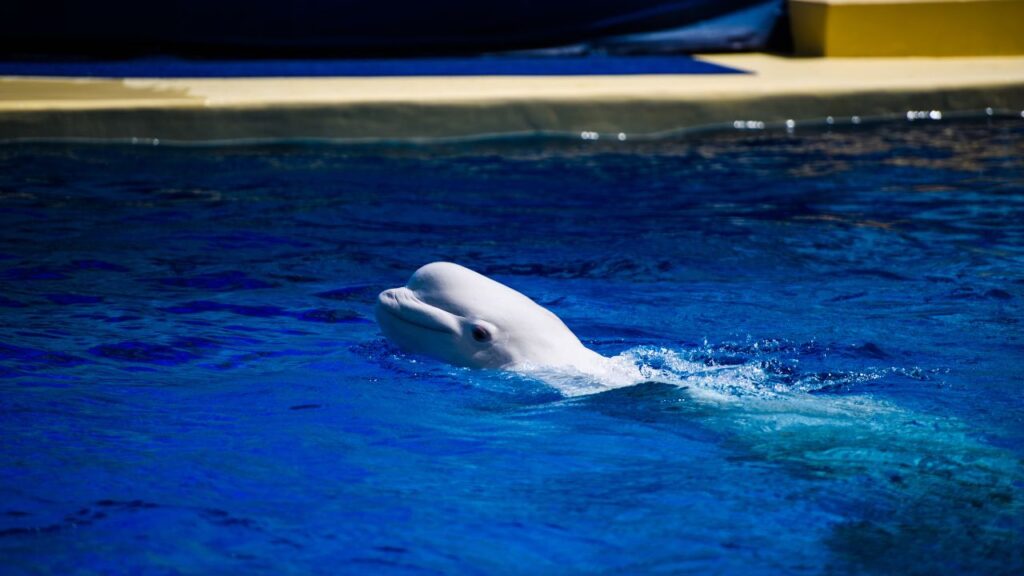
The first departure took place around 20 July 2026: two males, Frankie and Bertie Botts, to Texas, and four females to Chicago. The second, on 3 August, took seven females to San Antonio: Xena, Gemini, Skyla, Meeka, Eve, Neva and Calypso. The animals travelled in water-filled containers, under continuous veterinary supervision, part of the journey being flown by a Boeing 777 freighter. Close to two thousand miles in all.
The full plan covers twenty-eight cetaceans, shared between SeaWorld, the Shedd, the Georgia Aquarium and, possibly, the Oceanogràfic in Valencia, Spain. Seventeen belugas are still waiting at Marineland. Coordination is handled by the North American association of zoos and aquariums, whose president Dan Ashe has followed the case.
Why Marineland is emptying
In 2019 Canada passed Bill S-203, which bans keeping, breeding and acquiring cetaceans for entertainment. The animals already held were kept under a grandfather clause, but with no renewal possible: the Canadian captive population is bound to die out. The park stopped receiving the public in 2024, its financial position deteriorated, and it is now for sale.
The health record weighs heavily: some twenty animals, almost all belugas, have died on the site since 2019. A plan to send animals to a Chinese park had been blocked by the federal fisheries minister, precisely under the 2019 law. And euthanasia had ended up being raised publicly, for want of a solution. It was in this deadlock that the transfer to the United States was put together.
What awaits them in San Antonio
The Texas park is no newcomer: a colony of eight belugas already lived there, aged from two to forty years. The animals are housed in a complex built in 1988, seven connected tanks totalling more than two and a half million gallons, close to ten thousand cubic metres of salt water chilled to between 13 and 15 degrees, with a medical pool with a raisable floor.
The seven females that arrived in early August are being kept away from the public for the time it takes them to acclimatise. The two males, which arrived in July, are gradually being introduced to the belugas already on site. Introducing adults into an established group is no small matter in a species as social as this one: bonds build slowly, and the teams say they are working at the animals’ pace.
A rescue, or a move from one tank to another?
The disagreement deserves to be set out without being settled lightly. The receiving institutions point to better maintained facilities, larger veterinary teams, and animals that would otherwise have stayed in an abandoned park, at a point when euthanasia was already on the table.
The critics, led in particular by Naomi Rose of the Animal Welfare Institute, put forward three concrete objections. Transport remains a major stress for animals whose state of health is already impaired. Recent experience invites caution: of five belugas moved from Marineland in 2021, three died within eighteen months. Lastly, no commitment rules out breeding at the receiving institutions.
This last objection is not theoretical. SeaWorld San Antonio claims one of the largest beluga breeding programmes in the United States: half of the animals it houses were born there, and several belugas at other American institutions came from it. In other words, animals from a country that is organising the extinction of its captive population are joining a facility whose programme rests in part on birth in a tank. The difference in legislation between the two countries makes all the difference here.
What to take away
That banning captivity says nothing about the fate of the animals already born in a tank. A beluga born at Marineland cannot be released: it has never hunted, knows no wild group, and carries a pathogen load that rules out any contact with a free population. The only ways out are another tank, a coastal sanctuary, or euthanasia. Our page on captivity and sanctuaries sets out these alternatives, which are still rare and costly.
And that a national law shifts the problem as much as it solves it, as long as neighbouring countries do not have the same rules. Seventeen belugas are still waiting at Niagara Falls. If the subject interests you, our page on how to act for cetaceans lists the practical levers, and our species pages on the odontocetes place the beluga among its close relatives.
Sources: Mongabay, Blooloop, Good News Network, CKPG Today and Texas Public Radio. Legal framework: Canadian Bill S-203 (2019).
Did you find this article useful?
Add L'info des Cétacés to your preferred sources on Google. Our stories will be suggested to you more often, and the choice can be undone as easily as it is done.
 Follow us on Google
This preference is saved in your Google account and can be changed at any time. It is neither a certification nor a recommendation from Google.
Leave a review