Beluga (Delphinapterus leucas)

Key facts
Scientific name Delphinapterus leucas (Pallas, 1776)
Other names Bélouga, baleine blanche, dauphin blanc, marsouin blanc, moine de mer, bleuvet, “canari des mers” (French names). In English: beluga whale, white whale, sea canary.
Size Males 3.5 to 5.5 m; females 3.0 to 4.1 m; newborn about 1.50 m
Weight Males 1,100 to 1,600 kg (exceptionally up to about 1,900 kg); females 700 to 1,200 kg; newborn about 80 kg
Longevity Commonly 60 to 80 years; the oldest documented individual showed 80 dental growth layer groups, NOAA citing a longevity that may approach 90 years
Diet Opportunistic and varied: Arctic cod, salmon, herring, capelin, smelt, flatfish, Greenland halibut, supplemented by octopus, squid, shrimp, crabs, shellfish and marine worms
IUCN status Least Concern (LC) at global level, assessment by Lowry, Reeves & Laidre 2017, status maintained in version 2026-1 of the Red List (published on 9 July 2026). Cook Inlet (Alaska) subpopulation: Critically Endangered (CR). In Canada, the St Lawrence estuary population is listed as an endangered species (federal) and as threatened (Quebec, since 2000).

In brief

The only cetacean entirely white as an adult, the beluga is, with the narwhal, one of the two living members of the family Monodontidae, confined to Arctic and subarctic seas. Lacking a dorsal fin, fitted with a deformable melon and with cervical vertebrae that are not fused, which allow it to turn its head, it lives in very talkative groups in the cold waters, the estuaries and the sea ice of the Northern Hemisphere. Classified as Least Concern at global level, it nevertheless holds local populations in great danger, such as that of Cook Inlet in Alaska.

Identification

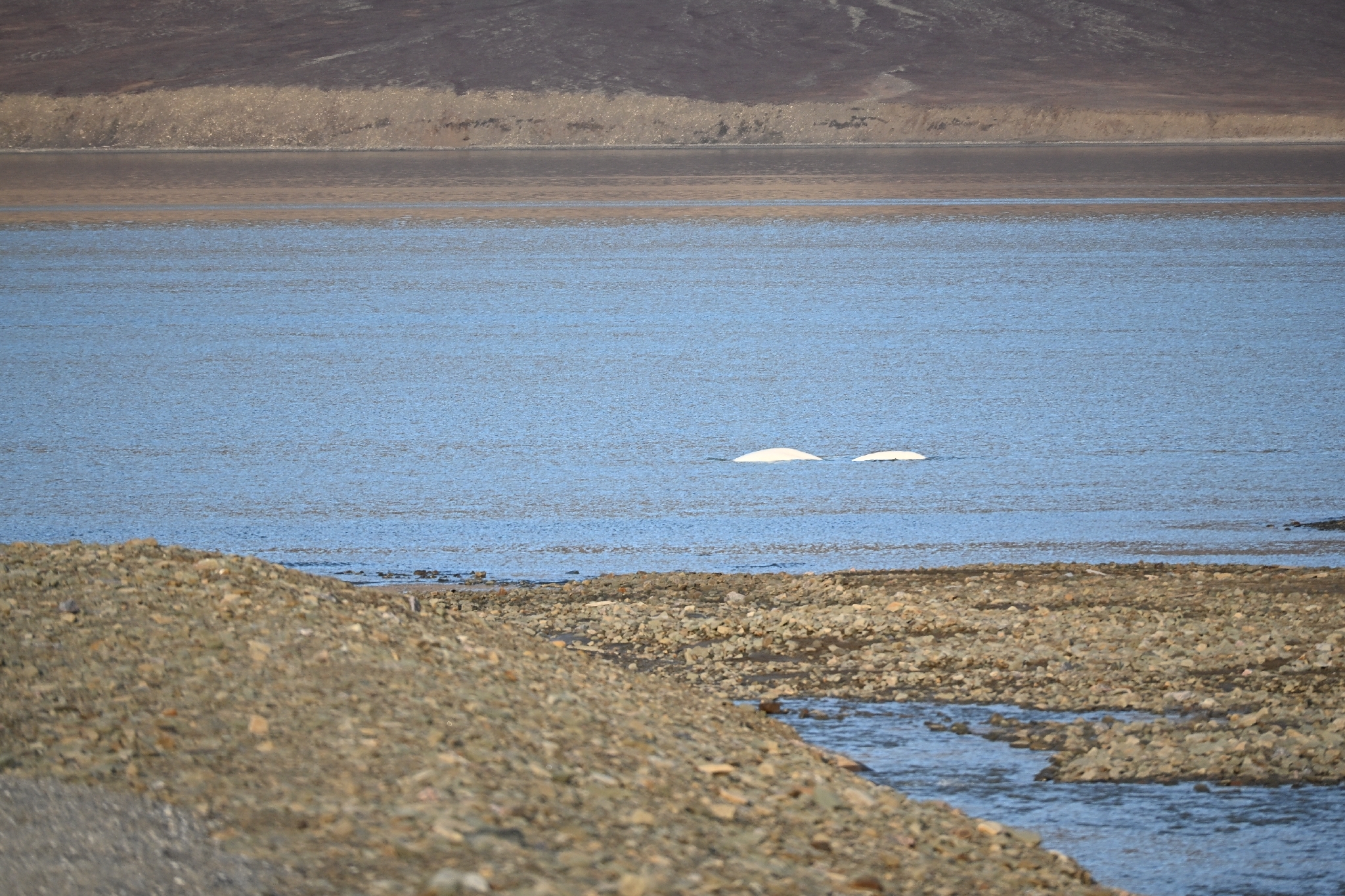
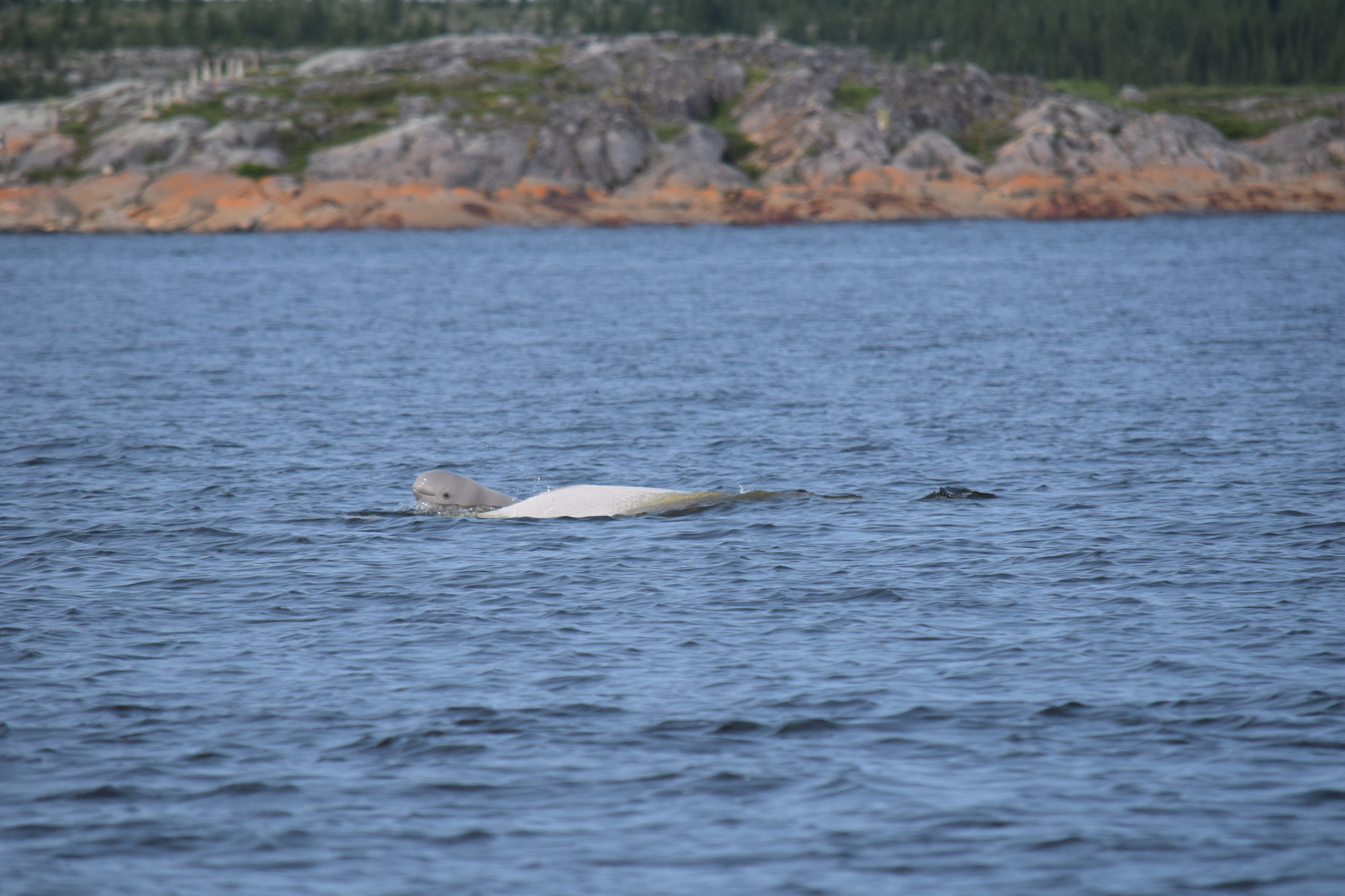
The adult beluga is immediately recognisable: a stocky body, entirely white or creamy white, measuring 3 to 5.5 m depending on sex, for a mass of 700 to 1,600 kg, exceptionally up to about 1,900 kg in the largest males. Males are about a quarter larger and heavier than females. The head carries a bulky, domed and deformable melon, which focuses and modulates echolocation sounds; the rostrum is very short, almost absent, and the wide mouth gives the animal a smiling expression. The jaws hold 32 to 40 small, blunt teeth.

Two features are striking straight away. First the absence of a dorsal fin, replaced by a simple tough dorsal ridge, the genus name <em>Delphinapterus</em> means literally “dolphin without a fin”, an adaptation to life under floating ice; this trait is not unique to the beluga, since it shares it with the narwhal and, outside the Arctic, with the finless porpoises and the right whale dolphins. Then, its seven cervical vertebrae are not fused, which allows it to turn and nod its head, a mobility that is extremely rare among cetaceans. Blubber accounts for 40 to 50% of body mass and can reach 15 cm in thickness. The beluga is also one of the few cetaceans to moult: each summer, in estuaries, it rubs on gravel bottoms to shed its old skin.

The colour changes with age: the newborn measures about 1.50 m for 80 kg and is born dark grey to brownish; it lightens progressively, from blue-grey to pale grey, before becoming white, generally at around 7 years in females and 9 years in males, later still in some populations. Confusion remains limited. The narwhal (<em>Monodon monoceros</em>), its closest relative, shares the absence of a dorsal fin but keeps a mottled grey coat; females, which have no tusk, may mislead an inexperienced observer. In temperate waters, Risso’s dolphin (<em>Grampus griseus</em>), which whitens with age through scarring, is told apart by its large falcate dorsal fin. Lastly, the name “beluga” also refers to a fish, the sturgeon <em>Huso huso</em>, the source of the caviar of the same name: no relation to the cetacean.

Taxonomy

Described by the naturalist Peter Simon Pallas in 1776, the beluga belongs to the family Monodontidae, which holds only two living species: the beluga and the narwhal, the only odontocetes endemic to the Arctic. The epithet <em>leucas</em> comes from the Greek for “white”. No subspecies is recognised, but the species is structured into a large number of management units, 21 to 22 subpopulations depending on the authors, defined from genetics, distribution, seasonal movements, exploitation histories and contamination profiles. Hybridisation with the narwhal, long suspected, was confirmed in 2019 by the genomic analysis of a skull collected in 1990 in Disko Bay, West Greenland: it was a first-generation male, 54% beluga and 46% narwhal, born to a narwhal mother and a beluga father.

Distribution and habitat

The distribution is circumpolar but discontinuous, in the Arctic and subarctic waters of the Northern Hemisphere, roughly between 50° and 80° north: Alaska, the Canadian Arctic, West Greenland, the Russian coasts, Svalbard and the Sea of Okhotsk. The combined world total exceeds 200,000 individuals. The largest units are found in western Hudson Bay (about 55,000 animals), the eastern Beaufort Sea (about 39,300), the eastern Canadian Arctic (about 21,400) and the eastern Chukchi Sea (about 20,700). United States waters hold five distinct stocks: Beaufort, Eastern Chukchi, Eastern Bering, Bristol Bay and Cook Inlet.

The beluga frequents above all shallow coastal waters, bays, deltas and estuaries in summer, and moves to the edge of the sea ice or to ice-free channels in winter. A relict population, isolated for several thousand years, occupies the St Lawrence estuary and the Saguenay fjord, in Quebec, all year round: it was estimated at 1,850 individuals in 2022, against 7,800 to 10,100 at the beginning of the twentieth century.

In France, the beluga is not a native species: it is absent from the Mediterranean, from the Pelagos Sanctuary, from the Bay of Biscay and from the overseas territories. Only two cases are documented there, both of individuals that had strayed far south of their range: the first hauled up in a fisherman’s nets in the Loire estuary in 1948, the second seen on 2 August 2022 in the Seine, near Poses, more than 170 km from the river mouth. Other comparable wanderings have been reported in Europe, in particular an animal that moved up the Rhine in Germany around the middle of the 1960s and an individual that stayed three months in the Thames estuary in 2018.

Biology and ecology

An opportunistic predator, the beluga takes a wide diversity of prey: Arctic cod, salmon, herring, capelin, smelt, flatfish, Greenland halibut, but also octopus, squid, shrimp, crabs, shellfish and marine worms. Its feeding follows local resources: in the St Lawrence estuary, capelin and herring dominate; in Alaska, the runs of salmon and eulachon set off episodes of intense feeding. It most often dives to some twenty metres for 3 to 5 minutes, but is able to go down to 900-1,000 m and to hold its breath for up to 20 to 25 minutes.

The species is eminently social. Groups most often number about ten individuals, often structured by age and by sex, but summer gatherings in estuaries can bring together several hundred to several thousand animals. The vocal repertoire is exceptionally rich, whistles, clangs, chirps, creaks and moos, to the point of earning the animal its nickname of “sea canary”; these calls are coupled with very fine echolocation, used to navigate under the ice and to detect prey.

Mating takes place at the end of winter and in spring. Gestation lasts about 12 to 15 months depending on the sources and the populations, and gives rise to a single calf; lactation continues for at least two years, sometimes longer, and females give birth only every two to three years. Sexual maturity is reached at around 4 to 14 years in females depending on the population, slightly later in males. Females show a decline in fertility with age, and a menopause has been described.

Longevity is markedly greater than was once believed: modern estimates place the usual lifespan between 60 and 80 years, the oldest documented individual showing 80 dental growth layer groups, and NOAA cites a longevity that may approach 90 years. The natural predators are the polar bear, which takes animals trapped at breathing holes, and the killer whale. Entrapment by ice, when the channels close over, is a notable cause of natural mortality.

Status and conservation

At global level, the beluga is classified as Least Concern (LC) on the IUCN Red List, a status arising from the assessment carried out by Lowry, Reeves and Laidre in 2017 and still in force in version 2026-1 of the Red List (July 2026). This global classification masks wide disparities: the Cook Inlet subpopulation, in Alaska, is assessed as Critically Endangered (CR). Estimated at about 1,300 animals in 1979, it had fallen to 279 individuals in 2018, a decline of close to 80%, before an estimate of 331 individuals during the aerial surveys of June 2022; it has been designated “depleted” under the Marine Mammal Protection Act since 2000 and listed as “endangered” under the Endangered Species Act since 22 October 2008. The St Lawrence estuary population is listed as an endangered species on the Canadian federal register and as a threatened species in Quebec since 2000.

The threats are many. Climate change and the loss of sea ice are transforming the habitat and opening the Arctic to shipping traffic. To these are added underwater noise, chemical contamination, St Lawrence belugas carry high burdens of organochlorines, polycyclic aromatic hydrocarbons and heavy metals, associated with a remarkably high frequency of cancers, the degradation of estuarine habitats, the scarcity of prey, ship strikes, entanglement in fishing gear, toxic algal blooms and disease. Historical commercial whaling was intense; present-day subsistence hunting takes on the order of a thousand animals a year, and live captures destined for dolphinaria, in particular in the Sakhalin-Amur region of the Sea of Okhotsk, have been the subject of independent scientific assessments. The species is listed in Appendix II of CITES. In France, all marine mammals come under the national list of protected species set by the ministerial order of 1 July 2011.

Watching this species

Watching a beluga means going north. The most spectacular summer gatherings form from June to August in the estuaries of western Hudson Bay, where thousands of animals come to moult and to calve, as well as in the Canadian Arctic, in Svalbard and along the coasts of Alaska. In Quebec, the St Lawrence estuary and the Saguenay fjord hold the only population accessible from inhabited shores all year round; there it is subject to strict approach rules, because of its status as a species at risk.

The animal is curious and not easily frightened, which makes it vulnerable to disturbance. The rule is never to try to close the distance, to cut the engines if animals come near of their own accord, not to split groups up or to come between a female and her calf, and to rule out entering the water alongside them. In French marine protected areas, approaching cetaceans closer than 100 metres has been prohibited since 1 January 2021.

In mainland France, no watching trip can target this species: the only two known occurrences, in 1948 and in 2022, involved stray animals in distress. Any sighting or stranding of a marine mammal must be reported to the Réseau national échouages, the national stranding network coordinated by the Observatoire Pelagis, without attempting to intervene oneself.

Frequently asked questions

Can the beluga be seen in France?

No. The beluga is an Arctic and subarctic species, absent from French waters. Only two stray individuals have been documented there: the first hauled up in a fisherman’s nets in the Loire estuary in 1948, the second spotted on 2 August 2022 in the Seine near Poses, more than 170 km from the river mouth. The latter, an animal of about 4 m and 800 kg, severely emaciated, was taken out of the river during the night of 9 to 10 August 2022 near the Saint-Pierre-la-Garenne lock, then euthanised during its transfer towards the Normandy coast, its condition having deteriorated rapidly.

Why is the beluga white?

It is not white from birth. The newborn is dark grey to brownish, then lightens progressively over the years, passing through blue-grey and pale grey before reaching the characteristic white, generally at around 7 years in females and 9 years in males. This pale coat is considered to be effective camouflage in an environment dominated by ice.

Why is it called the “sea canary”?

Because it is one of the most talkative cetaceans. Its repertoire includes whistles, clangs, chirps, creaks and moos, audible from the surface and even through the hull of a boat. These sounds serve social communication, while distinct click trains provide echolocation, indispensable for navigating under the sea ice and locating prey in often turbid water.

What is the difference between a beluga and a narwhal?

The two species make up the family Monodontidae on their own and share the absence of a dorsal fin, replaced by a ridge, a trait also found, outside the Arctic, in the finless porpoises and the right whale dolphins. The adult beluga is uniformly white and has no tusk; the narwhal stays mottled grey, and the male carries a long spiralled tooth. The two species can hybridise: a skull collected in 1990 in Disko Bay, Greenland, was shown in 2019 to be that of a first-generation hybrid, 54% beluga and 46% narwhal, born to a narwhal mother and a beluga father.

How many belugas are left in the world?

More than 200,000 individuals in all, spread over 21 to 22 subpopulations. The largest are found in western Hudson Bay (about 55,000 animals), the eastern Beaufort Sea (about 39,300) and the eastern Canadian Arctic (about 21,400). Some units, by contrast, are tiny: that of Cook Inlet, in Alaska, went from about 1,300 individuals in 1979 to 279 in 2018, with an estimate of 331 animals in 2022.

Why are St Lawrence belugas particularly fragile?

This population, isolated from the Arctic groups for several thousand years, lives all year round in a heavily industrialised estuary. Estimated at 1,850 individuals in 2022 against 7,800 to 10,100 at the beginning of the twentieth century, it combines chemical contamination, organochlorines, polycyclic aromatic hydrocarbons, heavy metals, associated with a frequency of cancers exceptionally high for a cetacean, underwater noise, shipping traffic, collisions and the scarcity of prey. It is listed as an endangered species in Canada and as threatened in Quebec.

Sources

Profile compiled from authoritative scientific sources (IUCN, NOAA Fisheries, specialist literature) and reviewed for factual accuracy.

Observed distribution

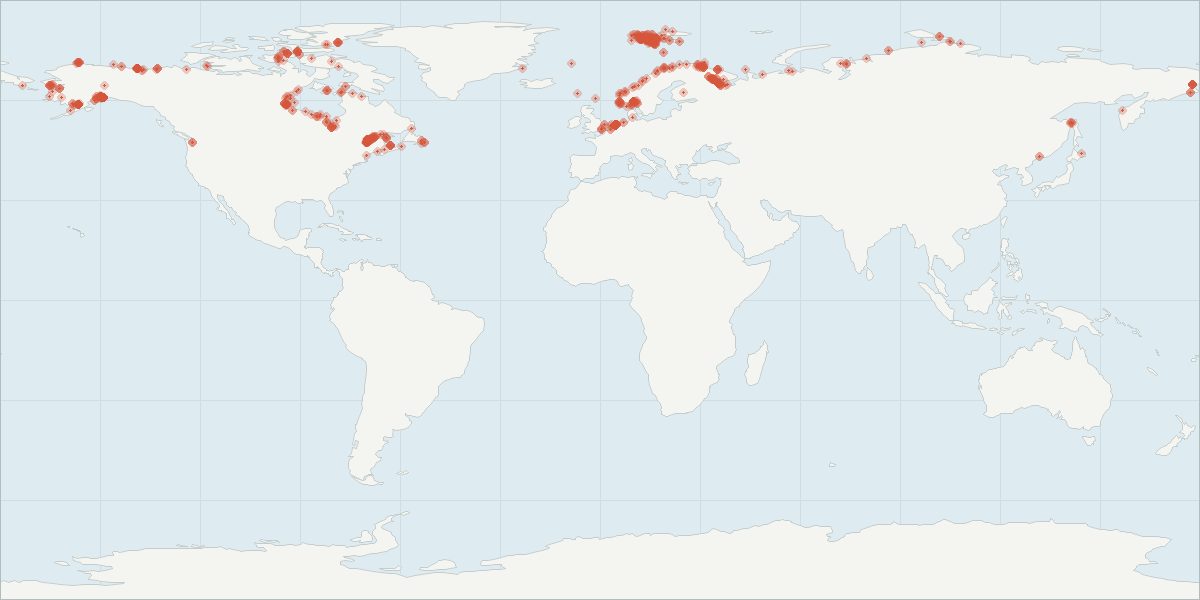
According to the open data of the GBIF, 1,809 georeferenced sightings of Delphinapterus leucas are recorded in our photographic index.

Main countries of observation
CountryNotes
Canada856
Netherlands287
United States of America286
Svalbard and Jan Mayen225
Norway107
Russian Federation98
unknown or invalid17
Greenland12
United Kingdom of Great Britain and Northern Ireland9
Finland2

Distribution map: Beluga (Delphinapterus leucas)

Distribution map: Beluga (Delphinapterus leucas), 1,809 georeferenced sightings from GBIF
1,809 georeferenced sightings of Delphinapterus leucas. Base map Natural Earth, public domain. GBIF data.
🗺️ Open the interactive mapTo zoom and pan. It uses the OpenStreetMap/CARTO base maps and the GBIF occurrence densities: no data is sent to these services before you click.

Presence through the year

Monthly distribution of 1,839 dated sightings (all years combined): the maximum is reached in August.

4200janvier : 268janfévrier : 30febmars : 8maravril : 104avrmai : 96maijuin : 240juinjuillet : 391juilaoût : 420Augustseptembre : 214sepoctobre : 55octnovembre : 10novdécembre : 3dec
Sightings by month
MonthNotes
janvier268
February30
mars8
avril104
mai96
juin240
juillet391
August420
septembre214
octobre55
novembre10
December3

These figures reflect survey effort (more boaters and more surveys in summer) as much as the actual presence of the species: to be interpreted with caution.

En images

Delphinapterus leucas
© Vanessa Hum, CC BY-NC, 2026
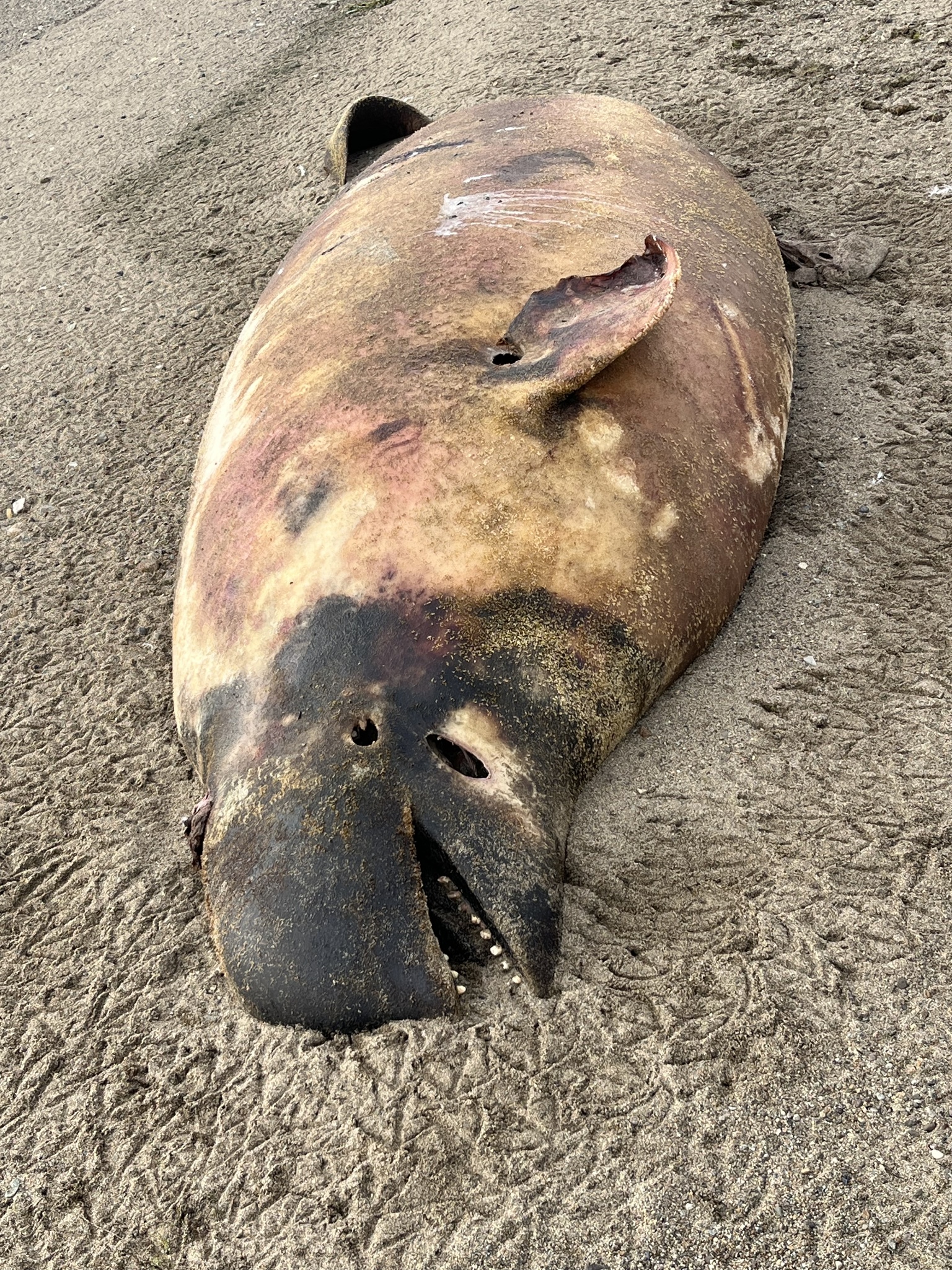
Delphinapterus leucas
© Angelina van der Vliet - Stiehl, CC BY-NC-ND, 2026
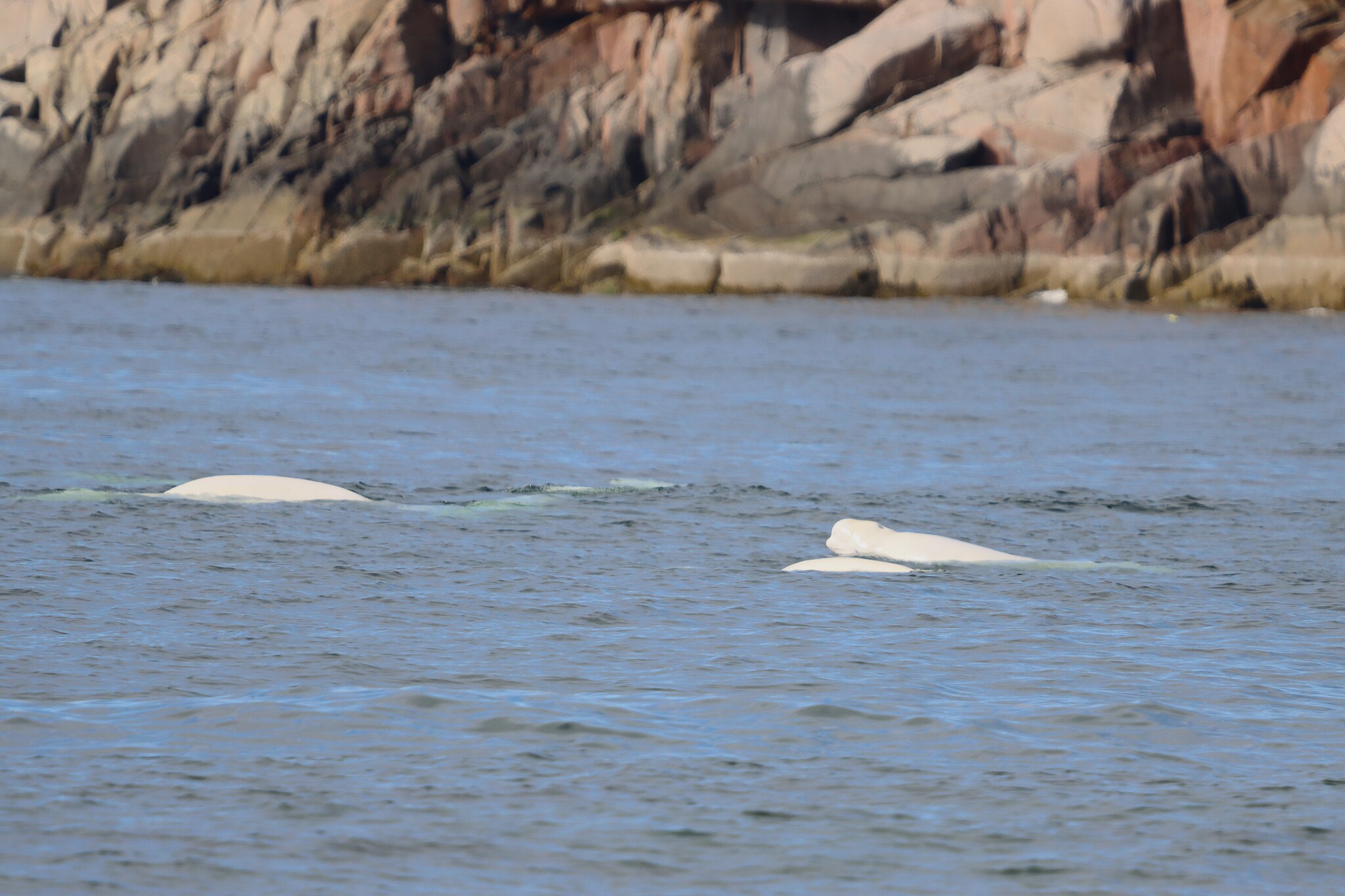
Delphinapterus leucas
© Лариса Артемьева, CC0, 2026
Delphinapterus leucas
© S Van Dijck, CC BY-NC-ND, 2026
Delphinapterus leucas
© Максим Беликов, CC BY-NC, 2026
Delphinapterus leucas
© Walter Das, CC BY-NC-ND, 2026
Delphinapterus leucas
© Hans Ivar Hortman, licence spécifique, 2026
Delphinapterus leucas
© Spider Cat, CC BY-NC, 2026
Delphinapterus leucas
© Fons de Meijer, CC BY-NC-ND, 2026
Delphinapterus leucas
© Stephen Petersen, CC BY-NC, 2026
Delphinapterus leucas
© DaniëlV, CC BY-NC-ND, 2026
Delphinapterus leucas
© Melvin Åsum, CC BY-NC-SA, 2026

Photographs from GBIF under a Creative Commons licence. The author and the licence of each photograph are given; please respect them if you reuse them.

Scientific references

  1. Stewart B., Stewart R. (1989) Delphinapterus leucas, Mammalian Species
  2. BRODIE P. (1969) Mandibular Layering in Delphinapterus leucas and Age Determination, Nature
  3. Recchia C. (1994) Social behaviour of captive belugas, Delphinapterus leucas
  4. JARRELL G., ÁRNASON Ú. (2009) Banded karyotypes of a belukha whale, Delphinapterus leucas, Hereditas
  5. Slack M. Bubble Stream Production by Belugas (Delphinapterus leucas)
  6. (2019) Delphinapterus leucas, CABI Compendium
  7. (2017) Beluga whale (Delphinapterus leucas), The Western Arctic Seas Encyclopedia
  8. (2016) Beluga Whale or White Whale (Delphinapterus leucas), The Eastern Arctic Seas Encyclopedia

Automatic selection of the most cited works mentioning the species (source: Crossref).