
On the night of 21 to 22 June 2026, two fin whales were harpooned off Iceland. The hunt was resuming after two blank seasons. The paradox is that almost none of the reasons usually invoked holds up: the Icelandic public does not eat the meat, the activity earns less than whale watching, public opinion is now mostly hostile, and the minister responsible states herself that this hunt is not in the public interest, while announcing a law to put an end to it.
Understanding why it carries on all the same calls for taking the explanations apart one by one.
Where things stand
Iceland is one of the three countries that still openly practise commercial whaling, along with Norway and Japan. It left the International Whaling Commission in 1992 before rejoining in 2002, attaching to its membership a reservation to the 1986 moratorium. It is that reservation which makes the activity lawful under international law, a mechanism set out on our page on the international legal framework.
The recent timeline is instructive, because it shows an activity that is already intermittent.
| Season | Fin whales killed | Circumstances |
|---|---|---|
| 2019 to 2021 | 0 | voluntary halt, Japanese market in decline |
| 2022 | 148 | resumption |
| 2023 | 24 | season suspended in June on animal welfare grounds, resumed in September |
| 2024 and 2025 | 0 | the company stood down, on economic grounds |
| 2026 | about thirty to date | resumed on 21 June, quota of 150 |
For 2026, the Icelandic marine research institute recommended a ceiling of 150 fin whales, a reduction of about 28% on previous advice, and 168 common minke whales. These quotas fall within a five-year licence granted at the end of 2024 and valid until 2029, which allows up to 209 fin whales a year.
First explanation set aside: the economy
It is the argument one expects, and it does not survive the figures.
Whale watching earns more than whaling. In 2017, a year for which the comparison is documented, whale-watching companies turned over 3.2 billion krónur, against 1.7 billion for the whaling business. The ratio is one to two, in favour of the living animals.
Icelanders do not eat whale. About 1.5% of the population eats it regularly. On the island, whale meat is bought above all by tourists who believe they are tasting a local tradition. And 95% of the products are exported, all of the fin whale going to Japan.
The Japanese market has closed up. That is the very reason for the blank seasons of 2024 and 2025: the head of the company cited falling prices in Japan, the weakness of the Icelandic króna and rising operating costs. In other words, when the activity stops it is for economic reasons; when it resumes, it is not because it has become profitable.
Second explanation set aside: public opinion
The reversal is clear and recent. In 2013, polls gave 56.9% support for the fin whale hunt against 17.1% opposition. Recent surveys give 41% opposed to 33% in favour.
The divide is generational: only 21% of 18 to 29 year olds approve, against 45% of those over 60. On the substance, 52.5% of those surveyed consider that the hunt is of no importance to the national economy, and 64.3% judge that it harms the country’s reputation.
An activity that does not enrich, that is not eaten, and that most people think damages the national image: the ordinary explanations are exhausted.
What actually explains its persistence
One man and one company. Fin whaling in Iceland means a single firm, Hvalur, and its head Kristján Loftsson, the country’s last industrial whaler. Hvalur is not only a fishing business: it is a holding structure whose income does not depend on whales. The hunt can therefore be kept going irrespective of its own profitability, which no market analysis would predict. Reducing a national industry to the determination of a single actor looks excessive, but here it is literally the case.
A matter of sovereignty. This is the most powerful driver, and the least visible from abroad. In a country of fewer than 400,000 inhabitants whose independence dates from 1944 and whose economic history is made of disputes over territorial waters, the right to decide alone how its marine resources are used carries considerable symbolic weight. Giving way to outside pressure costs more politically than the hunt itself brings in. That driver is all the more active in that Iceland is to decide in 2026, by referendum, on resuming accession negotiations with the European Union, which is firmly opposed to commercial whaling.
Administrative law. This is the explanation that is least publicly set out, and yet a decisive one. In June 2023, the minister Svandís Svavarsdóttir suspended the season on the eve of its opening, on the ground that the killing conditions breached Icelandic animal welfare law. The Parliamentary Ombudsman then found that suspension procedurally improper, for want of a sufficient legal basis and of reasonable notice. The lesson was taken: a licence duly granted for five years cannot be revoked by ministerial decision. A law is needed, which takes time and requires a majority.
The point of friction: the killing
It is on this ground, rather than on that of conservation, that the issue has moved most. The official veterinary inspections carried out on board have produced figures the industry has been unable to set aside.
Monitoring of the 2022 season, covering 148 animals, established that a substantial share of the fin whales did not die outright, some taking up to two hours to die. The professional council on animal welfare concluded from this that the method was incompatible with Icelandic law, which triggered the suspension of 2023.
The 2023 season, resumed in September under tightened conditions, was documented better still: 71% instantaneous deaths, so close to three animals in ten that were not; a mean delay of fourteen minutes for those; 21% of the animals hit by more than one harpoon; and one individual that took thirty-five minutes to die. An administrative fine was also imposed on the company for breach of the animal welfare law.
The difficulty is structural: an adult fin whale can weigh 70 tonnes, and the shot is fired from a moving vessel at a moving target. Our page on the history of whaling traces how these techniques developed, and our historical statistics give their scale over a century.
And the species, in all this
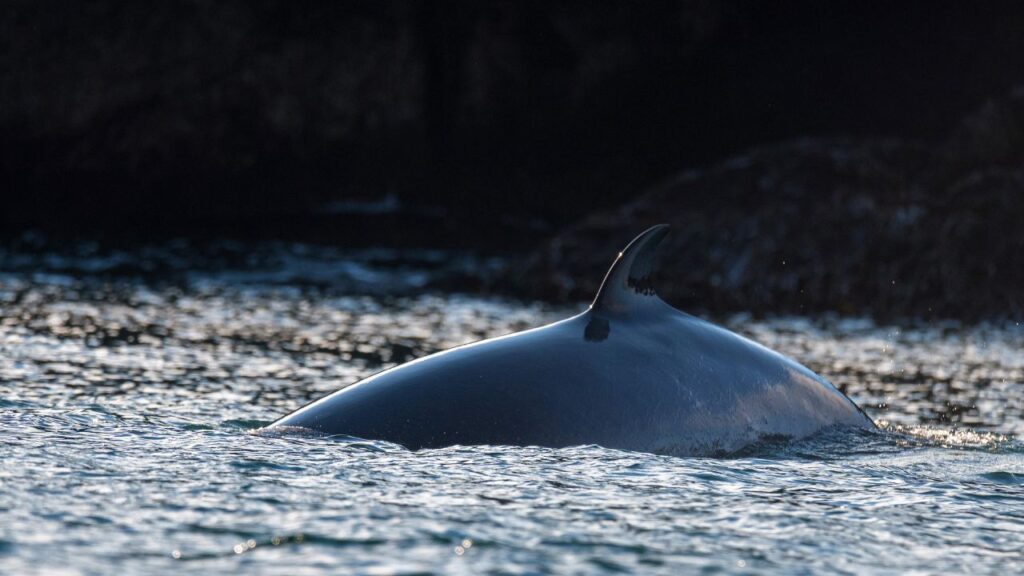
The fin whale is the second largest animal on the planet. It appears on the global IUCN Red List as Vulnerable, a legacy of industrial whaling that took hundreds of thousands of them in the twentieth century. The Icelandic authorities argue that the Northeast Atlantic population has rebuilt and that the quotas rest on national scientific advice. Opponents reply that a global status of vulnerability and a commercial take sit poorly together, and that the added value of this hunt does not justify the risk. Our page on IUCN conservation statuses sets out what these categories cover.
What could bring it to an end
Three prospects, which do not depend on the same actors.
A law. The minister responsible, Hanna Katrín Friðriksson, has stated publicly that commercial whaling is not in the public interest and announced a bill intended to put an end to it. That is the most direct route, and the only one that settles the question of the licence running until 2029.
The market. It has already stopped the hunt two years running, with no political decision involved. A Japanese outlet closed for good would be more effective than a treaty.
Time. Twenty-one per cent support among the under-thirties against forty-five among the over-sixties: this activity is carried by one generation, and the gap is widening.
For anyone wishing to weigh in, the most concrete step fits in a line, and it concerns travellers: do not order whale meat in Iceland, since domestic consumption rests largely on tourist curiosity. Our page on how to act for cetaceans lists the other levers.
Sources. In French: IFAW, Notre Planète, UP Magazine. In English: The Reykjavík Grapevine, Iceland Review, Whale and Dolphin Conservation, Environmental Investigation Agency, Animal Welfare Institute. In Spanish: elDiario.es, France 24, Infobae. In Italian: Il Fatto Quotidiano, Il Post, Italia che Cambia.
Did you find this article useful?
Add L'info des Cétacés to your preferred sources on Google. Our stories will be suggested to you more often, and the choice can be undone as easily as it is done.
 Follow us on Google
This preference is saved in your Google account and can be changed at any time. It is neither a certification nor a recommendation from Google.
Leave a review