| Scientific name | Platanista minor Owen, 1853. Recognised as a distinct species in 2021, after long being treated as the subspecies Platanista gangetica minor. |
|---|---|
| Other names | Indus river dolphin, blind river dolphin; bhulan (Urdu and Sindhi); dauphin de l’Indus, plataniste de l’Indus, dauphin aveugle de l’Indus (French). |
| Size | 2 to 2.2 m in the male, 2.4 to 2.6 m in the female. As in all platanistids, the female is distinctly larger than the male. Newborn: about 70 cm. |
| Weight | 70 to 110 kg in adults, the largest females approaching that upper limit. |
| Longevity | At least 28 years, an age established on a male whose dental growth layers were counted. |
| Diet | Bottom-dwelling fish and freshwater shrimp, detected by sonar and probed for in the silt: carps, catfish, gobies, clupeids. |
| IUCN status | Endangered (EN), 2022 assessment. The population is increasing, which is rare among river dolphins, but the range has contracted by about 80%. |
The Indus river dolphin is one of the few strictly freshwater cetaceans still surviving, and the only one whose population is clearly increasing. Functionally blind, it swims on its side in the turbid waters of Pakistan’s largest river. Recognised as a species in its own right only in 2021, it was previously regarded as a mere subspecies of the Ganges river dolphin. It occupies about 690 km of river today, a fifth of its historical range, cut by irrigation barrages into five cores of which only three appear viable. From some 1,200 individuals in 2001, it numbers about 1,800 in 2017.
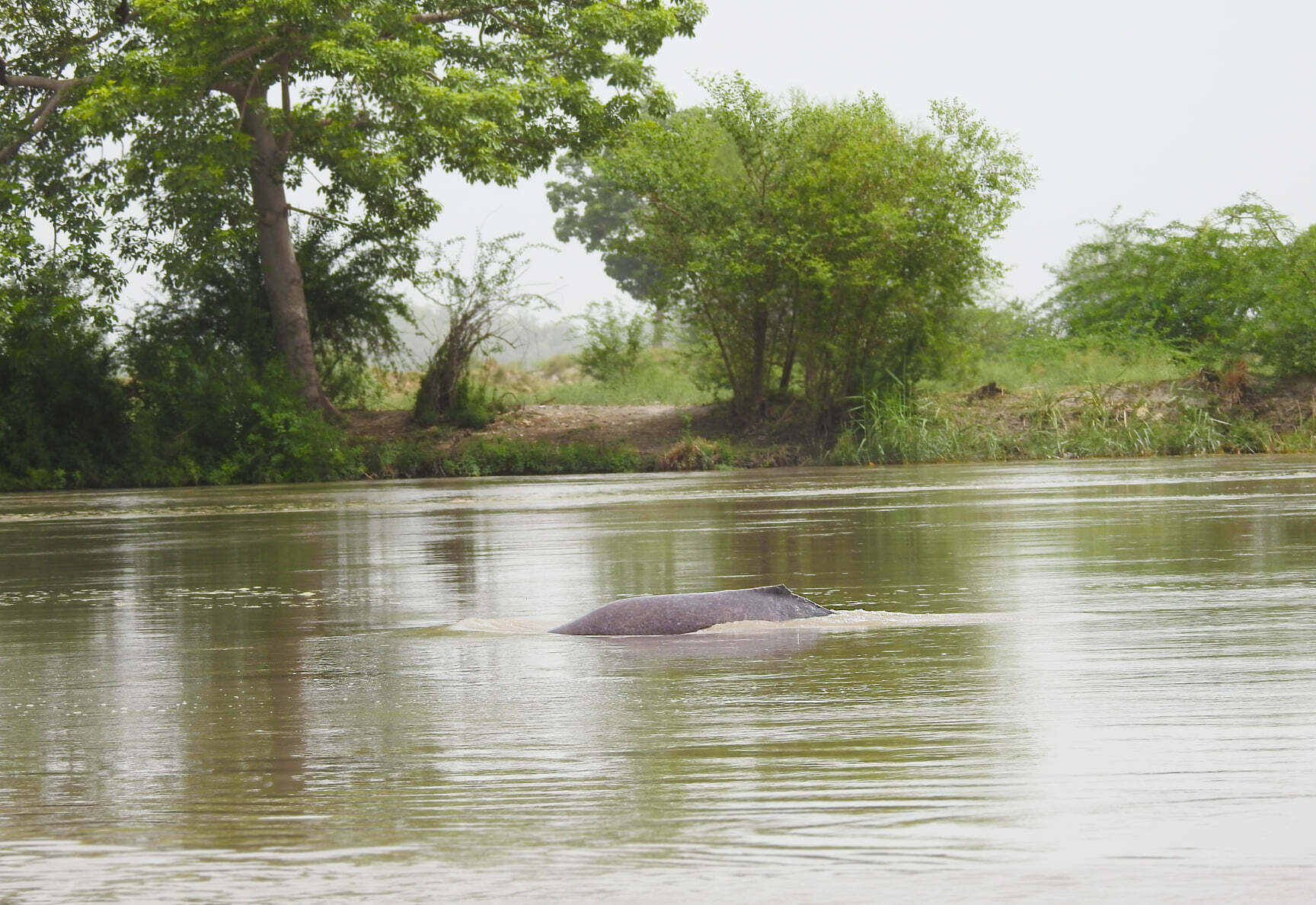
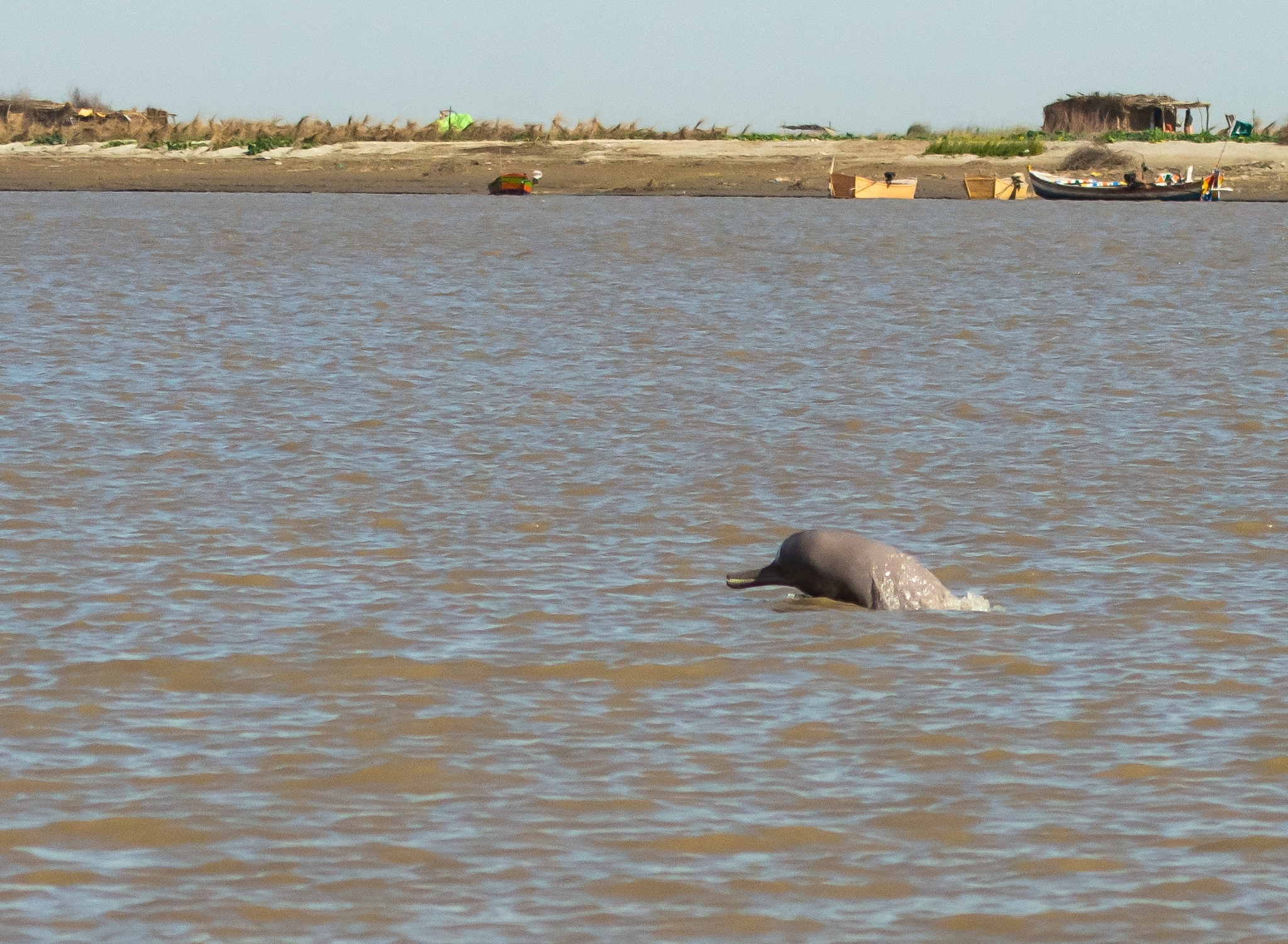
The Indus river dolphin has the stocky, greyish-brown body of the platanistids, with a very long, slender and slightly upcurved rostrum whose teeth remain visible out of the water with the jaws closed. It has no true dorsal fin, only a low triangular ridge at mid-back. The flippers are broad, almost rectangular, and the neck is mobile, a feature that marine cetaceans have lost.
Its most singular feature is the eye. It is reduced to a pinhead-sized opening and has no lens: the animal can perceive the intensity and direction of light, but forms no image. All its navigation and all its hunting rest on echolocation, in water where visibility is nil in any case.
It usually swims lying on its right side, one flipper brushing the bottom, sweeping the sediment with its sonar. This behaviour, shared with the Ganges river dolphin, is found in no other cetacean. The glossary term for it, side-swimming, describes an adaptation both to shallow depth and to the search for benthic prey.
The description goes back to Richard Owen, in 1853, on a specimen from the Indus. For more than a century the status of the taxon wavered: a distinct species for some, a mere geographical variant of the Ganges river dolphin for others. From 1998 onwards, the standard classification recognised two subspecies of a single species, Platanista gangetica gangetica and P. g. minor.
The question was settled in 2021 by Gill Braulik and colleagues, in Marine Mammal Science. The work combines cranial morphometrics, mitochondrial DNA and nuclear markers, and concludes that there are two lineages separated for about 550,000 years, in the Pleistocene. The taxonomy committee of the Society for Marine Mammalogy followed this revision: the family Platanistidae now contains two species, Platanista gangetica and Platanista minor.
This case is worth setting alongside that of the killer whale, whose proposed split in 2024 was not adopted. The difference lies in the convergence of the evidence: in the platanistids, genetics, skull morphology and geographical separation point the same way, with no residual gene flow possible between two basins that nothing connects.
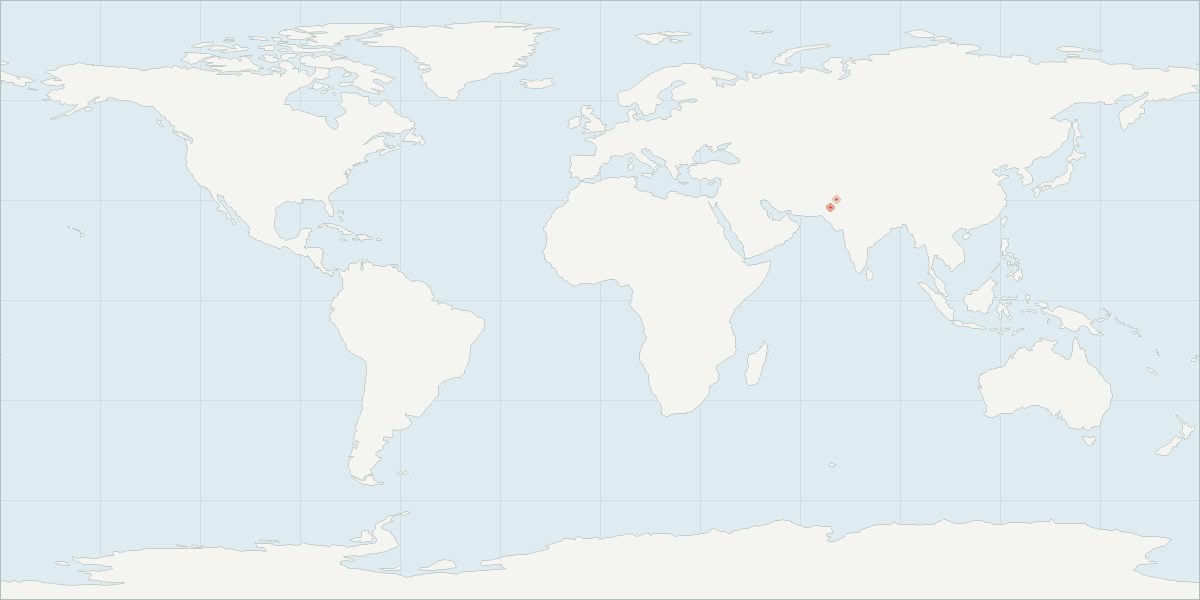
The species is endemic to the Indus basin, in Pakistan, with a very small residual population in the Beas River, in Indian Punjab. It once lived along nearly 3,400 km, main stem and major tributaries included. Today it occupies no more than about 690 km of the main stem, a contraction on the order of 80% since the 1870s.
This reduction has one precise cause and one only: the irrigation barrages. Built to feed the largest contiguous irrigation network in the world, they cannot be passed on the way upstream and they draw off most of the flow in the dry season. They have cut a continuous population into five isolated cores, of which only three are judged viable in the long term. The most populated reach, between the Guddu and Sukkur barrages, in Sindh, holds the majority of the animals.
A hazard specific to this system is being drawn into the irrigation canals: dolphins that pass down through an open gate find themselves trapped in a network with no way out, where they die unless someone retrieves them.
The Indus river dolphin is most often solitary or in pairs, lasting aggregations being rare. It produces echolocation clicks almost continuously, at a rate so sustained that hydrophones make it possible to census it by ear.
The female reaches maturity at about ten years, gives birth to a single calf after a gestation of about ten months, and the interval between two births is two years. Births are observed mainly between April and May, the high-water period.
It hunts close to the bottom, seizing fish and shrimp with its long rostrum. Its ability to exploit depths of less than two metres, where no other predator of its size ventures, explains its persistence in a river that is otherwise heavily degraded.
The species is listed as Endangered (EN) by the IUCN, in an assessment published in 2022 after the taxonomic split. The criterion applied is not population size but the extent of the range contraction and the severity of the fragmentation.
The population trajectory is nonetheless the best of any river dolphin in the world.
| Census | Estimated population |
|---|---|
| 2001 | about 1,200 |
| 2006 | about 1,550 |
| 2017 | about 1,800 |
This recovery rests on identifiable measures. Deliberate hunting, which targeted the animal’s oil, was banned and the ban was actually enforced. The Indus Dolphin Reserve, created in 1974 between Guddu and Sukkur, protects the main reach. Above all, the Sindh Wildlife Department has for decades run a programme to rescue animals trapped in the irrigation canals, which has returned several dozen of them to the river.
The remaining threats are the seasonal drying of certain reaches through water abstraction, bycatch in gillnets, industrial and agricultural pollution, and the genetic isolation of the smallest cores. The Beas River population, in India, can be counted on the fingers of one hand and its future is highly uncertain.
Watching is possible and organised, which sets the Indus river dolphin apart from most freshwater cetaceans. The reach between Sukkur and Guddu, in Sindh province, is the best place in the world to see it, the dry season concentrating the animals in the deepest pools. Boat trips are offered from Sukkur, and the encounter rate there is high.
The animal shows little of itself: it comes up for a brief blow, the rostrum often appearing first, and dives again without showing its back or its tail flukes. It does not breach and does not ride alongside boats. No sighting is of course possible in France or in Europe, where the species has never been held.
Yes, functionally. Its tiny eye has no lens: it detects the intensity and direction of light but forms no image. All its perception of the world passes through echolocation, which it uses almost without interruption.
The two species look very much alike and differ externally only in details of the skull and in proportions. What separates them lies elsewhere: two river basins with no connection, a divergence of about 550,000 years, and consistent genetic and cranial differences established by Braulik and colleagues in 2021. The Ganges river dolphin is far more numerous, on the order of 5,000 to 6,300 individuals.
About 1,800 individuals at the 2017 census, against about 1,200 in 2001. It is one of the few threatened cetaceans whose numbers are rising.
This side-swimming, with one flipper grazing the bottom, allows it to aim its sonar at the sediment where its prey hide and to move through very little water. No marine cetacean travels in this way.
Since 2021. The revision by Braulik et al., published in Marine Mammal Science, was followed by the taxonomy committee of the Society for Marine Mammalogy. Before that, the taxon was treated as the subspecies Platanista gangetica minor.
Because they cannot be passed on the way upstream and because they draw off water. They have broken a continuous population into five isolated groups, of which only three appear viable, and they divert animals into irrigation canals with no way out. Our page on how to act for cetaceans sets out the levers available against this kind of pressure.
Profile compiled from authoritative scientific sources (IUCN, Society for Marine Mammalogy, specialist literature) and reviewed for factual accuracy.
According to the open data of the GBIF, 3 georeferenced sightings of Platanista minor are recorded in our photographic index.
| Country | Notes |
|---|---|
| Pakistan | 3 |

Monthly distribution of 3 dated sightings (all years combined): the maximum is reached in janvier.
| Month | Notes |
|---|---|
| janvier | 1 |
| February | 0 |
| mars | 0 |
| avril | 0 |
| mai | 0 |
| juin | 0 |
| juillet | 1 |
| August | 0 |
| septembre | 0 |
| octobre | 0 |
| novembre | 0 |
| December | 1 |
These figures reflect survey effort (more boaters and more surveys in summer) as much as the actual presence of the species: to be interpreted with caution.


Photographs from GBIF under a Creative Commons licence. The author and the licence of each photograph are given; please respect them if you reuse them.
Automatic selection of the most cited works mentioning the species (source: Crossref).