| Scientific name | Platanista gangetica (Lebeck, 1801) |
|---|---|
| Other names | Ganges dolphin, susu, blind river dolphin; susu, soons (Hindi), shushuk (Bengali), hihu (Assamese), shus (Nepali). In French: plataniste du Gange, dauphin du Gange, sousouc, dauphin aveugle du Gange. |
| Size | 2.2 to 2.6 m in adults; females are larger than males, with documented maxima of 2.12 m in the male and 2.67 m in the female (for 108 kg). Older unofficial reports mention females of 4 m, but none has ever been scientifically confirmed. Newborn: 70 to 90 cm. |
| Weight | 51 to 89 kg in most adults; the largest female measured, 2.67 m long, reached 108 kg. |
| Longevity | About 20 to 30 years; the oldest documented individual is a 28-year-old male measuring 199 cm, and the oldest known female was 17.5 years old. |
| Diet | Bottom-dwelling and midwater fish (catfish, carp, gobies, clupeids, mahseers), freshwater prawns and molluscs; 0.6 to 3 kg of fish per day depending on the size of the animal, with a marked preference for prey 20 to 30 cm long. |
| IUCN status | Endangered (EN), most recent assessment published in July 2022 by the IUCN Cetacean Specialist Group (Kelkar, Smith, Alom, Dey, Paudel & Braulik; reference e.T41756A50383346). The Indus river dolphin (Platanista minor), a closely related species recognised since 2021, is also listed as Endangered. |
The Ganges river dolphin is one of the few strictly freshwater cetaceans still in existence. Functionally blind, with an outsized rostrum and a highly effective sonar, it lives in the great rivers of the Indian subcontinent, where it often swims on its side to probe the bottom. Listed as Endangered by the IUCN, it numbers about 5,000 to 6,300 individuals, fragmented by dams and threatened by gillnets, pollution and sand extraction.
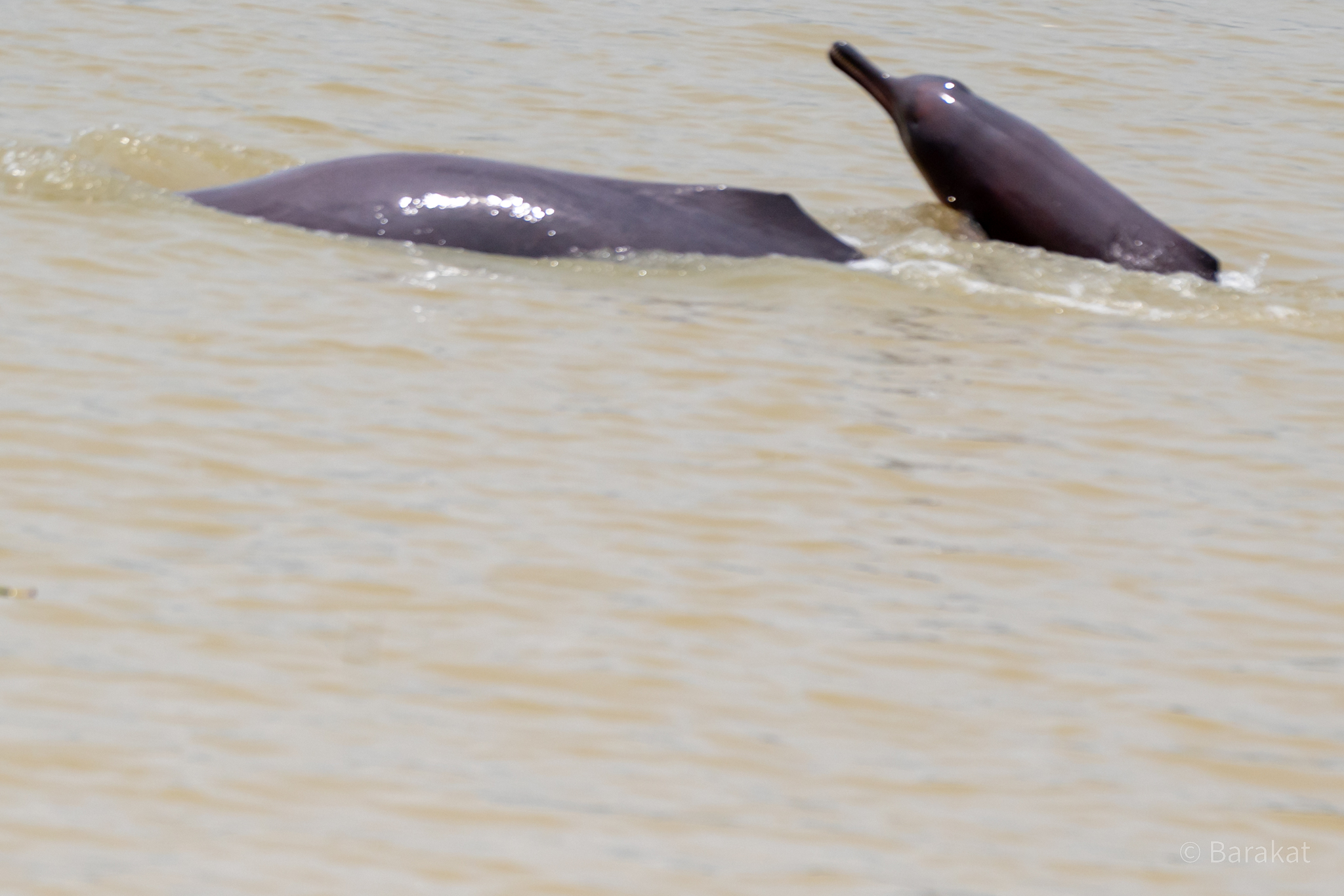
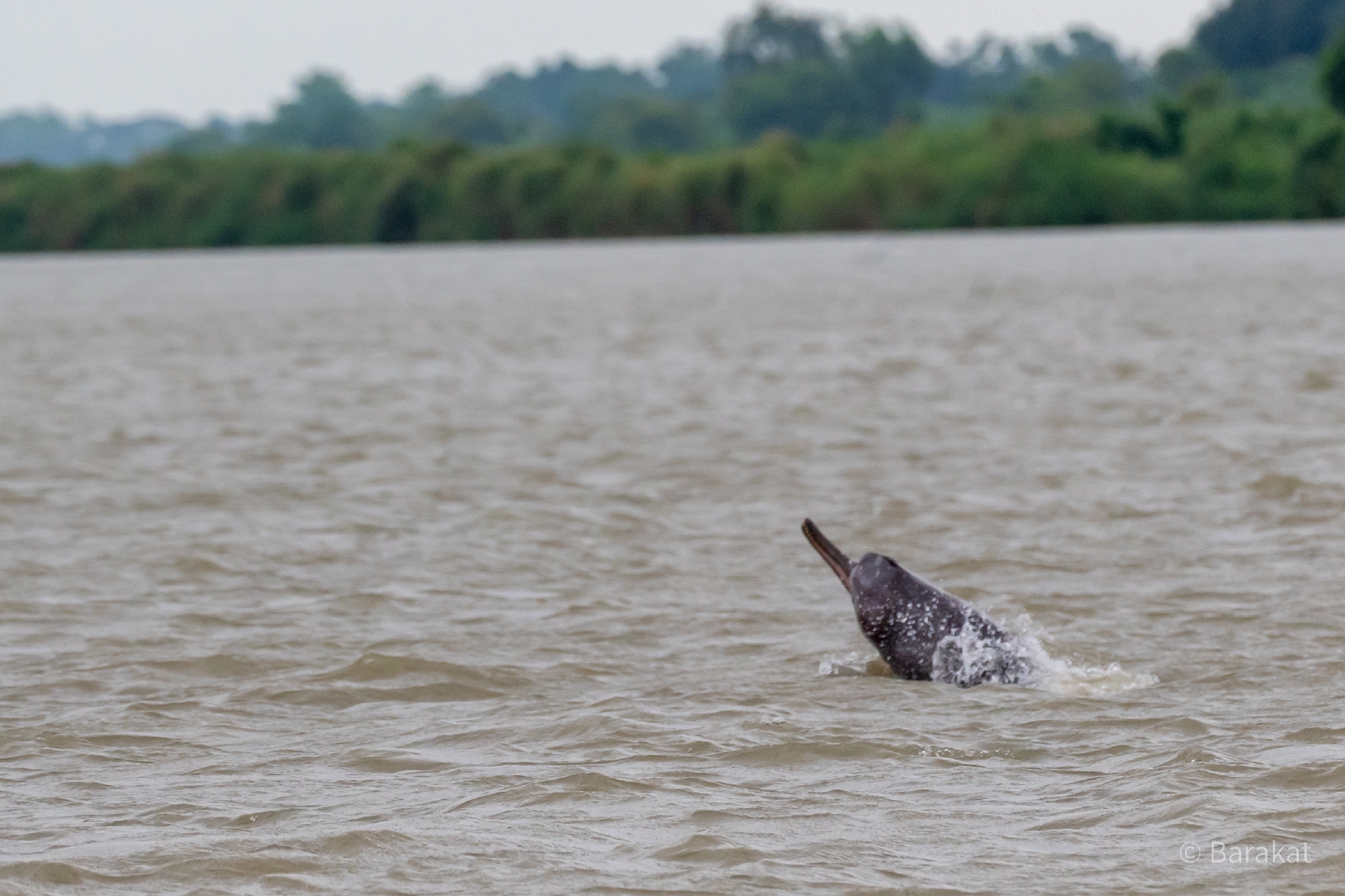
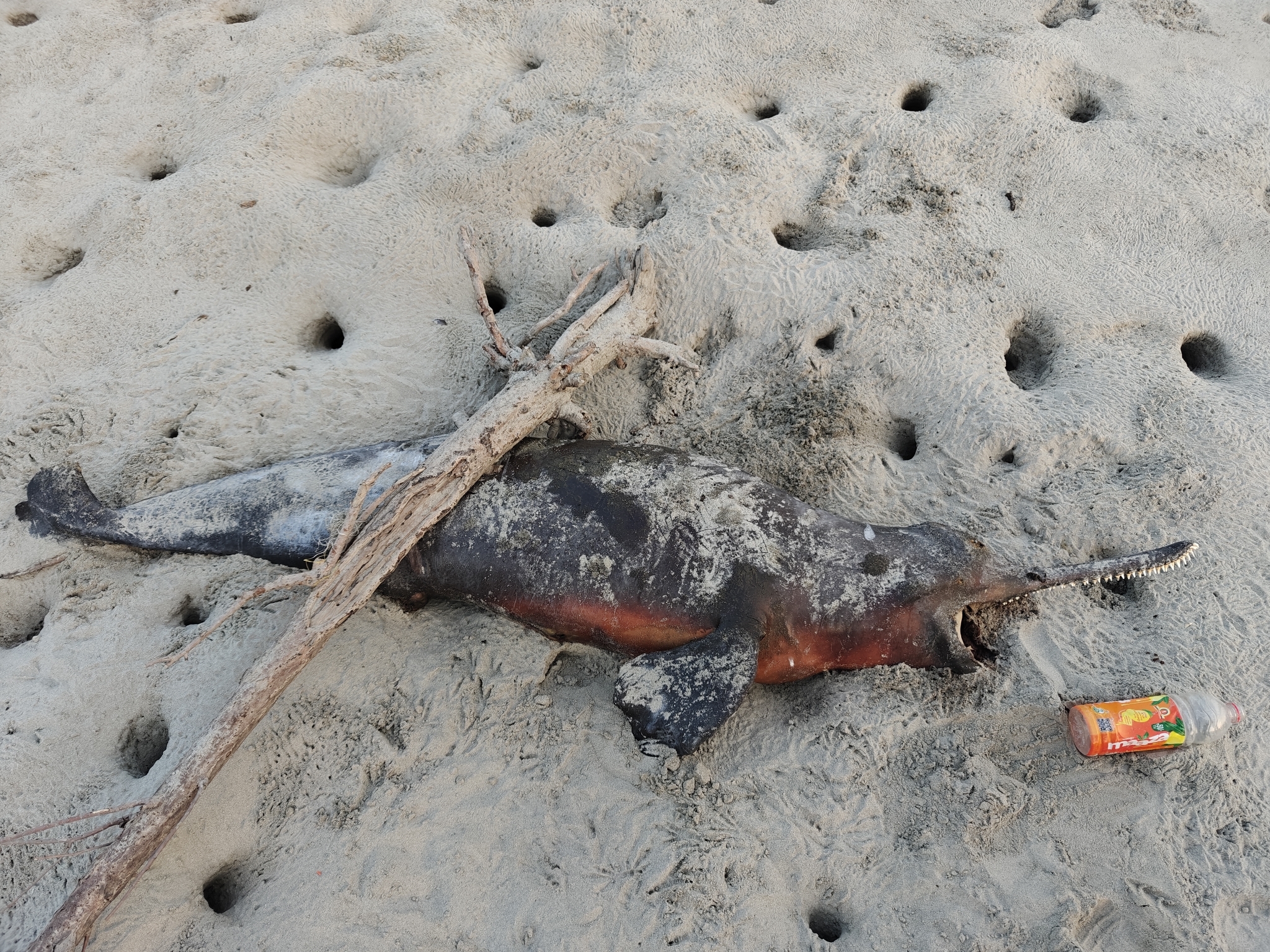
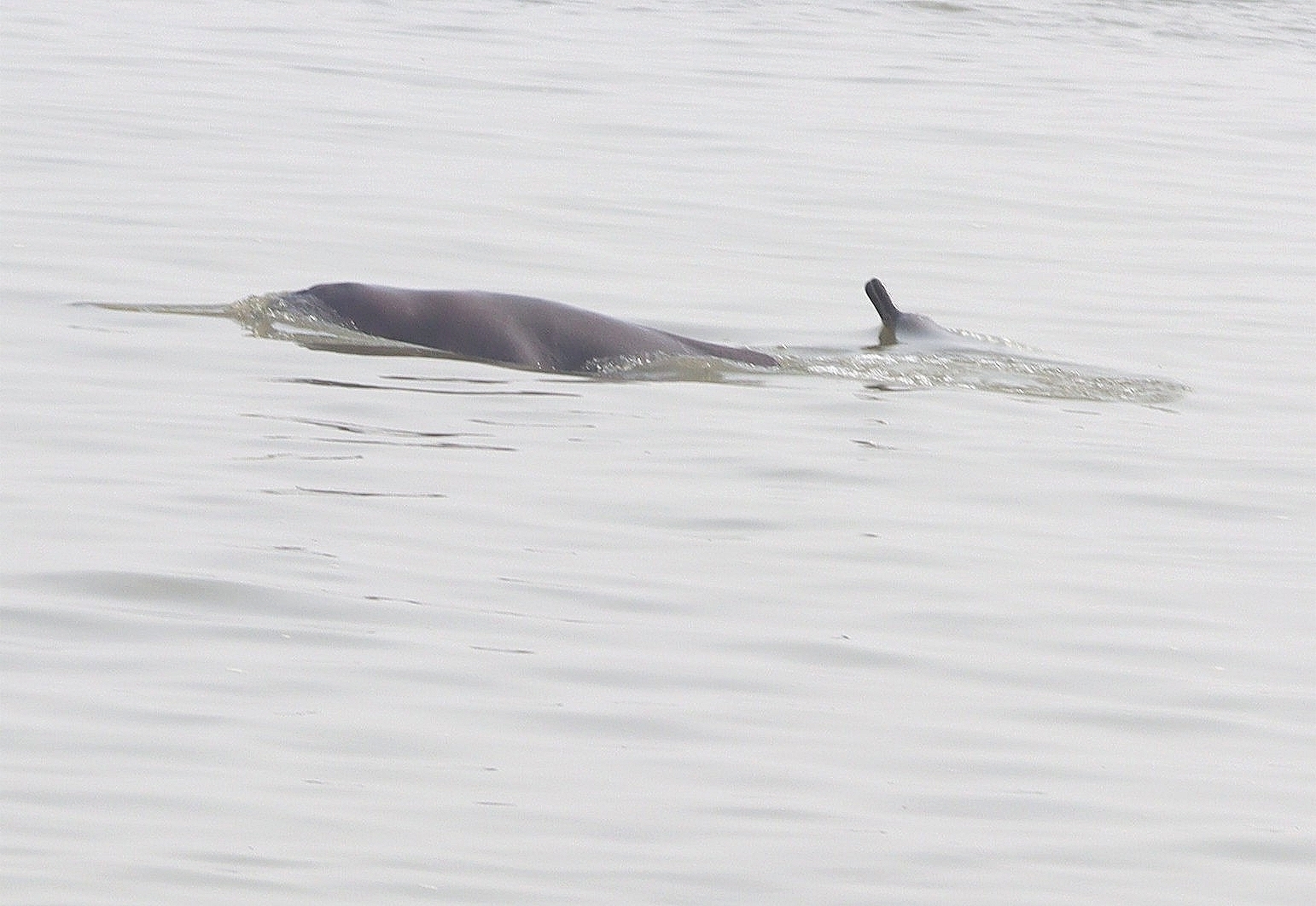
The Ganges river dolphin resembles no marine dolphin. Its body is stocky, with a rounded belly, chocolate brown to blue-grey in colour, paler on the underside. It has no true dorsal fin: the fin is reduced to a small, low triangular ridge, hump-shaped, set two thirds of the way along the back. The flippers are broad, almost square, and the finger bones can be made out beneath the skin; the tail fluke, very widely spread, measures some forty centimetres across. The neck is unusually flexible for a cetacean, the cervical vertebrae not being fused, which allows the animal to turn its head.
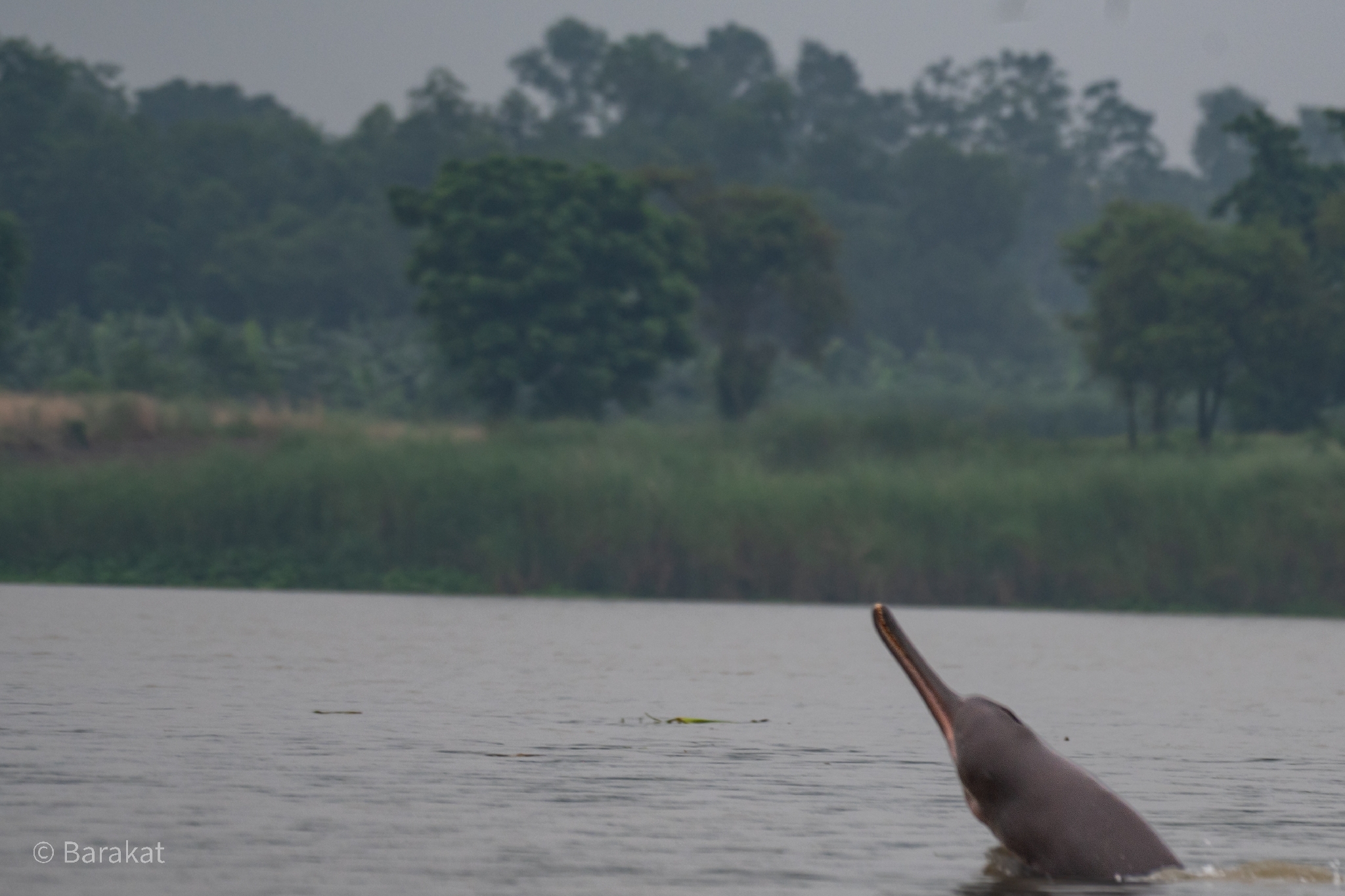
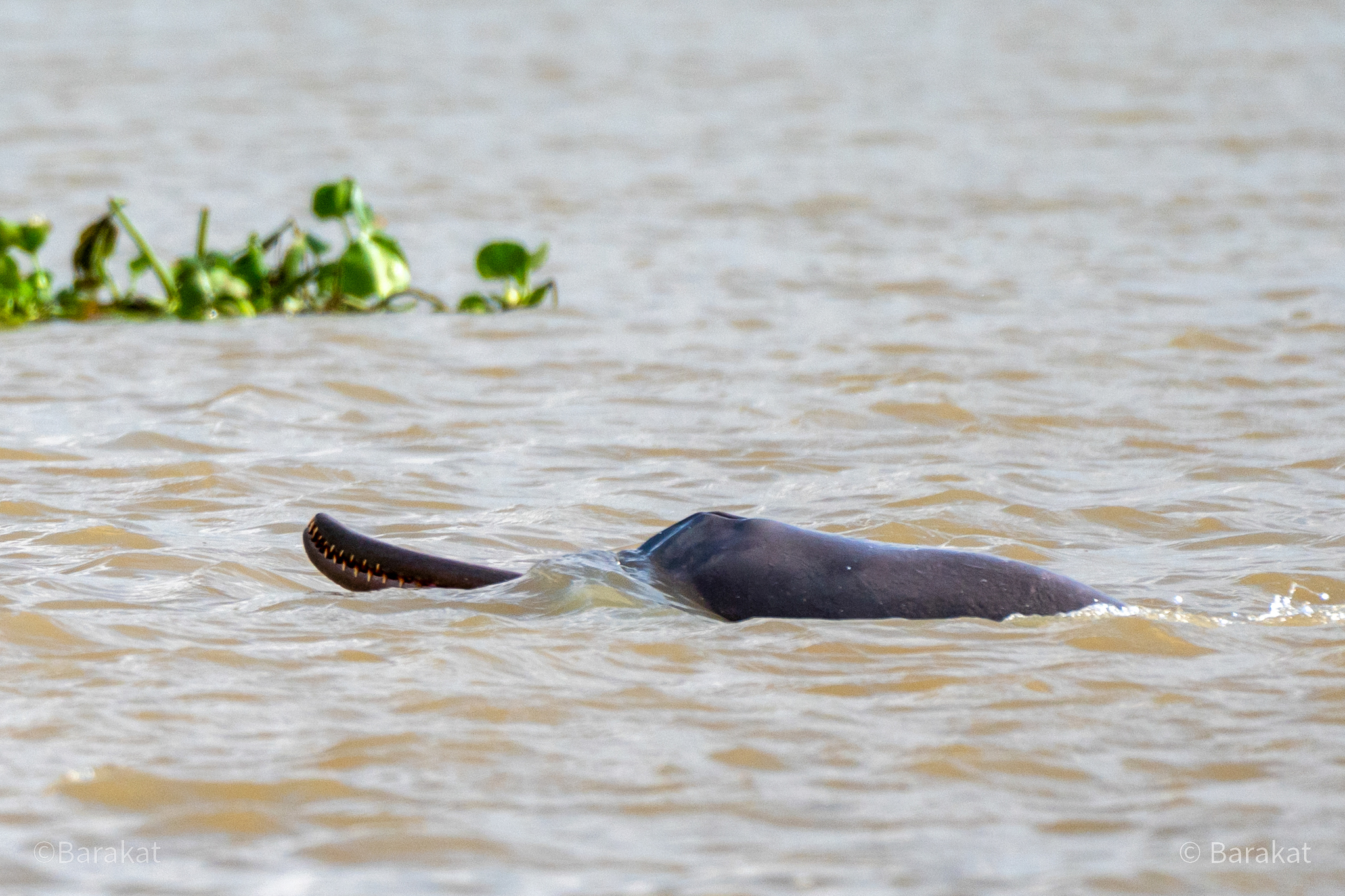
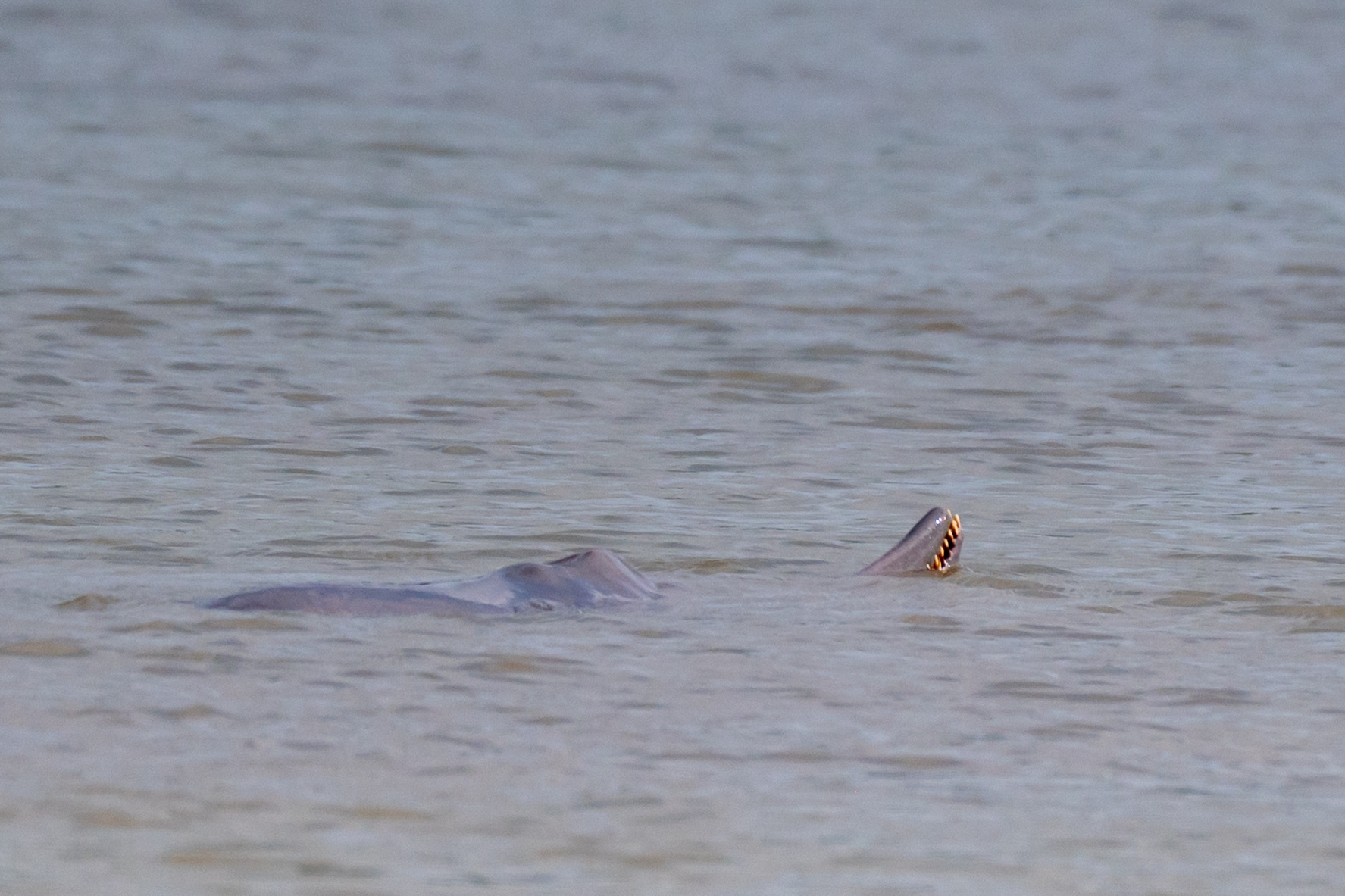
The most striking feature remains the rostrum: long, slender, slightly upturned, it can account for up to 20% of total body length. It carries on average 28 teeth in each half of the upper jaw, some individuals exceeding thirty; the front teeth, long and curved, project beyond the closed lips and form a genuine fish trap. The eyes are minute and lack a lens, with a flattened cornea and a reduced aperture working like a pinhole: the animal makes out little more than light from darkness and orients itself almost entirely by sonar. The skull bears large pneumatic maxillary crests that curl around the melon and project above the rostrum, a unique structure that focuses the echolocation clicks.
Females are larger than males and their rostrum lengthens further at maturity, which makes adults recognisable in the field. The most frequent confusion is with the Indus river dolphin, morphologically very close but geographically separate; the two species differ in particular by a bony projection at the frontal suture, present in the Ganges river dolphin and absent in the Indus one, and by tooth count: about 28 teeth on average per maxillary row in the Ganges river dolphin against 33 in the Indus one, any skull with fewer than 30 teeth being referred to the former and more than 33 to the latter, the intermediate zone remaining ambiguous. Locally, these dolphins are also confused with river sharks, a mistake that long fuelled unjustified persecution.
Order Cetacea, suborder Odontoceti (toothed whales), family Platanistidae, genus Platanista. The family Platanistidae is today the only survivor of an ancient lineage of freshwater dolphins and contains only two living species.
The species was described in 1801 as Delphinus gangeticus, from a specimen taken on the banks of the Hooghly, near Calcutta. Two descriptions were published in the same year, that of Heinrich Julius Lebeck on 24 August and that of William Roxburgh in September; priority goes to Lebeck, hence the current combination Platanista gangetica (Lebeck, 1801), even though many older sources still attribute the species to Roxburgh.
The Ganges and Indus river dolphins were long treated as two subspecies of a single species. A taxonomic revision published in 2021 in Marine Mammal Science concluded that they are two distinct species: Platanista gangetica for the Ganges, Brahmaputra and Meghna basins, and Platanista minor Owen, 1853 for the Indus. The revision rests on diagnostic differences in the skull, on tooth count and on the complete absence of mitochondrial haplotypes shared between the two basins, with five fixed differences indicating an interruption of genetic exchange for about 550,000 years.
The species is strictly freshwater and endemic to the Indian subcontinent. It occupies the great Ganges, Brahmaputra and Meghna system as well as the Karnaphuli and Sangu rivers, in India and Bangladesh, and extends up into Nepal in the Karnali and the Sapta Koshi, which hold the last nuclei (43 and 9 individuals respectively out of the 52 counted in the 2016 national census). The Narayani (Gandaki), long held to be deserted, yielded only a single photographed sighting in January 2022. The species has on the other hand disappeared from the Mahakali, on the western border of Nepal, illustrating the continuing contraction of its range.
The dolphin seeks out deep water of 3 to 9 m and tolerates temperatures ranging from 8 °C to more than 33 °C. It concentrates in specific microhabitats: deep pools, counter-currents downstream of confluences and of tight meanders, and the upstream and downstream ends of mid-channel islands. These hydraulic features concentrate fish and provide resting areas; their disappearance, in particular through sand extraction, translates directly into the loss of occupied reaches.
In France the species is absent: it occurs neither in the Mediterranean, nor in the Bay of Biscay, nor in the English Channel, nor in the overseas waters, and the family Platanistidae is represented in no French basin. No individual is held in any European facility; since 2013 India has banned the keeping of dolphins for entertainment, recognising them as “non-human persons”.
The Ganges river dolphin hunts by sonar, in water so laden with silt that sight is of no use. It produces sound almost continuously, day and night: close to 87% of its emissions are echolocation clicks, supplemented by bursts and twitters, while whistles are rare and do not appear to play a communication role. Its clicks are narrow-band and high-frequency: measurements made on wild animals give a mean centroid frequency of about 61 kHz (peak between 55 and 75 kHz), source levels that are low for an odontocete (about 183 dB re 1 µPa at 1 m) and very short inter-click intervals, of the order of 30 milliseconds, a short-range sonar suited to shallow and acoustically cluttered water. Its hunting behaviour is unique among cetaceans: it frequently swims on its side, most often the right side, tilted by some ten degrees and a few centimetres above the bottom, the head sweeping the substrate to flush out fish and crustaceans.
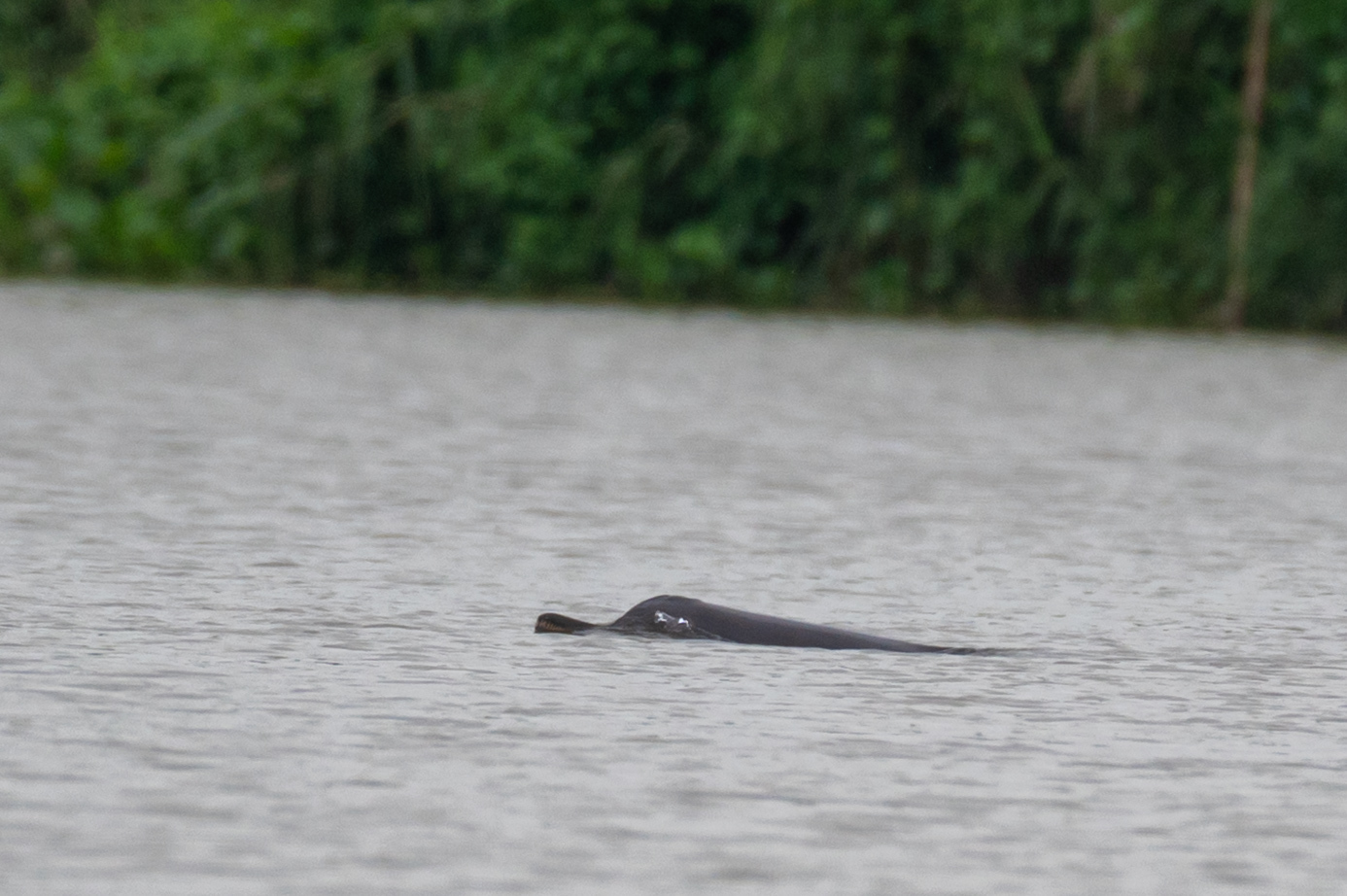
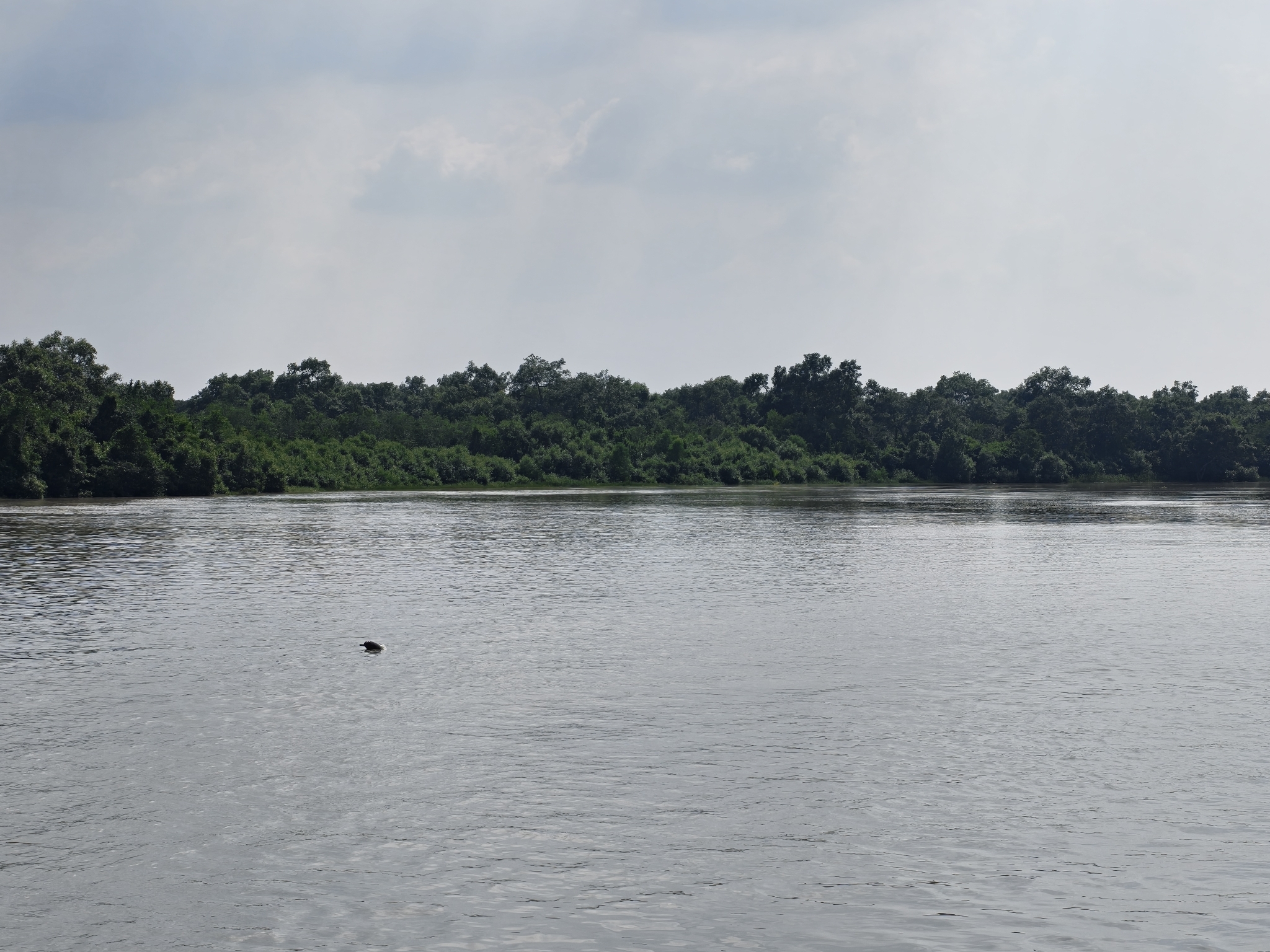
It is an unobtrusive animal, often solitary or in pairs, sometimes gathering in groups of three to ten individuals, exceptionally more, where prey is abundant. It breaches very rarely, is wary of boats and generally shows no more than a back and the tip of a rostrum at the surface. Its rest is fragmented: sleep periods are reported to total only about seven hours a day.
Breeding is not strictly seasonal, but births peak from October to March. Gestation lasts 8 to 12 months, most studies settling on 9 to 10 months, and produces a single calf of 70 to 90 cm. Weaning occurs between 2 and 12 months, around 8 months on average, the young remaining with its mother for about a year. Sexual maturity is reached at about 10 years in both sexes. This slow cycle, combined with small numbers, explains why the populations struggle to make good accidental mortality.
The Ganges river dolphin is listed as Endangered (EN) on the IUCN Red List, a status confirmed by the assessment published in July 2022; the species had moved from Vulnerable to Endangered in 1996. That assessment puts the figure at the order of 5,000 individuals, adults and juveniles combined, higher than earlier estimates. Its authors stress that this rise reflects the broadening of survey coverage, now complete in India and Nepal, and not a recovery: the underlying trend remains a continuous and steady decline.
The first comprehensive survey carried out in India under Project Dolphin, between 2021 and 2023 and over more than 8,000 km of watercourse, was presented in March 2025: it estimates 6,327 river dolphins, of which 6,324 Ganges river dolphins (about 5,689 in the Ganges basin and 635 in the Brahmaputra basin) and 3 Indus river dolphins in the Beas river. Uttar Pradesh (2,397) and Bihar (2,220) hold most of the numbers, ahead of West Bengal (815) and Assam (635). In Nepal, a national survey conducted in 2016 recorded only 52 individuals, 43 of them in the Karnali and its tributaries and 9 in the Koshi. In the lower Ganges, the 2022-2023 campaign counted 303 dolphins in the Bhagirathi-Hooghly system.
The threats are cumulative. Dams and barrages fragment the populations into isolated nuclei: the Farakka barrage, in service since 1975, has cut the river and reduced downstream flows. Bycatch in monofilament gillnets is the leading cause of direct mortality, compounded by a residual hunt for the oil, used as bait for catfish. To this are added industrial and agricultural pollution with bioaccumulation of heavy metals, sand extraction that destroys the counter-currents, overfishing that depletes prey, and motorised river traffic, a source of collisions and of noise that masks echolocation.
The species has a solid legal framework: Appendix I of CITES, Appendix II of CMS since 1991 and Appendix I since 2002, Schedule I of the Indian Wild Life (Protection) Act of 1972, which grants it the highest level of protection. It was declared the national aquatic animal of India in 2009 and is the official animal of the city of Guwahati. The Vikramshila sanctuary, created in 1991 in Bhagalpur district (Bihar), remains the only dedicated Indian sanctuary; sanctuaries have also been established in the Sundarbans in Bangladesh. Project Dolphin, launched in 2020, made possible the first satellite tag tracking of the species.
Watching calls for patience: the animal is shy, almost never leaps and shows only a brown back and a tapering rostrum during brief surfacings. The best areas are confluences, pronounced meanders and the surroundings of river islands, where counter-currents concentrate fish. In India, the Vikramshila sanctuary near Bhagalpur (Bihar), the Ganges in Uttar Pradesh, the Chambal and the Brahmaputra in Assam offer regular chances; in Nepal, the Karnali and the Koshi hold the last nuclei. Recorded densities are higher in the dry season, when the animals fall back into the residual pools, which makes sightings easier but also leaves the dolphins more vulnerable to disturbance.
A few rules apply. Keep a good distance, cut or reduce the engine on approach, avoid lingering in the counter-currents that serve as resting areas, and never try to attract the animals with food. Trips run by trained local operators, often from fishing communities, have the advantage of making the species a living economic resource rather than bycatch. Reporting any animal entangled in a net or stranded to a conservation body is useful: such information feeds directly into the monitoring of mortality.
Almost. Its minute eyes lack a lens and have a flattened cornea with a very reduced aperture, working like a pinhole. The animal probably perceives the difference between light and darkness, as well as the direction the light comes from, but it forms no image. In the silt-laden waters of the Ganges and the Brahmaputra, sight would in any case be useless: the dolphin orients itself and hunts by sonar, emitting high-frequency clicks almost without interruption.
The IUCN assessment published in 2022 puts the figure at the order of 5,000 individuals, adults and juveniles combined. The Indian survey carried out between 2021 and 2023 under Project Dolphin, presented in March 2025, estimates 6,324 for India alone. These figures, higher than in the past, are explained by far more complete survey coverage, and not by an increase in numbers: the general trend remains one of decline. Nepal holds only a residual population, estimated at 52 individuals in the 2016 national census.
Since a taxonomic revision published in 2021, they are two distinct species: Platanista gangetica for the Ganges, the Brahmaputra and the Meghna, and Platanista minor for the Indus. They look very much alike, but the Ganges river dolphin has a bony projection at the frontal suture that the other lacks, and a lower tooth count: about 28 teeth on average per maxillary row, against 33 in the Indus river dolphin. Their mitochondrial lineages share no haplotype, a sign of a separation of about 550,000 years. Both species are listed as Endangered.
No. It is a strictly freshwater cetacean, confined to the rivers of India, Bangladesh and Nepal. It occurs neither in the Mediterranean, nor in the Bay of Biscay, nor in the English Channel, nor in the French overseas waters, and no European facility holds one. Seeing it means travelling to its native range, where guided river trips exist.
This is a hunting behaviour peculiar to the genus Platanista. The animal lies on its side, most often the right one, tilts by some ten degrees and moves a few centimetres above the bottom, the head sweeping the substrate. This posture lets it probe the mud with its long rostrum and its sonar to flush out buried fish, prawns and molluscs, in often shallow water.
Dams and barrages, beginning with the Farakka barrage in service since 1975, have broken the river into isolated stretches and reduced low-water flows. To this are added bycatch in gillnets, the leading cause of direct mortality, a residual hunt for the oil used as bait, industrial and agricultural pollution, sand extraction that destroys the counter-currents where the dolphins live, overfishing and motorised river traffic, a source of collisions and of noise.
Species profile compiled from authoritative scientific sources (IUCN, NOAA Fisheries, specialist literature) and checked for factual accuracy.
According to the open data of the GBIF, 161 georeferenced sightings of Platanista gangetica are recorded in our photographic index.
| Country | Notes |
|---|---|
| India | 126 |
| Bangladesh | 17 |
| Nepal | 16 |
| Pakistan | 4 |
| unknown or invalid | 3 |

Monthly distribution of 161 dated sightings (all years combined): the maximum is reached in octobre.
| Month | Notes |
|---|---|
| janvier | 13 |
| February | 8 |
| mars | 12 |
| avril | 11 |
| mai | 3 |
| juin | 7 |
| juillet | 14 |
| August | 4 |
| septembre | 5 |
| octobre | 68 |
| novembre | 7 |
| December | 9 |
These figures reflect survey effort (more boaters and more surveys in summer) as much as the actual presence of the species: to be interpreted with caution.


Photographs from GBIF under a Creative Commons licence. The author and the licence of each photograph are given; please respect them if you reuse them.
Automatic selection of the most cited works mentioning the species (source: Crossref).