Killer whale (Orcinus orca)

Key facts
Scientific name Orcinus orca (Linnaeus, 1758)
Other names In French: épaulard, orque épaulard, orque gladiateur, “baleine tueuse” (a calque of the English); killer whale or orca in English.
Size Males: 6 to 8 m on average, up to about 9.7 m (the OFB gives an overall range of 5 to 9.8 m). Females: 5 to 7.3 m, up to 8.5 m. Newborns: 2 to 2.7 m.
Weight Males: 3.6 to 9 tonnes, maximum documented 10 to 11 t. Females: 1.3 to 3.6 t, maximum 7.5 t. Newborns: 136 to 220 kg depending on the source.
Longevity Females: about 50 years on average, commonly 60 to 80 years, exceptionally more than 90 years. Males: about 30 years on average, up to 50-60 years (the male J1 died at 59; John Coe, in Scotland, is estimated to be at least 60, which would make him one of the oldest males known in the wild).
Diet A strictly carnivorous apex predator, with strong specialisations by ecotype: fish (salmon, herring, tuna, rays and sharks), marine mammals (seals, sea lions, dolphins, porpoises, whale calves), cephalopods, seabirds and turtles. Mean daily intake is estimated at around 227 kg.
IUCN status Data Deficient (DD) globally, a status confirmed in the 2025-2 edition of the Red List. Strait of Gibraltar subpopulation (Iberian killer whales): Critically Endangered (CR), 2019 assessment, under criterion D alone (very small population, fewer than 50 mature individuals); criteria C2a(i,ii); D corresponded to the earlier provisional assessment, of 2006. In France, the national Red List also classes it as DD.

In brief

The killer whale (Orcinus orca) is the largest member of the family Delphinidae and the predator at the top of marine food webs: an adult male can exceed 8 m for 6 tonnes, with a dorsal fin reaching 1.80 m in height. Cosmopolitan, it occurs in every ocean, from the sea ice to tropical waters, and comes in ecotypes with distinct diets, dialects and hunting traditions, transmitted culturally within matrilineal lineages among the most stable in the animal world. Globally, the IUCN still classes it as “Data Deficient” for want of taxonomic certainty, while several local populations, among them the Iberian killer whales of the Strait of Gibraltar, are critically endangered.

Identification

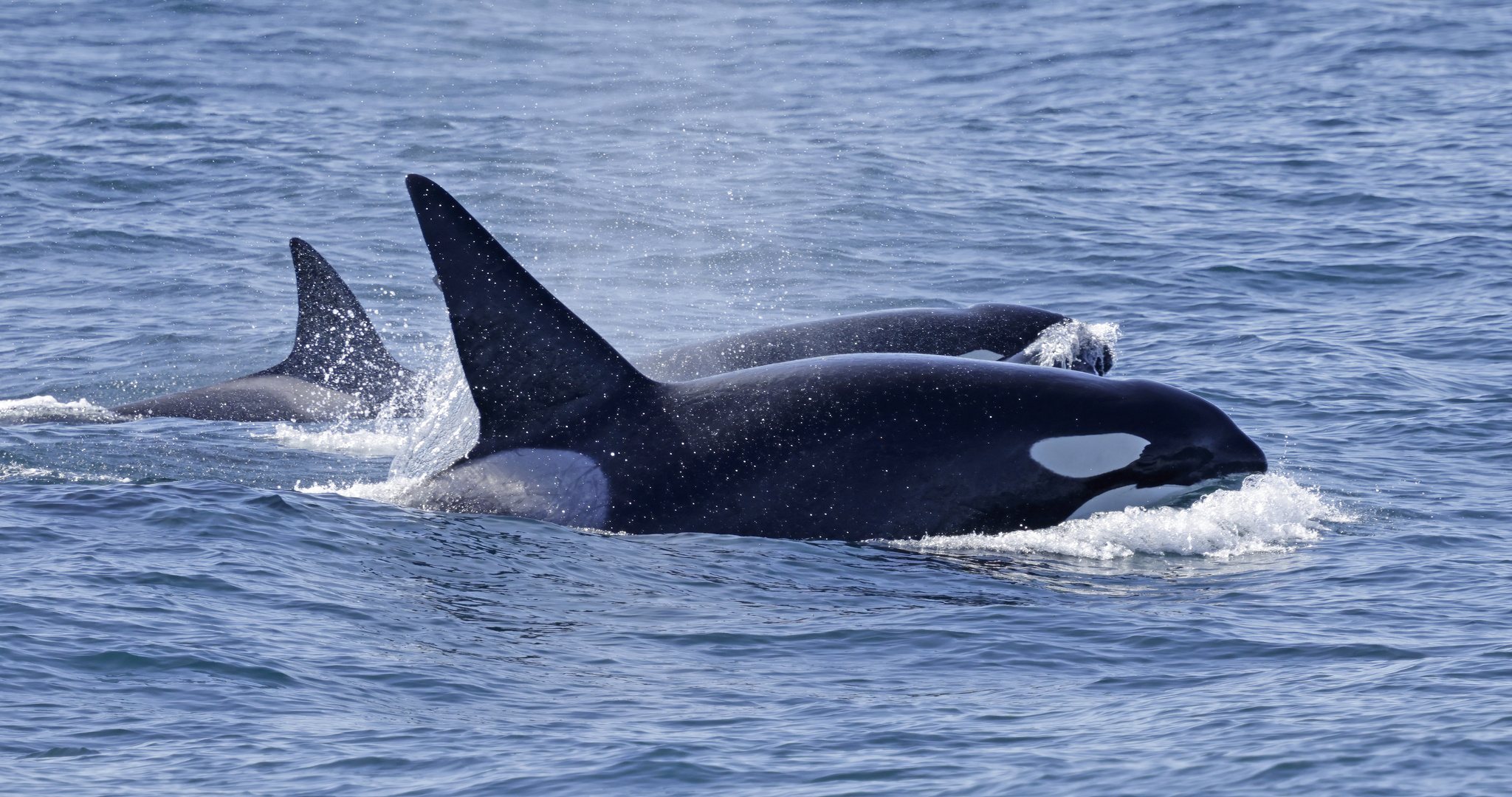
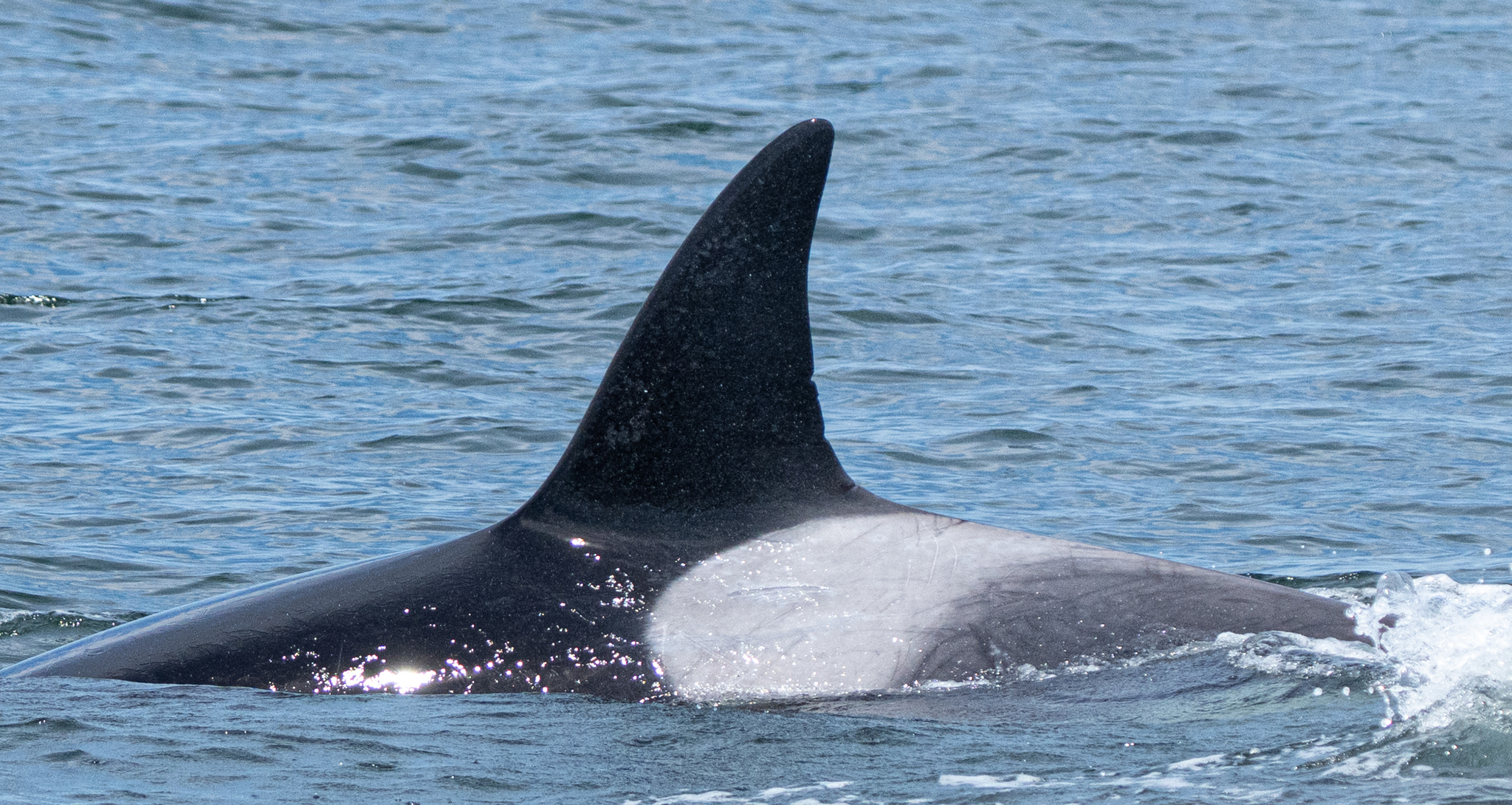
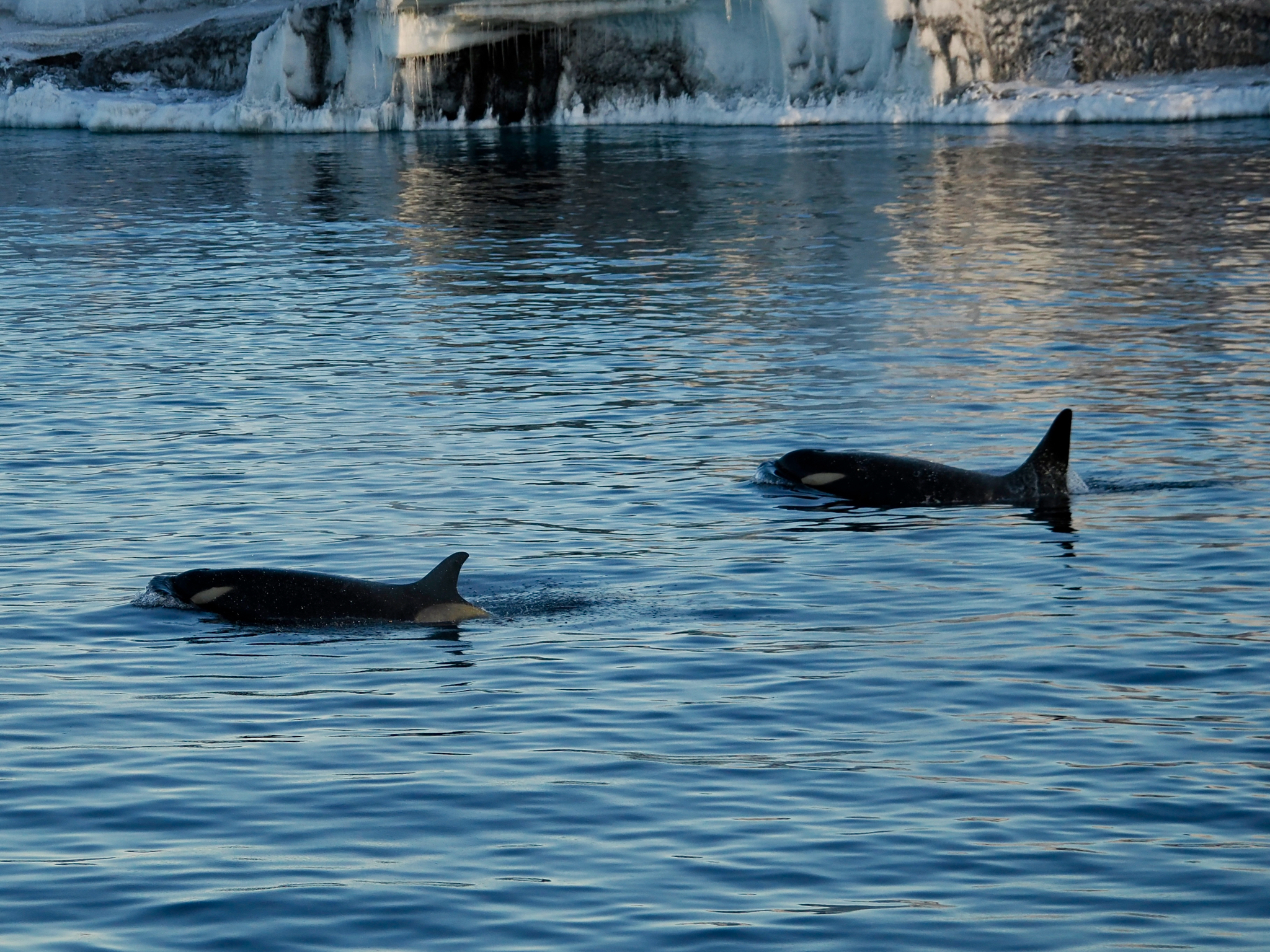
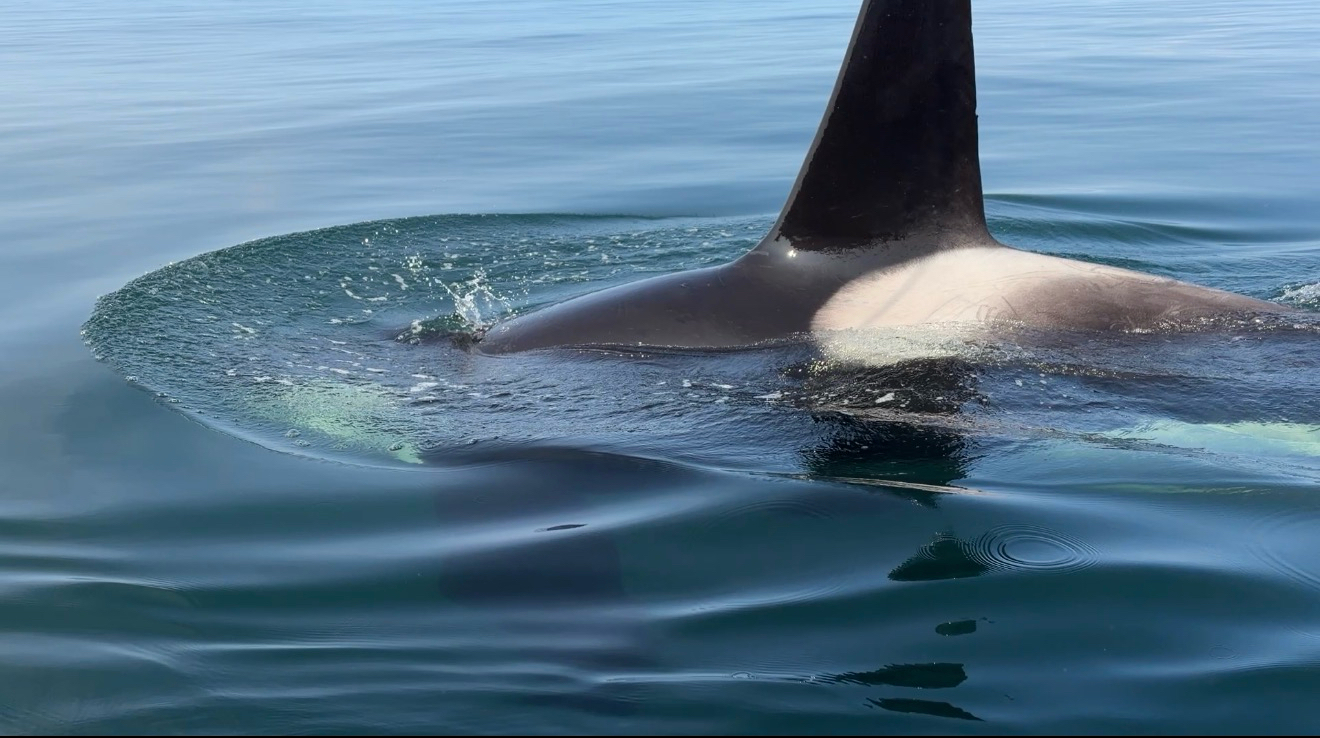
The killer whale is probably the most recognisable cetacean in the world. Its massive, fusiform body is black on the dorsal surface and white on the ventral surface, from chin to anus; an oval white patch, known as the postocular patch, sits above each eye, and a grey “saddle”, more or less marked, extends behind the dorsal fin. This saddle pattern, together with the notches and scars of the dorsal fin, serves researchers as a genuine fingerprint, and each animal is identified individually by photo-identification. The head is rounded, with no marked rostrum, and the jaws carry 46 to 50 conical teeth, slightly inclined backwards and inwards, adapted to gripping and tearing rather than to chewing.

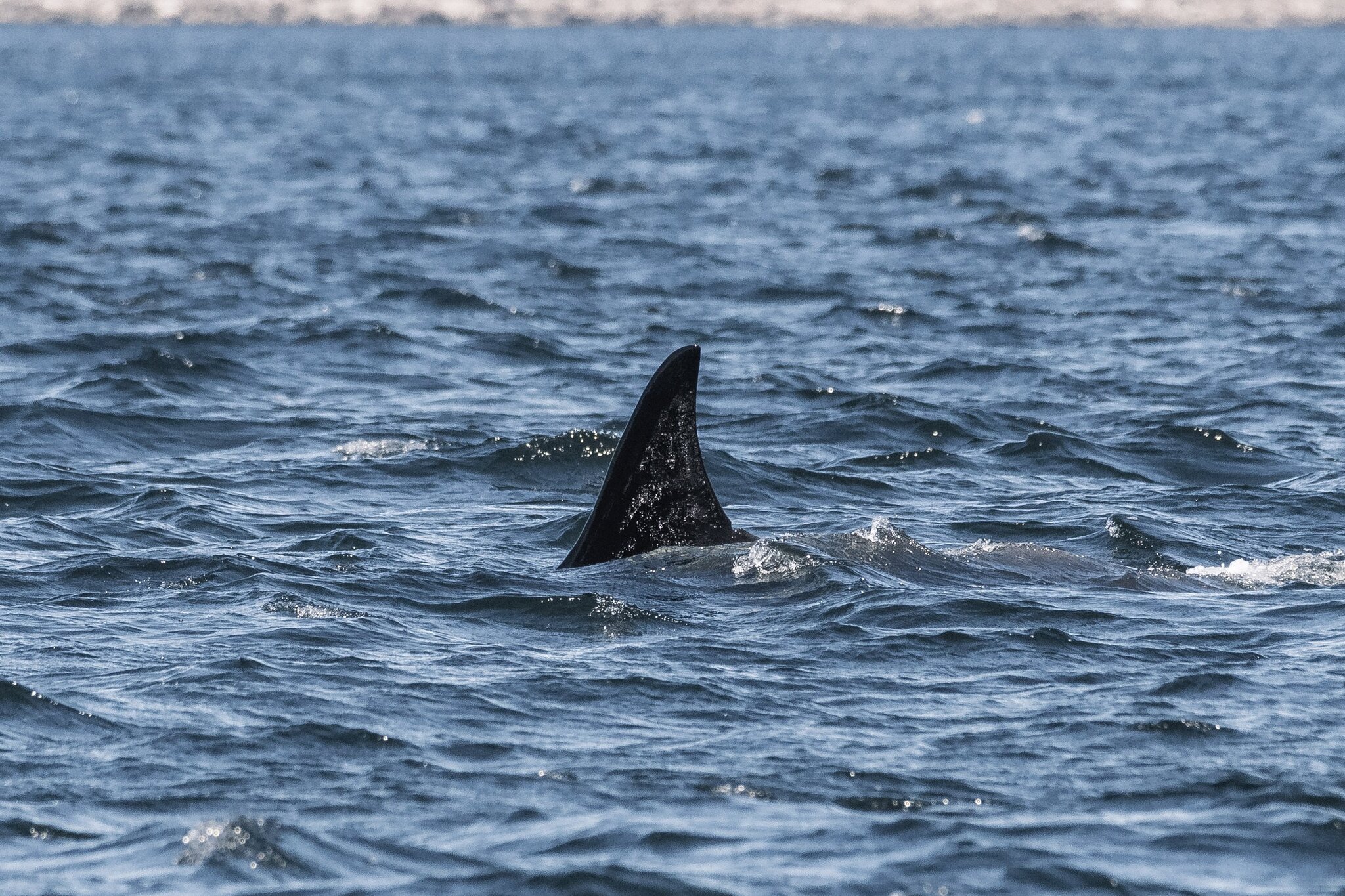
Sexual dimorphism is one of the most pronounced of all the delphinids. The adult male generally measures 6 to 8 m for 3.6 to 9 tonnes and carries a triangular, almost vertical dorsal fin 1 to 2 m high; its flippers and tail fluke are out of proportion in the same way. The female is smaller (5 to 7.3 m, 1.3 to 3.6 t) and her fin, falcate, rarely exceeds 90 cm. Newborns, 2 to 2.7 m long, are born with pale areas tinged orange-yellow that whiten over the first months. The blubber layer reaches 7.6 to 10 cm, body temperature is maintained between 36 and 38 °C, and the species has the second heaviest brain of the marine mammals after that of the sperm whale.

The risk of confusion is limited: no other large cetacean combines this black and white contrast, this eye patch and this giant fin. At a distance, an isolated female or juvenile may nonetheless be confused with other large dark delphinids such as the false killer whale (Pseudorca crassidens), uniformly black, or the pilot whales (genus Globicephala). The latter do have a pale saddle behind the fin and a pale band behind the eye, but neither shows the sharp black and white contrast of the killer whale or its large oval eye patch, and their fin, low and broad-based, is set distinctly further forward on the back. An unusual anatomical detail: the tail region of the killer whale lengthens with age, which is unique among cetaceans.

Taxonomy

Described by Linnaeus in 1758 under the name Delphinus orca, the species was placed in the genus Orcinus by Fitzinger in 1860. It belongs to the family Delphinidae, of which it is the largest member, and is the only living species of its genus; its lineage is thought to have separated from the other delphinids about 11 million years ago.

Its internal taxonomy is one of the most debated files in cetology. Since the 1970s biologists have distinguished several sympatric but genetically and culturally isolated “ecotypes”: in the north-east Pacific, the residents (fish-eating), the transients or Bigg’s killer whales (mammal-eating) and the offshore killer whales; in the North Atlantic, types 1 and 2; in the Antarctic, types A, B (large and small form), C and D. In 2024, Morin and colleagues proposed in Royal Society Open Science that the residents and Bigg’s killer whales be raised to the rank of full species (Orcinus ater and Orcinus rectipinnus). The Committee on Taxonomy of the Society for Marine Mammalogy did not follow that proposal the same year: citing possible episodic gene flow between ecotypes and the absence of a comparative analysis at global scale, it provisionally recognises them as subspecies, Orcinus orca ater, O. o. rectipinnus and O. o. orca (the nominate subspecies). That uncertainty is precisely why the IUCN keeps the species as “Data Deficient“.

Distribution and habitat

The killer whale is the most widely distributed cetacean on the planet: it occupies every ocean, from the Arctic and Antarctic sea ice to tropical seas, on the high seas as well as along the coasts. The highest densities (more than 0.40 individuals per 100 km²) are recorded in the north-east Atlantic along the Norwegian coast, in the North Pacific around the Aleutians and the Gulf of Alaska, and in the Southern Ocean off Antarctica. The global population is estimated at at least 50,000 individuals (a 2006 estimate still cited by NOAA), of which about 25,000 in the Antarctic, 8,500 in the tropical Pacific, 2,250 to 2,700 in the north-east Pacific and 500 to 1,500 in Norwegian waters.

In France, the Office français de la biodiversité states that the species may be encountered throughout the maritime areas of metropolitan France and the overseas territories, but metropolitan sightings remain rare. The Observatoire PELAGIS, which coordinates the national stranding network, recorded in 2022 only eight killer whale strandings in metropolitan France over fifty years; the immature female of 4.26 m and 1,100 kg that came up the Seine as far as Tancarville in May 2022, and died of starvation, was the first known case in the English Channel. The Bay of Biscay accounts for most sightings at sea, in particular off Capbreton (October 2019, July 2020) and as far as the waters off Royan (July 2021). In the Mediterranean there is no resident population: only the Strait of Gibraltar and the Gulf of Cádiz, at the entrance to the basin, take in killer whales regularly. Incursions further east are exceptional; four killer whales identified by photo-identification as belonging to the Icelandic community thus reached the Gulf of Genoa in December 2019, after a journey of about 8,000 km.

Overseas, by contrast, France is home to an emblematic population: that of the Crozet archipelago, in the Terres australes et antarctiques françaises, studied since the 1960s and monitored individually for several decades.

Biology and ecology

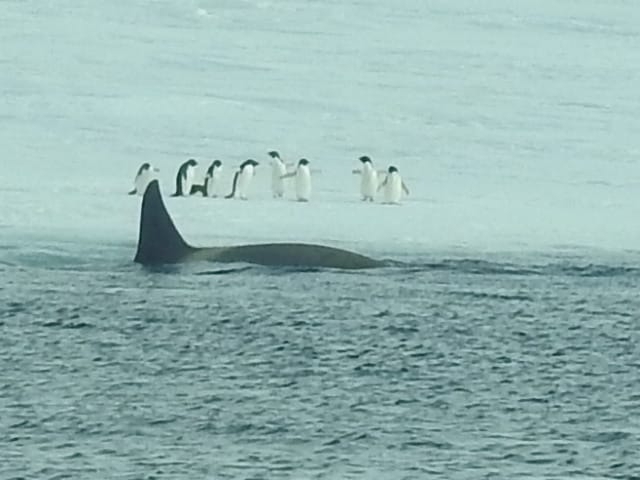
A generalist predator at the scale of the species but highly specialised at that of its populations, the killer whale exploits some thirty fish species and a wide range of warm-blooded prey. The north-east Pacific residents feed 96% on salmon, of which 65% Chinook salmon; Norwegian killer whales practise “carousel feeding” on herring shoals; Bigg’s killer whales take seals, sea lions, porpoises and whale calves; Iberian killer whales follow bluefin tuna on their migrations. The Crozet killer whales, for their part, alternate between fish, penguins, elephant seals and cetaceans, and practise strand feeding to catch young pinnipeds on the beaches, a behaviour taught by the mothers over several years, the first successful captures coming at around 5 or 6 years old, and known in only two populations in the world, with that of Península Valdés in Argentina. Hunting is most often cooperative and coordinated.

Social life rests on the matriline, a group of descendants of a single female numbering 5.5 individuals on average and able to bring together several generations. Among the residents, sons as well as daughters stay with their mother all their life. Matrilines associate into pods (1 to 4 matrilines), then into clans sharing one dialect, and finally into communities. Each population does indeed have its own vocal repertoire, 7 to 17 call types, 11 on average among the residents, learnt and transmitted culturally, a genuine “family badge”. Mammal-eating killer whales, by contrast, are most often silent when hunting, acoustic discretion being necessary with prey able to hear them.

Breeding is slow. Females reach sexual maturity at around 10 to 13 years, males at around 15 but do not actually breed until around 21. Gestation lasts 15 to 18 months (13 to 17 months according to some sources) and produces a single calf, suckled for at least a year and often two, with an interval between births of about 3 to 5 years. Juvenile mortality is high: 37 to 50% of newborns die in the first seven months. The killer whale is one of the very few mammals to undergo a true menopause: females stop breeding at around 40 but can live several decades more, playing a key role of ecological memory for their group. The species can reach 56 km/h in bursts and most often dives at shallow depth, with occasional dives of several hundred metres. No fatal attack on a human has ever been documented in the wild.

Status and conservation

Globally, the killer whale is classed as “Data Deficient” (DD) on the IUCN Red List, a status confirmed in the 2025-2 edition. That classification does not reflect an absence of threat but a taxonomic uncertainty and a lack of reliable estimates for most populations. The picture hardens as soon as one goes down to the scale of the subpopulations. That of the Strait of Gibraltar, known as the Iberian population, has been classed as Critically Endangered (CR) since 2019, under criterion D alone: it numbers only about forty individuals (some 39 counted), well under 50 mature individuals, and depends closely on bluefin tuna; recruitment there is very low, no calf surviving in some years. In the north-east Pacific, the Southern Residents have been listed as endangered under the US Endangered Species Act since 18 November 2005 and numbered no more than 74 individuals in July 2025, against 97 in 1996; the AT1 transient stock, down from 22 to six or seven animals since the Exxon Valdez oil spill of 1989 and with no birth observed since 1984, has been listed as depleted under the Marine Mammal Protection Act since 2004. The French population of Crozet has also undergone a documented collapse: 93 individuals in 1988-1989, 43 in 1998-2000, only 33 formally identified in 2014, mainly as a result of illegal fishing for Patagonian toothfish after 1996, which the French Navy brought to an end in 2002.

The main threats are the scarcity of prey (Chinook salmon, bluefin tuna), the bioaccumulation of persistent organic pollutants, with PCBs, highly concentrated in the blubber of a long-lived apex predator, impairing immunity and reproduction, disturbance and noise from vessels, bycatch in fishing gear, oil spills and military sonar. Depredation on the toothfish longlines around Crozet illustrates a direct conflict with fishing: between 2003 and 2012, for more than 5,000 tonnes landed, some 2,600 tonnes are thought to have been taken by killer whales and sperm whales.

The species is fully protected in France by the order of 1 July 2011 setting the list of marine mammals protected on national territory; it is listed in Annex IV of the Habitats Directive and in Annex A of the European CITES Regulation (CITES Appendix II). The French Red List classes it as “Data Deficient”, the European assessment giving it as “Least Concern” according to the OFB.

Watching this species

The prime watching areas worldwide are the Salish Sea and eastern Vancouver Island, the Norwegian fjords and Icelandic waters in winter at the time of the herring concentrations, the Antarctic Peninsula, and the Strait of Gibraltar from May to September, when Iberian killer whales follow the bluefin tuna migration.

In metropolitan France, sightings remain a matter of luck. The Bay of Biscay, and the approaches to the Capbreton Canyon in particular, accounts for most reports; the English Channel sees only sporadic passages and the French Mediterranean exceptional incursions. No commercial trip there is dedicated to the species: encounters happen by chance on “large cetacean” trips or on offshore passages. Any sighting or stranding is worth reporting to the Observatoire PELAGIS (La Rochelle), which runs the national stranding network and has an online reporting form as well as a telephone line open seven days a week.

On the ethical side, the usual rules apply with particular strictness: never cut across the path of a group, do not come between a female and her calf, keep a steady speed and a sufficient distance, limit the length of the approach. The literature notes that whale watching can stress the animals and alter their hunting behaviour when boats come too close. A particular case: since May 2020, Iberian killer whales have been interacting with the rudders of sailing boats off Spain (first the Strait of Gibraltar and Andalusia, then as far as Galicia), Portugal and Morocco, more than 500 interactions recorded, more than 250 boats damaged and several sinkings, with no human injury, fifteen individuals being identified as involved. PELAGIS notes that these animals can travel up as far as Galicia and the Bay of Biscay, and recommends stopping the vessel in the event of such an encounter.

Frequently asked questions

Why is the killer whale classed as “Data Deficient” when it is so well known?

Because the listing applies to the species as a whole and its taxonomy is not settled: the north-east Pacific ecotypes are perhaps distinct species, and most of the world’s populations have no reliable population estimate. The IUCN therefore cannot apply its quantitative criteria at global scale. That does not prevent certain subpopulations from being assessed separately and judged critically endangered: this is the case of the killer whales of the Strait of Gibraltar, classed CR in 2019 under criterion D, the criterion for very small populations.

Are there killer whales in French waters?

Yes, but rarely in metropolitan France. The OFB states that the species may frequent all French maritime areas; in practice, metropolitan sightings are concentrated in the Bay of Biscay, in particular off Capbreton, and PELAGIS recorded only eight strandings in fifty years, the first case in the English Channel dating from May 2022. Overseas, by contrast, France is home to a well studied population at the Crozet archipelago, in the TAAF.

Are there killer whales in the Mediterranean?

There is no resident population in the Mediterranean. Only the Strait of Gibraltar and the Gulf of Cádiz, at the entrance to the basin, take in killer whales regularly, mainly between May and September. Incursions into the western basin are exceptional: in December 2019, four killer whales identified by photo-identification as coming from Iceland were observed as far as the Gulf of Genoa, after a journey of about 8,000 km.

Is the killer whale dangerous to humans?

No fatal attack by a wild killer whale on a human has ever been documented, unlike several serious accidents that have occurred in captivity. The interactions with sailing boats observed since 2020 off the Iberian Peninsula, Spain, from the Strait of Gibraltar to Galicia, Portugal and Morocco, target the rudders exclusively and have caused no injury, even though several boats have sunk. The leading scientific hypotheses point to play behaviour or a cultural fashion among young individuals.

How long does a killer whale live, and why do females live longer?

Males live some thirty years on average, exceptionally 50 to 60 years; the Scottish male John Coe, estimated to be at least 60, is among the oldest known in the wild. Females commonly reach 50 to 80 years, sometimes more than 90. The killer whale is one of the very few mammals to undergo a true menopause: females stop breeding at around 40 but go on living for a long time, passing on to their matriline the memory of the areas and the hunting techniques.

Do all killer whales eat the same thing?

No, and this is one of their most remarkable traits. Each ecotype has a highly specialised diet, transmitted culturally: 96% salmon among the north-east Pacific residents, herring in Norway, bluefin tuna among Iberian killer whales, marine mammals among Bigg’s killer whales, elephant seals and penguins at Crozet. These populations do not mix, even when they share the same waters.

Sources

Factsheet compiled from authoritative scientific sources (IUCN, NOAA Fisheries, specialist literature) and reviewed for factual accuracy.

Observed distribution

According to the open data of the GBIF, 8,583 georeferenced sightings of Orcinus orca are recorded in our photographic index.

Main countries of observation
CountryNotes
United States of America2,989
Canada2,931
Norway576
Antarctica437
New Zealand350
Australia258
Iceland208
Argentina137
Russian Federation72
Mexico71

Distribution map: Killer whale (Orcinus orca)

Distribution map: Killer whale (Orcinus orca), 8,583 georeferenced sightings from GBIF
8,583 georeferenced sightings of Orcinus orca. Base map Natural Earth, public domain. GBIF data.
🗺️ Open the interactive mapTo zoom and pan. It uses the OpenStreetMap/CARTO base maps and the GBIF occurrence densities: no data is sent to these services before you click.

Presence through the year

Monthly distribution of 8,620 dated sightings (all years combined): the maximum is reached in August.

12050janvier : 535janfévrier : 445febmars : 504maravril : 640avrmai : 806maijuin : 1194juinjuillet : 1192juilaoût : 1205Augustseptembre : 841sepoctobre : 452octnovembre : 436novdécembre : 370dec
Sightings by month
MonthNotes
janvier535
February445
mars504
avril640
mai806
juin1,194
juillet1,192
August1,205
septembre841
octobre452
novembre436
December370

These figures reflect survey effort (more boaters and more surveys in summer) as much as the actual presence of the species: to be interpreted with caution.

En images

Orcinus orca
© Robin Gwen Agarwal, CC BY-NC, 2026
Orcinus orca
© Kevin Toomer, CC BY-NC, 2026
Orcinus orca
© croller, CC BY-NC, 2026
Orcinus orca
© Tobin Sparling (he/him), CC BY-NC, 2026
Orcinus orca
© naturalistnkc, CC BY-NC, 2026
Orcinus orca
© Lauren S., CC BY-NC, 2026
Orcinus orca
© vancouver_island_whale_watch, CC BY-NC, 2026
Orcinus orca
© Paolo Pietropaolo, CC BY-NC, 2026
Orcinus orca
© cwlonie6626, CC BY-NC, 2026
Orcinus orca
© Ron + Sandy, CC BY-NC, 2026
Orcinus orca
© Jason Stee, CC BY-NC, 2026
Orcinus orca
© sdkevorkian, CC BY-NC, 2026

Photographs from GBIF under a Creative Commons licence. The author and the licence of each photograph are given; please respect them if you reuse them.

Scientific references

  1. Dwyer S. (2011) Cookie Cutter Shark (Isistius sp.) Bites on Cetaceans, with Particular Reference to Killer Whales (Orca) (Orcinus orca), Aquatic Mammals
  2. Heyning J., Dahlheim M. (1988) Orcinus orca, Mammalian Species
  3. Baird R. (2001) Status of Killer Whales, Orcinus orca, in Canada, The Canadian field-naturalist
  4. Hanson B. (2014) Trans-Pacific Consumption of Cephalopods by North Pacific Killer Whales (Orcinus orca), Aquatic Mammals
  5. Shapiro A. (2008) Orchestration : the movement and vocal behavior of free-ranging Norwegian killer whales (Orcinus orca)
  6. Miller P. (2000) Maintaining contact : design and use of acoustic signals in killer whales, Orcinus orca
  7. Hawke D., Dobinson J. (2001) Some seabird associations with dusky dolphins (Lagenorhynchus obscurus) at Kaikoura and with orca (Orcinus orca) at Nelson, New Zealand, Notornis
  8. Thommen H., Swarbrick K., Biedenweg K. (2021) Mixed emotions associated with orca ( Orcinus orca ) conservation strategies, Conservation Science and Practice

Automatic selection of the most cited works mentioning the species (source: Crossref).