| Scientific name | Steno bredanensis (G. Cuvier in Lesson, 1828); some references cite simply Lesson, 1828 |
|---|---|
| Other names | In English: rough-toothed dolphin, slopehead. In French: dauphin à bec étroit, sténo rostré, sténo à rostre étroit, dauphin à dents rugueuses. In Spanish: delfín de dientes rugosos. |
| Size | 2.1 to 2.6 m in adults (series of 64 specimens from the Atlantic, the Pacific and the Mediterranean: 209 to 265 cm); maxima reported in Brazil of 2.83 m for a male and 2.70 m for a female. About 1 m at birth. |
| Weight | 90 to 155 kg in adults, for a mean mass of about 130 kg; the largest individuals approach 160 kg. |
| Longevity | At least 32 years (documented record; Carey & Judge, 2000), with NOAA giving 36 years or more. True longevity is probably underestimated, the age series available for this offshore species remaining very limited. |
| Diet | Epipelagic fish of good size (dolphinfish/mahi-mahi, needlefish and garfish, sauries, cutlassfish, silversides, snipefish) and cephalopods (squid, octopus, including the blanket octopus). Cases of bait being taken from fishing lines are documented. |
| IUCN status | Least Concern (LC) globally, assessment by Kiszka, Baird & Braulik (assessed on 30 August 2018, published on the Red List in 2019, e.T20738A50376703), with an unknown population trend. The Mediterranean subpopulation, isolated in the eastern basin, has been the subject of a separate regional assessment: it has been listed as Near Threatened (NT) since 2021 (Kerem, Frantzis, Scheinin & Goffman, e.T160158217A160158353), owing to its very small size, its isolation and its exposure to bycatch. This listing was endorsed by ACCOBAMS Resolution 8.12 (2022). |
The rough-toothed dolphin (Steno bredanensis) is an oceanic dolphin of warm seas, the only member of its genus, recognisable above all by its sloping forehead, which continues without a break into a long, narrow rostrum, a “conical” outline unique among delphinids. It owes its name, rough-toothed dolphin, to the fine longitudinal ridges that roughen the enamel of its teeth. Unobtrusive, fairly rare everywhere but present throughout the tropical and subtropical oceans, it is listed as Least Concern (LC) by the IUCN, with well studied island nuclei in Hawaii, the Canaries and French Polynesia.
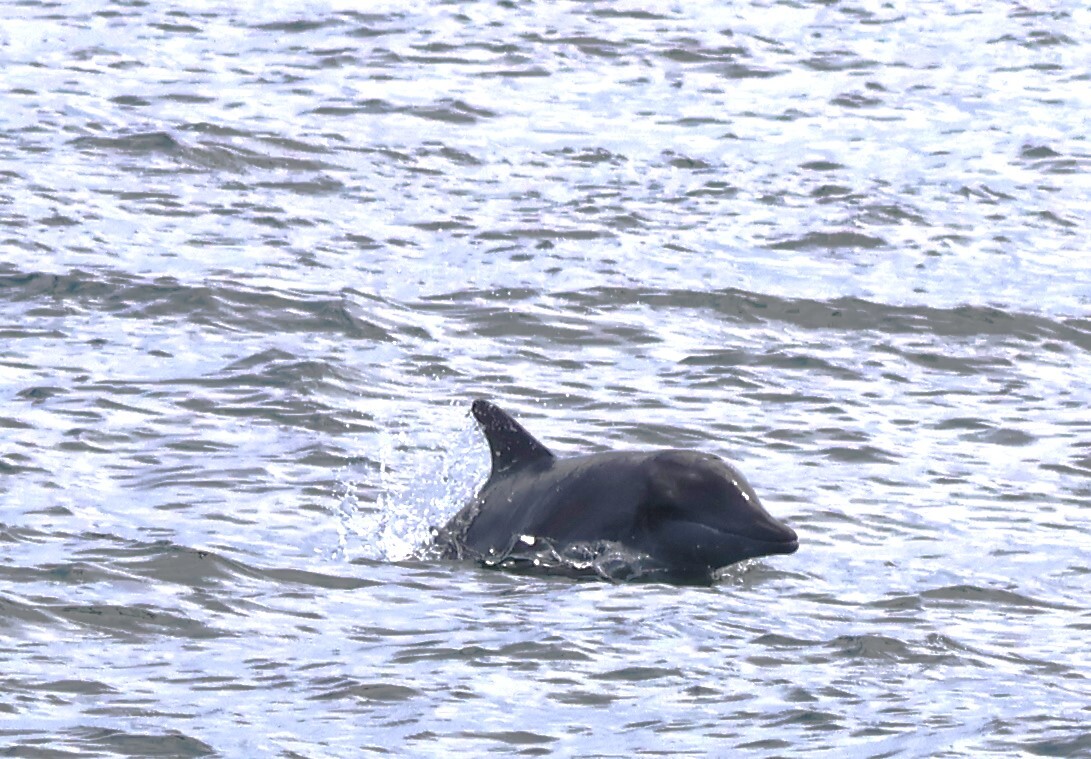
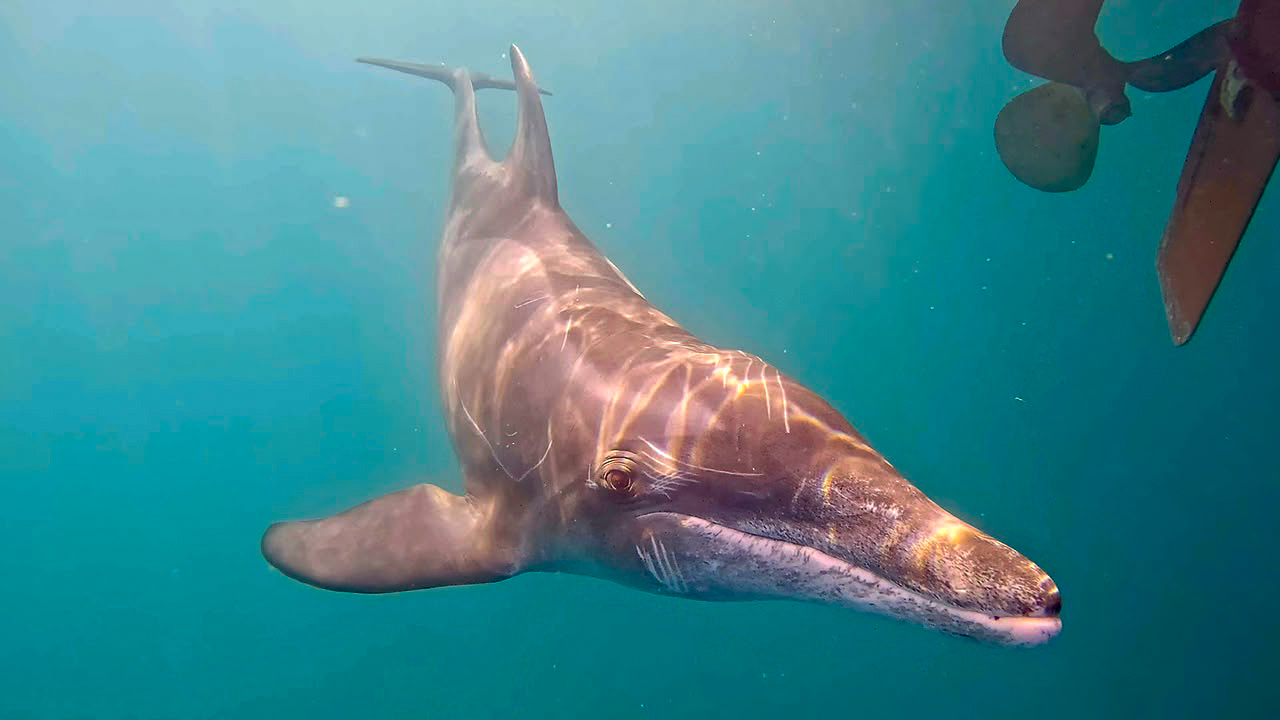
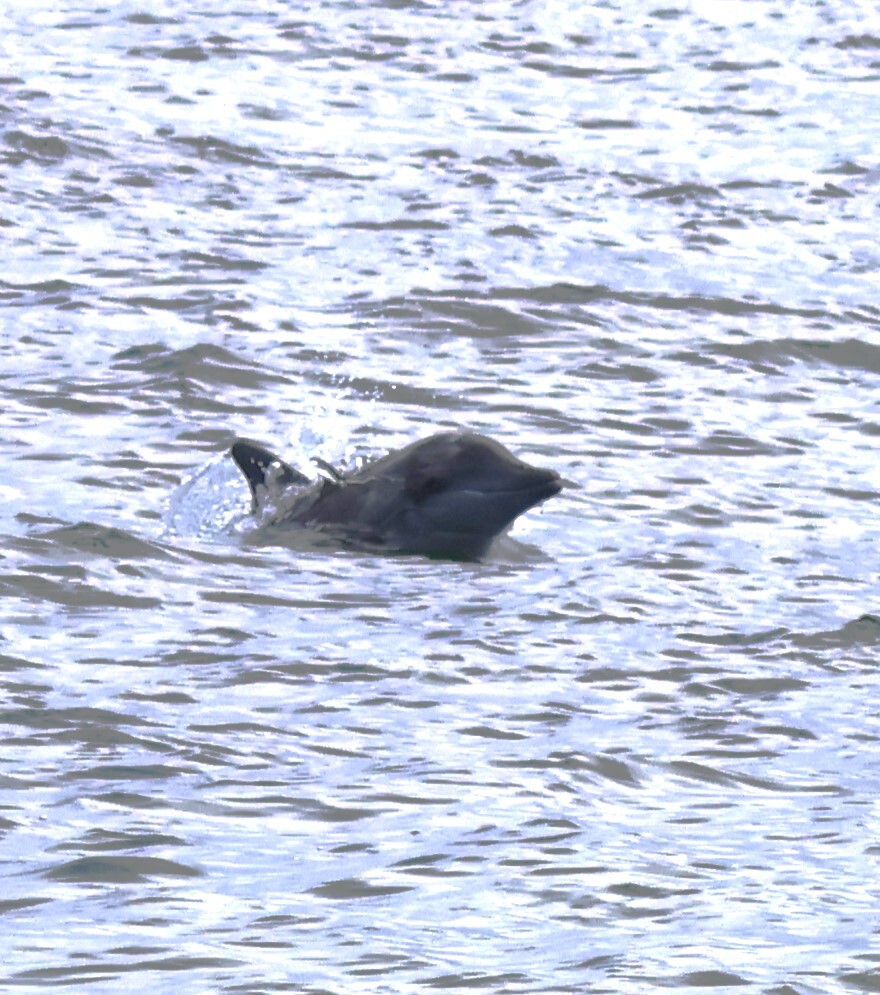
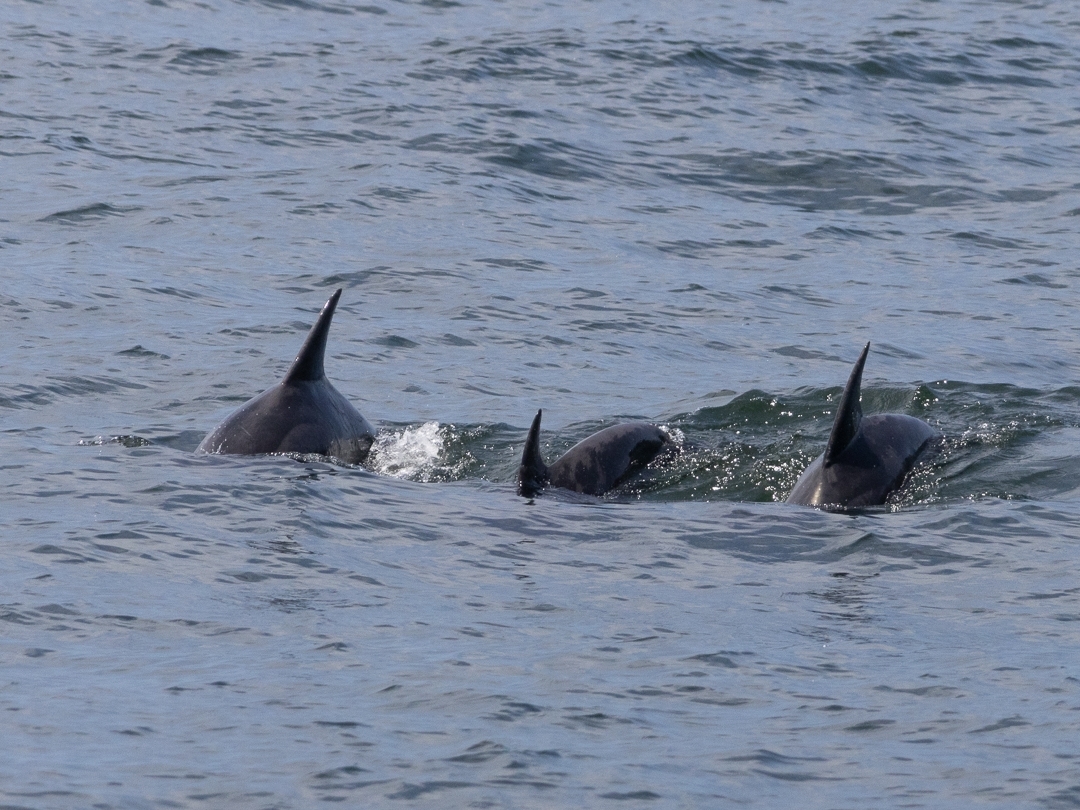
The rough-toothed dolphin is a medium-sized delphinid with a streamlined but solidly built body. Its distinctive feature is the profile of the head: the melon, barely domed, slopes down in a continuous line to a long, laterally compressed rostrum, without the transverse crease that clearly marks the boundary between forehead and beak in almost all other dolphins. This “conical” head, which suggests a somewhat archaic profile, shows particularly well when the animal swims at the surface with beak and chin out of the water, a “skimming” gait very characteristic of the species. The dorsal fin is tall, triangular to falcate, and the flippers are large, broad and set quite far back.
The coloration is grey, with a darker dorsal cape that begins above the eye, widens gradually towards the rear and spills onto the flanks, which are themselves a paler grey. The belly, the lower jaw and often the lips are white to pinkish, and these “white lips” are an excellent field criterion. Older adults frequently show a mottled appearance, blotched with white, pink or yellow, due in part to scarring: circular cookiecutter shark bites, tooth rakes from conspecifics, marks left by cephalopods. Young animals, for their part, are a more uniform grey. The dentition numbers 19 to 26 teeth per upper half-jaw and 19 to 28 per lower half-jaw; the crowns carry fine longitudinal striations, a diagnostic feature when the teeth can be compared side by side with those of other delphinids.
The most frequent confusions involve the common bottlenose dolphin (Tursiops truncatus), whose rostrum is distinctly shorter and separated from the melon by a marked crease, and whose dorsal fin is less upright. Dolphins of the genus Stenella, Atlantic spotted dolphin (Stenella frontalis), pantropical spotted dolphin (Stenella attenuata), spinner dolphin (Stenella longirostris), also have an elongated beak, but always with that frontal demarcation which the rough-toothed dolphin lacks. On the skull, confusion with the humpback dolphins (genus Sousa) is resolved by the number of teeth, much higher in the latter (30 to 38 per half-jaw), and by the length of the mandibular symphysis, which reaches about a third of the mandible in the rough-toothed dolphin.
Steno bredanensis belongs to the family Delphinidae and is the only species of the genus Steno Gray, 1846, which is itself monotypic. The genus name comes from the Greek stenos, “narrow”, in reference to the rostrum; the epithet bredanensis honours the naturalist Jacob van Breda, who studied and illustrated the specimen on which the description was based. The nomenclatural history is notoriously tangled: the name Delphinus rostratus, applied in 1817 by Desmarest to an animal stranded at Paimpol, in Brittany, was already occupied, and Lesson proposed in 1828 the replacement name Delphinus bredanensis; the current combination Steno bredanensis is in use only from 1955 onwards. A second French stranding, on the Île d'Aix at the mouth of the Charente, was described in 1836 under the name Delphinorhynchus santonicus, today a synonym.
The position of the genus within the Delphinidae remains debated. Steno was long placed in the subfamily Steninae, alongside Sotalia, on the strength of cytochrome b analyses; datasets combining mitochondrial and nuclear DNA suggest on the contrary that Steninae is an artificial grouping, and bring Steno closer to the Globicephalinae, a classification adopted by several current reference works. At the intraspecific level, a worldwide phylogeography published in 2022 (mitochondrial control region sequences, mitogenomes and nuclear introns) brought to light a distinct Atlantic clade, separated from the cosmopolitan clade for about 890,000 years and diagnosable with 98% reliability; the authors conclude that rough-toothed dolphins of the Atlantic and those of the Indian and Pacific Oceans taken together meet the criteria for recognition as two subspecies. This proposal has not yet been taken up by all taxonomic reference works, which to date recognise no formal subspecies.
The rough-toothed dolphin occurs in all the oceans, Atlantic, Indian and Pacific, as well as in the Mediterranean, in warm temperate, subtropical and tropical waters. Its distribution extends approximately from 40° north to 35° south, with a few more northerly sightings regarded as vagrant (the coasts of Oregon and Washington, the Scheldt estuary in the North Sea).
It is above all a species of offshore and deep waters. In French Polynesia, sightings are concentrated at depths of 1,000 to 2,000 m, 1.8 to 5.5 km from the coast; in Hawaii they most often take place beyond 1,500 m of depth and more than 3 km from shore; in the Canaries the mean depth at sighting slightly exceeds 500 m, at an average of 4.4 km from the coast. These three sectors have in common steep-sided volcanic islands bordered by oceanic water very close inshore, a configuration that favours resident island populations, as the site fidelity and the genetic differentiation observed between Hawaiian archipelagos and between Polynesian island groups confirm. Animals also frequent distinctly more coastal waters, notably in Brazil and Honduras.
In the Mediterranean, the rough-toothed dolphin is confined to the eastern basin, mainly the Levantine basin, where it forms a small isolated population of Atlantic origin, interpreted as a relict of a formerly wider one; acoustic detections off eastern Sicily suggest a more westerly presence. A gathering of some forty individuals was notably observed in 2006 inside the port of Haifa itself, where the animals were feeding on mullet.
For France, the species is not part of the regular fauna of the French Mediterranean, the Bay of Biscay or the English Channel: metropolitan records consist of isolated historical strandings, among them those at Paimpol in Brittany and on the Île d'Aix, which founded the nomenclature. In the north-east Atlantic the species is rare outside Macaronesia (the Canaries, the Azores, Madeira). It is overseas that the rough-toothed dolphin is best represented: it is regular in the French Antilles, where it is among the species of the Agoa Sanctuary (sightings off Saint-François, in Guadeloupe), and relatively abundant in French Polynesia, notably in the Society Islands, with occasional sightings as far as the Marquesas.
The rough-toothed dolphin feeds on epipelagic fish and cephalopods. Stomach contents from stranded animals and observations at sea show a varied diet: adult dolphinfish, needlefish and garfish, sauries, silversides, cutlassfish, snipefish, squid and octopus. In the Azores, rough-toothed dolphins have been seen exploiting a ball of snipefish in turn, in the company of Cory's shearwaters; cooperative fish-herding techniques are regularly described, notably in the Canaries and in Honduras.
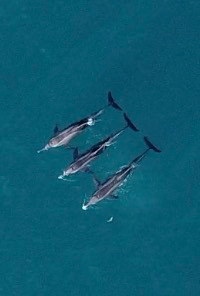
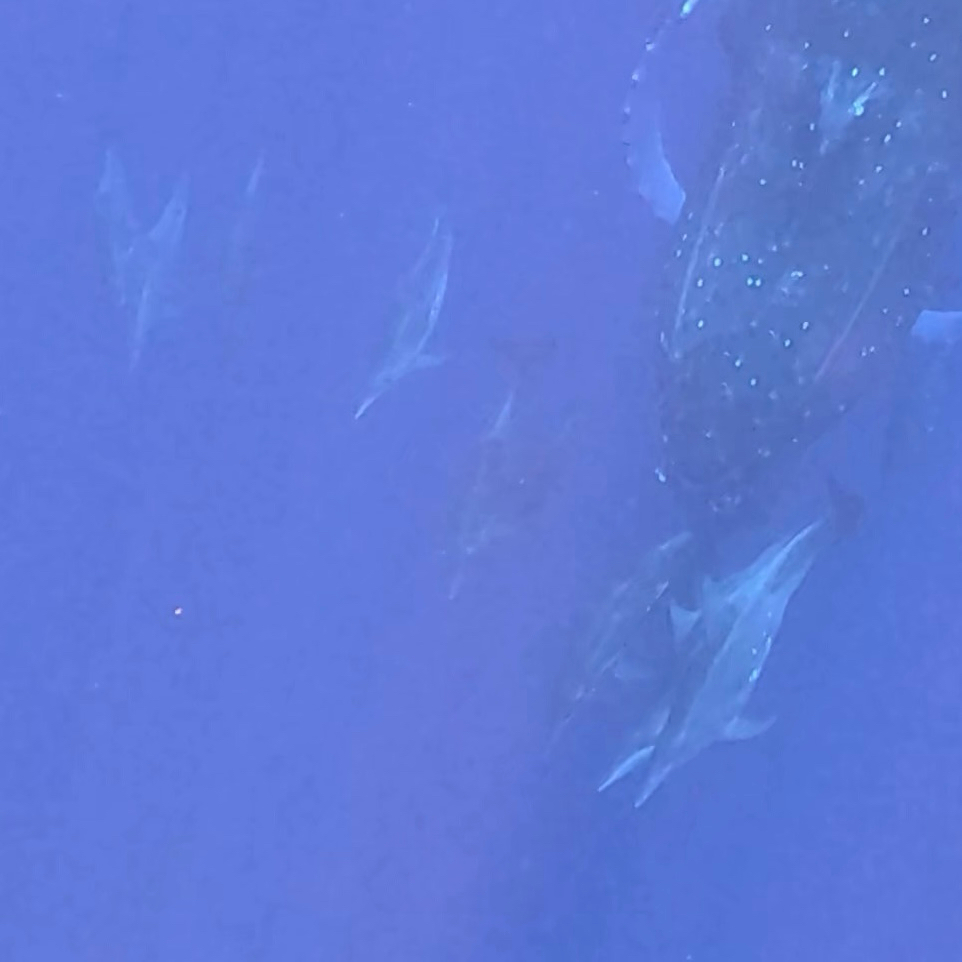
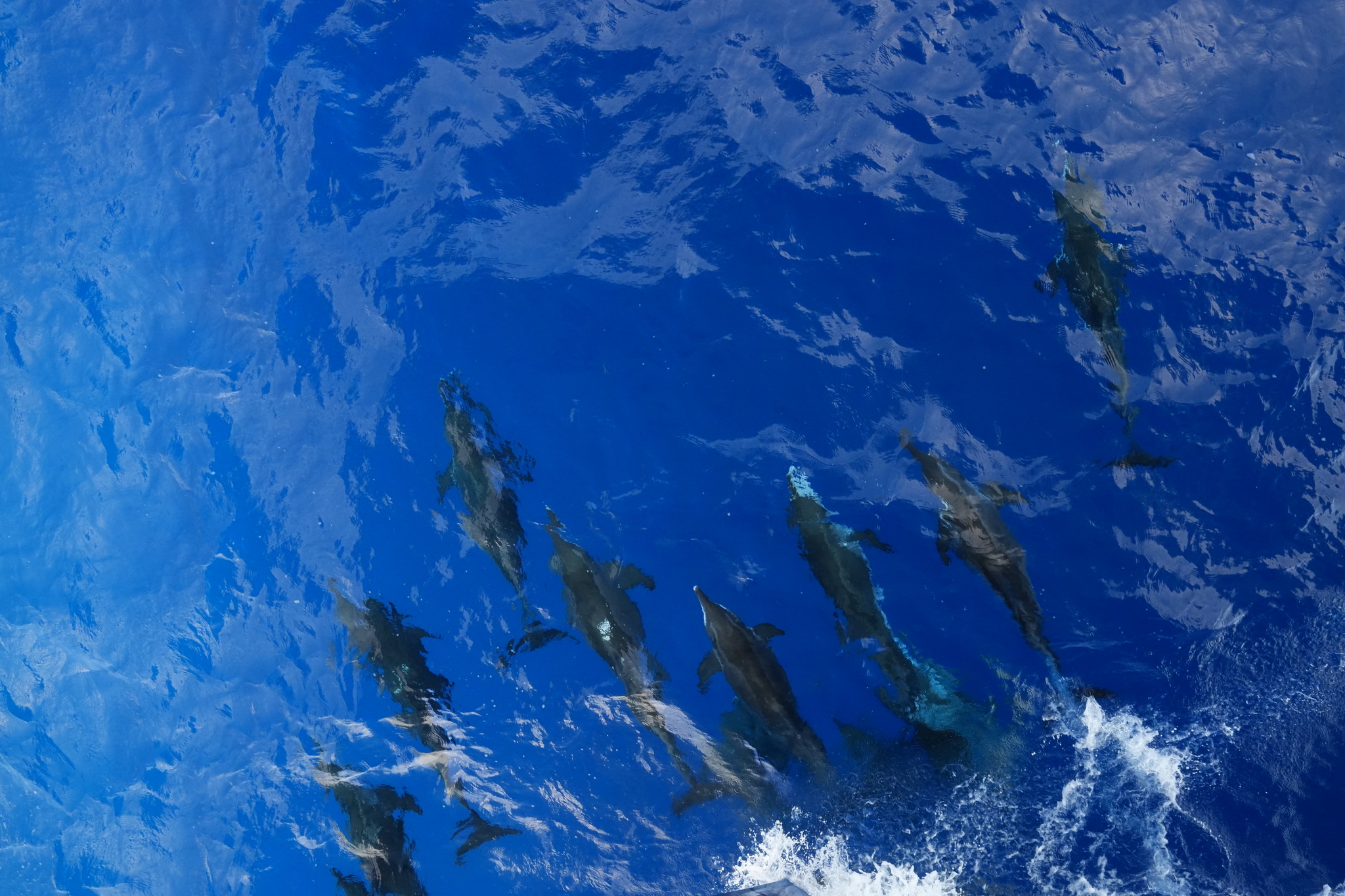
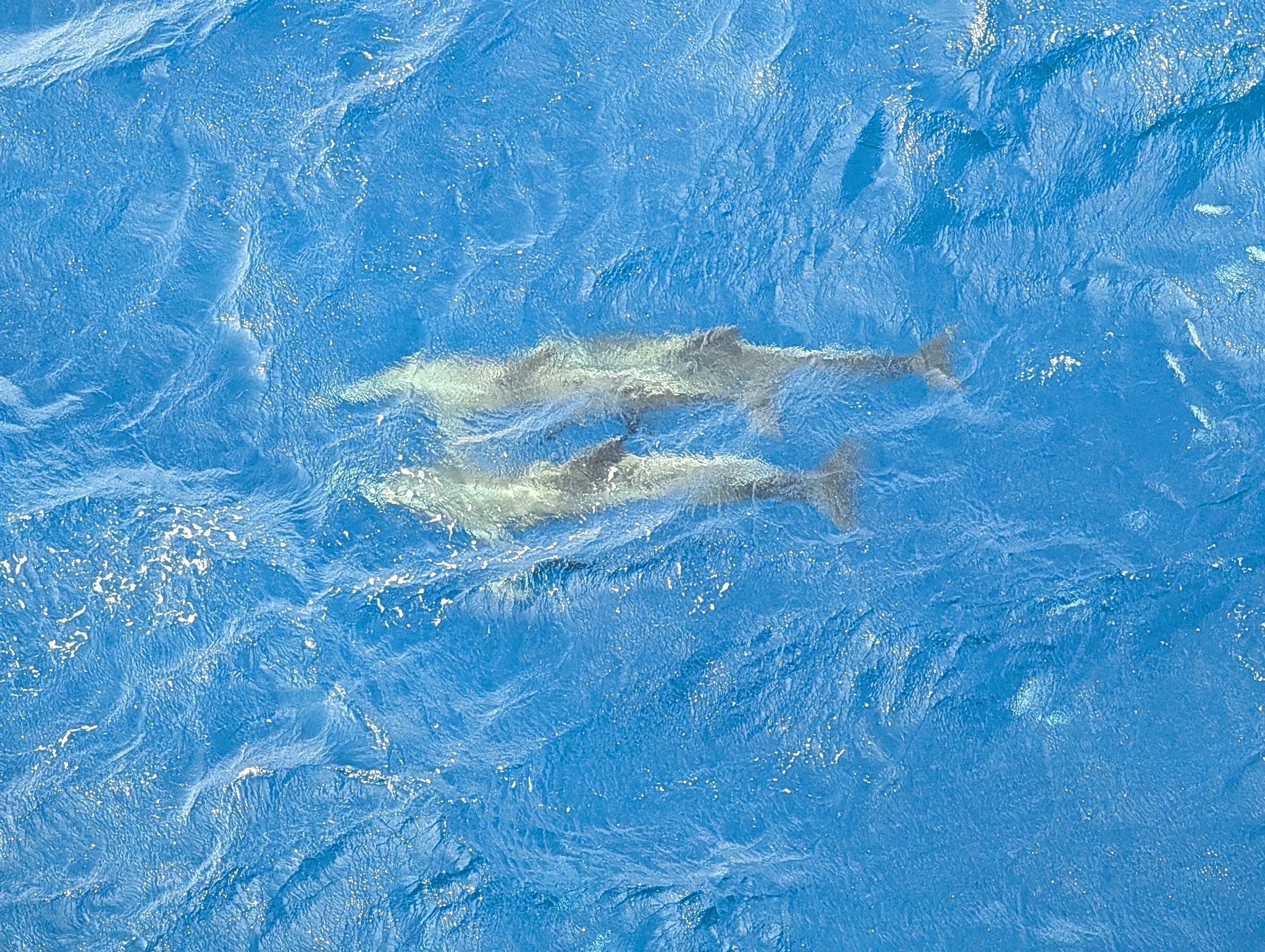
The species is social without being excessively gregarious. Groups most often number 10 to 20 individuals, but sizes vary a great deal from region to region: a mean of 10.8 animals in French Polynesia (2 to 35), a median of 7 in Hawaii, where encounters range from a lone individual to more than 90, up to a gathering estimated at 160 animals in the Mediterranean. The social organisation is of the fission-fusion type, with tight subgroups of 2 to 8 individuals that swim in synchrony and with lasting bonds, particularly between females and young. Interspecific associations are frequent: common bottlenose dolphin, melon-headed whale, false killer whale, Fraser's dolphin, short-finned pilot whale, spinner dolphin, Atlantic spotted dolphin, and even humpback whale. The rough-toothed dolphin is described as an occasional “bow rider”, reaching 16 km/h when it does so, and it shows a marked curiosity towards floating objects.
As for diving, animals have been recorded at 70 m of depth and the species can hold its breath for up to 15 minutes. Its echolocation clicks, emitted in very brief bursts of 0.1 to 0.2 s, cover a wide band running from 2.7 to 256 kHz, with a maximum peak frequency around 25 kHz, a low value compared with those of the false killer whale, Risso's dolphin or the common bottlenose dolphin; whistles lie between 3 and 12 kHz.
Breeding remains poorly known. The newborn measures about 1 m; growth is rapid, young reaching at least 2 m by around 5 years. Females begin sexual maturation between 3 and 6 years and become mature at around 8 to 10 years, at 212 to 219 cm and 101 to 108 kg; males mature between 5 and 10 years, at 211 to 216 cm and 83 to 102 kg. The available data do not allow the gestation period, the lactation period or the existence of a calving season to be established. Caregiving behaviour is documented: echelon swimming of young against the mother's flank, and the prolonged support at the surface of a dead calf by its mother and two other adults in the Canaries. The presumed predators are large sharks and the killer whale; cookiecutter shark bites are commonplace. Finally, the species is subject to mass strandings, sometimes of several dozen individuals, reported notably in Senegal, Hawaii, Virginia and Florida.
Globally, the rough-toothed dolphin is listed as Least Concern (LC) on the IUCN Red List, in an assessment published in 2019. The sum of the available abundance estimates reaches about 221,000 individuals (221,186 precisely), but it covers only a small part of the range: the total population is in all likelihood far higher. The two best documented contingents are the eastern tropical Pacific (about 145,900 animals, CV = 0.32, ship surveys) and the Hawaii exclusive economic zone (about 72,500 animals, CV = 0.39). The other stocks counted are far more modest: about 620 individuals in the northern Gulf of Mexico and about 270 along the Atlantic coast of the United States. The resident island populations of Hawaii, for their part, number only a few hundred to a little over a thousand animals depending on the island (about 1,665 for Kauai and Niihau together, fewer than 200 around the island of Hawaii). Population trends are not documented and no major threat at the scale of the species has been identified.
Pressures nonetheless remain real and locally strong. Bycatch is the first among them, in particular in longlines, purse seines and drifting gillnets; catches are reported from Japan, Sri Lanka, Brazil, the eastern tropical Pacific and the Mediterranean. Direct hunts target the species or include it in their catches: drive fisheries in Japan, the Solomon Islands and Papua New Guinea, harpooning in West Africa and at Saint Helena, sale of meat in Sri Lankan markets, odontocete hunting at Saint Vincent in the Caribbean. In Hawaii, the theft of bait from lines, with fishers reporting the loss of 20 to 50% of their bait, generates a conflict of use, with reported cases of illegal shooting and poisoning. To these are added chemical contamination (PCB levels reaching 39 ppm have been measured in the tissues of animals stranded in Hawaii, with established transfer from mothers to young), the ingestion of plastic waste and underwater noise pollution, which interferes with communication and echolocation.
The species is listed in Appendix II of CITES and in Annex II of the SPAW Protocol for the Caribbean, and in France it holds the status of protected marine mammal. In the French Antilles it falls under the Agoa Sanctuary, which covers the whole exclusive economic zone of Martinique, Guadeloupe, Saint Martin and Saint Barthélemy. The Mediterranean case calls for particular vigilance: the subpopulation of the eastern basin, very small and cut off from the Atlantic, has been listed as Near Threatened (NT) since 2021, a status endorsed by ACCOBAMS Resolution 8.12 in 2022, and it accumulates gillnet bycatch, mass strandings and exposure to gas prospecting and to active military sonars, in a sea where human pressures are intensifying.
Watching a rough-toothed dolphin takes patience and, most often, going well away from the coast. The best sectors are volcanic archipelagos bordered by deep water: Hawaii, the Canaries, the Azores and Madeira, and, for France, French Polynesia and the Antilles, where the species is regular. In metropolitan France, no survey trip can reasonably target this species, whose presence there is a matter of historical accident.
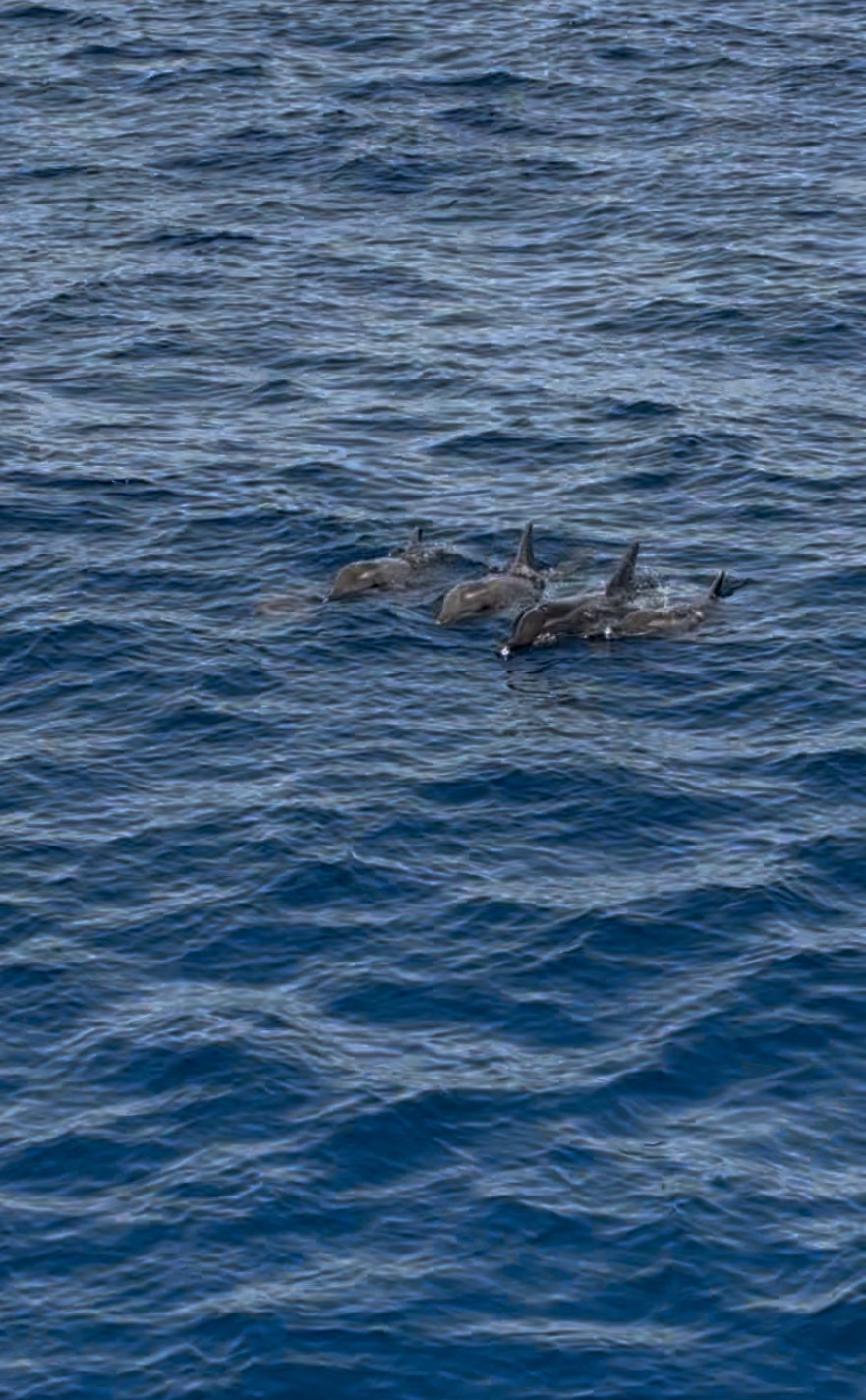
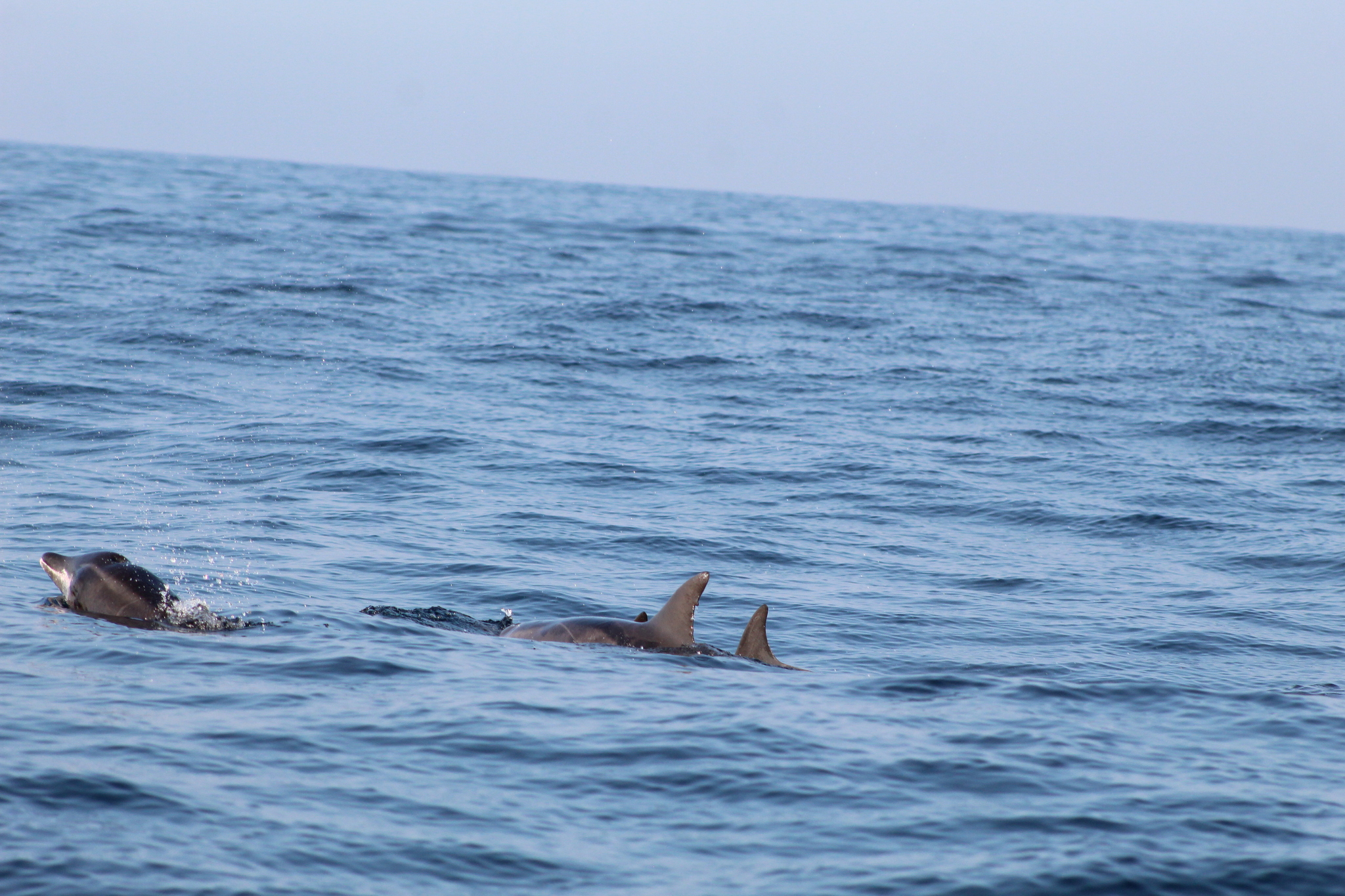
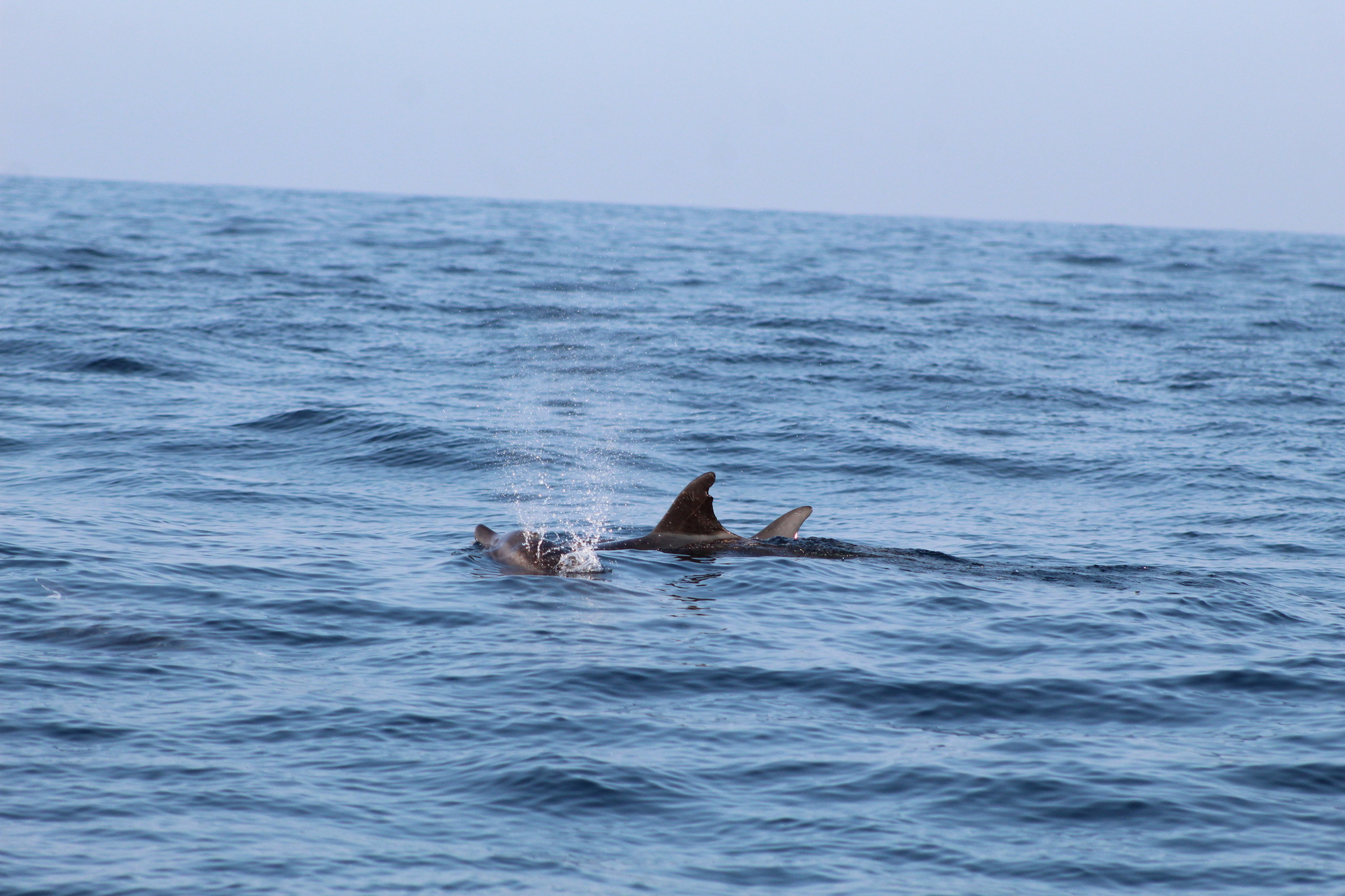
On the water, what to look for is a particular way of swimming: animals pressed close against one another, moving forward at the surface with beak and chin emerged, rather than a troop of leaping dolphins. The rough-toothed dolphin breaches little, but it can make powerful leaps and come in to bows. Binoculars serve above all to check two details: the absence of a crease between forehead and beak, and the paleness of the lips and the lower jaw. A good photograph of the dorsal fin, whose notches and scars remain stable from one year to the next, allows photo-identification and feeds into monitoring programmes.
The ethics of approach are those that apply to all cetaceans: navigation at a constant and reduced speed, approach from the side and never head on or from behind the group, minimum distance respected, no pursuit and no splitting of a group, engine in neutral if the animals come of their own accord, and prompt withdrawal in the presence of young. Entering the water and swimming with the animals are to be ruled out. Any stranding, alive or dead, should be reported to the competent national stranding network rather than handled: in a species subject to mass strandings, the information gathered has real scientific value.
Because the enamel of its teeth carries fine longitudinal ridges that give it a rasping surface, absent in other delphinids. The feature is visible only on teeth examined close up: it is a laboratory criterion, not a field one. The rough-toothed dolphin has 19 to 26 teeth per upper half-jaw and 19 to 28 per lower half-jaw.
The common bottlenose dolphin has a short rostrum, clearly separated from the melon by a well marked transverse crease. In the rough-toothed dolphin, the forehead slopes down in a continuous line to the beak, with no break at all: the head forms a cone. Two further clues help: the white to pinkish lips and lower jaw, and the very typical swimming at the surface with beak and chin emerged.
Yes, but essentially overseas. It is regular in the French Antilles, where it is one of the species of the Agoa Sanctuary, and relatively abundant in French Polynesia, in particular in the Society Islands. In metropolitan France it is part neither of the regular fauna of the French Mediterranean nor of that of the Bay of Biscay or the English Channel: only a few historical strandings are known there, among them the Paimpol animal that served as the basis for the description of the species.
Up to about 15 minutes. Individuals have been recorded at 70 m of depth, but its real capacities are probably greater than the measured values, dive data remaining scarce for this offshore species.
Least Concern (LC) globally, according to the IUCN Red List assessment published in 2019, with an unknown population trend. The main pressure is bycatch in fishing gear, to which are added localised direct hunts, chemical contamination, plastic waste and underwater noise. The Mediterranean subpopulation, isolated in the eastern basin and very small, is the subject of a separate assessment: it has been listed as Near Threatened (NT) since 2021.
Rarely. Groups typically number 10 to 20 individuals, organised into tight subgroups of 2 to 8 animals swimming in synchrony, within a social system of the fission-fusion type. Exceptional gatherings have been reported: more than 90 individuals in Hawaii, about 160 in the Mediterranean.
No global population figure has been established. The sum of the available regional estimates is close to 221,000 individuals, of which about 145,900 for the eastern tropical Pacific and about 72,500 for the Hawaii exclusive economic zone. Since these surveys cover only a small part of the range, the real population is in all likelihood far higher.
Species account compiled from authoritative scientific sources (IUCN, NOAA Fisheries, specialist literature) and reviewed for factual accuracy.
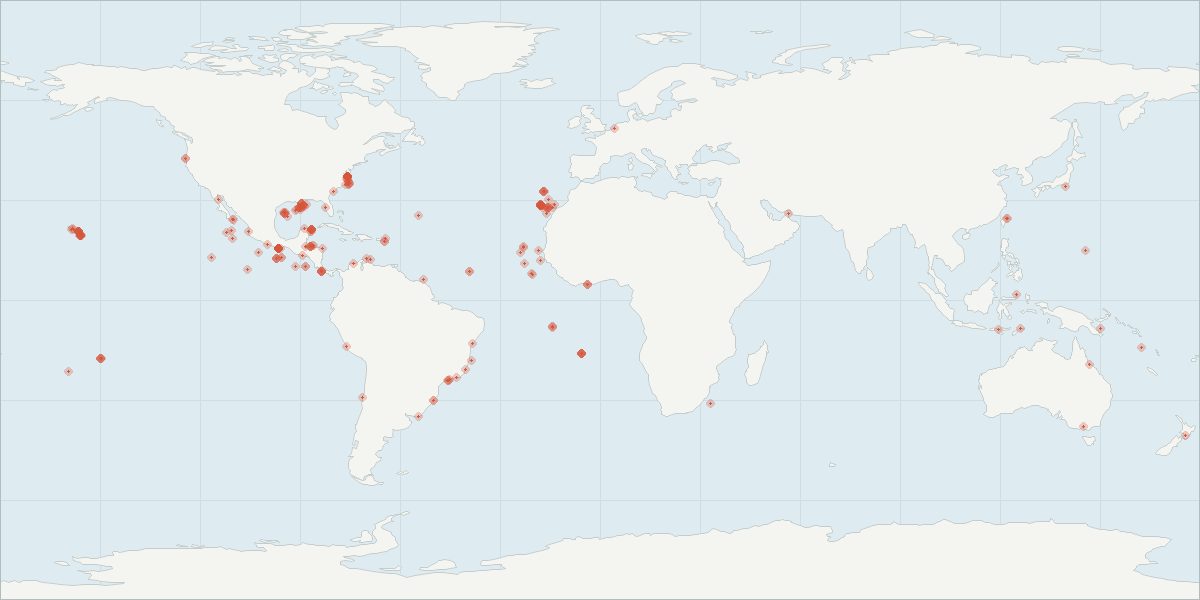
According to the open data of the GBIF, 246 georeferenced sightings of Steno bredanensis are recorded in our photographic index.
| Country | Notes |
|---|---|
| United States of America | 99 |
| Mexico | 40 |
| Spain | 24 |
| Brazil | 13 |
| Saint Helena, Ascension and Tristan da Cunha | 11 |
| unknown or invalid | 9 |
| Honduras | 8 |
| Colombia | 7 |
| French Polynesia | 7 |
| Costa Rica | 6 |

Monthly distribution of 265 dated sightings (all years combined): the maximum is reached in juillet.
| Month | Notes |
|---|---|
| janvier | 19 |
| February | 26 |
| mars | 28 |
| avril | 14 |
| mai | 24 |
| juin | 22 |
| juillet | 34 |
| August | 24 |
| septembre | 20 |
| octobre | 34 |
| novembre | 8 |
| December | 12 |
These figures reflect survey effort (more boaters and more surveys in summer) as much as the actual presence of the species: to be interpreted with caution.


Photographs from GBIF under a Creative Commons licence. The author and the licence of each photograph are given; please respect them if you reuse them.
Automatic selection of the most cited works mentioning the species (source: Crossref).