| Scientific name | Pseudorca crassidens (Owen, 1846) |
|---|---|
| Other names | False killer whale; French: faux-orque, fausse orque, faux épaulard, pseudorque à dents épaisses; Spanish: Orca falsa |
| Size | Females 4 to 5.4 m; males up to about 6 m (extremes reported at 6.1 m); newborns 1.5 to 2.1 m |
| Weight | 700 to 2,200 kg depending on the source: females commonly a little over 1,100 kg, large males up to about 2,200 kg |
| Longevity | Up to 63 years in females and 58 years in males; menopause observed between 44 and 55 years; generation length estimated at 25 years |
| Diet | Large pelagic fish (dolphinfish/mahi-mahi, yellowfin tuna, skipjack tuna, albacore, wahoo, opah, pomfrets, swordfish, sailfish) and cephalopods; occasionally small injured dolphins |
| IUCN status | Near Threatened (NT), criteria version 3.1. Global assessment dated 23 July 2018, published in 2018 (errata version published in 2019, e.T18596A145357488). Global population trend: unknown. Earlier assessments: Data Deficient (DD) in 2008, Lower Risk/least concern in 1996. The insular population of the main Hawaiian Islands has been listed as “endangered” under the United States Endangered Species Act since 28 November 2012 and as “depleted” under the Marine Mammal Protection Act. |
The false killer whale (Pseudorca crassidens) is a large, entirely dark delphinid with a slender body and a rounded, beakless head, which frequents the deep tropical to warm temperate waters of the three oceans. A top predator specialising in large pelagic fish, it lives in very close-knit and lasting groups within which prey sharing is frequent. Listed as Near Threatened (NT) by the IUCN, it is chiefly threatened by bycatch in hook-and-line fisheries, whose catches it readily plunders.
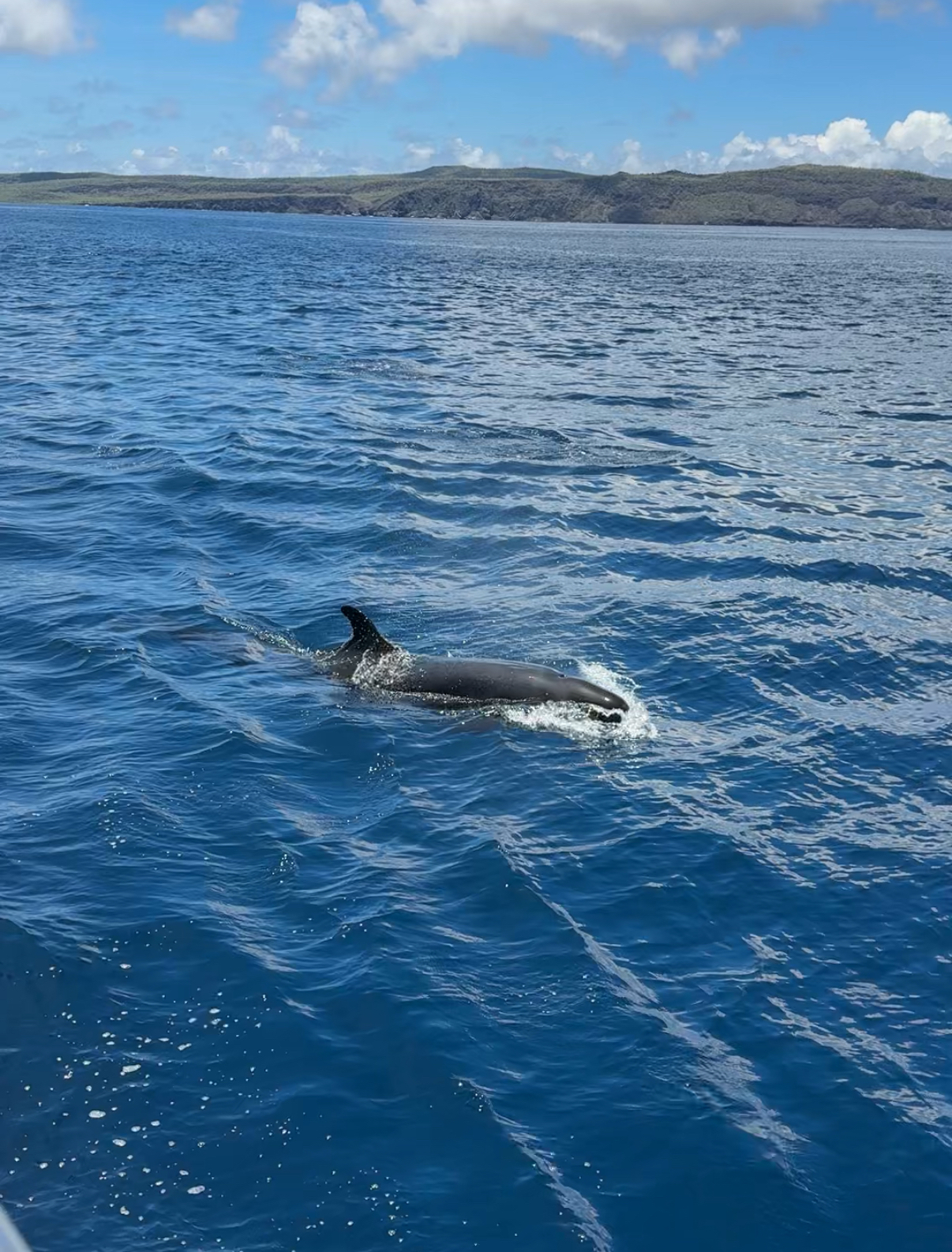
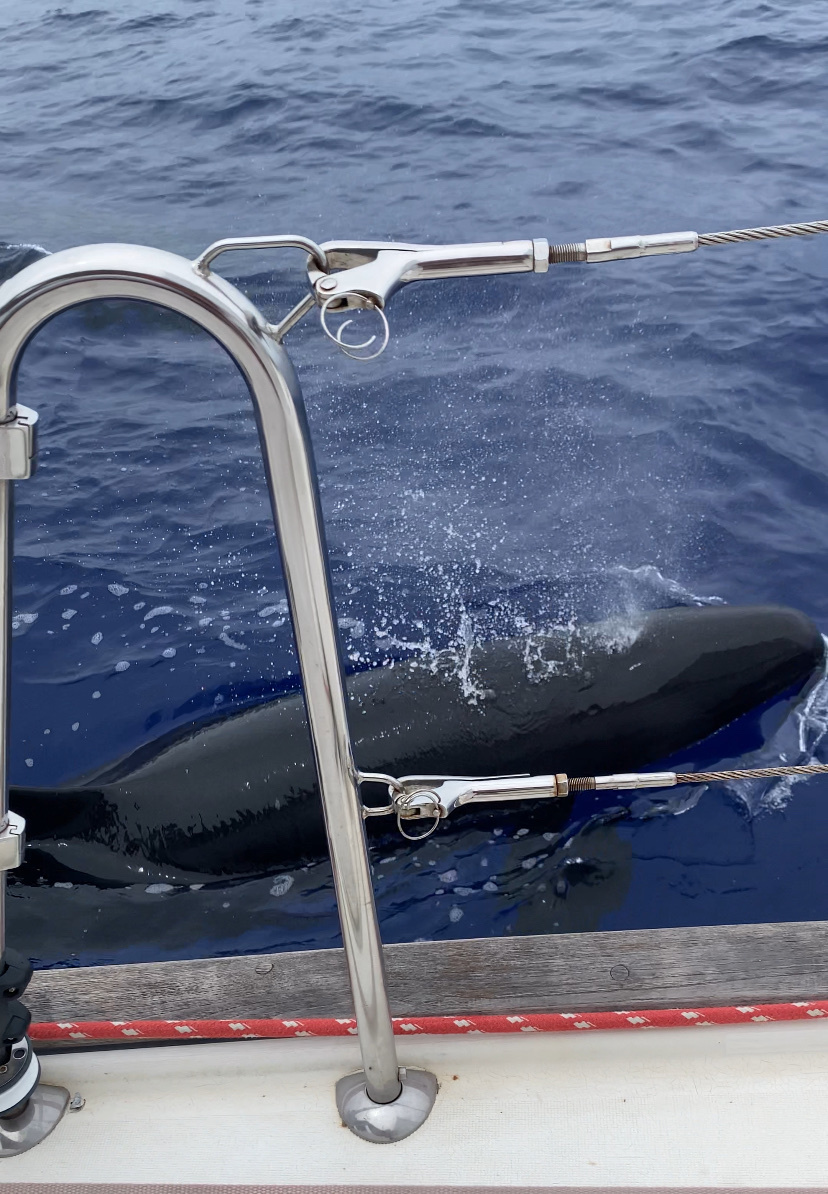
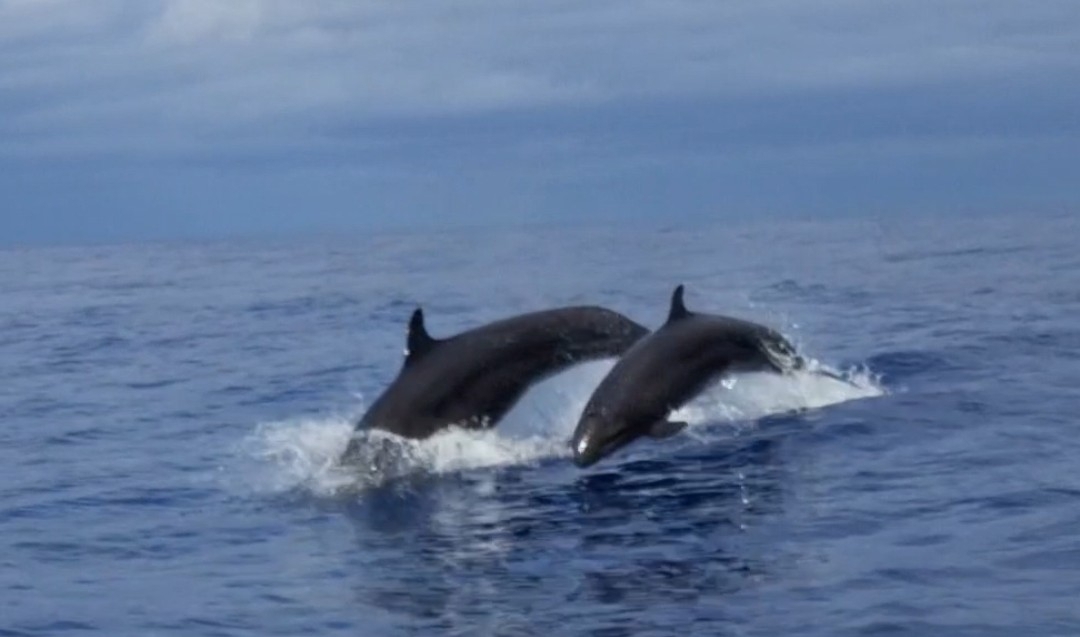
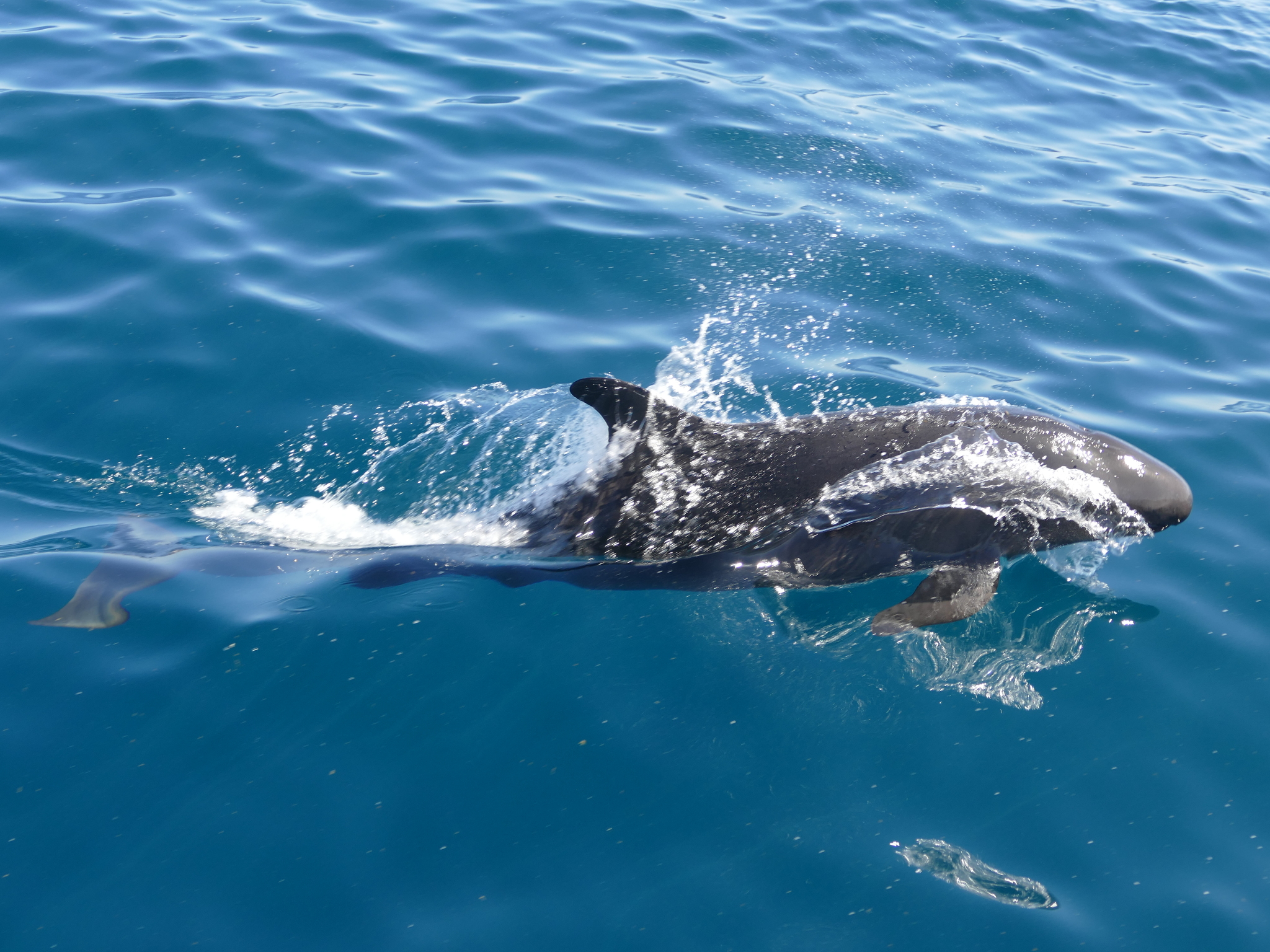
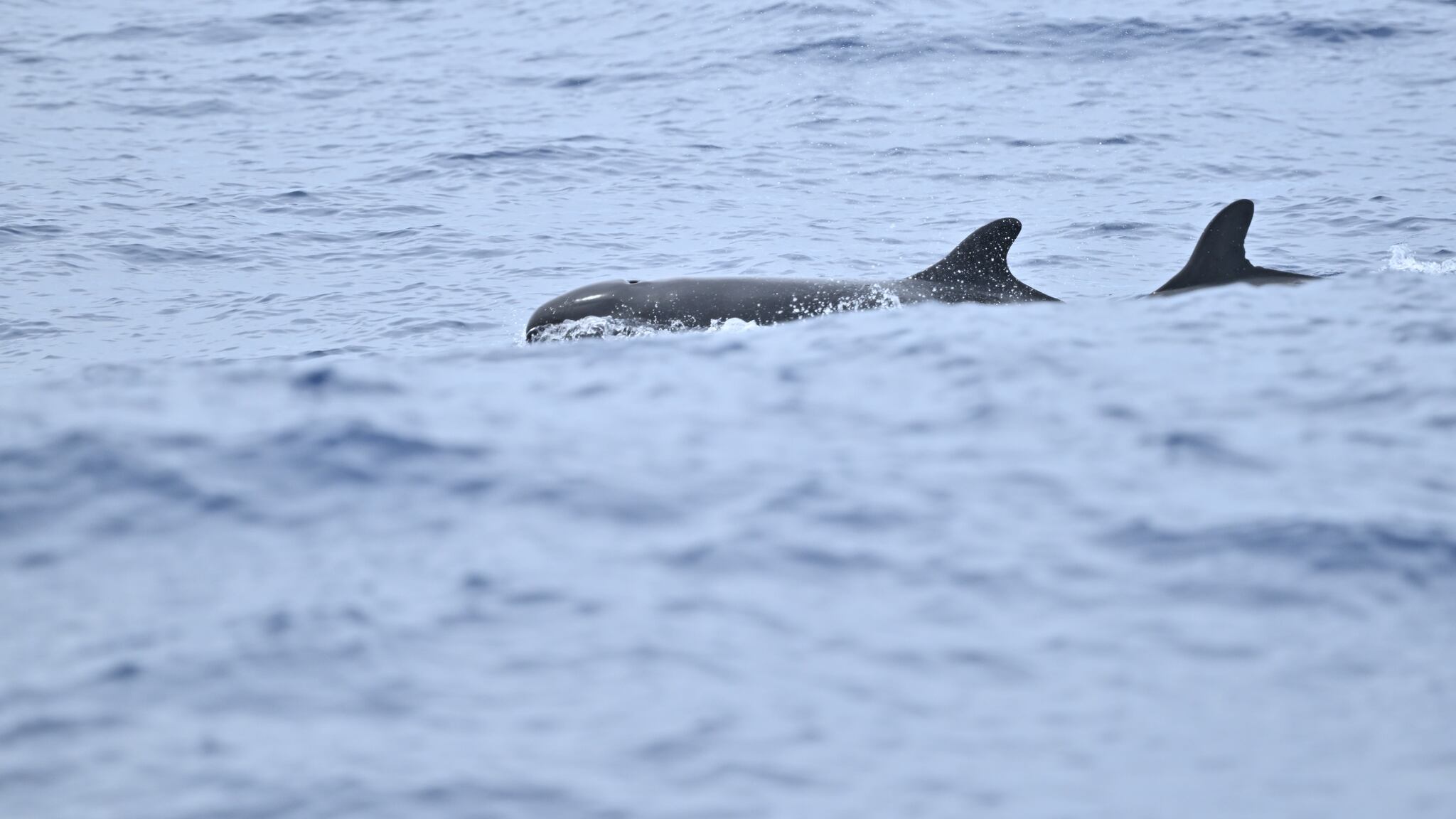
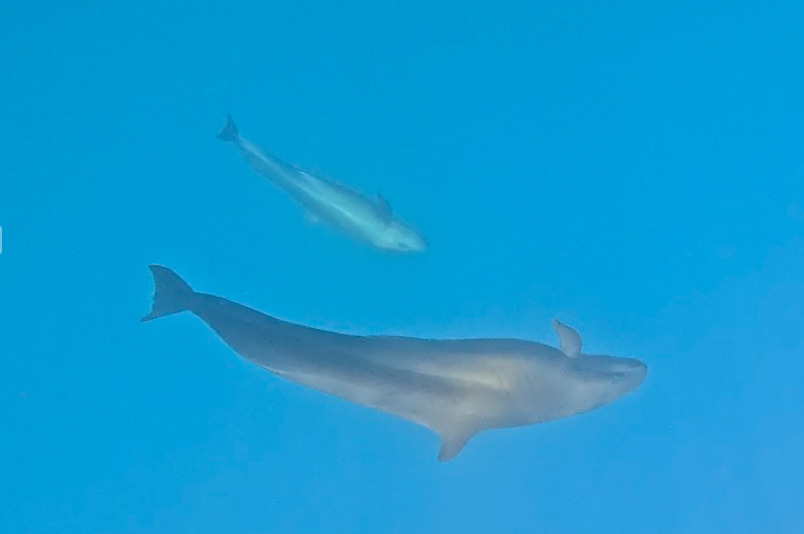
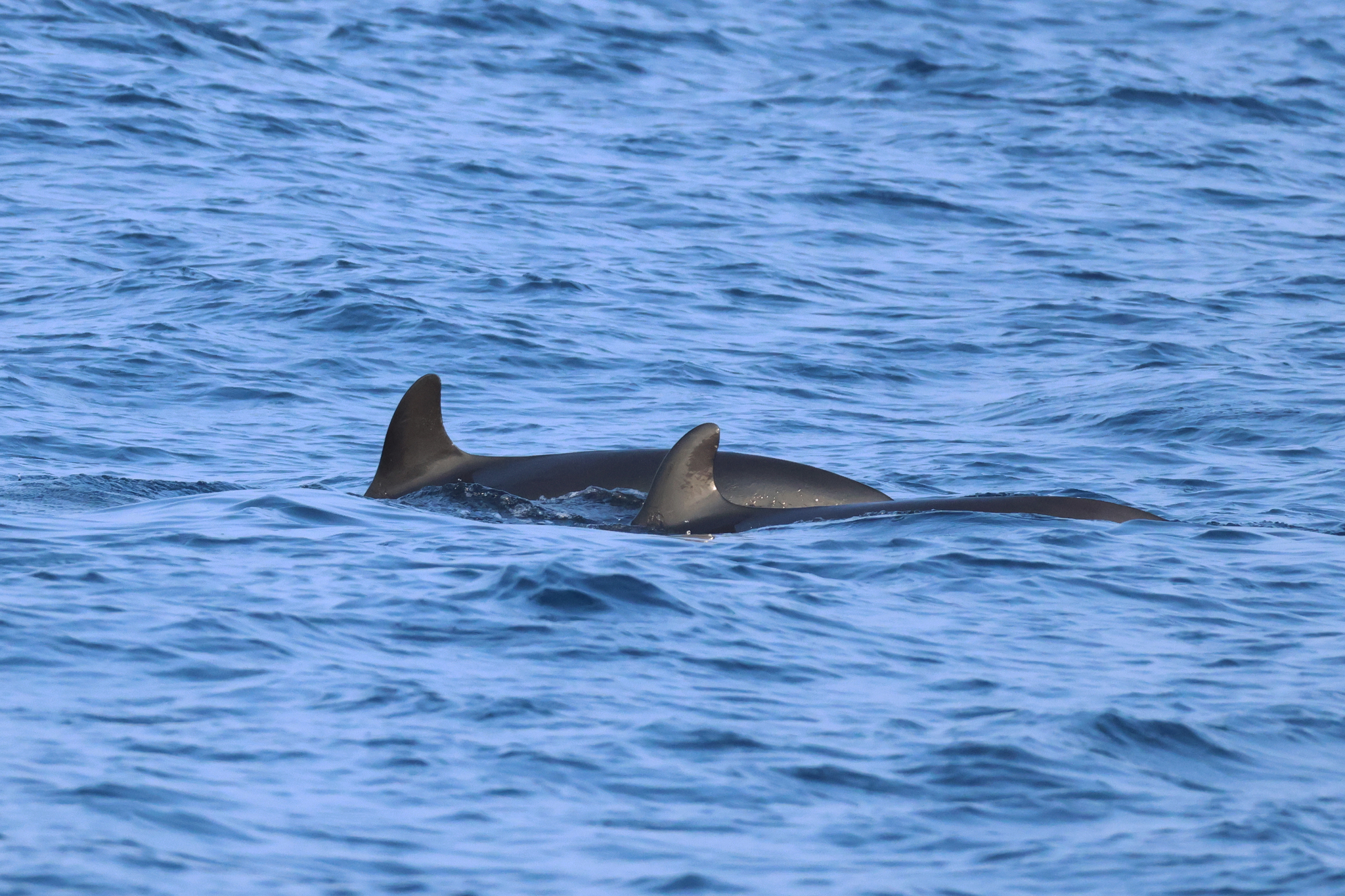
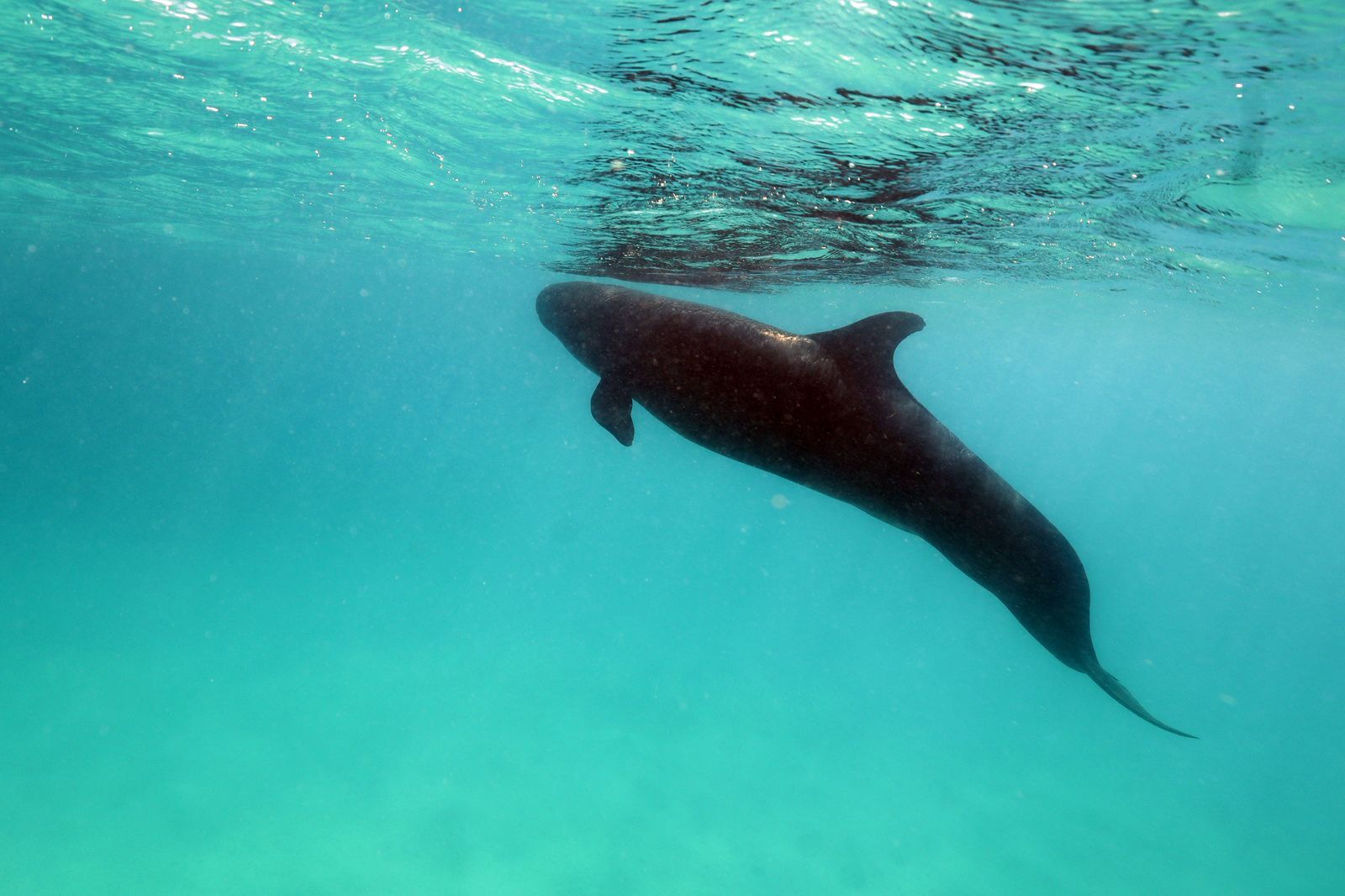
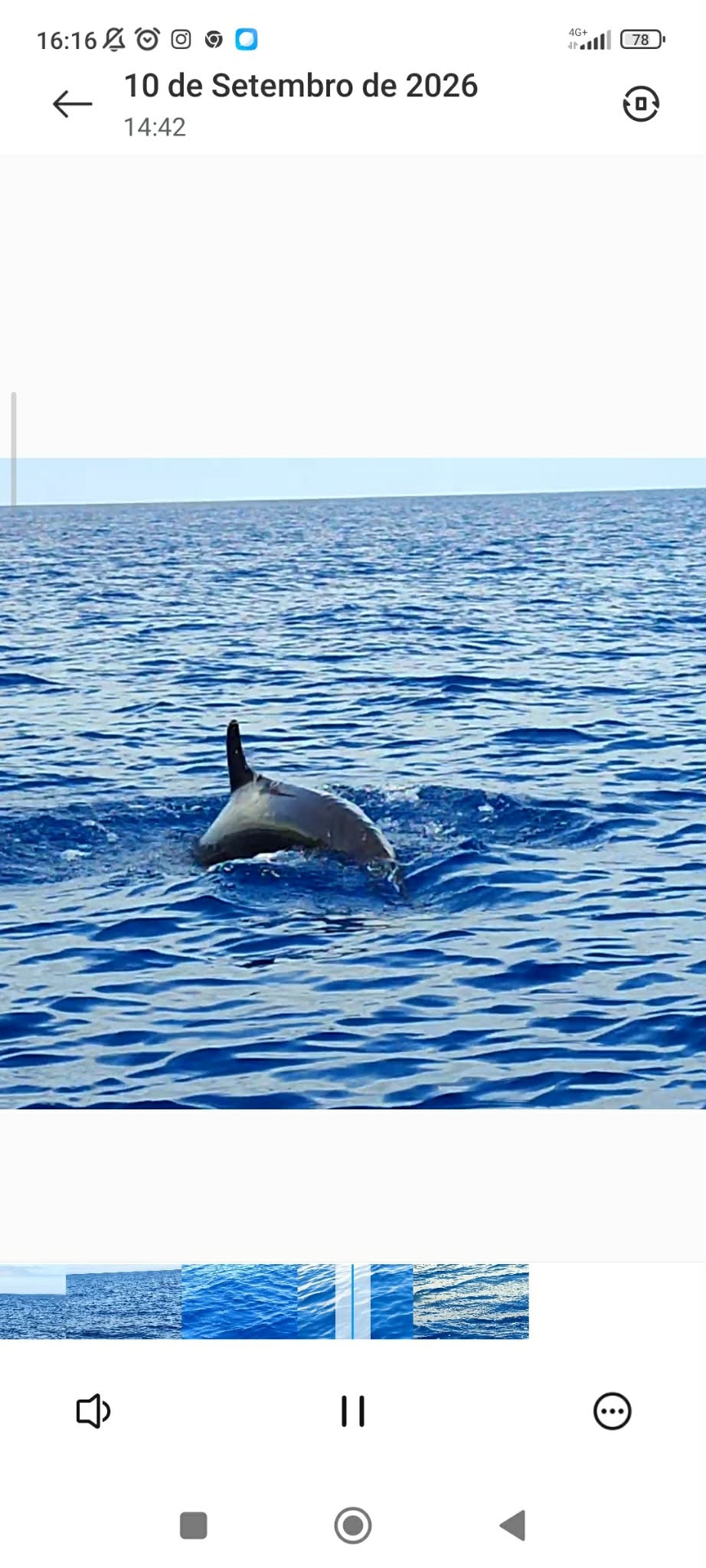
The false killer whale is a large oceanic dolphin with a long, slim, cylindrical body, entirely black or very dark grey, sometimes lightened by a paler greyish patch on the chest, between the flippers. The head is conical and rounded, with a well-developed melon and no marked beak; the line of the mouth slopes distinctly upwards. The falcate dorsal fin is set at the middle of the back or slightly behind it. Females most often measure 4 to 5.4 m, males up to about 6 m; adults weigh from a few hundred kilograms to more than two tonnes in the largest males. It is one of the largest delphinids, exceeded only by the killer whale and the pilot whales.
The most diagnostic feature lies in the flippers: long, narrow and set far forward, they show a marked bend on their leading edge that gives them a characteristic S-shaped outline, unique among cetaceans. The jaw is powerful and armed with massive conical teeth, seven to eleven per half-jaw, some forty in all, about 8 cm high and 1.5 to 2.5 cm thick; it is this dental robustness that earned the species its epithet crassidens, “thick teeth”. The circular scars left by cookiecutter sharks and the notches in the dorsal fins allow researchers to identify animals individually by photo-identification.
Several species invite confusion. The trickiest are two small delphinids that are also entirely dark and beakless: the melon-headed whale (Peponocephala electra) and the pygmy killer whale (Feresa attenuata), which scarcely exceed 2.7 m; in them the head is shorter and the flippers lack the S-shaped bend, and adult size is half as great. The pilot whale has a far more bulbous head and a broad, low dorsal fin set distinctly further forward. The killer whale is a problem only for immature females seen at a distance: its contrasting black and white pattern and its much taller dorsal fin dispel the doubt. Risso’s dolphin has a markedly taller dorsal fin, a squarer head and a body covered with pale scars that fade with age, whereas the false killer whale stays uniformly dark. At a distance, the false killer whale’s very fast, energetic swimming, its frequent breaches landing on its side and its liking for ships’ bows also help in recognising it.
The false killer whale belongs to the family Delphinidae (order Cetartiodactyla) and is the only living representative of the genus Pseudorca. Richard Owen described it in 1846 under the name Phocaena crassidens from a subfossil skull, which explains why the species was first known as an extinct form before being observed alive. Its common name comes from the resemblance of its skull to that of the killer whale, Orcinus orca, of which it is nonetheless not the closest relative.
No subspecies is currently recognised. There is nevertheless geographical variability in cranial morphology and in life history traits, and above all a marked genetic structuring, between ocean basins as well as within a single basin, and even within a single archipelago. In Hawaii, combining genetic analyses, satellite tracking and photo-identification has made it possible to distinguish three subpopulations: two partially overlapping insular populations (main islands and north-western islands) and a pelagic population that extends well beyond the exclusive economic zone. A distinct subpopulation is also likely in New Zealand. The actual number of subpopulations worldwide remains unknown, for want of sampling over most of the range.
In captivity, the false killer whale has bred with the common bottlenose dolphin (Tursiops truncatus) to produce fertile hybrids nicknamed “wholphins”, a few of which live at Sea Life Park in Hawaii.
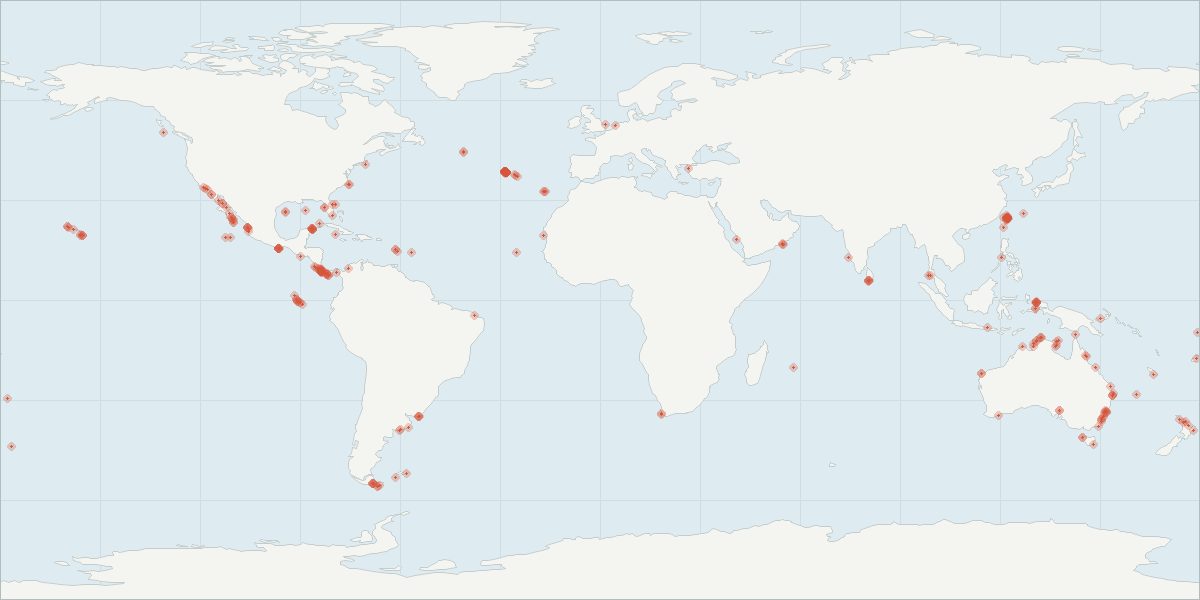
The false killer whale occupies the tropical, subtropical and warm temperate waters of the Atlantic, the Pacific and the Indian Ocean. Essentially pelagic, it usually stays offshore over deep bottoms, but comes close to the coast around oceanic islands. It rarely goes beyond 50° of latitude in either hemisphere and its densities are highest in the tropics: in the north-eastern Pacific they fall by an order of magnitude north of about 15°N. It occurs in several semi-enclosed seas, the Sea of Japan, the Yellow Sea and the Gulf of Bohai, the Timor Sea, the Arafura Sea, the Red Sea and the Persian Gulf, while the few records from the Baltic Sea are regarded as extralimital.
The species is nowhere abundant and is among the least numerous delphinids, even in its areas of highest density. The sum of the available estimates reached 59,157 individuals at the time of the 2018 assessment, but the two largest, 38,900 animals in the eastern tropical Pacific (1986-1991 surveys) and 16,668 in the north-western Pacific (1983-1991), were already more than twenty-five years old; the true global population in all likelihood exceeds 60,000 animals. Elsewhere the estimates are far more modest: 777 individuals in the Gulf of Mexico (2003-2004), 442 in United States waters of the north-western Atlantic (2011), 111 off New Zealand (photo-identification, 2005-2012).
In France the false killer whale is a protected species and the Office français de la biodiversité reports it in most national maritime areas. The situation differs greatly from one seaboard to another. In mainland France it remains rare along the European Atlantic coasts and is only an occasional visitor to the western Mediterranean, where a few strandings have been recorded in Spain, France and Italy; across the whole Mediterranean basin, only nine sightings and eight strandings were reported between 1988 and 2013. It is in the overseas territories that the species is most regular: it is seen in the Agoa sanctuary in the French Antilles, off Réunion, where it often accompanies common bottlenose dolphins, and also at Mayotte, in French Polynesia and in New Caledonia. The Réseau national échouages, the national stranding network run by Observatoire Pelagis, has recorded more than 25 stranded false killer whales in the French overseas territories between 1990 and 2019.
The false killer whale is a high trophic level predator that feeds mainly on large pelagic fish and cephalopods: dolphinfish, yellowfin tuna, skipjack tuna, albacore, wahoo, opah, pomfrets, swordfish and sailfish are among its documented prey. In Hawaii, direct observations indicate that large gamefish, dolphinfish, tunas and istiophorid billfishes, make up the bulk of the diet. This specialisation sets it apart from most cetaceans of the same distribution, which instead exploit small mesopelagic fish, and places it in direct competition with the most lucrative fisheries. It does sometimes attack and eat small dolphins that have been injured or disorientated on release from tuna purse seines, behaviour which probably reflects opportunism rather than a preference for marine mammals.
Its dives can last up to 18 minutes; it takes its prey at high speed, typically between 300 and 500 m deep. The insular animals of Hawaii exploit bottoms of less than 100 m as readily as areas 4,700 m deep.
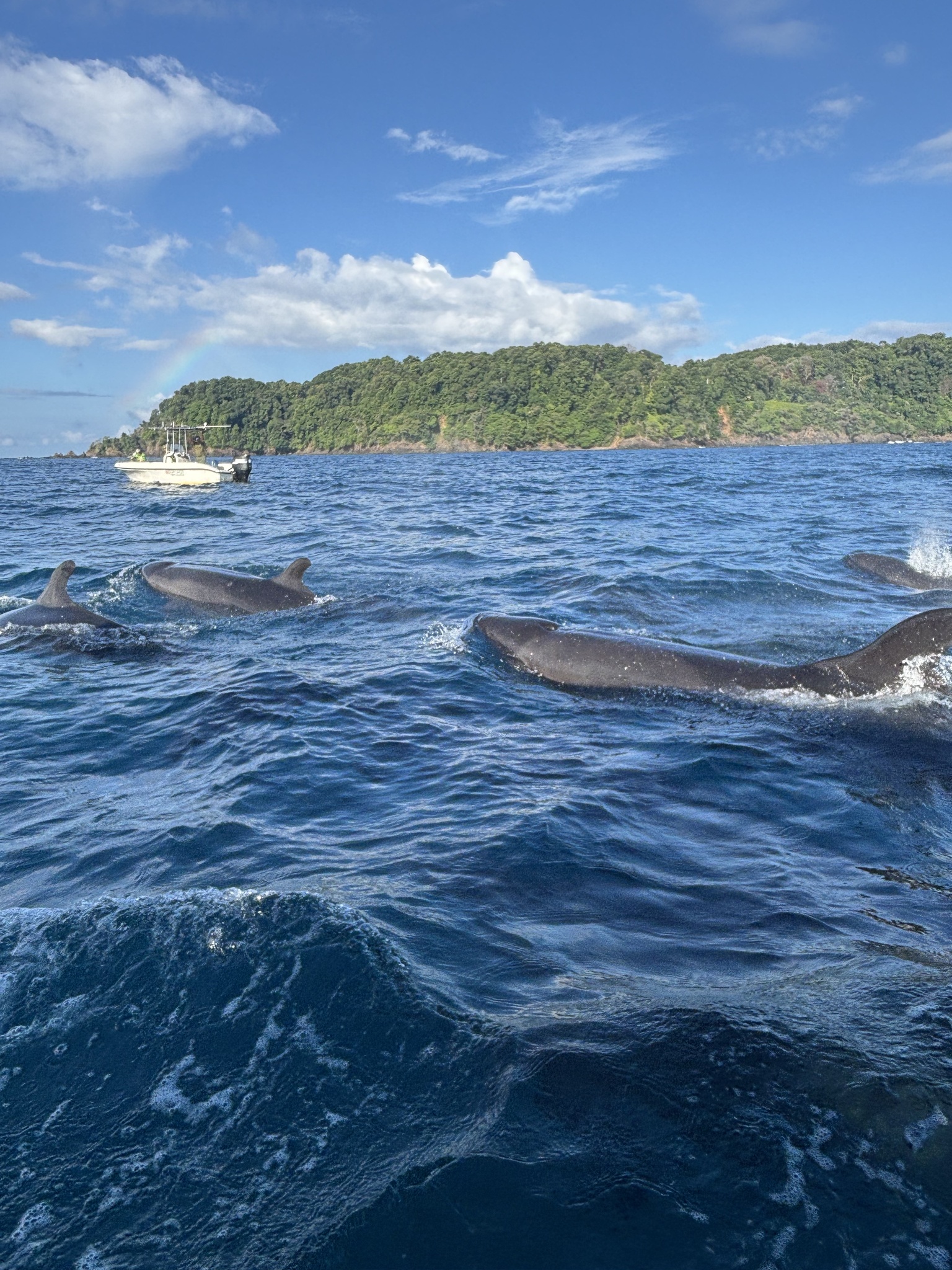
Social life is remarkably structured. False killer whales form very close-knit groups of ten to about sixty individuals, often split into subgroups spread over several kilometres, which can gather into aggregations of several hundred animals. Photo-identification has demonstrated the long-term stability of these bonds: the insular population of the main Hawaiian Islands falls into four large social clusters and shows site fidelity established since the mid-1980s. Hunting is cooperative and prey sharing frequent, several individuals converging on a captured fish, and cases of sharing with human divers have been reported.
Reproduction is slow. Females reach sexual maturity at around 8 to 11 years; in males the data are scarcer and far more variable, puberty being estimated at between about 10 and 18 years depending on the population (10.5 to 18.5 years in Japan, 5.25 to 17.5 years in South Africa). Gestation lasts 11 to 16 months and produces a single calf of 1.5 to 2.1 m, suckled for a year and a half to two years. The interval between two births is long, of the order of seven years according to the available estimates. Rarely among mammals, females undergo menopause between 44 and 55 years, while longevity reaches 63 years. This life history, combined with a generation length estimated at 25 years, makes populations very sensitive to additional mortality, even at low levels.
The species is also one of those that strand en masse: the largest documented mass stranding of false killer whales involved 835 individuals in Argentina in 1946, one of the largest cetacean strandings ever reported. The strong cohesion of the groups probably explains these events, which are liable to reduce a local population for a long time.
The IUCN has listed the false killer whale as “Near Threatened” (NT) since the global assessment of 23 July 2018, which replaced the “Data Deficient” status assigned in 2008. The global trend remains unknown: low densities make estimates imprecise and rule out reliable monitoring in most sectors. The species was judged close to the threshold of the “Vulnerable” category under criterion A2d, without the data allowing that threshold to be crossed.
The main threat is bycatch. Attracted by the catches and baits of longlines, false killer whales are regularly hooked on them: in the Hawaii deep-set longline fishery, observed at about 20%, they are the most frequently caught cetacean, at a rate of about 1.5 individuals per ten million hooks set. Documented mortality and serious injury there exceeded the potential biological removal level in ten of the twelve years from 2003 to 2015. Rates more than fifteen times higher have been recorded on Spanish longliners in the Azores. The species was also the cetacean most often killed by the western and central Pacific purse seine fishery in 2009, with an estimated mortality of 281 animals, and catches are documented in the gillnets of about ten countries.
Directed hunts have weighed heavily at local level. In Japan, 2,643 false killer whales were reported killed between 1972 and 2008, including 637 in 1978 alone, about 31% of the estimated coastal population. Opportunistic takes still occur in Indonesia and the Antilles, and deliberate shooting in response to depredation is reported in Hawaii as in the Indian Ocean. To these are added the scarcity of large predatory fish, contamination by persistent organic pollutants, all the adult males sampled in the insular population of Hawaii exceed the PCB thresholds associated with immunosuppression, and plastic ingestion.
The Hawaiian case accounts for most of the management measures. The insular population of the main islands, the only one for which a trend is monitored, has lost more than half its numbers in less than two generations; it was estimated at 139 individuals in 2022, with an average decline of 1.1% per year since 1999 and of 3.5% per year over the last decade. It has been listed as “endangered” under the Endangered Species Act since 28 November 2012, critical habitat was designated on 24 July 2018 between the 45 m and 3,200 m isobaths, and a take reduction plan has required since 2013 the use of “weak” circle hooks and strengthened leaders intended to let the animals free themselves.
Internationally, the false killer whale is listed in Appendix II of CITES and is covered by the Convention on Migratory Species as well as by the ACCOBAMS agreement in the Mediterranean. In France it holds protected species status: capture, destruction, transport and intentional disturbance are prohibited, offences being punishable by a fine of €150,000 and three years’ imprisonment.
An offshore species, the false killer whale is rarely seen from the coast. The best chances are around oceanic islands, where it comes close to deep slopes: Hawaii, Réunion, the French Antilles within the Agoa sanctuary, French Polynesia and New Caledonia. In mainland France, an encounter is an exceptional event.
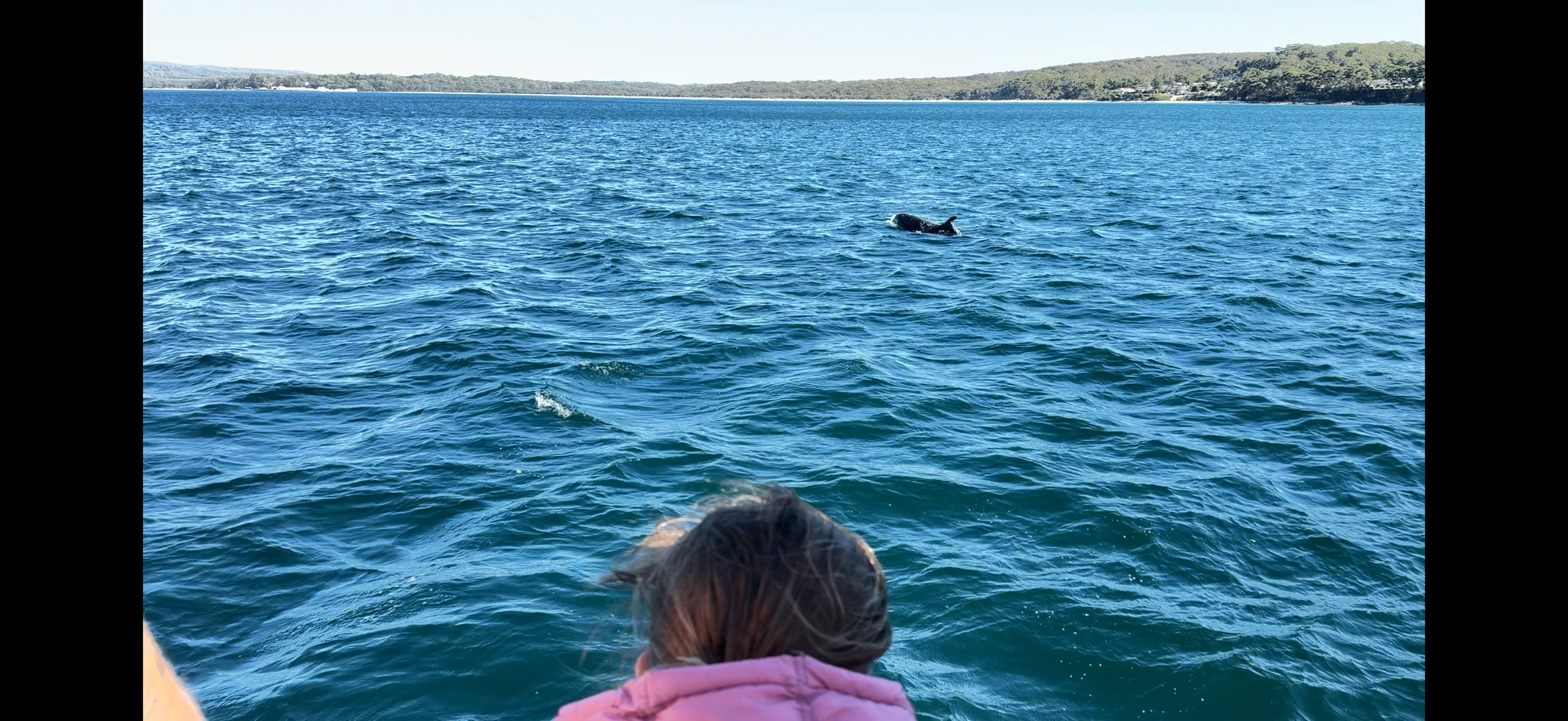
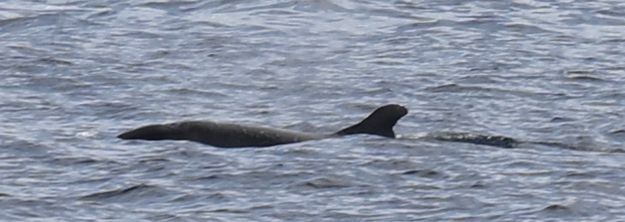
On the water, a group gives itself away by fast, energetic swimming, frequent breaches landing on the side, and genuine curiosity towards vessels: the animals readily come to ride the bow wave. One has to look wide, because a single group may be split into subgroups of one to a few individuals spread over several kilometres, and the dark falcate dorsal fin, seen in isolation, is easily confused with that of a pilot whale or a melon-headed whale. A false killer whale holding a large fish crosswise in its mouth, head out of the water, is on the other hand a very characteristic image of the species.
The approach should remain cautious and respectful. Accepted good practice is to approach from behind and to the side, at a constant and reduced speed, never cutting across the path of the group or splitting it, keeping a distance of about a hundred metres, limiting the length of the observation and moving away at the first sign of avoidance. Putting swimmers in the water and feeding are to be avoided: besides the disturbance, they encourage habituation to fishing boats and hence depredation, which lies behind the main cause of mortality in the species. In France, intentional disturbance of a cetacean is an offence. Any stranded animal, alive or dead, must be reported to the Réseau national échouages coordinated by Observatoire Pelagis, without being handled.
No. Both belong to the family Delphinidae, but the false killer whale is the only living representative of the genus Pseudorca and is not the killer whale’s closest relative. Its name comes solely from the resemblance of its skull to that of Orcinus orca, noted by Richard Owen when he described the species in 1846 from a subfossil skull. In the field, confusion is unlikely: the false killer whale is uniformly black, with no white markings, smaller and far more slender.
Chiefly two small delphinids that are also entirely dark and beakless: the melon-headed whale (Peponocephala electra) and the pygmy killer whale (Feresa attenuata). Both rarely exceed 2.7 m, about half the size of an adult false killer whale, and their flippers lack the S-shaped bend that marks the species. The pilot whale, with its more bulbous head and its broad, low dorsal fin set well forward, and Risso’s dolphin, paler and covered with scars, are more easily told apart.
Yes, but mainly in the overseas territories. The species is reported in the Agoa sanctuary in the French Antilles, off Réunion, at Mayotte, in French Polynesia and in New Caledonia; the Réseau national échouages has recorded more than 25 stranded individuals in the overseas territories between 1990 and 2019. In mainland France, the false killer whale remains rare along the Atlantic coasts and is only an occasional visitor to the western Mediterranean, where only a few strandings have been recorded.
It is listed as “Near Threatened” (NT) on the global IUCN Red List, a status arising from the assessment of 23 July 2018 which succeeded the “Data Deficient” classification of 2008. The global trend is unknown. The insular population of the main Hawaiian Islands, the only one whose change over time has been quantified, has been listed as “endangered” under the United States Endangered Species Act since November 2012: it was estimated at 139 individuals in 2022 and has been declining by about 3.5% per year over the past ten years.
The social cohesion of the groups is implicated: the bonds between individuals are so strong that the stranding of a sick or disorientated animal can draw in all its companions. The false killer whale is among the species most affected: the largest mass stranding ever documented for the species involved 835 individuals in Argentina in 1946, one of the largest cetacean strandings known, the record across all species remaining attributed to about a thousand pilot whales in the Chatham Islands in 1918. Such events can affect a local population for a long time.
It does happen, but remains marginal. False killer whales have been seen attacking and eating small dolphins that were injured or disorientated as they were released from tuna purse seines. Specialists interpret this behaviour as the opportunistic exploitation of an easy resource rather than as true predation on marine mammals: the diet of the species consists very largely of large pelagic fish and cephalopods.
Females reach sexual maturity at around 8 to 11 years. In males the available samples are much smaller and the ages widely scattered: puberty is thought to lie between about 10 and 18 years, with estimates of 10.5 to 18.5 years in Japan and 5.25 to 17.5 years in South Africa. In both sexes reproduction is slow: a single calf about every seven years, for a generation length estimated at 25 years.
It is the nickname given to hybrids born in captivity from a cross between a false killer whale and a common bottlenose dolphin (Tursiops truncatus). A few individuals live at Sea Life Park in Hawaii, and one of them proved fertile. These hybrids remain a captivity phenomenon and have no known bearing on the biology of wild populations.
Profile compiled from authoritative scientific sources (IUCN, NOAA Fisheries, specialist literature) and reviewed for factual accuracy.
According to the open data of the GBIF, 273 georeferenced sightings of Pseudorca crassidens are recorded in our photographic index.
| Country | Notes |
|---|---|
| Australia | 49 |
| United Kingdom of Great Britain and Northern Ireland | 44 |
| Portugal | 38 |
| Mexico | 38 |
| United States of America | 31 |
| Costa Rica | 20 |
| Chinese Taipei | 19 |
| Indonesia | 12 |
| Ecuador | 9 |
| Panama | 8 |

Monthly distribution of 300 dated sightings (all years combined): the maximum is reached in septembre.
| Month | Notes |
|---|---|
| janvier | 27 |
| February | 18 |
| mars | 25 |
| avril | 31 |
| mai | 17 |
| juin | 27 |
| juillet | 29 |
| August | 26 |
| septembre | 38 |
| octobre | 28 |
| novembre | 10 |
| December | 24 |
These figures reflect survey effort (more boaters and more surveys in summer) as much as the actual presence of the species: to be interpreted with caution.


Photographs from GBIF under a Creative Commons licence. The author and the licence of each photograph are given; please respect them if you reuse them.
Automatic selection of the most cited works mentioning the species (source: Crossref).