| Scientific name | Mesoplodon eueu Carroll, McGowen, McCarthy, Marx, Aguilar, Dalebout et al., 2021 |
|---|---|
| Other names | Ramari’s beaked whale, Maori beaked whale (English); mésoplodon de Ramari, baleine à bec de Ramari (French); Zifio de Ramari (Spanish); Baleia-bicuda-de-Ramari, baleia-bicuda-maori (Portuguese); Ramari-Zweizahnwal (German); Mesoplodonte di Ramari (Italian). The type specimen was given the name Nihongore by Te Rūnanga o Makaawhio. |
| Size | About 5 m; adult female holotype of 5.06 m; maximum known length of the order of 5.3 m |
| Weight | Not documented for the species; published values for comparably sized animals of the mirus/eueu complex range between about 1,000 and 1,360 kg |
| Longevity | Unknown: no ageing study has been published for this species |
| Diet | Cephalopods and mesopelagic to bathypelagic fish; the stomach contents of an individual stranded in South Africa held squid of the genus Teuthowenia and unidentified fish remains |
| IUCN status | Data Deficient (DD), assessment published in 2022 by Brownell and Pitman, the first since the species was recognised. No subpopulation is assessed separately. The DD status is still in force in the current version of the Red List (2026-1). |
Ramari’s beaked whale is a medium-sized beaked whale, described only in 2021, which frequents the temperate waters of the southern hemisphere. Long confused with True’s beaked whale (Mesoplodon mirus) of the North Atlantic, it has proved genetically and morphologically distinct from it, the two lineages having diverged in the Early Pleistocene. A deep-water, inconspicuous species known almost exclusively from strandings, it is listed as “Data Deficient” by the IUCN.
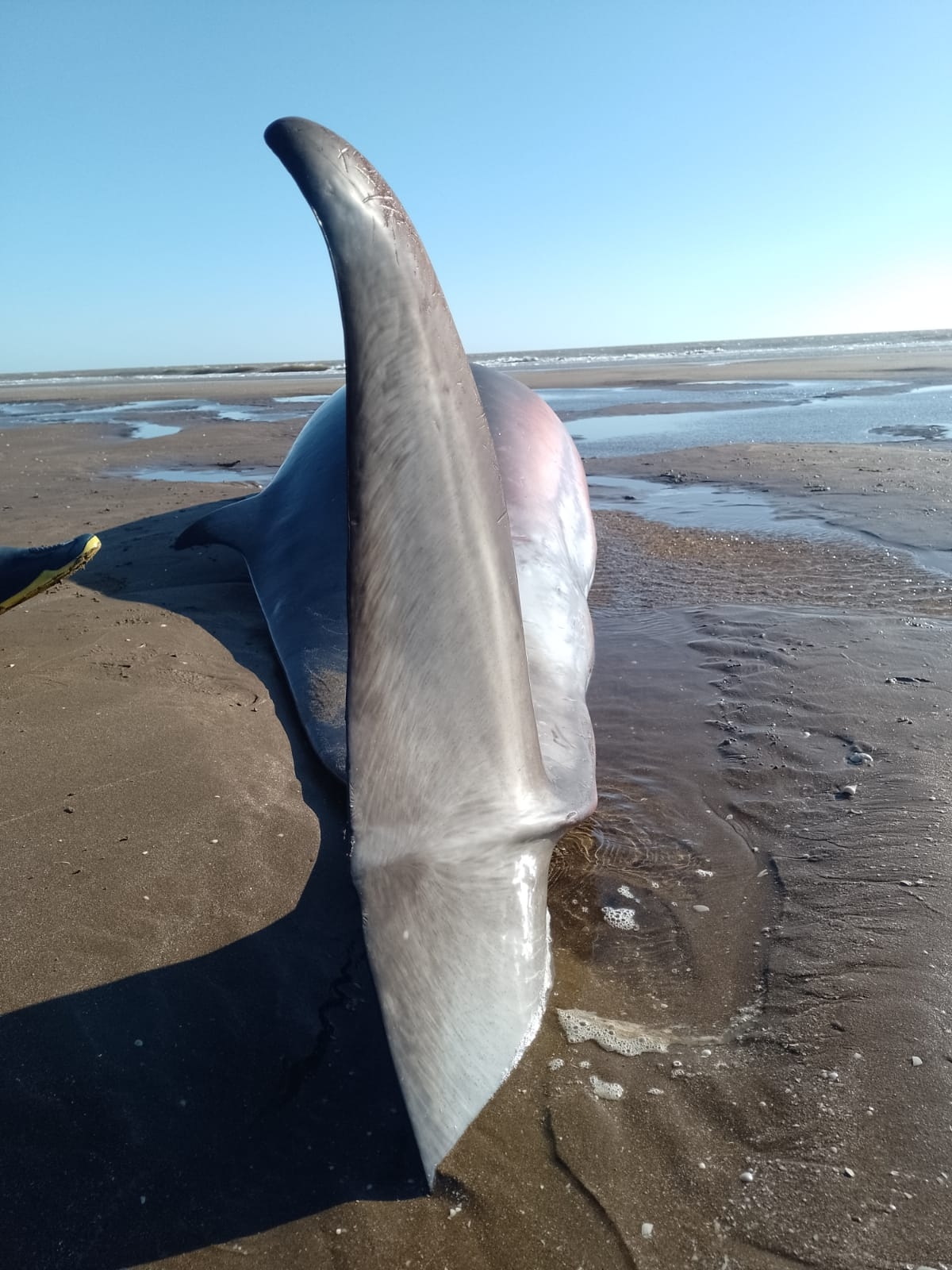
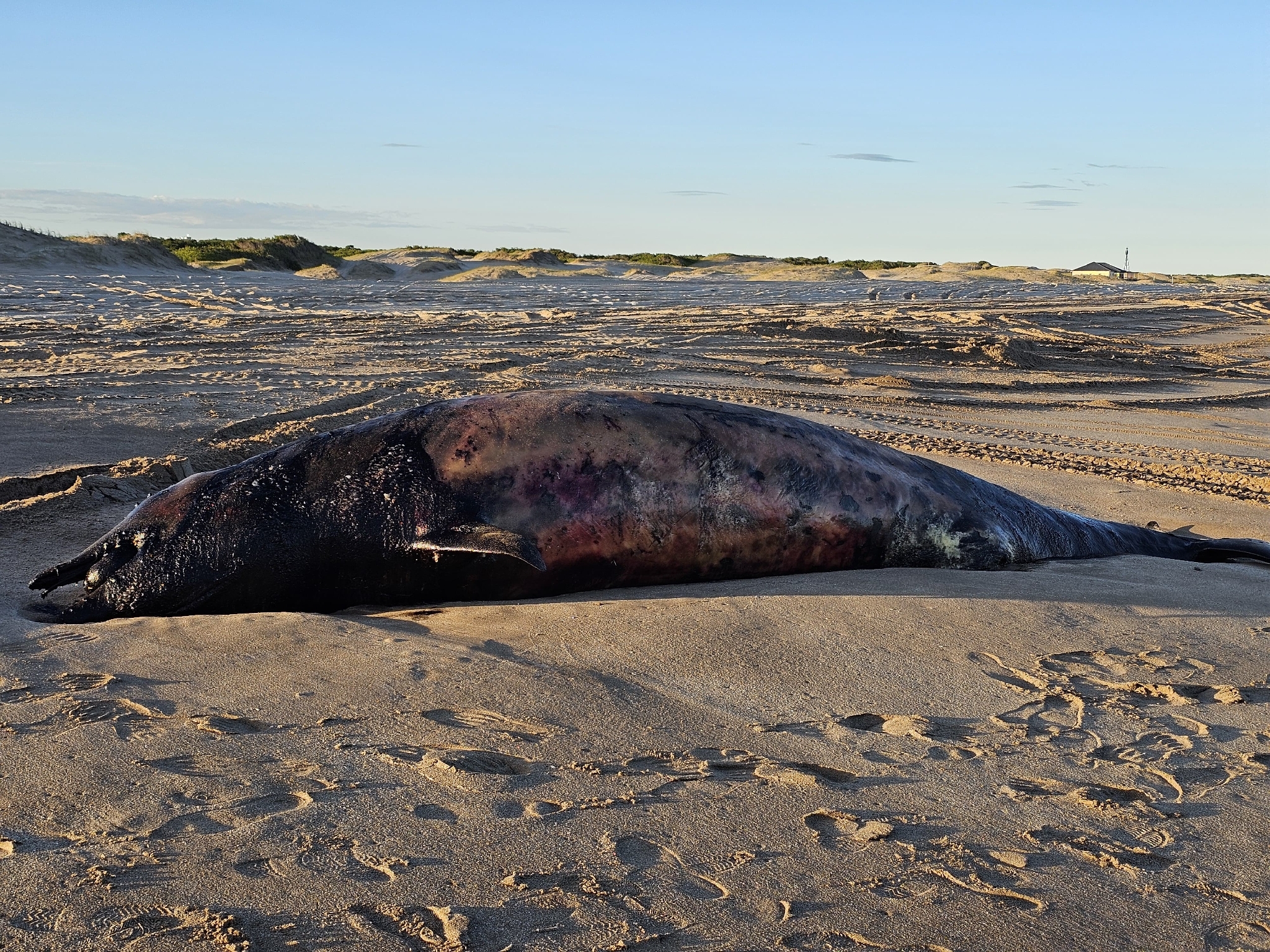
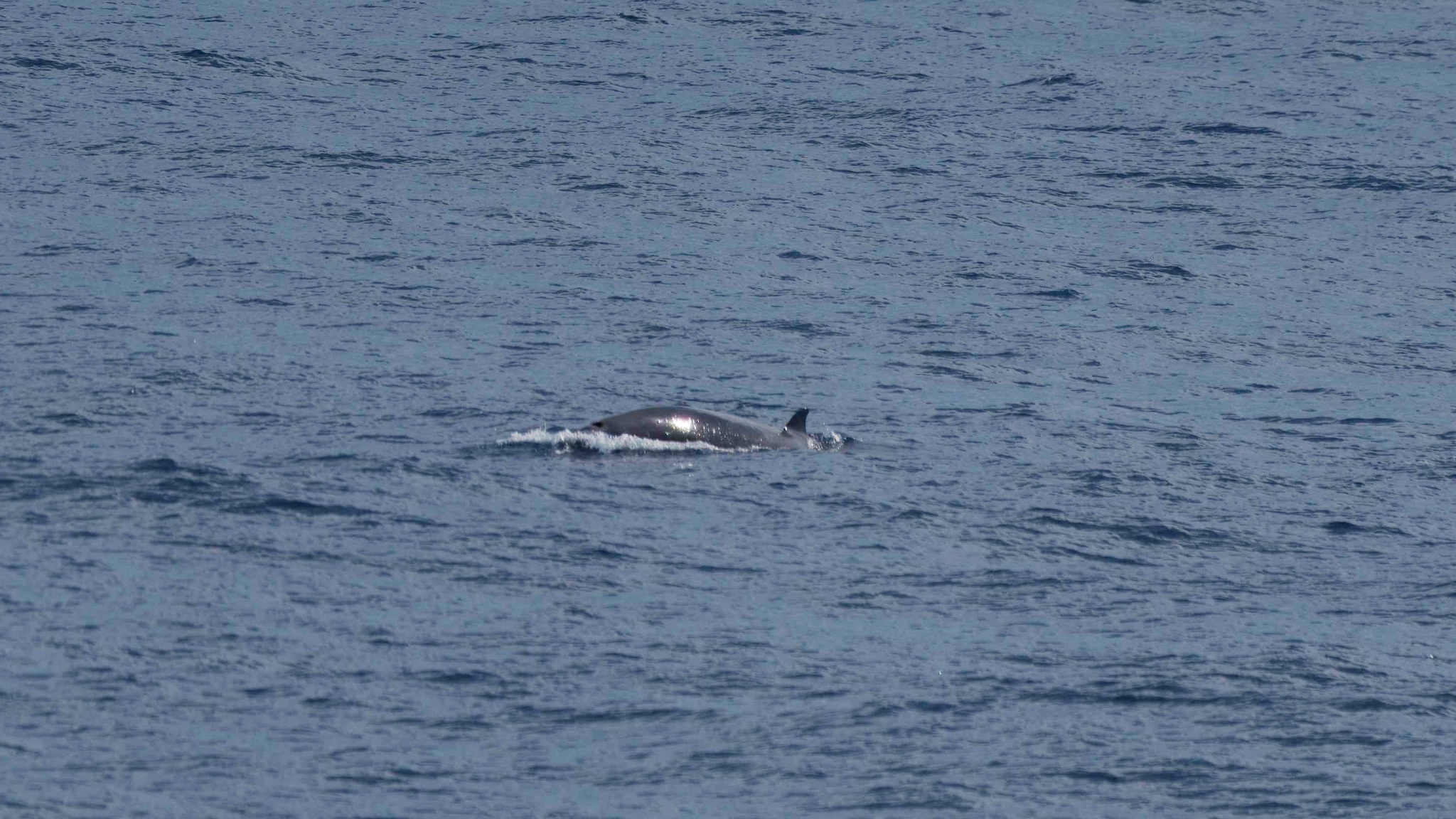
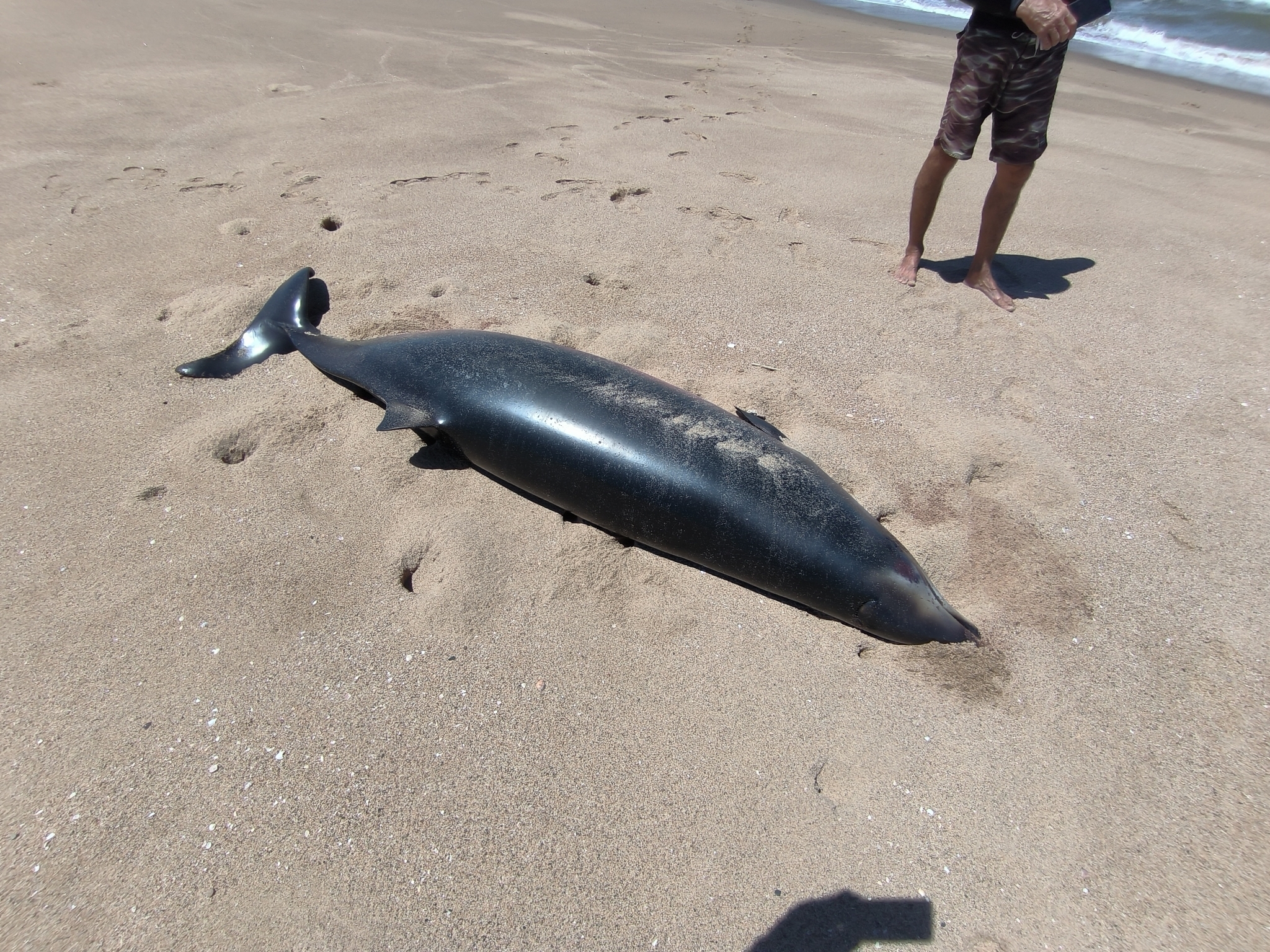
Ramari’s beaked whale has the silhouette typical of the genus Mesoplodon: a spindle-shaped, fairly stocky body tapering markedly towards the tail as well as towards the rostrum, a rounded and well defined melon, a rather straight beak and a short, straight mouthline. The dorsal fin, small and falcate, is set two thirds of the way back along the back. Adults reach about 5 m, the holotype measuring 5.06 m and the maximum known length approaching 5.3 m, which places the species among the largest mesoplodont beaked whales.
The coloration is grey overall, with a dark eye patch. A female stranded in South Africa showed a whitish back extending from the dorsal fin to the tail stock, and several individuals carry the whitish mark on the tail stock as well as numerous circular scars left by cookiecutter sharks (Isistius), a feature common to all mesoplodont beaked whales. As in its congeners, only adult males carry a pair of large tusk-like teeth, here set at the very tip of the lower jaw and erupting through the gum; females and young animals have no visible teeth. Sexual dimorphism can also be read on the skull: males have a greater bizygomatic width (about 359 mm against 347 mm in females) and more advanced ossification of the mesorostral cartilage.
Possible confusions are numerous. Seen at sea, the species cannot be reliably told apart from True’s beaked whale: the authors of the description stress that the external appearances of the two species do not separate consistently, and identification rests on the skull or on genetics. Compared with M. mirus, Ramari’s beaked whale has a shorter rostrum and mandibular symphysis, a broader rostral base and more developed premaxillary crests and premaxillary fossae. Within its range it may also be confused with the other southern mesoplodont beaked whales, whose males are distinguished chiefly by the position and the shape of their tusks.
Mesoplodon eueu belongs to the beaked whale family, known as Ziphiidae or as Hyperoodontidae depending on the classification, and to the subfamily Hyperoodontinae. The genus Mesoplodon is the richest in species of all cetaceans.
The species was formally described in 2021 in the Proceedings of the Royal Society B by an international team led by Emma Carroll, combining genomics and morphometrics. The holotype, catalogued as NMNZ MM003000, is a pregnant adult female of 5.06 m collected on 27 November 2011 at Waiatoto Spit, in the South Westland of the South Island of Aotearoa New Zealand (43°59′18″ S, 168°47′19″ E). Its skeleton and that of its foetus are held at the Museum of New Zealand Te Papa Tongarewa, in Wellington, the tissue samples being deposited at the New Zealand Cetacean Tissue Archive in Auckland. The morphometric analysis covered 15 specimens from the North Atlantic and 23 from the southern hemisphere, including the two holotypes.
Until that description, the southern animals were referred to M. mirus and regarded as an Indian Ocean population. Time-calibrated mitogenomes place the initial divergence between the two lineages at around 2 million years (95% credible interval: 1.4 to 2.6 Ma), a later reanalysis proposing about 2.6 Ma; the end of gene flow is estimated at between 0.35 and 0.55 Ma.
The epithet eueu comes from the Khwedam word //eu//’eu, “big fish”, chosen in consultation with the South African Khoisan Council, several strandings coming from Khoisan territories. The common name honours Ramari Stewart, a Māori cetacean specialist; “ramari” also means “rare event” in the Māori language.
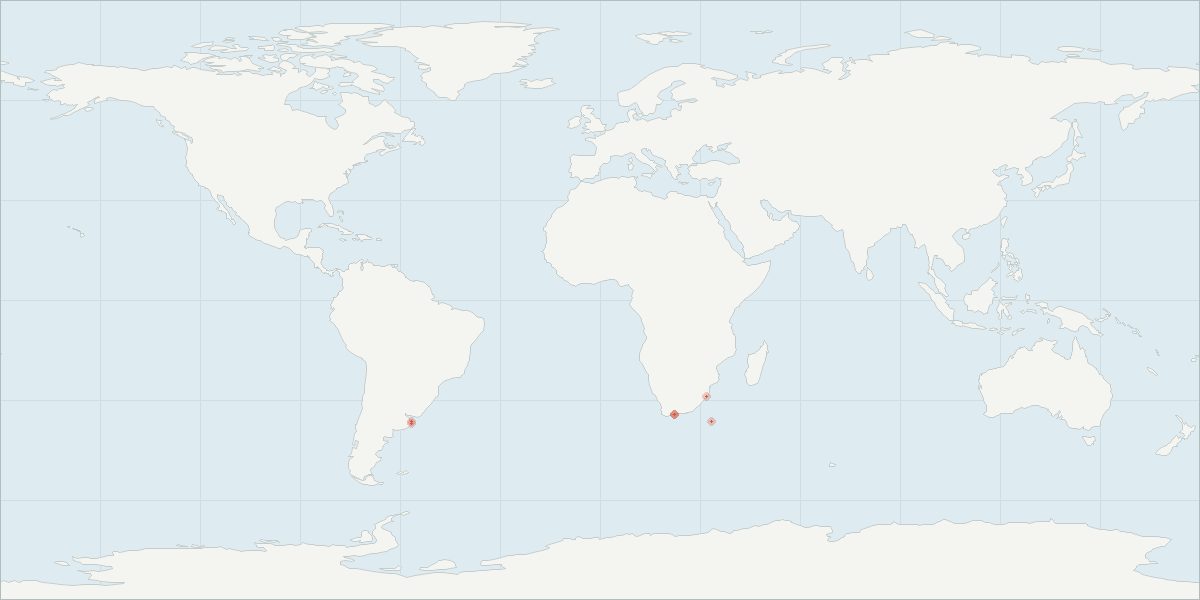
Ramari’s beaked whale in all likelihood occupies the whole of the temperate waters of the southern hemisphere, within a latitude band of the order of 30 to 50° S that corresponds to a maximum of deep-sea biodiversity. It is an oceanic, deep-water species, associated with continental slopes and abyssal plains rather than with coastal waters.
Genetically confirmed records come from South Africa, Australia and Aotearoa New Zealand. Other reports, not all of which have received molecular confirmation, concern Mozambique, the Walters Shoals south of Madagascar, Tristan da Cunha and south-eastern Brazil, where an adult male stranded alive on 4 May 2004 on the northern coast of the state of São Paulo, a report published at the time as the first for the western tropical Atlantic south of the equator. In 2024 the first record for Uruguay was published, concerning an adult female and a juvenile in all likelihood associated with her, stranded in the department of Canelones: this is the first documented case for the temperate south-western Atlantic, confirmed by morphometrics and by sequencing of mitochondrial DNA. The known reference specimens correspond to animals stranded between 1977 and 2018.
In France, the species has been the subject of no confirmed report, neither in mainland France nor in the overseas territories. Its strictly southern distribution excludes it from the Mediterranean, the Bay of Biscay and the English Channel. It is the sister species, True’s beaked whale (Mesoplodon mirus), that frequents the temperate North Atlantic, the Bay of Biscay included: any mesoplodont beaked whale of this type sighted or stranded on the mainland French coasts belongs to M. mirus and not to M. eueu.
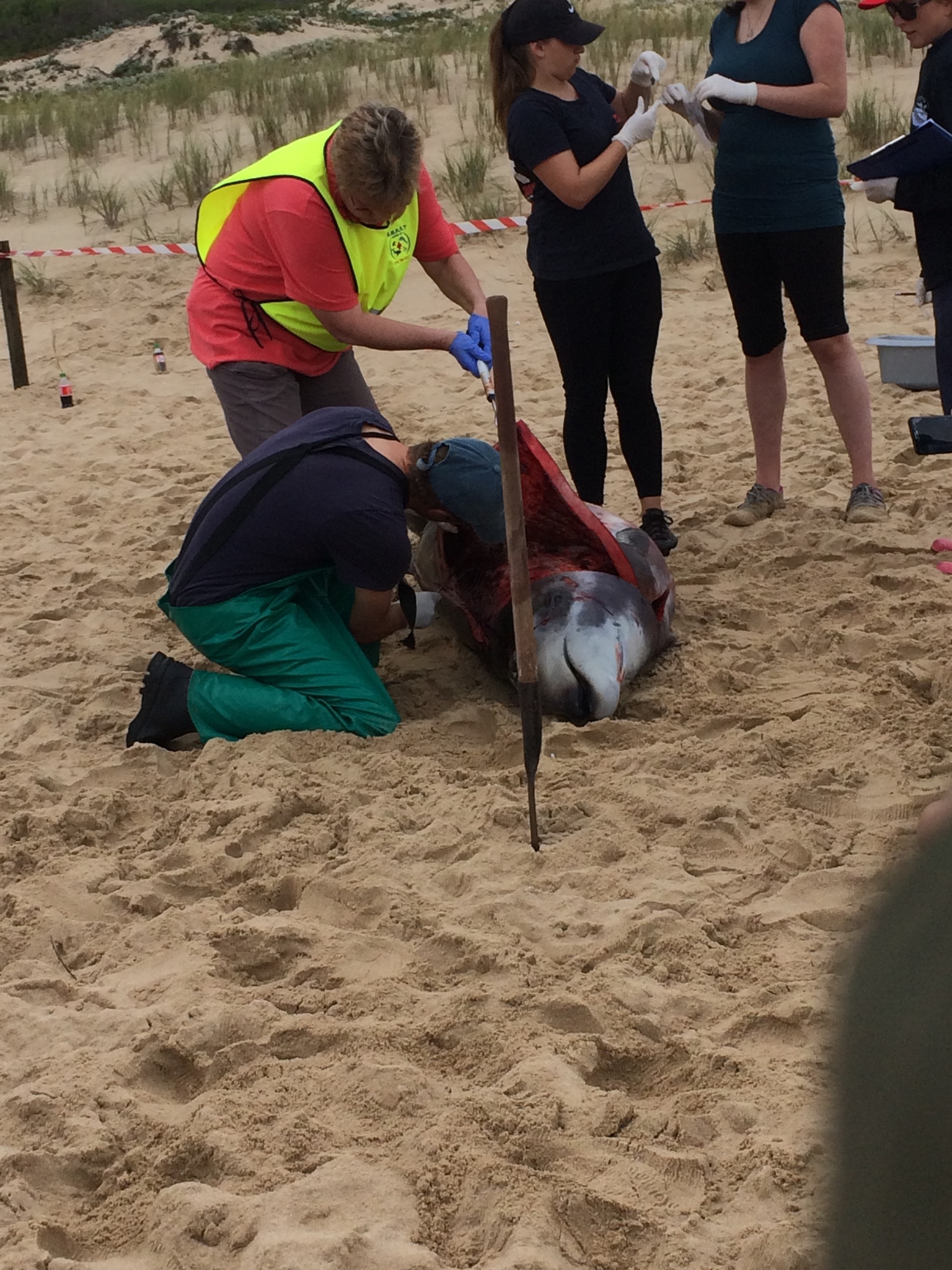
Like all mesoplodont beaked whales, Ramari’s beaked whale is a deep diver that feeds by suction: by drawing the tongue back and spreading the gular grooves, the animal creates a drop in pressure in its mouth cavity and draws in its prey, a technique that makes teeth unnecessary for capture. The only published stomach contents, those of a South African individual, comprised squid of the genus Teuthowenia and unidentified fish remains. The diet therefore remains very poorly known, but it fits the general pattern of the genus, dominated by cephalopods and supplemented by deep-water fish.
The tusks of males serve not for feeding but for confrontations between rivals, as the long paired linear scars carried by adults indicate. No data exist on group size, social structure, or the depth or the duration of dives specific to this species; by comparison, the beaked whales of the mirus/eueu complex are described as solitary or gathered in small groups of five to six individuals, inconspicuous and wary at the surface.
Breeding is documented only indirectly. The holotype was a pregnant female carrying a foetus, and the Uruguayan stranding brought together an adult female and a juvenile. Gestation length, size at birth, the interval between two births, age at sexual maturity and longevity remain unknown. No sighting at sea had been reported at the time the species was described, and encounters with living animals remain exceptional: most of what is known comes from stranded animals.
The IUCN Red List places Mesoplodon eueu in the category “Data Deficient” (DD), on the basis of an assessment published in 2022 by Brownell and Pitman, the first since the species was recognised; that status is still in force in the current version of the Red List (2026-1). No population estimate and no population trend is available, and no subpopulation is distinguished. By way of comparison, the North Atlantic sister species, M. mirus, was reassessed as “Least Concern” (LC) in the same year. Like all cetaceans, Ramari’s beaked whale is listed in Appendix II of CITES.
Threats documented for this species in particular are non-existent, for want of monitoring, but those bearing on beaked whales in general apply. Underwater noise comes first: mid-frequency active military sonars and seismic surveys provoke marked behavioural responses in these animals, liable to make them surface too fast and to trigger decompression accidents, a mechanism associated with several mass strandings of mesoplodont beaked whales elsewhere in the world. Next come bycatch in drifting gillnets and longlines, together with the ingestion of plastic debris, an established cause of mortality in several ziphiids. For a species whose abundance is unknown, even a low level of accidental mortality can have unsustainable effects.
Ramari’s beaked whale is among the hardest cetaceans in the world to observe. It lives offshore, over depths of several hundred to several thousand metres, spends very little time at the surface, breaches only rarely and avoids vessels. No reliable watching area has been identified, and no commercial trip targets this species: encounters are a matter of chance, during oceanographic campaigns or offshore crossings in the temperate southern waters, in particular off South Africa, southern Australia and New Zealand.
In practice, the main possible contribution remains the reporting of strandings. It was by this route that the species was discovered, and every documented carcass, photographs of the head and the jaw, measurements, a tissue sample for genetic analysis, brings irreplaceable information. A stranded animal must be neither moved nor handled: the appropriate national network should be alerted and people and dogs kept at a distance, since a cetacean carcass can present a health risk.
At sea, good practice requires cutting the engine, never crossing the path of a group or pursuing it, and moving away at the slightest prolonged dive: these animals are particularly sensitive to acoustic disturbance.
Because it was confused with True’s beaked whale (Mesoplodon mirus): the southern animals were regarded as simply an Indian Ocean population. It took the combination of mitochondrial genome analysis and cranial morphometrics on 38 specimens to show that these were two distinct species, separated for about 2 million years.
The epithet eueu takes up the Khwedam word //eu//’eu, “big fish”, proposed by the South African Khoisan Council, several strandings coming from Khoisan territories. The common name honours Ramari Stewart, a Māori cetacean expert who took part in the work; “ramari” also means “rare event” in Māori. The New Zealand type specimen was named Nihongore.
No. No confirmed report exists in France, neither in mainland France nor in the overseas territories: the species belongs to the temperate waters of the southern hemisphere. In the Bay of Biscay, it is its North Atlantic sister species, True’s beaked whale, that is present.
Not by sight: the authors of the description state that the external appearances of the two species do not separate consistently. The distinction rests on the skull, a shorter rostrum and mandibular symphysis, a broader rostral base, more developed premaxillary crests in M. eueu, or on genetic analysis. In practice, geographical location is the first clue, the two species occupying different hemispheres.
It feeds at depth on cephalopods and fish. The only stomach examined, that of a South African individual, contained squid of the genus Teuthowenia and fish remains. Like other mesoplodont beaked whales, it draws in its prey by suction, pulling the tongue back and expanding its throat; its teeth, present only in males, serve for fights between rivals and not for feeding.
It has been listed as “Data Deficient” (DD) by the IUCN since the 2022 assessment, a status still in force in the current version of the Red List (2026-1): no population estimate and no trend is available. The threats identified for beaked whales in general are underwater noise (military sonars, seismic surveys), bycatch in fishing gear and the ingestion of plastic debris.
Yes, on at least two occasions. An adult male stranded alive on 4 May 2004 on the northern coast of the state of São Paulo, in south-eastern Brazil: that case was published as the first record for the western tropical Atlantic south of the equator. In 2024, an adult female and a juvenile stranded in the department of Canelones provided the first record for Uruguay and the first documented case for the temperate south-western Atlantic, confirmed by morphometrics and by sequencing of mitochondrial DNA.
Profile compiled from authoritative scientific sources (IUCN, NOAA Fisheries, specialist literature) and reviewed for factual accuracy.
According to the open data of the GBIF, 7 georeferenced sightings of Mesoplodon eueu are recorded in our photographic index.
| Country | Notes |
|---|---|
| South Africa | 4 |
| Argentina | 2 |

Monthly distribution of 7 dated sightings (all years combined): the maximum is reached in janvier.
| Month | Notes |
|---|---|
| janvier | 3 |
| February | 0 |
| mars | 1 |
| avril | 0 |
| mai | 0 |
| juin | 0 |
| juillet | 0 |
| August | 1 |
| septembre | 0 |
| octobre | 0 |
| novembre | 1 |
| December | 1 |
These figures reflect survey effort (more boaters and more surveys in summer) as much as the actual presence of the species: to be interpreted with caution.


Photographs from GBIF under a Creative Commons licence. The author and the licence of each photograph are given; please respect them if you reuse them.
Automatic selection of the most cited works mentioning the species (source: Crossref).