| Scientific name | Phocoena sinus Norris & McFarland, 1958 |
|---|---|
| Other names | Vaquita; vaquita marina, cochito (Spanish); vaquita, Gulf of California porpoise (English); marsouin du golfe de Californie (French) |
| Size | Females up to about 150 cm, males up to about 140 cm; newborn about 75 cm |
| Weight | About 30 to 55 kg in adults (documented maximum of the order of 48 kg); about 7 kg at birth |
| Longevity | About 20 years; the oldest documented individual was at least 21 years old |
| Diet | Demersal and benthic fish (grunts, sciaenids), squid and crustaceans |
| IUCN status | Critically Endangered (CR), criteria A2a; C1+2a(ii); D; E, assessment published in 2022, decreasing trend. Listed CR without interruption since 1996 (Vulnerable in 1978, Endangered in 1990). No distinct subpopulation is recognised, the species being endemic to the upper Gulf of California. |
The Gulf of California porpoise, universally known by its Spanish name vaquita, is the smallest cetacean in the world and, today, the most endangered. Endemic to one corner of the upper Gulf of California, in Mexico, it is thought to number no more than a handful of individuals after a fall of about 99% in its numbers between 1997 and 2018, caused by drowning in gillnets. The most recent surveys nevertheless show that the last animals are still breeding.
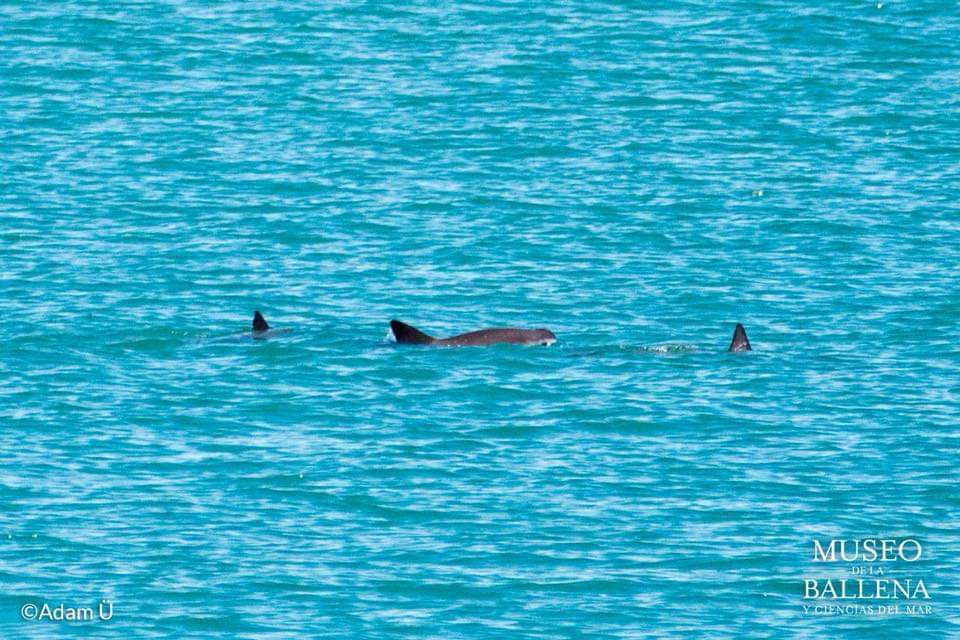
With a maximum length of about 150 cm in females and 140 cm in males, for an adult mass of between about 30 and 55 kg, the vaquita is the smallest cetacean known. The newborn measures of the order of 75 cm for about 7 kg. The outline is the stocky, compact one of the porpoises: rounded head with no projecting rostrum, streamlined body, no beak. The coloration combines a dark grey back, pale grey flanks and a white belly.
The most recognisable feature is the face. Well-marked black patches ring the eyes and border the lips, drawing an expression often compared to make-up. The dorsal fin, triangular, is proportionally tall and broad for a porpoise, a distinctive feature generally interpreted as an adaptation to thermoregulation in waters that can become very warm in summer. Sexual dimorphism is clear: females are longer, with a bulkier head and broader flippers, while males carry a more developed dorsal fin. As in all Phocoenidae, the teeth are spade-shaped rather than conical.
Confusion in the field is unlikely, since no other porpoise occurs in the Gulf of California; the small cetaceans found there (common bottlenose dolphin, common dolphin) are larger, more demonstrative and have a beak. The most frequent confusion is in fact linguistic: the “porpoise” seen in France is the harbour porpoise (Phocoena phocoena), a related but quite distinct species, larger, darker and without the black facial mask.
Phocoena sinus belongs to the family Phocoenidae, that of the porpoises, and to the genus Phocoena, which it shares in particular with the harbour porpoise (Phocoena phocoena), Burmeister’s porpoise (Phocoena spinipinnis) and the spectacled porpoise (Phocoena dioptrica). The species was described in 1958 by the American zoologists Kenneth S. Norris and William N. McFarland, from skulls collected on a beach in the upper Gulf of California. Unusually for a cetacean, it was not until 1985 and the examination of fresh specimens that its external appearance was fully described: the animal is so inconspicuous that its morphology long remained conjectural.
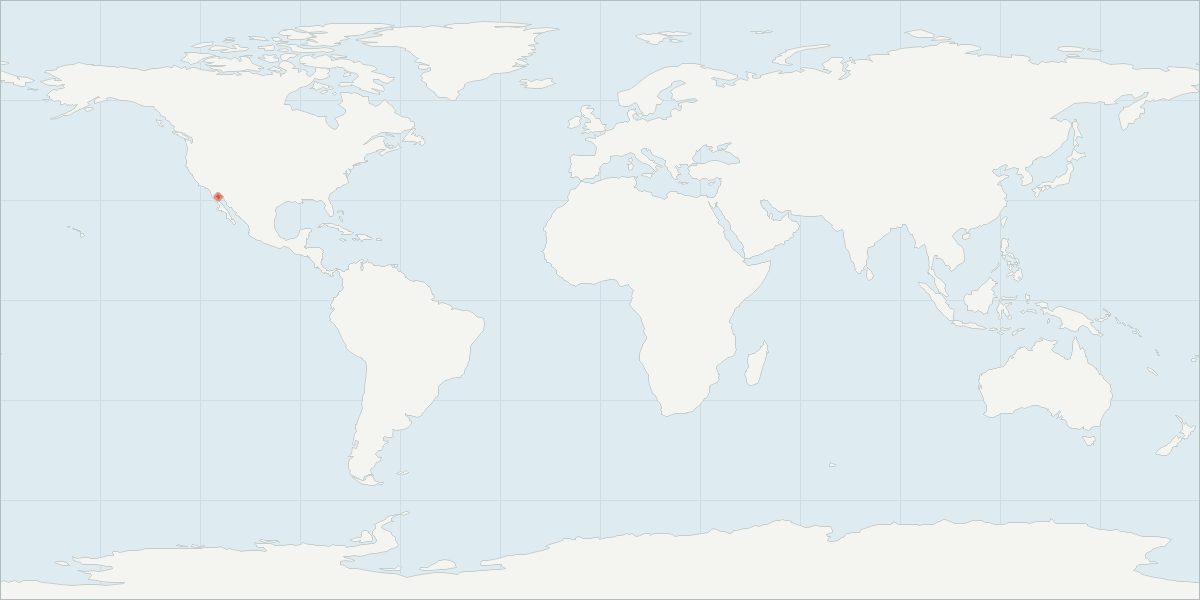
Endemic to the northern end of the Gulf of California (Mexico), over about 4,000 km² off San Felipe; turbid coastal waters 10 to 50 m deep. Absent from all French waters, mainland and overseas alike.
Solitary or in pairs, sometimes in groups of about ten individuals; narrow-band echolocation peaking at around 139 kHz; sexual maturity at 3-6 years; gestation of 10 to 11 months; a single calf, generally from February to April; lactation of 6 to 8 months; an interval between births generally of two years, although annual calving has been documented; longevity of about 20 years.
Critically Endangered (IUCN, 2022 assessment); Appendix I of CITES; listed as “endangered” under the United States Endangered Species Act and “depleted” under the Marine Mammal Protection Act. Single dominant threat: drowning in gillnets, in particular those of totoaba poaching. Successive protections: a refuge of 1,263 km² (2005), a gillnet ban (2015, then 2017), a zero tolerance area (2020), anti-net concrete blocks sunk by the Mexican Navy (2022).
A species that cannot be watched in practice: no whale watching, never kept for any length of time in captivity (the only two attempts, in 2017, ended in failure), sightings confined to official scientific surveys carried out in very calm seas from large vessels equipped with high-power binoculars.
The September 2025 survey concluded, by expert elicitation, that there was a 67% probability that 7 to 10 different individuals had been seen in the area studied, against 6 to 8 in 2024 and 8 to 12 in 2023. These figures are minimum numbers of animals observed and not a full estimate of the population: above all they confirm that very probably no more than ten to fifteen individuals remain.
For a single reason: bycatch in gillnets. The species is not hunted. It drowns in gear set for shrimp and above all for the totoaba, a fish of comparable size whose swim bladder feeds a highly lucrative illegal trade towards Asia.
Yes. Females barely exceed 150 cm and males 140 cm, for an adult mass of about 30 to 55 kg. It also has the smallest range of any marine mammal, of the order of 4,000 km².
No. The species is strictly endemic to the upper Gulf of California, in Mexico, and has never been reported anywhere else. The porpoise that can be encountered in France, in the English Channel or in the Bay of Biscay, is the harbour porpoise (Phocoena phocoena), a related but different species.
The attempt was made in October-November 2017 with the VaquitaCPR programme: two females were captured and placed temporarily in a floating pen. The first, a young female, had to be released because of stress; the second, an adult, died, which brought the programme to an end. The vaquita has never been kept for any length of time in captivity, and conservation now rests entirely on the protection of its habitat and the removal of gillnets.
The data remain too imprecise to establish a trend, but the 2023 to 2025 surveys no longer show a fall of the magnitude recorded previously, of the order of 45% a year. Calves are observed almost every year, and drone measurements in 2025 confirmed the survival of individuals born after 2022: breeding is continuing.
Profile compiled from authoritative scientific sources (IUCN, NOAA Fisheries, specialist literature) and reviewed for factual accuracy.
According to the open data of the GBIF, 3 georeferenced sightings of Phocoena sinus are recorded in our photographic index.
| Country | Notes |
|---|---|
| Mexico | 11 |
| United States of America | 2 |

Monthly distribution of 3 dated sightings (all years combined): the maximum is reached in mars.
| Month | Notes |
|---|---|
| janvier | 0 |
| February | 0 |
| mars | 1 |
| avril | 0 |
| mai | 0 |
| juin | 0 |
| juillet | 0 |
| August | 0 |
| septembre | 1 |
| octobre | 0 |
| novembre | 1 |
| December | 0 |
These figures reflect survey effort (more boaters and more surveys in summer) as much as the actual presence of the species: to be interpreted with caution.

Photographs from GBIF under a Creative Commons licence. The author and the licence of each photograph are given; please respect them if you reuse them.
Automatic selection of the most cited works mentioning the species (source: Crossref).