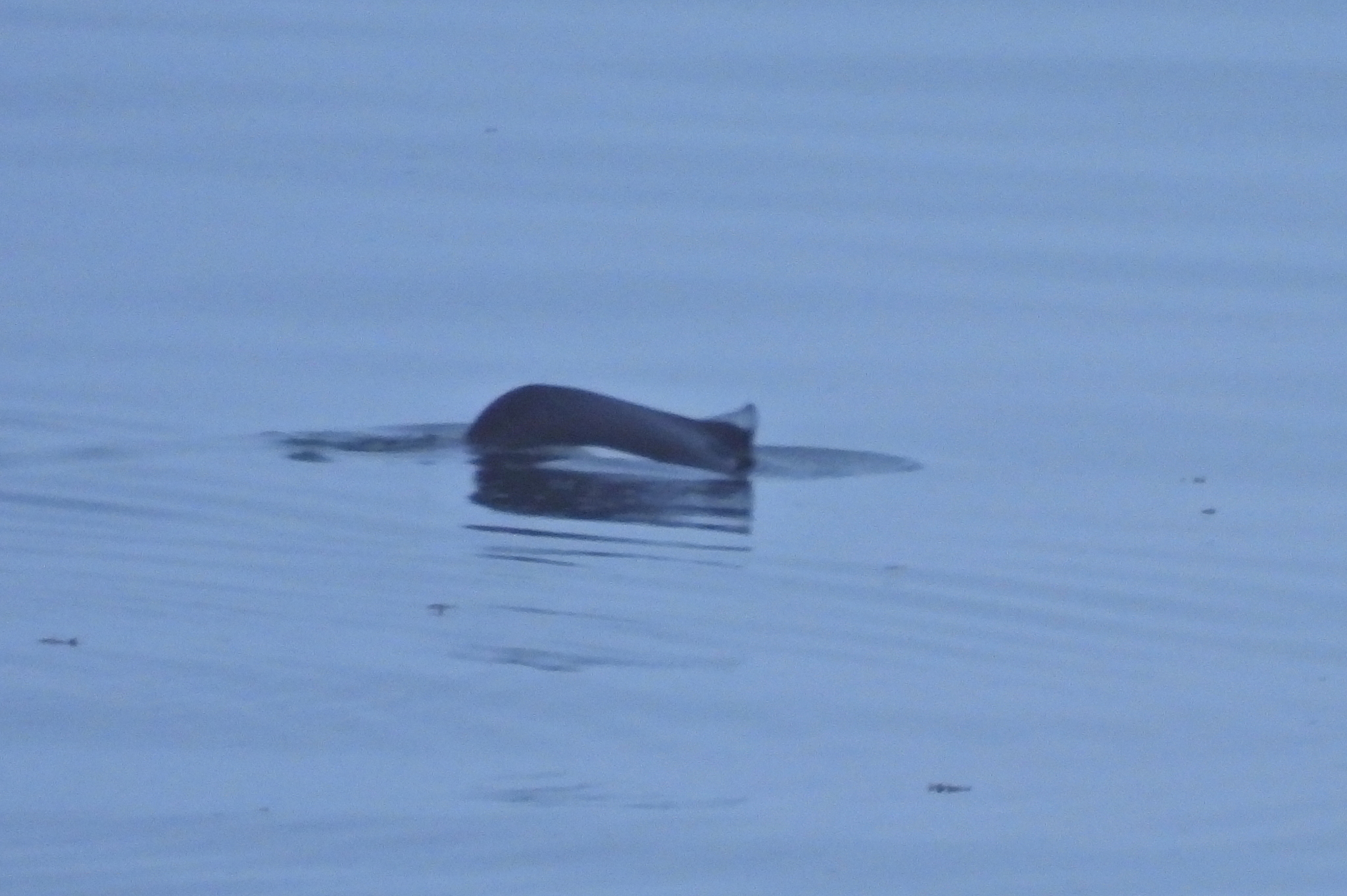
| Scientific name | Phocoenoides dalli (True, 1885) |
|---|---|
| Other names | Dall’s porpoise (English), marsouin de True or True’s porpoise (for the subspecies Phocoenoides dalli truei), marsouin à flancs blancs (French) |
| Size | 1.7 to 2.4 m; most often 1.8 to 2.0 m (females up to ~2.10 m, males up to ~2.20 m, documented maximum 2.39 m in the Sea of Okhotsk). Newborn: 85 cm to 1 m. |
| Weight | 130 to 220 kg |
| Longevity | 15 to 20 years on average (16-17 years most often cited), documented maximum about 22 years |
| Diet | Mesopelagic fish (lanternfish/myctophids, Pacific hake, smelt, capelin), schooling pelagic fish (herring, sardine, anchovy, jack mackerel), cephalopods (gonatid squid), occasionally crustaceans. Hunts mainly at night. |
| IUCN status | Least Concern (LC), assessment of 22 March 2017, published in 2018 (Jefferson & Braulik, The IUCN Red List of Threatened Species 2018: e.T17032A50370912). Population trend: unknown. No subpopulation is assessed separately to date; the subspecies Phocoenoides dalli truei Andrews, 1911, endemic to the north-west Pacific and forming a single population, is flagged as deserving a separate assessment. |
Dall’s porpoise is the only member of its genus and the fastest of the small cetaceans: it travels at up to about 55 km/h over short distances and then throws up at the surface a distinctive plume of water, the “rooster tail”. Stocky, black and white, it occurs only in the cold, deep waters of the North Pacific, from California to the Bering Sea and as far as Japan. Listed as Least Concern by the IUCN, with a population probably above 1.2 million animals, it nevertheless remains the target of the largest direct hunt of small cetaceans in the world.
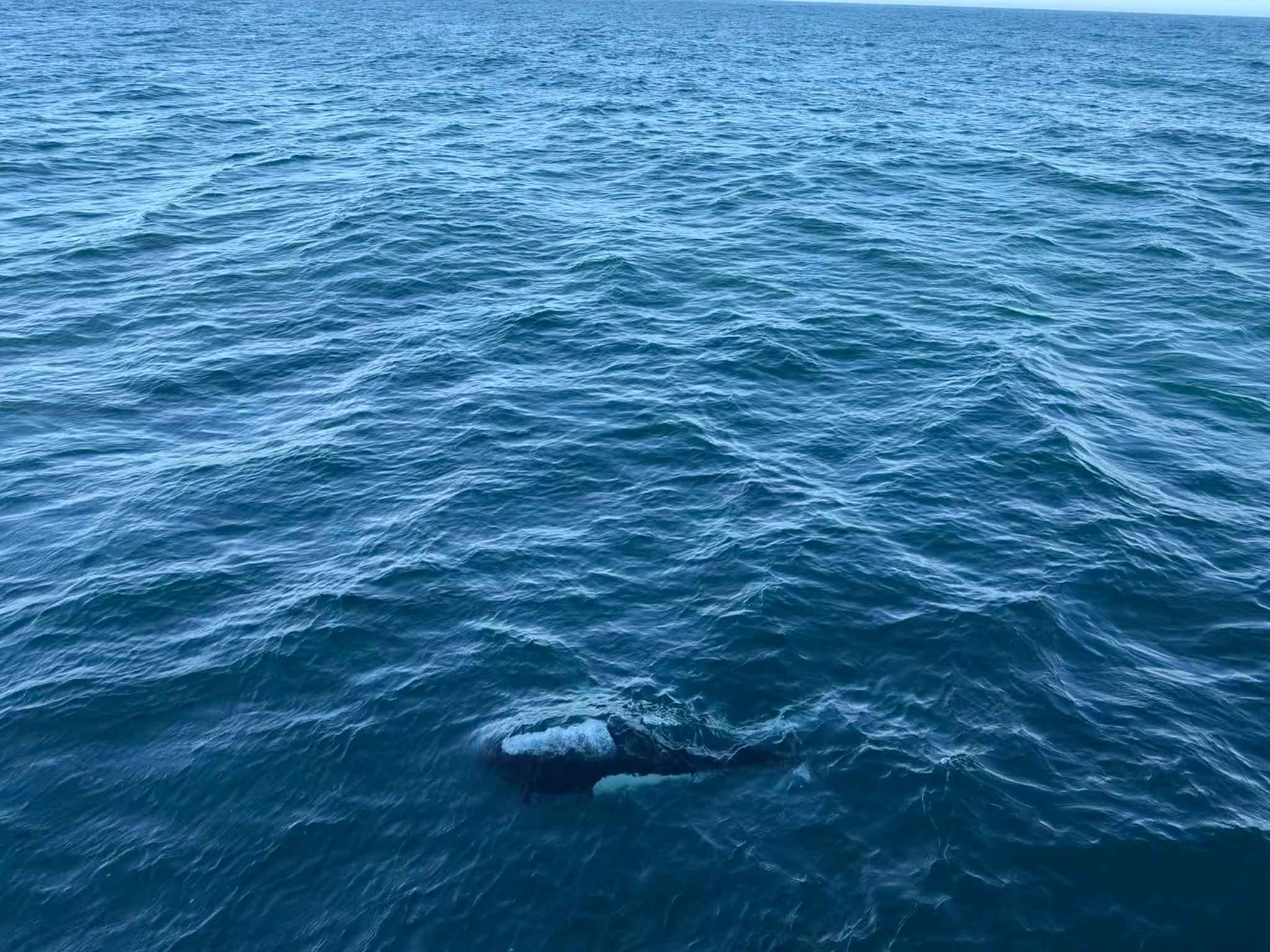
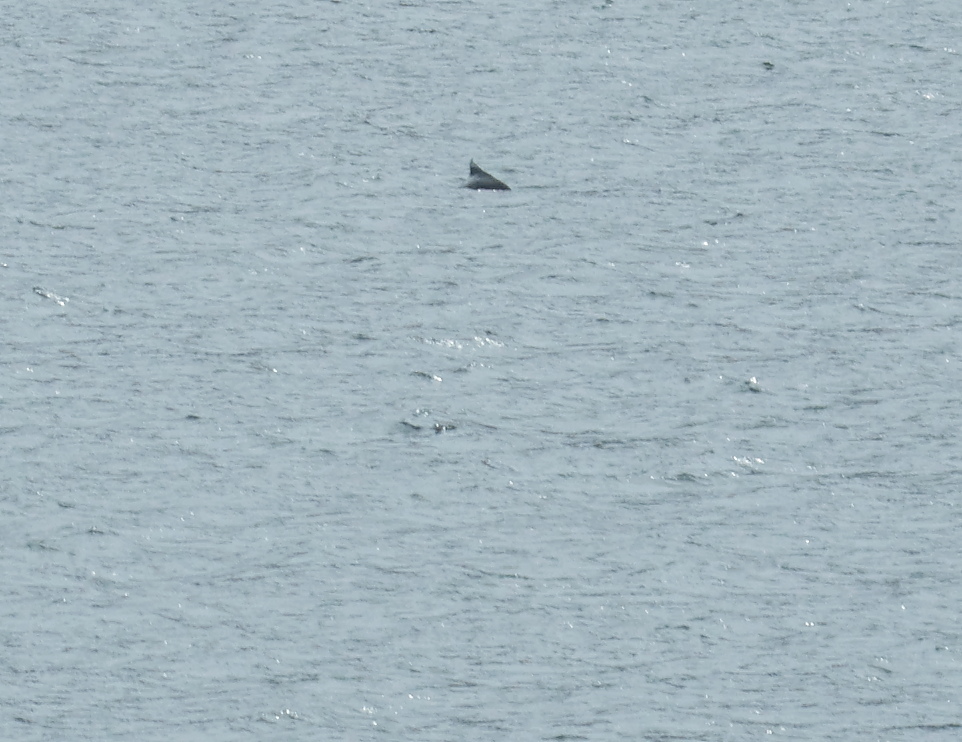
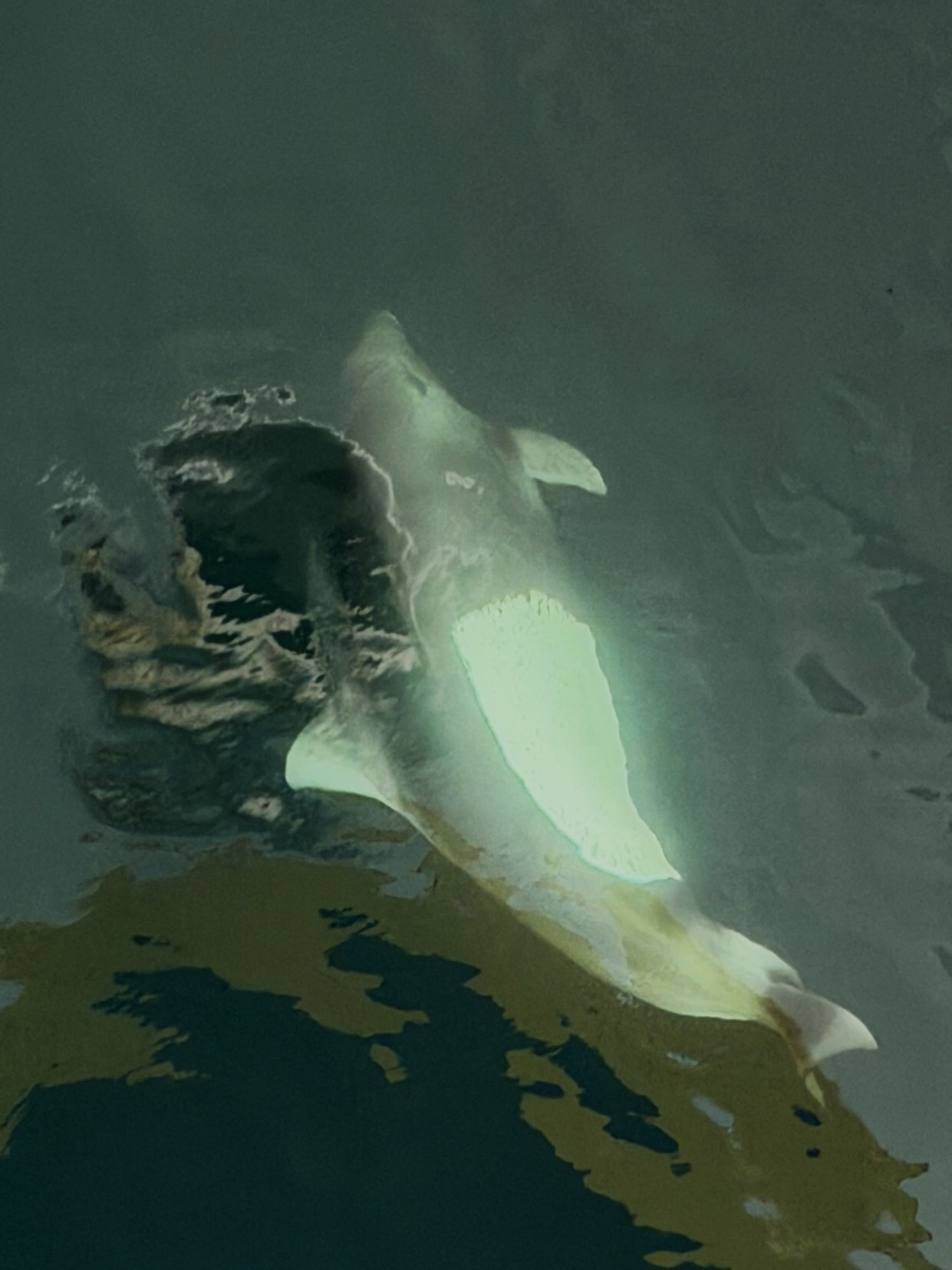
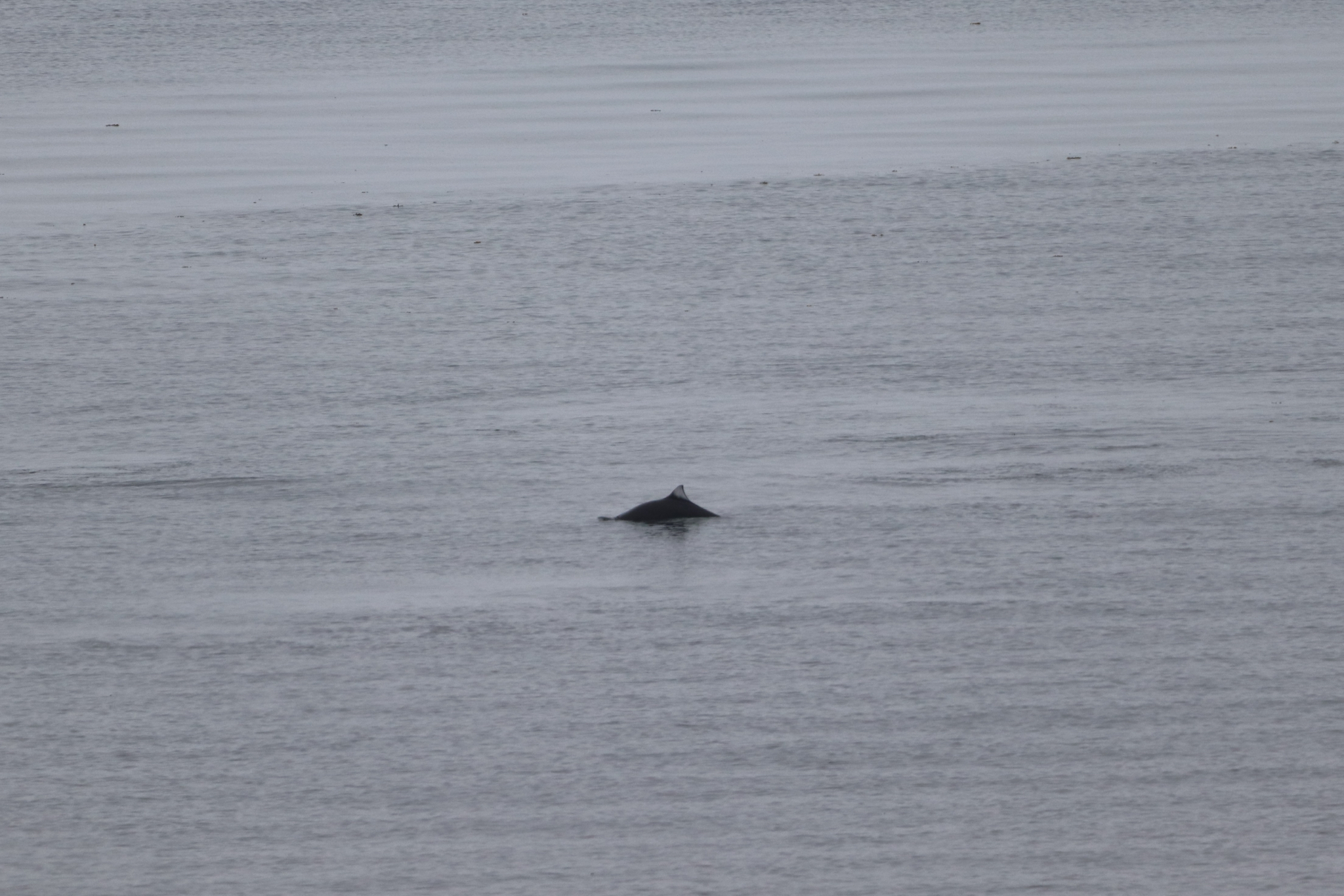
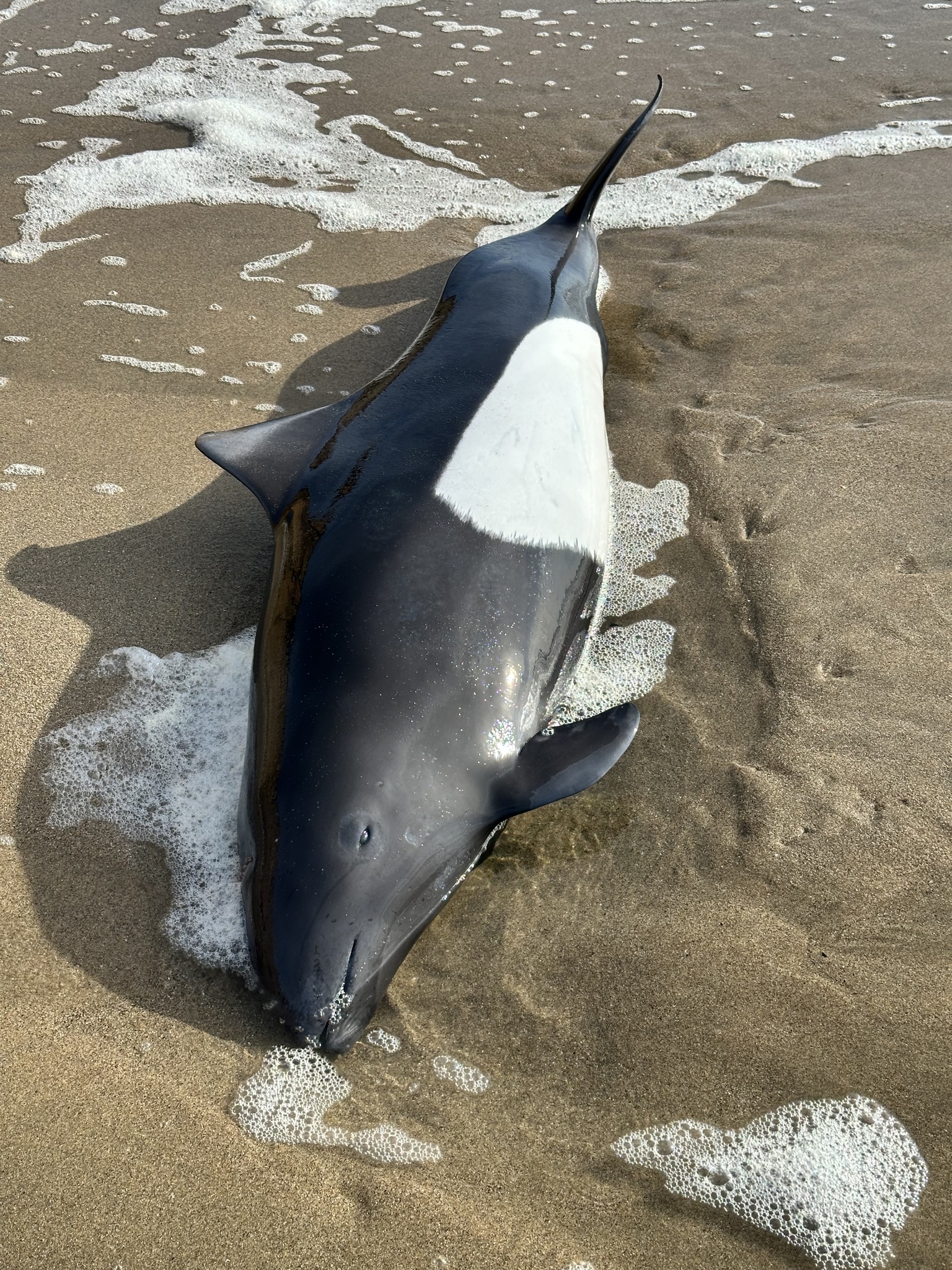
Dall’s porpoise is immediately recognisable by its massive outline and its strongly contrasting colour pattern. The body is stocky, almost humped, with a tiny head and no beak, a feature shared by all porpoises. The coat is black or very dark grey, marked on the belly and the flanks by a large, sharply defined white patch whose forward extension varies between individuals and between subspecies. The triangular dorsal fin is set at the middle of the back and often leans forward; its upper edge, like that of the tail fluke, is trimmed with a white or pale grey border (the “frosting”). Adults most often measure 1.8 to 2.0 m, rarely more than 2.2 m, with a documented maximum of 2.39 m, and weigh 130 to 220 kg. Sexual dimorphism is marked: mature males are larger, with a thicker tail stock and a dorsal fin leaning further forward; females top out at around 2.10 m and males at around 2.20 m, the largest known individuals, males from the Sea of Okhotsk, reaching 2.39 m. Entirely black (melanistic) and entirely white (albino) forms exist, but remain rare. The mouth carries very numerous tiny spade-shaped teeth, between 38 and 56 per jaw depending on the individual.
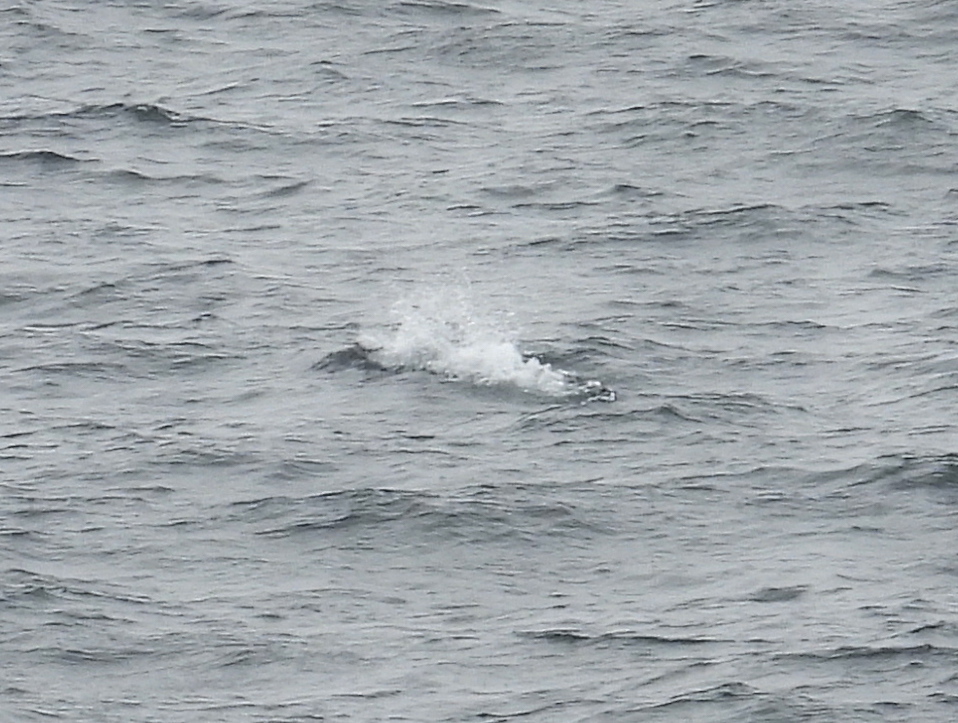
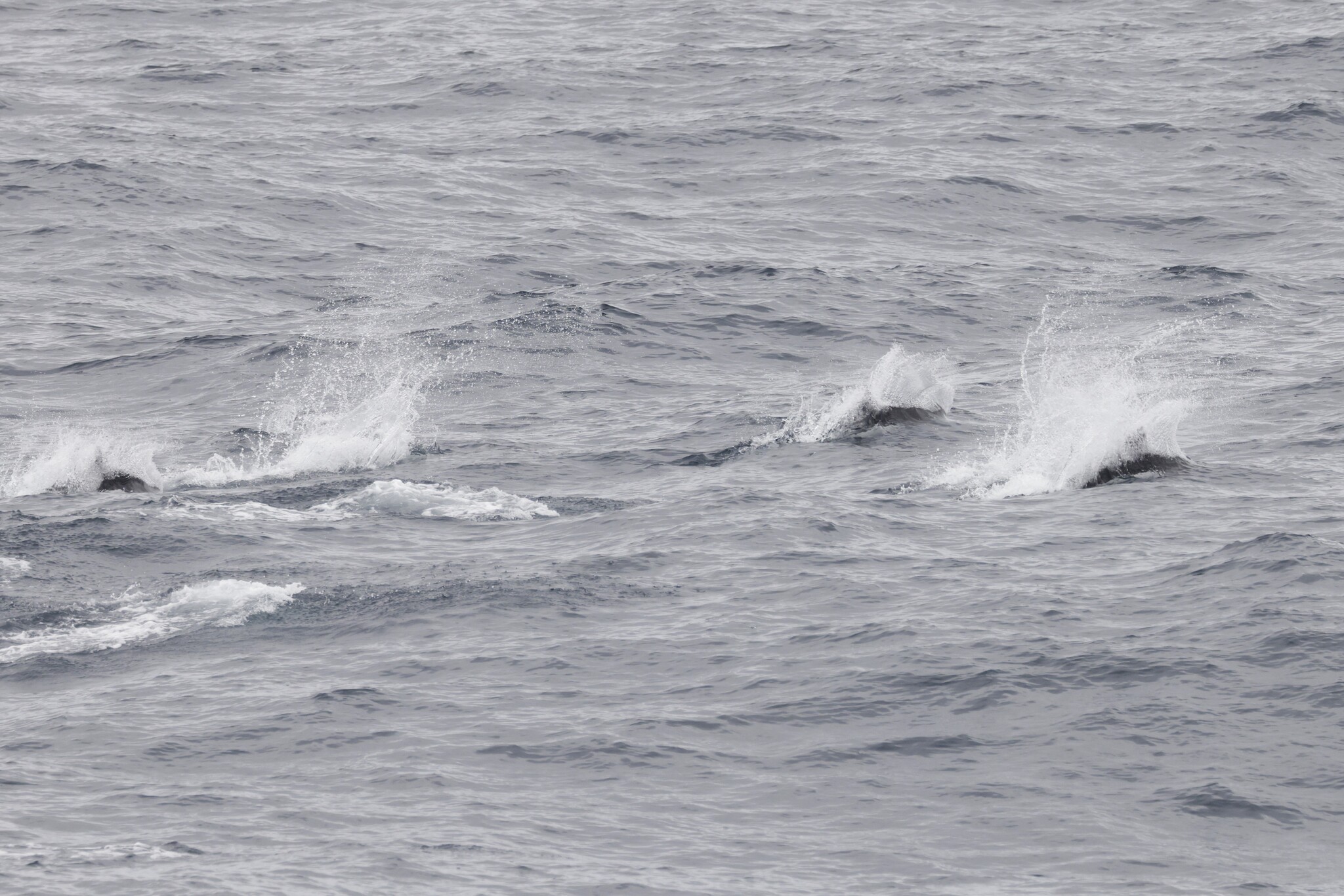
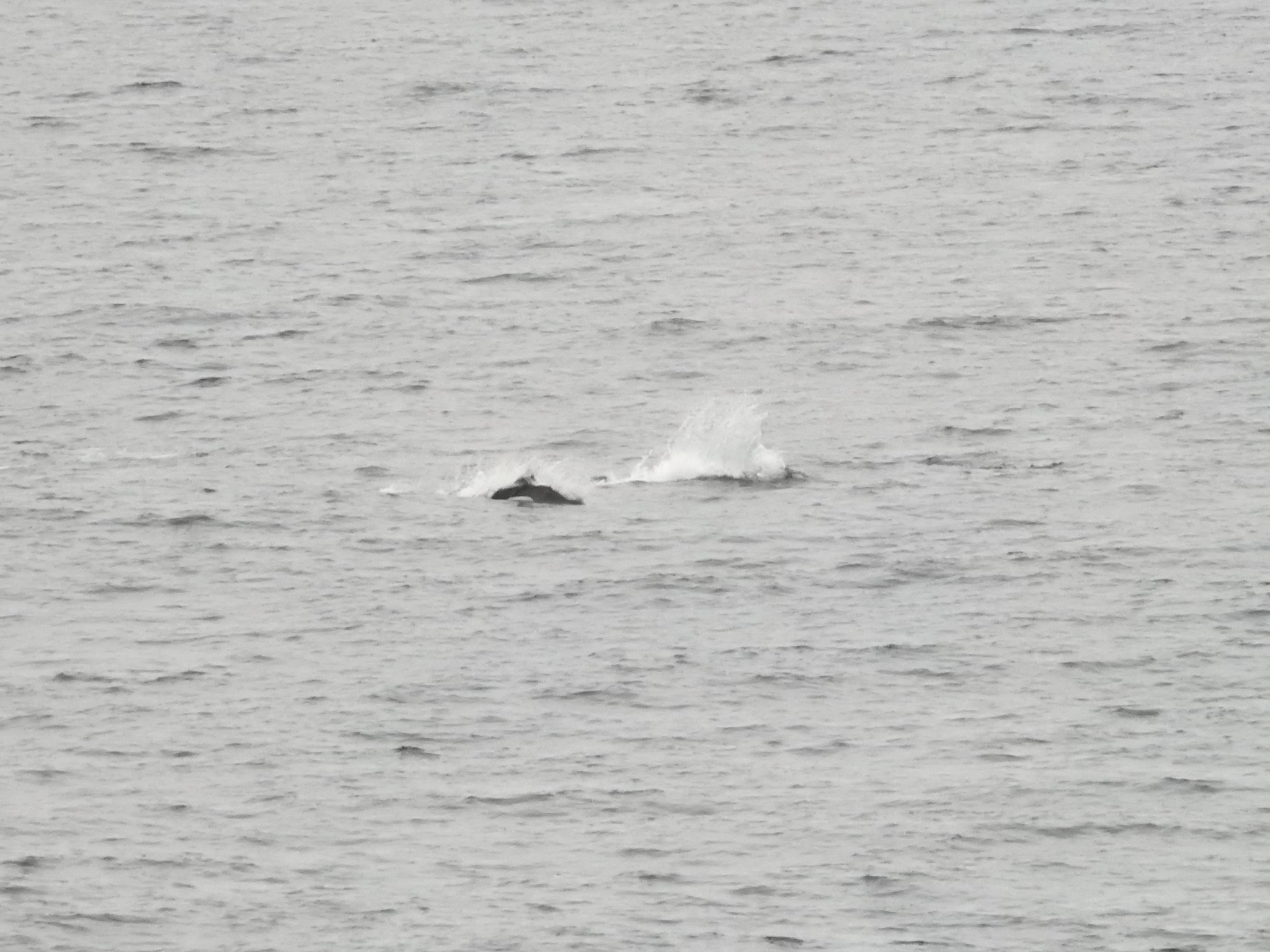
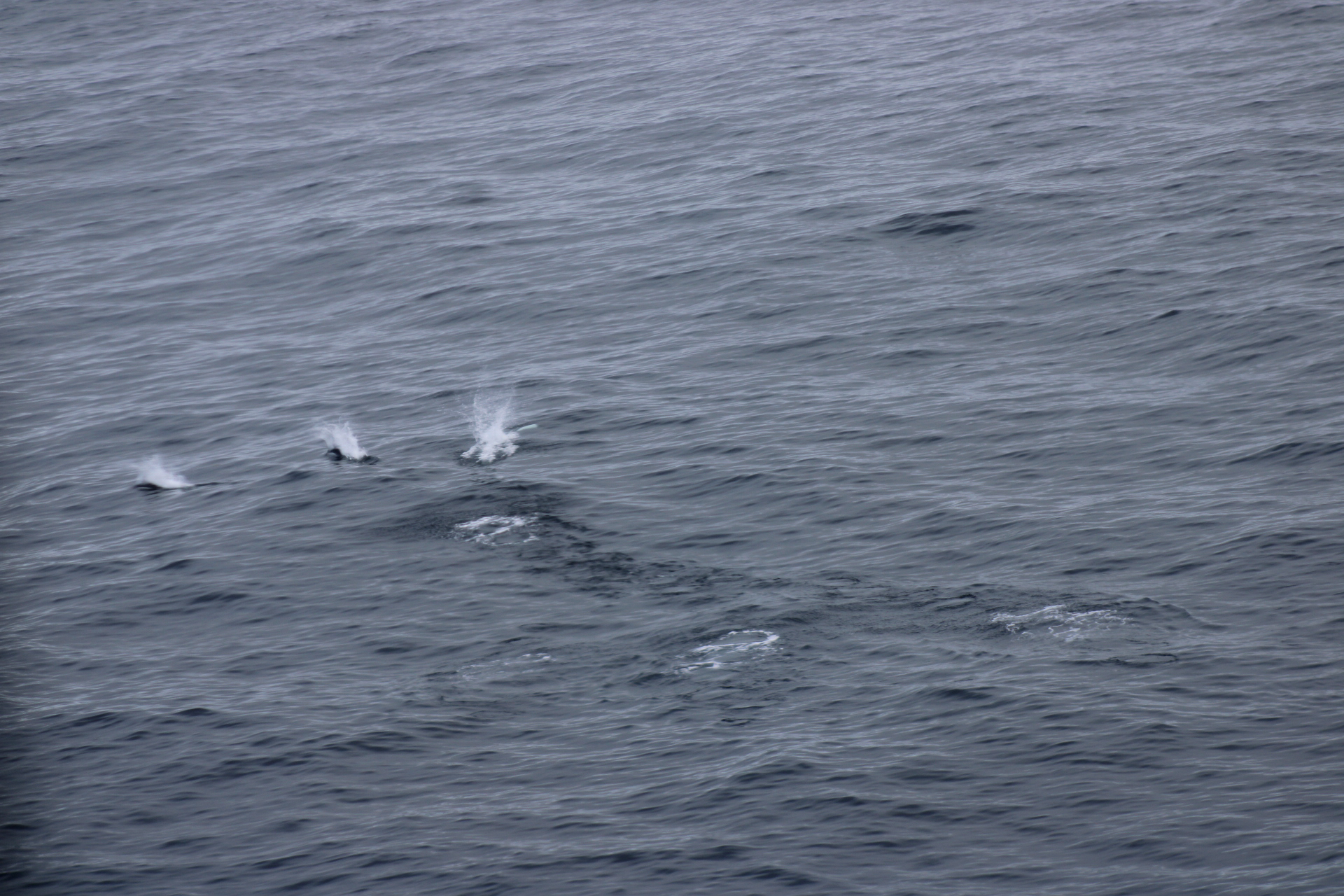
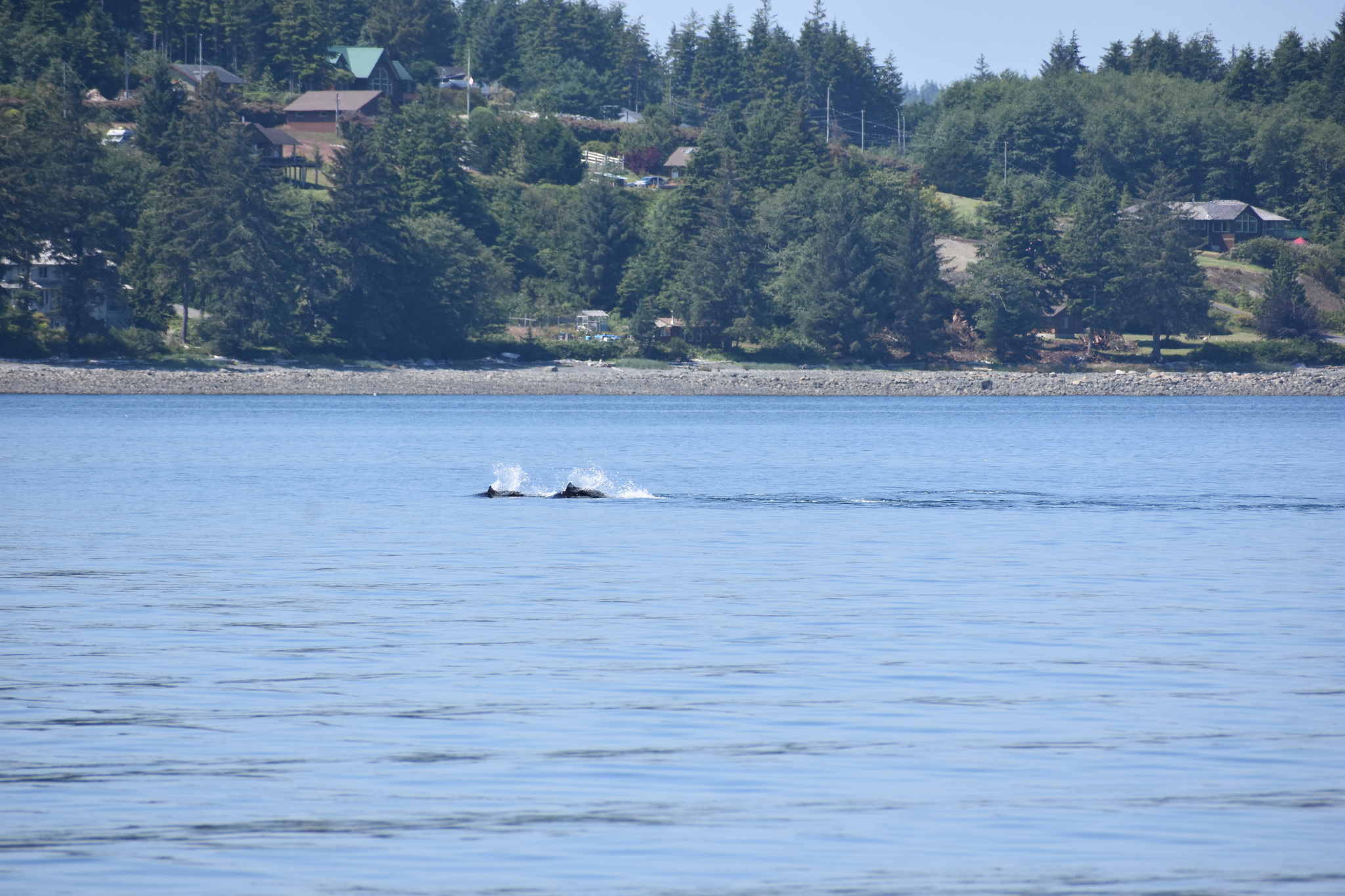
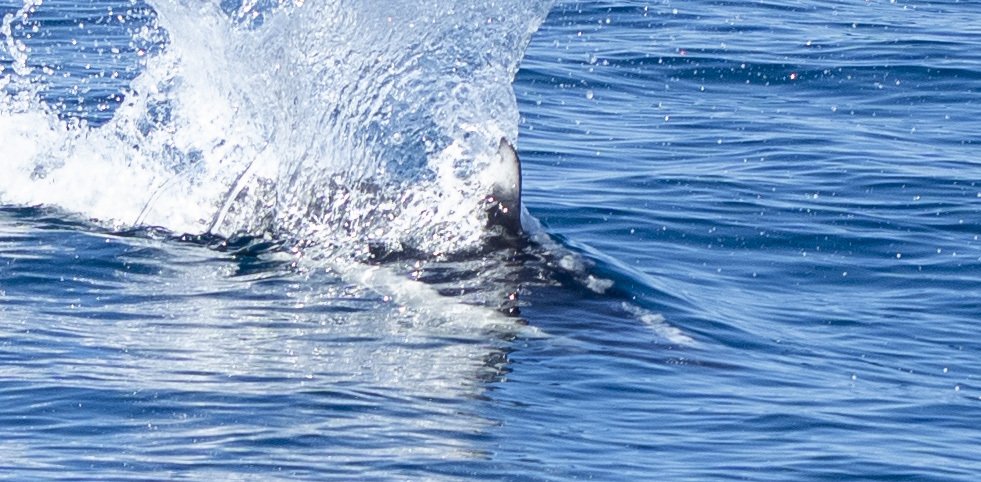
Surface behaviour is as diagnostic as the coat. At high speed the animal does not leap: it breaks the surface in a grazing movement that throws a very recognisable cone of spray backwards, the well-known “rooster tail”, often the only clue visible before the animal is identified. This cetacean readily rushes to the bow of vessels, including fast ones, then abruptly loses interest, a behaviour that contrasts with the usual discretion of porpoises.
Confusion remains possible. At a distance, the black and white contrast and the upright dorsal fin can suggest a young killer whale, but size (less than 2.5 m against several metres) and the absence of a white eye patch settle the matter. The harbour porpoise (Phocoena phocoena), present in part of the temperate North Pacific, is smaller, uniformly grey-brown without a sharply marked white flank patch, and never produces a rooster tail. The two species do in fact hybridise fairly regularly in the north-east Pacific, and the hybrids show intermediate colorations that complicate identification at sea. Lastly, the western subspecies truei differs from the nominate form by a white patch that extends markedly further forward along the body, as far as the region of the flippers.
Dall’s porpoise belongs to the order Cetacea, suborder Odontoceti (toothed whales), and to the family Phocoenidae, which brings together the porpoises. It was described in 1885 by the American naturalist Frederick W. True, from a specimen taken in a strait west of Adak Island, in the Aleutians (Alaska); the specific epithet honours the naturalist William Healey Dall. As the original combination used another genus, the authority is written in brackets: Phocoenoides dalli (True, 1885). The species is today the only one in the genus Phocoenoides, which is therefore its own.
Two subspecies are recognised: Phocoenoides dalli dalli (True, 1885), widely distributed across the whole North Pacific, and Phocoenoides dalli truei Andrews, 1911, known as True’s porpoise, confined to the north-west Pacific, off Japan and in the southern Sea of Okhotsk. Roy Chapman Andrews first described truei in 1911 as a species in its own right, Phocoenoides truei, erecting on that occasion the genus Phocoenoides to hold the two forms; later work, morphological and then molecular, retained only one species, truei being brought down to the rank of subspecies, with some authors seeing in it no more than a morphotype. This last forms a single population, which has led some specialists to recommend a separate conservation assessment.
Hybridisation with the harbour porpoise, documented in particular in the waters of British Columbia, is frequent enough to be regarded as a regular phenomenon rather than an anecdotal one.
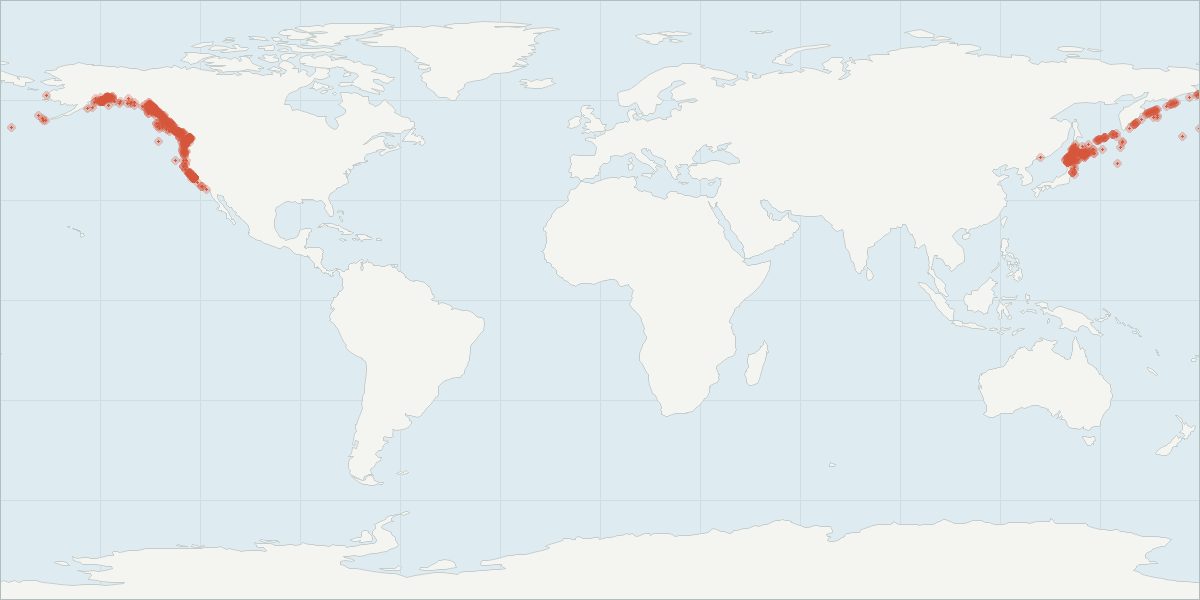
The range of Dall’s porpoise is strictly limited to the North Pacific and its adjacent seas, between about 30° and 62° north. In the east, the species occurs from California to the Bering Sea, by way of Oregon, Washington State, British Columbia and the whole Gulf of Alaska; in the west, it occupies Russian waters, the Sea of Okhotsk, the Sea of Japan and the coasts of Japan and Korea. It is a species of cold, deep water: it seeks depths greater than about 180 m and surface temperatures between 2 and 17 °C, generally avoiding water above 18 °C. It is found offshore in the open sea as well as in deep inlets, fjords and the inside passages of the North American coast. Some populations make seasonal movements, heading north in spring and back south in autumn, but the species is present all year round over much of its range. Locally, its distribution has changed: in the inland waters of the Salish Sea (Puget Sound, the Strait of Georgia, the Strait of Juan de Fuca), where it was common until the early 1990s, it has since become rare, for reasons that are still poorly understood.
In France, Dall’s porpoise is absent. Its range overlaps neither mainland waters, the English Channel, the North Sea, the Bay of Biscay, the Mediterranean, nor those of the overseas collectivities, which lie outside the temperate North Pacific. The only phocoenid recorded in French maritime areas is the harbour porpoise (Phocoena phocoena), present in mainland France, mainly in the English Channel, the North Sea and the Bay of Biscay, as well as at Saint-Pierre-et-Miquelon. Any report of a Dall’s porpoise in the north-east Atlantic or the Mediterranean therefore comes down to a confusion of species.
Dall’s porpoise is an opportunistic predator of open water. Its diet combines mesopelagic fish, lanternfish (myctophids) above all, but also Pacific hake, smelt and capelin, schooling pelagic fish such as herring, sardine, anchovy and jack mackerel, and cephalopods, in particular squid of the family Gonatidae. Crustaceans (krill, shrimp) appear occasionally in stomach contents, without making up a significant part of the diet. The species hunts mainly at night, when the deep scattering layer rises towards the surface and brings its prey within reach. Routine feeding dives remain modest, of the order of a few tens of metres, but the animal is capable of going markedly deeper: NOAA Fisheries reports dives reaching about 500 m.
Like all porpoises, the species is acoustically specialised: it emits narrow-band high-frequency echolocation clicks, whose peak most often lies between 120 and 140 kHz, and produces no whistles. These frequencies, well above the hearing sensitivity of killer whales, are interpreted as an anti-predator adaptation, mammal-eating killer whales and large sharks being among its few natural predators.
Social life is organised in small, fluid groups of 2 to 20 individuals, most sightings involving units of fewer than a dozen animals. Loose gatherings of several hundred, or even several thousand, individuals form over rich feeding areas. The mating system is polygynous, the males practising mate guarding.
Reproduction is slow, as in all cetaceans. Females reach sexual maturity at around 3 to 6 years, males rather at 5 to 8 years. Gestation lasts 10 to 12 months and produces a single calf, measuring 85 cm to 1 m at birth, generally between June and September. Lactation extends over several months, a period of less than a year according to NOAA Fisheries and longer according to other work, and the interval between two births is about three years, varying with the condition of the female. Longevity is short for a cetacean: 15 to 20 years on average, with individuals documented up to 22 years.
Dall’s porpoise is listed as Least Concern (LC) on the IUCN Red List. The assessment in force, carried out on 22 March 2017 and published in 2018 (Jefferson & Braulik, e.T17032A50370912), gives a population trend of “unknown”, for want of abundance series long enough. The world population is estimated at more than 1.2 million individuals and no decline at the scale of the range has been demonstrated, which justifies the listing. Regional estimates are large but heterogeneous: about 554,000 animals in the Sea of Okhotsk, 104,000 off Japan, 83,000 in Alaska. For the west coast of the United States, NOAA Fisheries gives a figure of the order of 100,000 individuals, while recent surveys covering the California-Oregon-Washington area arrive at a markedly lower figure, around 26,000; nearly 5,000 animals are estimated in British Columbia. At the local scale, on the other hand, the species has undergone a documented collapse in the inland waters of the Salish Sea, where it was common until the early 1990s.
The main historical pressure remains the directed hunt in Japan, carried out with the hand harpoon: more than 45,000 animals were taken there in 1988, which made it the largest direct hunt of small cetaceans in the world. NOAA Fisheries documents still mention an order of magnitude of 18,000 catches a year, but that figure reflects an earlier situation: the catches actually declared in recent years are far below the quotas, with 109 individuals taken against a quota of 8,535 in the 2023 fiscal year. The second threat is bycatch. The large high-seas driftnets for salmon and squid, responsible for several thousand deaths a year at the end of the 1980s, largely ceased after the United Nations moratorium of the early 1990s, but the species continues to be caught in gillnets, trawls and gear targeting groundfish, salmon and squid, in Japanese, Russian, Canadian and American waters; about 1,300 catches a year are reported for Russian gillnets. To this are added contamination by organochlorine pollutants, PCBs and DDE accumulate in the blubber and disrupt hormonal function and reproduction, and underwater noise, which interferes with communication and echolocation.
On the regulatory side, the species is listed in Appendix II of CITES, protected in the United States by the Marine Mammal Protection Act and by Canadian marine mammal legislation, and subject to catch quotas in Japan. The IUCN assessors recommend putting in place long-term abundance monitoring, the only means of detecting any regional declines, in particular for the subspecies truei, which forms a single population.
Dall’s porpoise is watched in the temperate to subarctic North Pacific, all year round. The most favourable sectors are south-east Alaska and the Gulf of Alaska, the deep waters of British Columbia (the Inside Passage, Johnstone Strait, Queen Charlotte Strait, off Vancouver Island), the waters off Washington State, Oregon and northern California, and the coasts of Hokkaidō and northern Honshū in Japan, where the truei form occurs. The inland waters of the Salish Sea, on the other hand, Puget Sound, the Strait of Georgia, the Strait of Juan de Fuca, the San Juan Islands, where the species was common until the early 1990s, are no longer a good area for watching: the aerial surveys of the 2010s detected only a tiny number of animals there, a local collapse that is still unexplained, coinciding with the strong return of the harbour porpoise. As the species frequents deep water, offshore trips or ferry crossings in deep inlets often offer better chances than coastal excursions.
At sea, the first sign is almost always the rooster-tail plume, visible at a good distance in a calm sea; the animal itself shows little, and never leaps. Dall’s porpoise frequently comes to ride the bow wave, which allows close and fleeting sightings, the chance to check the white flank patch and the pale border of the dorsal fin. A flat sea and low-angled light make detection easier.
On the ethical side, it is worth recalling that it is the animals that choose to approach vessels, never the other way round: one must not abruptly change course or speed to intercept a group, nor chase it, nor cut it in two. Keeping a constant speed and course, reducing engine revolutions in the presence of animals and respecting the distances recommended by local authorities, American and Canadian regulations strictly govern the approach to marine mammals, are the basic rules. Groups that include young animals call for heightened caution. Lastly, reporting sightings to regional monitoring networks is a useful contribution to knowledge of a species whose population trend remains undetermined.
It is the fastest of the small cetaceans: it reaches about 55 km/h (34 miles per hour) over short distances. This burst of speed comes with a unique visual sign, the cone of spray known as the “rooster tail” that it throws up behind it as it breaks the surface. Several large cetaceans and some large dolphins can, however, sustain high speeds over longer distances.
No. Dall’s porpoise lives only in the North Pacific, between about 30° and 62° north. It is absent from mainland waters and from the overseas collectivities. The only porpoise that can be seen in French waters is the harbour porpoise (Phocoena phocoena), present above all in the English Channel, the North Sea, the Bay of Biscay and at Saint-Pierre-et-Miquelon.
In the deep waters of the temperate to subarctic North Pacific: south-east Alaska and the Gulf of Alaska, the Inside Passage and Johnstone and Queen Charlotte straits in British Columbia, the waters off Washington State, Oregon and northern California, and the coasts of Hokkaidō and northern Honshū in Japan. Beware, on the other hand, of older guides that recommend Puget Sound, the Strait of Georgia or the San Juan Islands: the species was common there until the early 1990s, but the aerial surveys of the 2010s detected only a tiny number of animals.
The black and white contrast and the upright triangular dorsal fin can cause confusion at a distance. Size, however, is decisive: Dall’s porpoise rarely exceeds 2.2 m, against several metres for a killer whale even as a juvenile. The porpoise does not have the white eye patch characteristic of the killer whale, and its white patch is lateral and ventral, not dorsal.
Two subspecies are recognised: Phocoenoides dalli dalli (True, 1885), distributed across the whole North Pacific, and Phocoenoides dalli truei Andrews, 1911, True’s porpoise, confined to the north-west Pacific, off Japan and in the southern Sea of Okhotsk. Roy Chapman Andrews described truei in 1911 as a distinct species, creating on that occasion the genus Phocoenoides; later work brought it down to the rank of subspecies, with some authors seeing in it no more than a simple morphotype.
Because the world population is estimated at more than 1.2 million individuals and because no decline has been demonstrated at the scale of the range. The IUCN nevertheless gives a population trend of “unknown”: the monitoring series are too short to detect any regional falls, which justifies the recommendation of long-term abundance monitoring. Local collapses do exist, such as the one observed in the inland waters of the Salish Sea.
Yes. Hybridisation with the harbour porpoise (Phocoena phocoena) is documented and regarded as fairly frequent in the north-east Pacific, in particular off British Columbia. The hybrids show intermediate colorations that make identifying them at sea delicate.
Mammal-eating killer whales and large sharks, among them the great white shark. Its narrow-band high-frequency echolocation clicks, whose peak lies between 120 and 140 kHz, lie above the most sensitive range of killer whale hearing: this acoustic signature is interpreted as an adaptation that allows it to hunt without being detected.
Entry compiled from authoritative scientific sources (IUCN, NOAA Fisheries, specialist literature) and reviewed for factual checking.
According to the open data of the GBIF, 945 georeferenced sightings of Phocoenoides dalli are recorded in our photographic index.
| Country | Notes |
|---|---|
| United States of America | 470 |
| Japan | 263 |
| Canada | 166 |
| Russian Federation | 81 |

Monthly distribution of 977 dated sightings (all years combined): the maximum is reached in juin.
| Month | Notes |
|---|---|
| janvier | 6 |
| February | 24 |
| mars | 22 |
| avril | 42 |
| mai | 124 |
| juin | 221 |
| juillet | 169 |
| August | 213 |
| septembre | 104 |
| octobre | 28 |
| novembre | 10 |
| December | 14 |
These figures reflect survey effort (more boaters and more surveys in summer) as much as the actual presence of the species: to be interpreted with caution.


Photographs from GBIF under a Creative Commons licence. The author and the licence of each photograph are given; please respect them if you reuse them.
Automatic selection of the most cited works mentioning the species (source: Crossref).