| Scientific name | Phocoena dioptrica Lahille, 1912 |
|---|---|
| Other names | Lahille’s porpoise; in French: marsouin à lunettes, marsouin de Lahille; in Spanish: marsopa de anteojos; former scientific name: Australophocaena dioptrica |
| Size | Males up to about 2.24 m; females up to about 2.04-2.05 m; newborn about 1 m |
| Weight | About 55 to 115 kg; maximum known 110-115 kg in males, about 85 kg in females |
| Longevity | Unknown: no longevity estimate has been published for the species, the few age data available relating only to age at sexual maturity. |
| Diet | Carnivorous: small fish (anchovies of the genus Engraulis, ornate cowfish Aracana ornata), cephalopods (beaks of cuttlefish of the genus Sepia) and crustaceans (stomatopods) |
| IUCN status | Least Concern (LC), 2018 assessment (Dellabianca, Pitman & Braulik), status maintained in recent editions of the Red List. The species was listed as “Data Deficient” (DD) in 2008. No subpopulation is assessed separately. |
The spectacled porpoise is a small cetacean of the Southern Ocean, immediately recognisable by its sharply two-toned body, black above and white below, and by the dark patch ringed with white that surrounds each eye, the origin of its name. Adult males carry an outsized dorsal fin, a sexual dimorphism without equivalent among porpoises. Unobtrusive, fast and confined to cold waters among the most isolated on the globe, it remains one of the least well known cetaceans: the IUCN lists it as “Least Concern” on a provisional basis, in the absence of any population estimate.
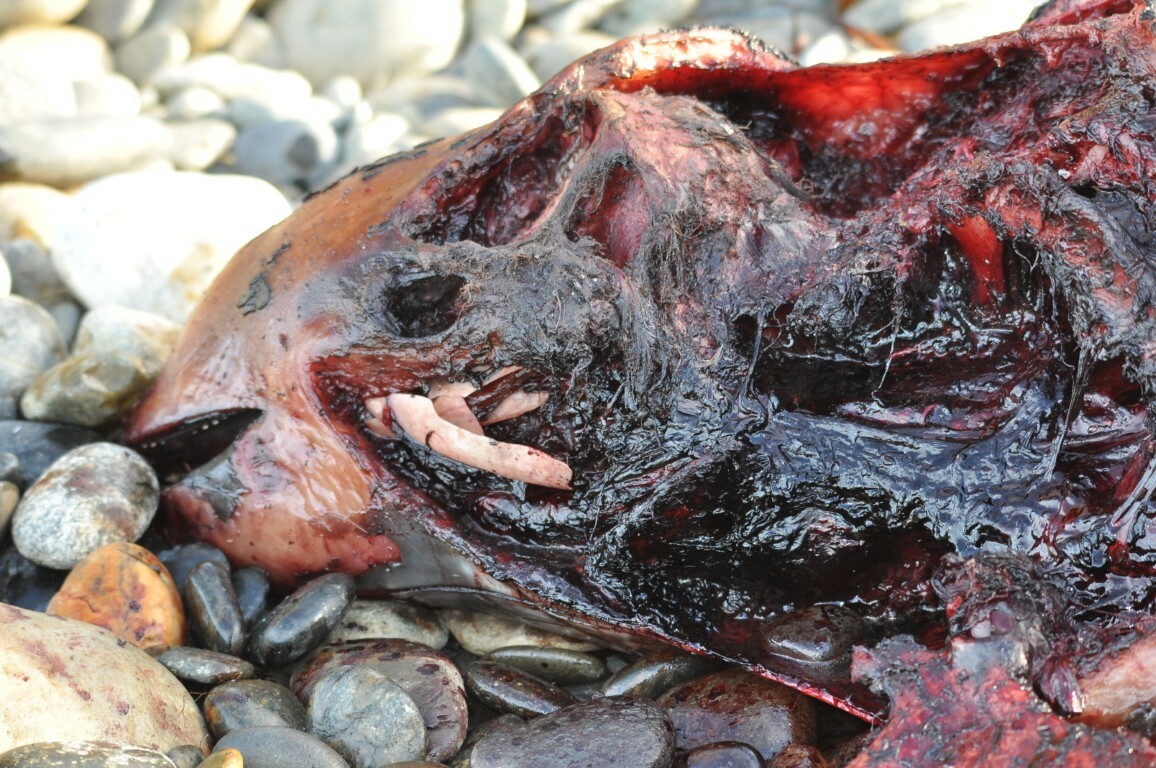
The spectacled porpoise is one of the largest members of its family. Males reach about 2.24 m for a maximum known weight of 110 to 115 kg, females remaining smaller, around 2.04-2.05 m and up to about 85 kg; the newborn measures close to a metre. The body is stocky, the head round and without a rostrum, as in all porpoises, and the flippers are small, rounded and set very far forward. The dentition is characteristic of the family: spade-shaped teeth, rather than conical as in dolphins, numbering about 17 to 23 pairs in the upper jaw and 16 to 20 in the lower jaw.
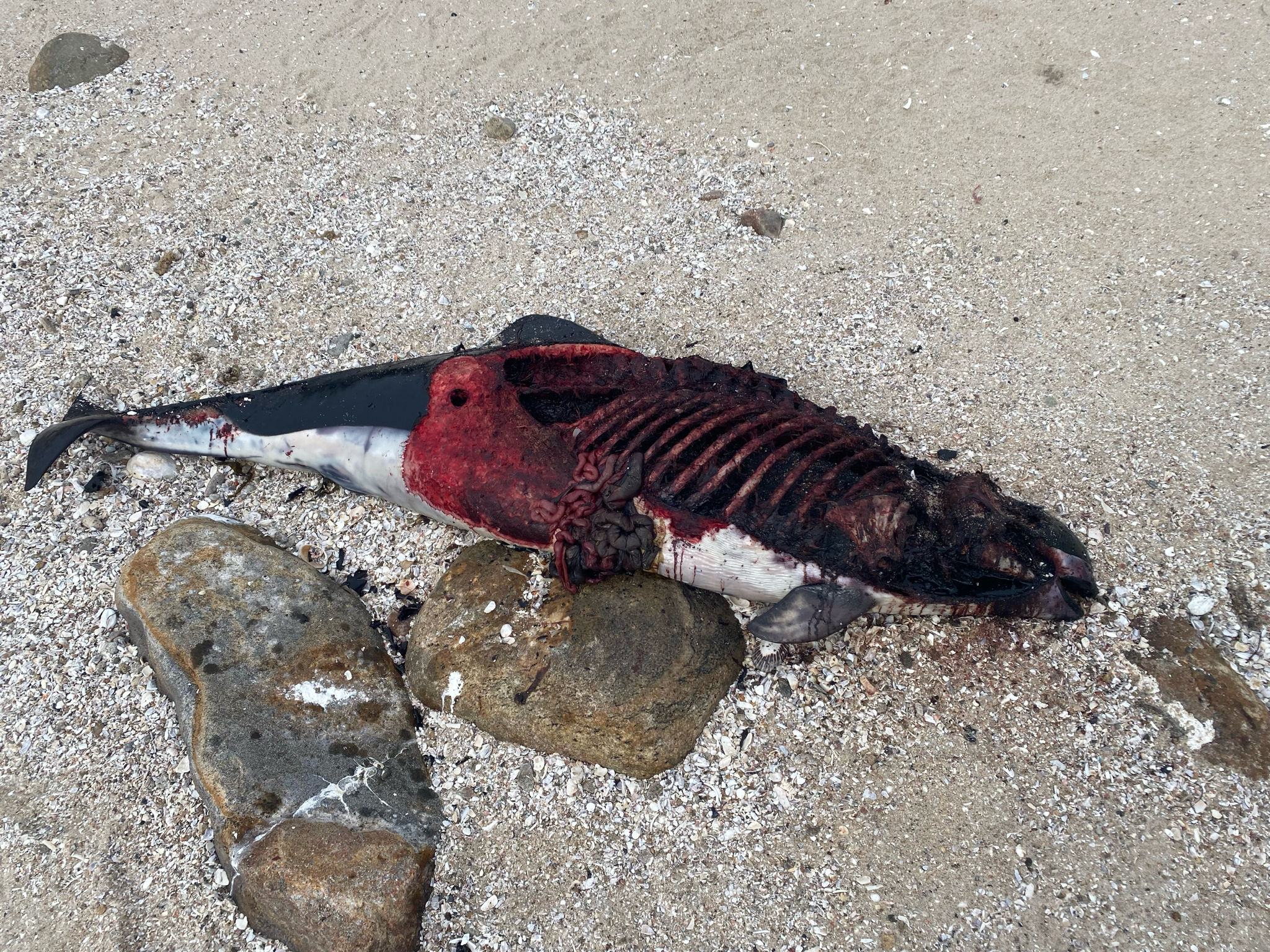
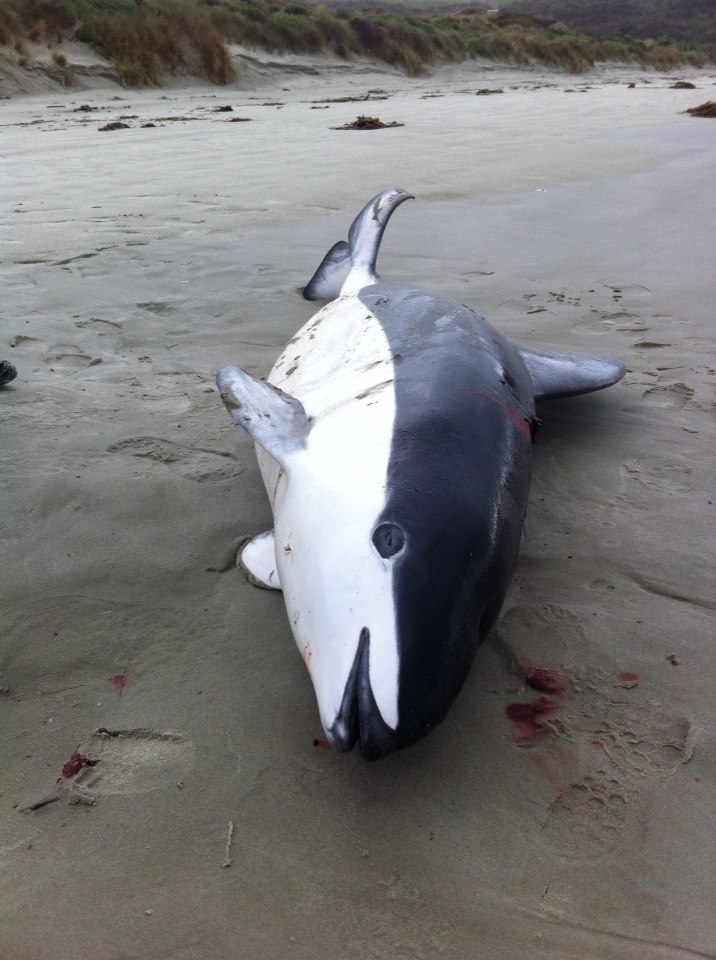
Coloration is the best field criterion. The back, a deep black sometimes with a blue sheen, is separated from the pure white belly by a sharp dividing line that runs the whole length of the body and passes above the eye. It is this line that isolates, against the pale background, a dark disc around each eye, outlined by a fine white border: the famous “spectacles”. The lips are black, a grey line often joins the corner of the mouth to the leading edge of the flipper, and a pale saddle surrounds the base of the dorsal fin. Young animals are duller, grey rather than black, with a light grey belly, and females generally show softer contrasts than males.
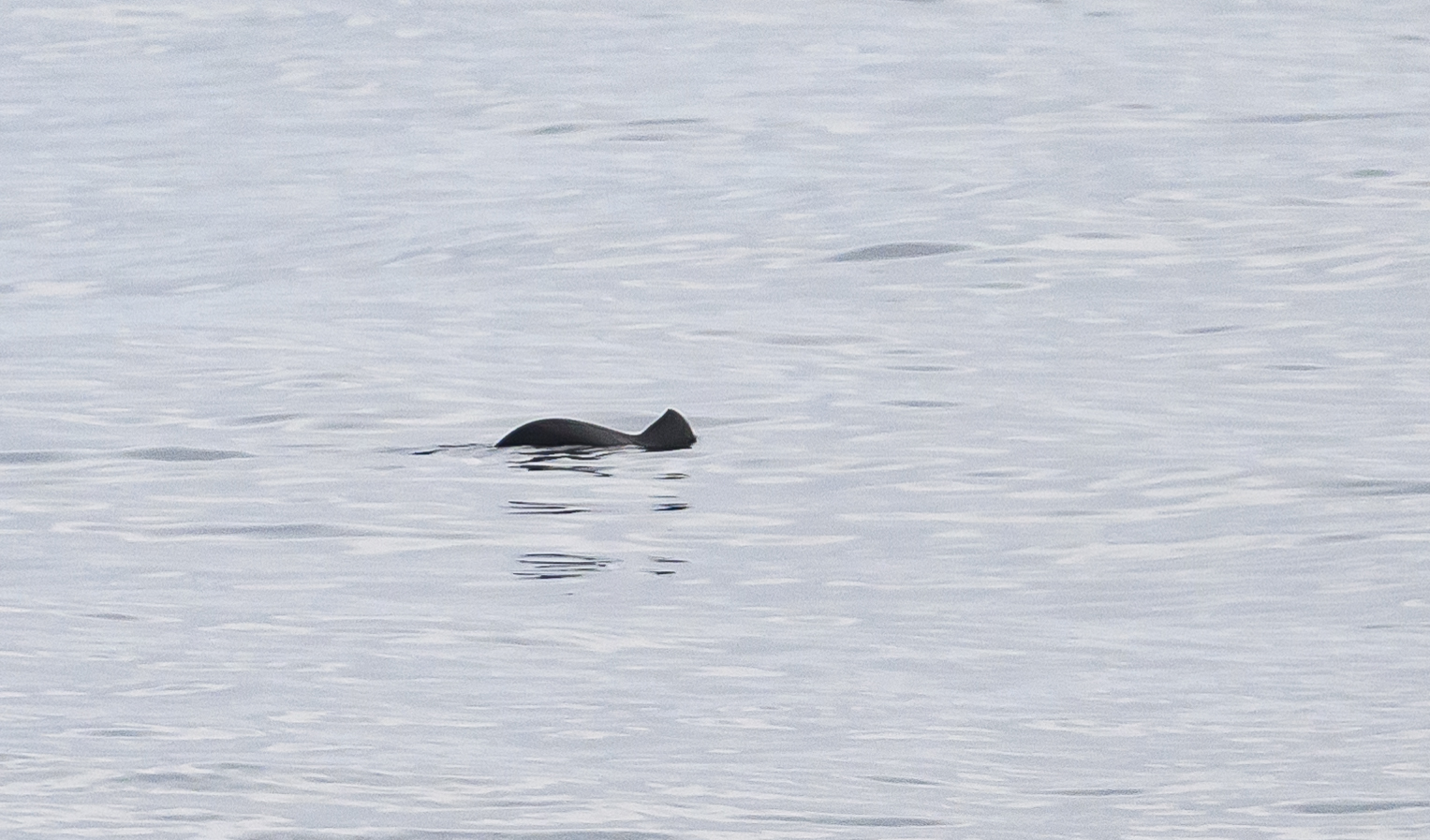
Sexual dimorphism is the most spectacular feature of the species, and the only one this marked among porpoises: the dorsal fin of the adult male is massive, broadly rounded and oval, of the order of 25 cm in height, whereas that of the female remains triangular and modest, around 12 cm. An adult male glimpsed from a distance may therefore suggest a very small killer whale; the function of this outsized dorsal fin, generally linked to sexual selection, is not established. The possibilities for confusion are few but real. Off South America, the Burmeister’s porpoise shares its range: it is immediately distinguished by a uniformly dark livery, with no sharply marked white belly, and by a low dorsal fin, sloping backwards and set very far back on the body. In subantarctic waters, the hourglass dolphin (Cephalorhynchus cruciger, formerly Lagenorhynchus cruciger) is also black and white, but it has a marked rostrum, a falcate dorsal fin and an hourglass pattern on the flank, and it readily bow-rides, a behaviour the spectacled porpoise never adopts. At Kerguelen, finally, the Commerson’s dolphin (Cephalorhynchus commersonii kerguelenensis) shows a comparable two-toned pattern, but a much duller one than that of the South American subspecies: dark grey where the latter is black, light grey where it is white, with blurred rather than sharp boundaries. Its pale areas cover much of the flanks and the front of the body, and its dorsal fin is low and rounded, without hypertrophy.
The spectacled porpoise belongs to the family Phocoenidae, the small group of the porpoises, distinct from that of the oceanic dolphins. It was described in 1912 by Lahille under the name Phocoena dioptrica; the epithet dioptrica refers precisely to the animal’s eye “spectacles”.
Its morphological singularity, a size greater than that of the other porpoises, a sharply contrasted colour pattern, a hypertrophied dorsal fin in the male, led some authors to place it in a genus of its own, Australophocaena. That combination did not survive later analyses: genetic and morphometric work returned it to the genus Phocoena, alongside the harbour porpoise (Phocoena phocoena), the Burmeister’s porpoise (Phocoena spinipinnis) and the vaquita (Phocoena sinus). The name Australophocaena dioptrica survives as a synonym in the older literature and in certain international regulatory texts.
The species is confined to the southern hemisphere, in cold temperate, subantarctic and Antarctic waters. Long known almost solely from coastal strandings, it was at first regarded as an inshore animal; at-sea sightings made during oceanographic surveys have since shown that it is above all an offshore species, with a very probably circumpolar distribution.
In the south-west Atlantic, the data cover an axis running from southern Brazil (the state of Santa Catarina) and Uruguay to Tierra del Fuego, by way of the Argentine coast, with records from the Falkland Islands and South Georgia. In the Indian sector, the species is reported from the Kerguelen Islands and Heard Island; in the Pacific sector, from Macquarie and the Auckland Islands, south of New Zealand, around Tasmania and as far as the south of the Australian mainland. Surface temperatures recorded during sightings range from 0.9 to 10.3 °C, with most of them between 4.9 and 6.2 °C; the southernmost known sighting was made at 64°34′ S, well inside the Antarctic zone. More than 270 strandings and skeletal remains have been recorded for the Atlantic coast between Tierra del Fuego and southern Argentina alone, by far the main reservoir of specimens for science; the world total, spread over the whole range, is therefore higher still.
In France, the spectacled porpoise has no documented presence in the metropolitan territory: it is absent from the English Channel, the Bay of Biscay and the Mediterranean, and it belongs neither to the fauna of the ACCOBAMS area nor to that of the Pelagos sanctuary. The link with France runs exclusively through the southern overseas territories: the species is occasionally reported in the maritime areas of the subantarctic islands of the French Southern and Antarctic Lands, in particular around the Kerguelen archipelago, and it is among the marine mammals documented for the Important Marine Mammal Area (IMMA) “Heard Island, Kerguelen and Surrounding Waters”, which covers about 1.77 million km² on the Kerguelen plateau.
Feeding is known only from a very small number of stomachs examined. They contained anchovies of the genus Engraulis, cephalopod beaks attributed to the genus Sepia, stomatopods and an ornate cowfish (Aracana ornata): a diet of small fish, cephalopods and crustaceans consistent with that of the other porpoises. No hunting sequence has ever been observed at sea, and the acoustic data amount to a first recording published in 2019 (Giardino et al.): the species’ echolocation repertoire, narrow-band high-frequency clicks as in all porpoises, remains almost entirely to be described, for want of a dedicated passive acoustic monitoring programme.
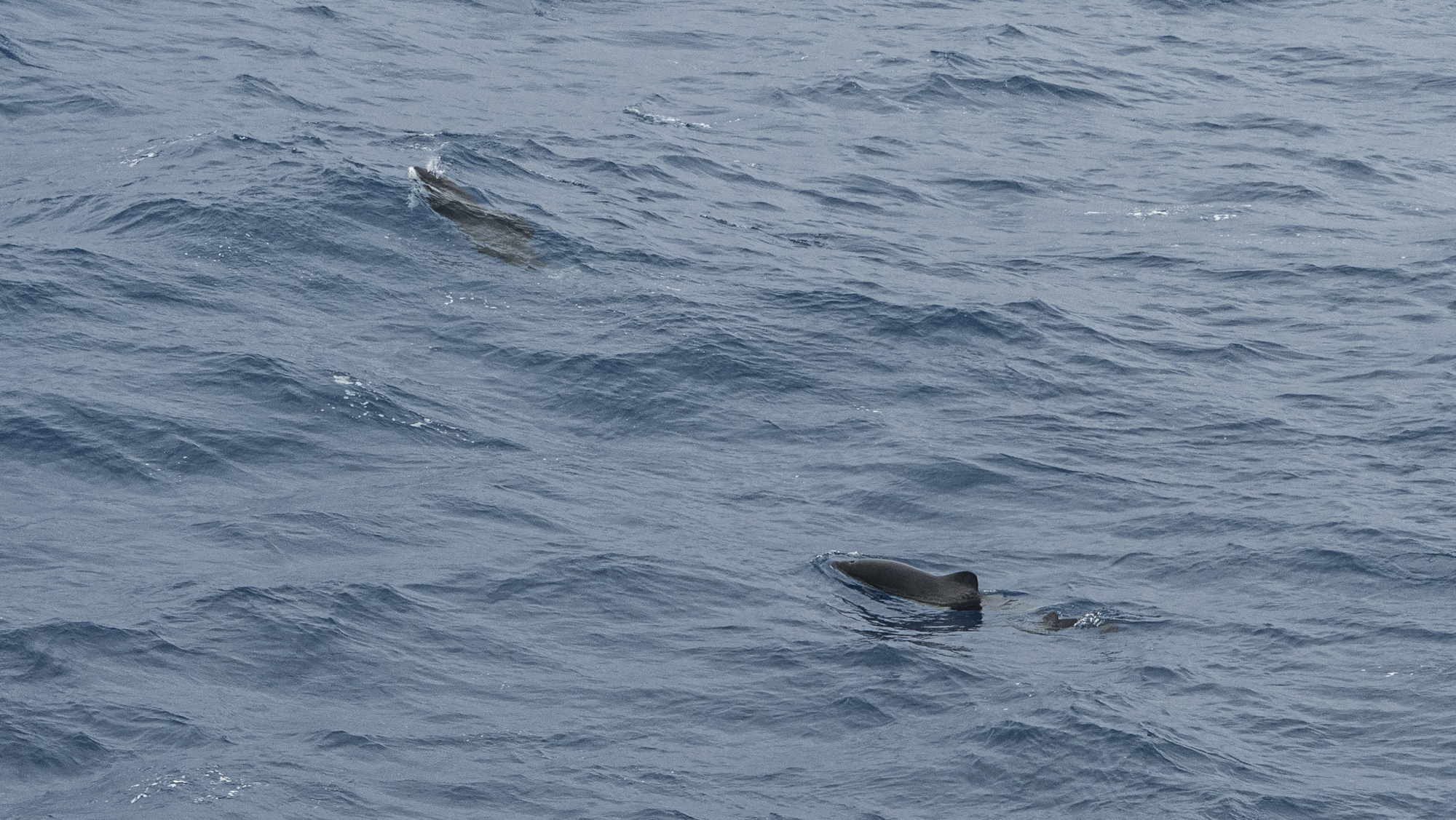
Social life amounts to very small units. At-sea sightings report groups of one to five individuals, with a mean size close to two animals; six mother-calf pairs have been noted, each accompanied by one or two additional adults that always included a mature male. Surface behaviour is evasive: the blow is almost invisible, the animal does not breach, does not play in the bow waves and moves away quickly as a vessel approaches, in the manner of the harbour porpoise.
Breeding remains poorly documented. Births appear to be concentrated in the austral spring and summer, between November and February in the Tierra del Fuego region, and the newborn measures about one metre. The available data do not allow the gestation period to be established with certainty: the Office français de la biodiversité gives a range of 8 to 11 months and sexual maturity reached between 2 and 5 years, or at around 1.8 m in length, but these figures remain approximate, and the duration of lactation as well as the interval between two births are unknown. No longevity estimate has been published.
As for predation, carcasses and sightings suggest that the killer whale, the leopard seal (Hydrurga leptonyx) and various sharks may attack the species. On the beaches of Tierra del Fuego, kelp gulls regularly exploit stranded carcasses.
The spectacled porpoise has been listed as “Least Concern” (LC) on the IUCN Red List since the 2018 assessment, carried out by Dellabianca, Pitman and Braulik; it had previously been placed, in 2008, in the “Data Deficient” (DD) category. This listing should be read with caution: the assessors stress that it could just as well have been kept as DD, in the absence of the slightest abundance estimate, and that a listing as “Near Threatened” (NT) was considered. The status is therefore explicitly provisional, and the population trend is not known. An indirect indication comes from genetics: analysis of the mitochondrial DNA of some fifty individuals reveals a high diversity, compatible with a large and stable population or with a recent expansion over a vast area.
The main identified threat is bycatch. Gillnets, whose fine filaments are poorly detected by porpoise echolocation, are directly implicated: at least 34 bycatch events were recorded in them in Tierra del Fuego between 1975 and 1990. The bottom and pelagic trawls operating off Argentina and Chile are a further source of mortality, the scale of which has not been quantified. Carcasses are reported to be used at times as bait in the crab fishery, with an undetermined frequency and impact. Locally, in Tierra del Fuego, the rate of strandings has been judged potentially unsustainable for the population concerned. Remains found in shell middens show, moreover, that the canoe peoples of the region were already eating the species several thousand years ago, no directed hunt surviving today. To the direct threats are added the pollution of southern waters and the effects of climate change on the productivity of the Southern Ocean.
On the regulatory side, the species is listed in Appendix II of CITES, under the general listing of cetaceans, and in Appendix II of the Convention on Migratory Species (CMS). In French law, it appears on the list of the order of 1 July 2011 setting the list of marine mammals protected on national territory and the arrangements for their protection: the intentional destruction, mutilation, capture or removal of live or dead individuals is prohibited at all times, as is their intentional disturbance, throughout the national territory and in waters under French sovereignty or jurisdiction, which includes the waters of the French Southern and Antarctic Lands.
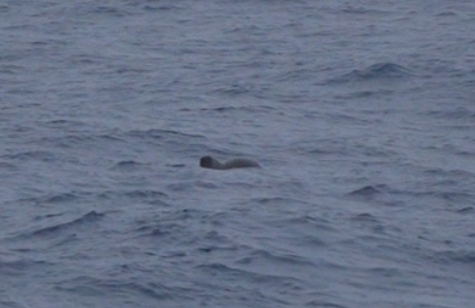
Seeing a spectacled porpoise is a matter of pure luck. The species lives far from the usual shipping routes, does not approach boats, does not breach and produces a blow so faint that it goes unnoticed as soon as the sea gets up: the few sightings come almost entirely from research or expedition vessels crossing the Southern Ocean, in the Drake Passage, off South Georgia, the Falklands, Kerguelen or south of New Zealand. The chances are better in calm seas and good visibility, which incidentally introduces a notable bias into the available data.
In practice, what one looks for is a strongly contrasted black and white shape that appears briefly, without a splash, often alone or in twos. The most reliable marker is the dorsal fin of the adult male, disproportionate and rounded, without equivalent in the region. At Kerguelen, care is needed not to confuse the animal with the Commerson’s dolphin, far more frequent and far more demonstrative in the bays: the local population of that dolphin sets dark greys against light greys with blurred boundaries, where the porpoise cuts a clear black against a pure white.
Any approach must remain passive: no pursuit, no change of course towards the animal, no acceleration. Intentional disturbance is an offence in French waters, and the species is in any case so wary that an approach manoeuvre only shortens the sighting. The most useful contribution is to document, photographs of the dorsal fin and the flank, position, time, conditions, and to pass the information to the scientific teams concerned, in particular to the managers of the Réserve naturelle nationale des Terres australes françaises for any sighting or stranding at Kerguelen or Crozet. Given the very small number of existing data, a single well documented sighting has real scientific value.
Because the dividing line between the black back and the white belly passes above the eye, isolating against the pale background a dark disc outlined by a fine white border around each eye. The effect suggests a pair of spectacles, which the scientific epithet dioptrica also conveys.
Not in metropolitan France: the species is strictly southern and is present neither in the English Channel, nor in the Bay of Biscay, nor in the Mediterranean. It is, however, occasionally reported in the waters of the subantarctic islands of the French Southern and Antarctic Lands, in particular around Kerguelen, where it is among the marine mammals documented for the Heard-Kerguelen IMMA.
It is one of the largest porpoises. Males reach about 2.24 m for 110 to 115 kg, females about 2.04 to 2.05 m for a maximum of about 85 kg. The newborn measures close to a metre.
The spectacled porpoise is the only porpoise to show sexual dimorphism this pronounced: the dorsal fin of the adult male, oval and rounded, is close to 25 cm in height against about 12 cm for the triangular fin of the female. The function of this hypertrophy is not established; it is generally compared with the sexually selected characters observed in other cetaceans, such as the killer whale.
The Burmeister’s porpoise is uniformly dark, with no clearly separated white belly, and its dorsal fin is low, sloping backwards and set very far back on the body. The spectacled porpoise, by contrast, shows a sharp black and white contrast, the eye “spectacles” and, in the male, a tall rounded fin placed at mid-back.
It has been listed as “Least Concern” (LC) since the 2018 IUCN assessment, after having been regarded as “Data Deficient” (DD) in 2008. This listing is explicitly provisional: there is no population estimate and the population trend is unknown. The main documented threat is bycatch in gillnets, at least 34 cases recorded in Tierra del Fuego between 1975 and 1990, to which are added the bottom and pelagic trawls operating off Argentina and Chile, whose impact has not been quantified.
Very poorly. Only one acoustic recording of the species has been published, in 2019: like all porpoises, it emits narrow-band high-frequency clicks, but its repertoire remains to be described for want of dedicated passive acoustic monitoring. Its longevity, for its part, has never been estimated; the only age data available concern sexual maturity, reached between 2 and 5 years according to the Office français de la biodiversité.
Profile compiled from authoritative scientific sources (IUCN, NOAA Fisheries, specialist literature) and reviewed for factual accuracy.
According to the open data of the GBIF, 10 georeferenced sightings of Phocoena dioptrica are recorded in our photographic index.
| Country | Notes |
|---|---|
| Argentina | 6 |
| Australia | 3 |
| New Zealand | 3 |
| Chile | 1 |
| Falkland Islands (Malvinas) | 1 |

Monthly distribution of 14 dated sightings (all years combined): the maximum is reached in December.
| Month | Notes |
|---|---|
| janvier | 0 |
| February | 2 |
| mars | 0 |
| avril | 1 |
| mai | 1 |
| juin | 1 |
| juillet | 1 |
| August | 0 |
| septembre | 3 |
| octobre | 0 |
| novembre | 1 |
| December | 4 |
These figures reflect survey effort (more boaters and more surveys in summer) as much as the actual presence of the species: to be interpreted with caution.


Photographs from GBIF under a Creative Commons licence. The author and the licence of each photograph are given; please respect them if you reuse them.
Automatic selection of the most cited works mentioning the species (source: Crossref).