| Scientific name | Lagenorhynchus albirostris Gray, 1846 |
|---|---|
| Other names | White-nosed dolphin; “squidhound”, a nickname used by Canadian fishermen. In French: lagénorhynque à bec blanc, dauphin à bec blanc, lagénorhynque à rostre blanc; German: Weißschnauzendelfin; Dutch: witsnuitdolfijn; Danish: hvidnæse; Norwegian: kvitnos / hvitnos; Icelandic: blettahnýðir; Spanish: delfín de hocico blanco. |
| Size | 2.4 to 3.1 m as a rule (up to about 3.2 m); 1.1 to 1.2 m at birth |
| Weight | 180 to 350 kg (most often 200 to 300 kg); about 40 kg at birth |
| Longevity | Over 30 years, with individuals reaching about 37 years |
| Diet | Demersal and pelagic fish, very largely dominated by gadids (cod, haddock, whiting, pouting); herring and capelin locally; cephalopods (squid, octopus) and benthic crustaceans as a supplement |
| IUCN status | Least Concern (LC) globally, assessment of 18 March 2018, published in 2018 (Kiszka & Braulik), population trend unknown. Regional European assessment: Least Concern (LC), assessment of 9 January 2023, trend judged stable. No subpopulation is assessed separately; the species is absent from the Mediterranean. In France, the national Red List of the mammals of metropolitan France (IUCN France / MNHN, November 2017) classifies it as Near Threatened (NT) as a visiting species. |
The white-beaked dolphin is a robust, acrobatic dolphin strictly confined to the cold waters of the North Atlantic, from Cape Cod to the Barents Sea. Its tall falcate dorsal fin, the pale saddle that follows it and its very short rostrum distinguish it from its neighbours. With combined numbers exceeding 100,000 individuals, it is classified as Least Concern, but the warming of the water is an underlying threat; in France it is no more than a rare visitor to the eastern English Channel and the southern North Sea.
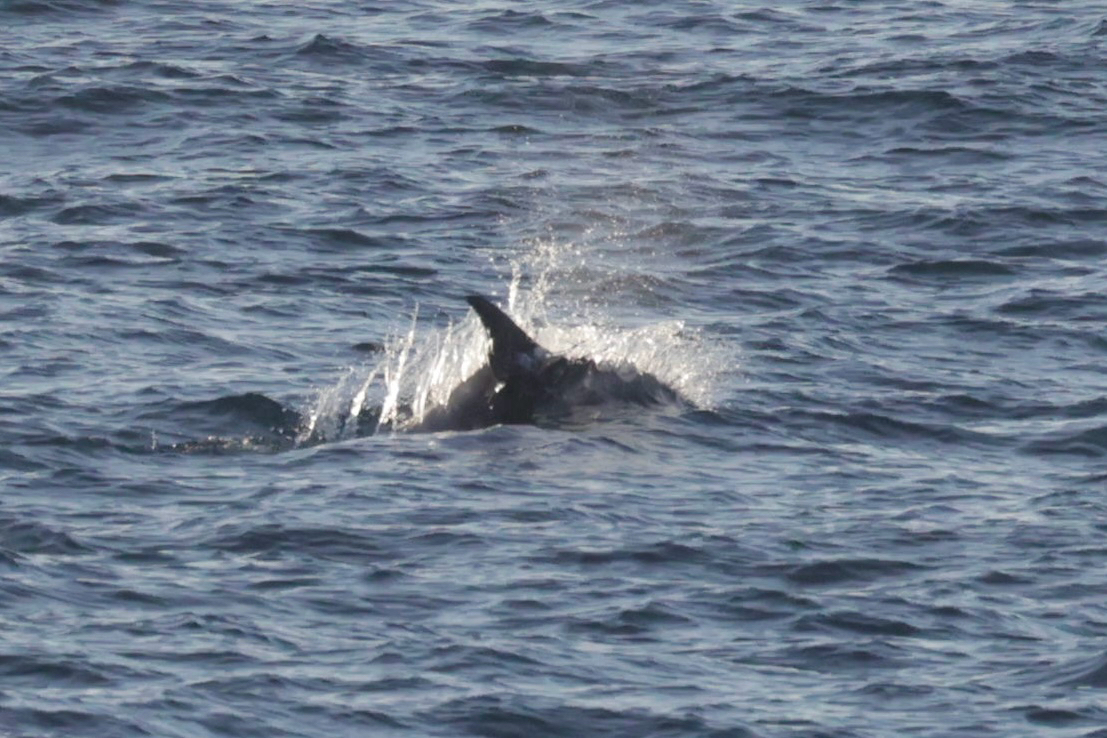
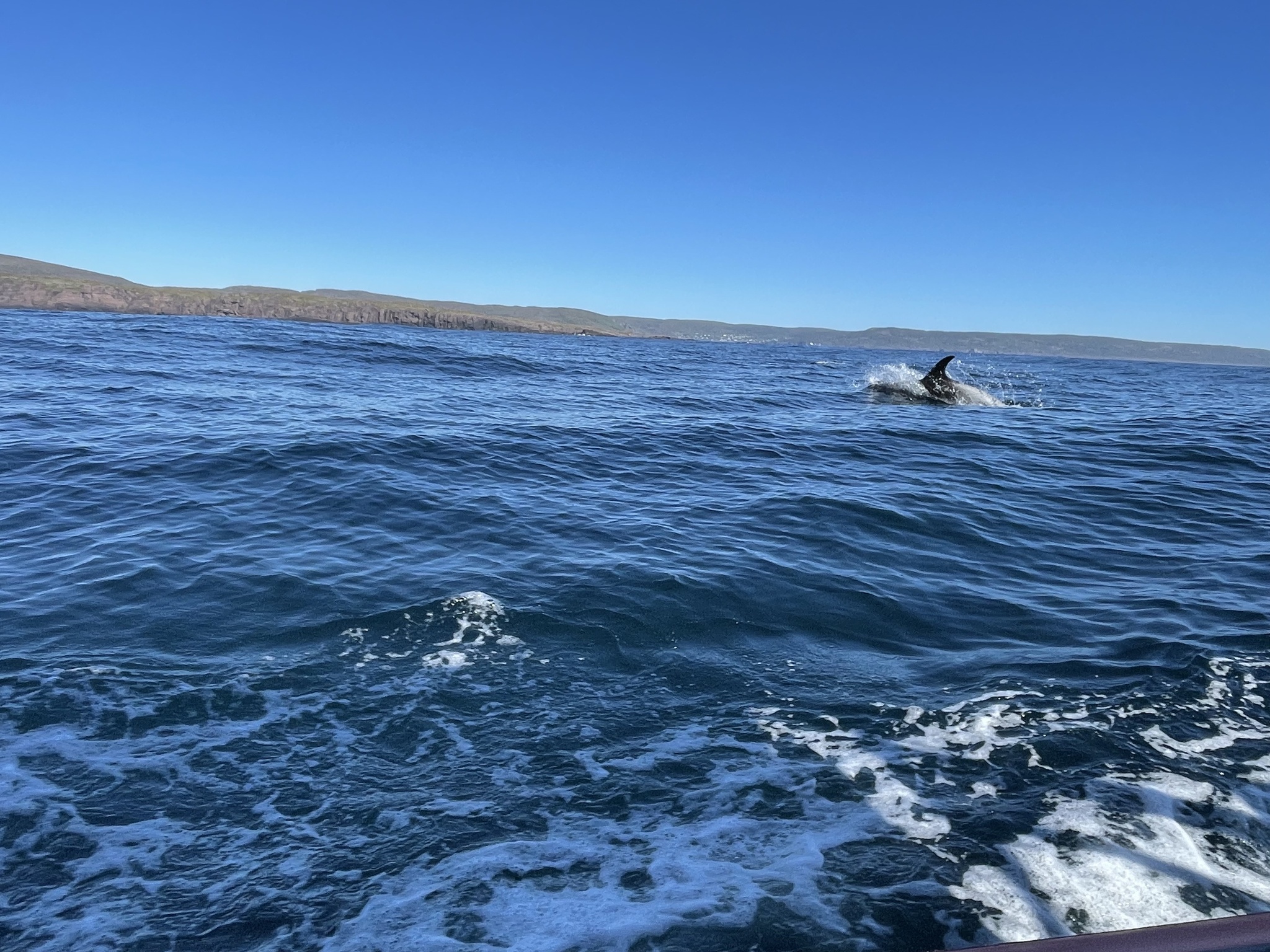
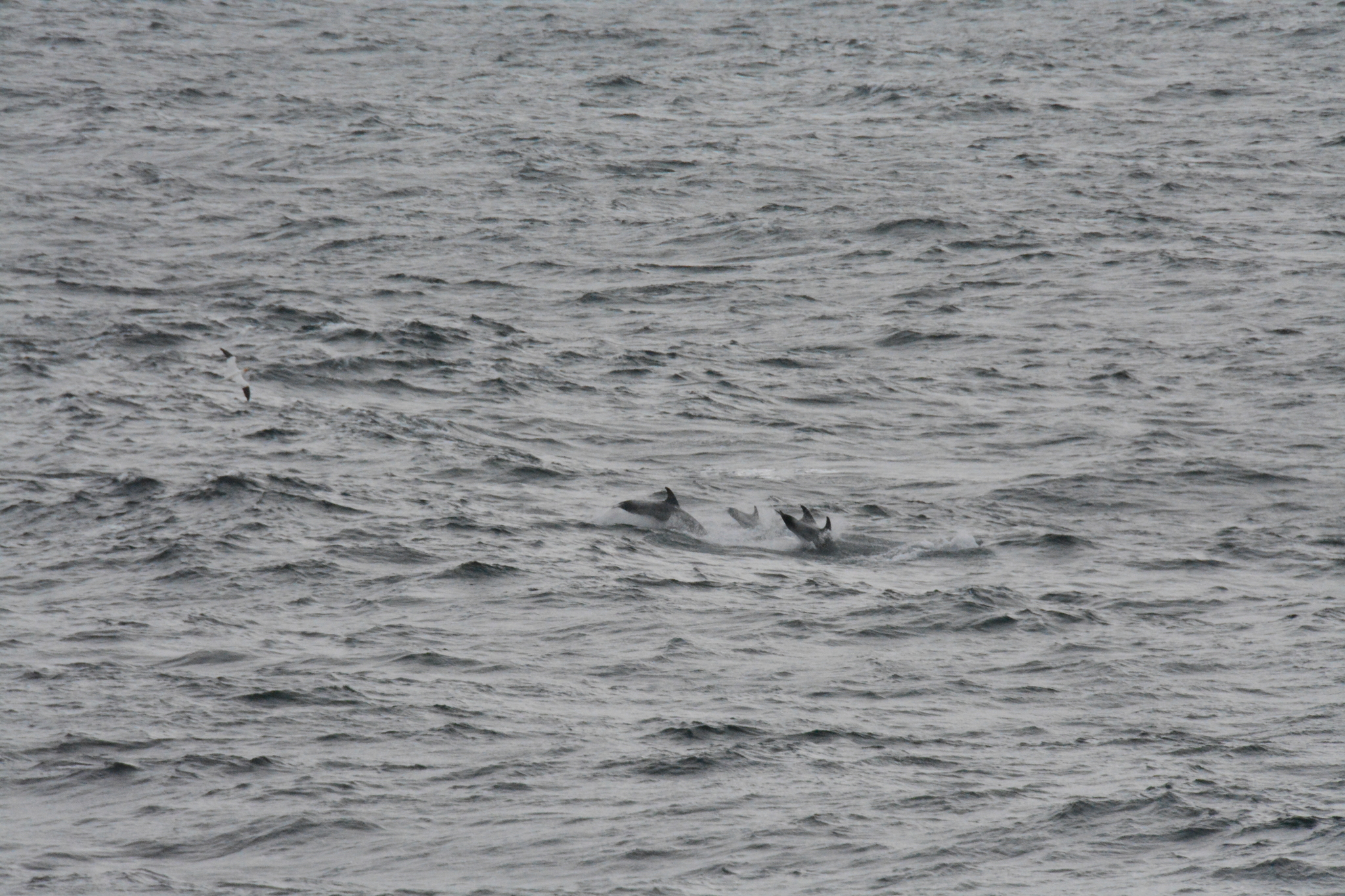
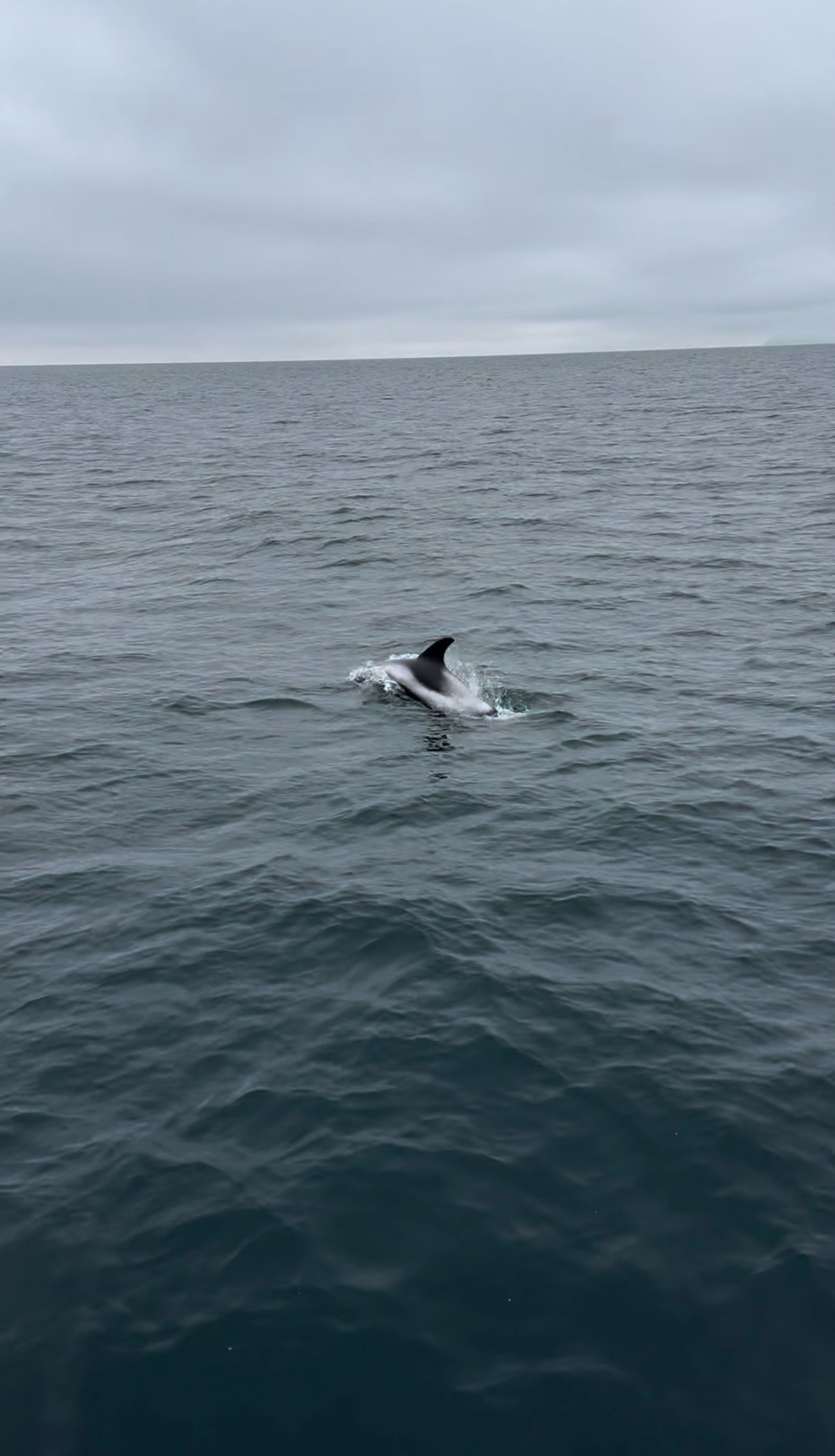
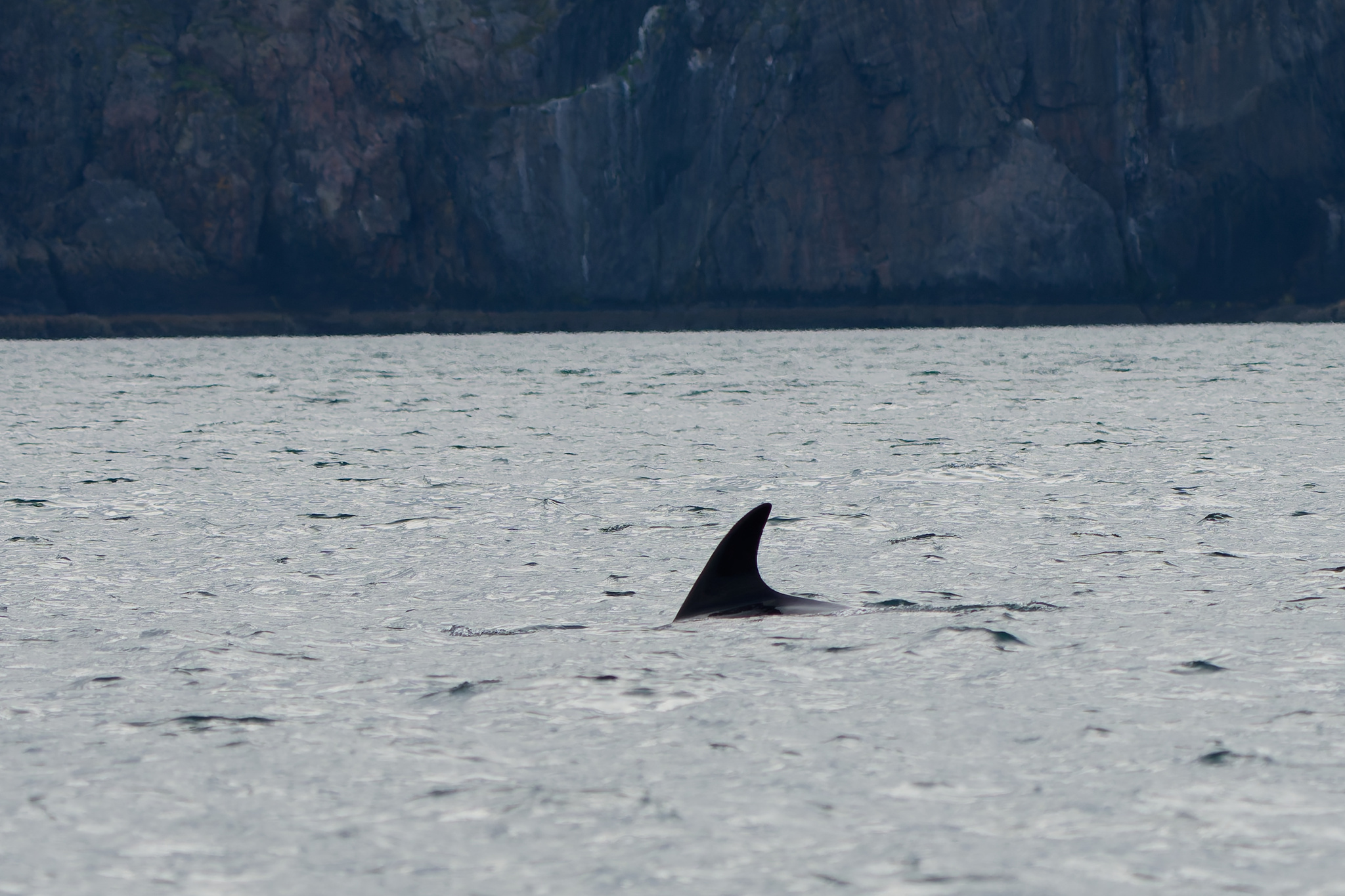
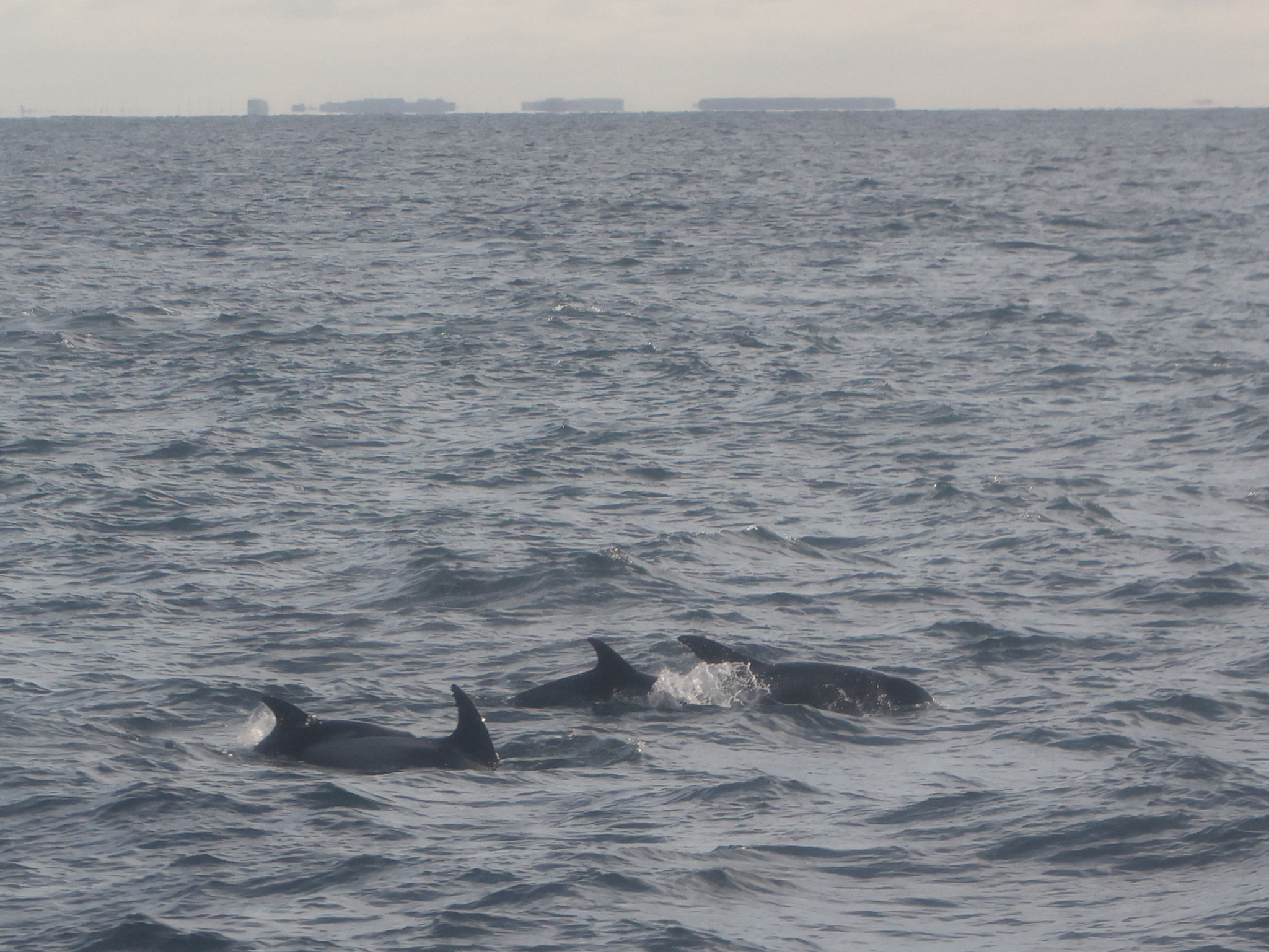
This is a medium-sized but distinctly stocky dolphin: 2.4 to 3.1 m for 180 to 350 kg, with a majority of adults between 200 and 300 kg, males being on average somewhat larger than females. The body is massive, a thick spindle, and the dorsal fin is one of the best criteria: tall, broad at the base, frankly falcate, it can account for nearly 15% of the animal’s total length. The rostrum, by contrast, is very short, only 5 to 8 cm, and separated from the melon by a clear crease. The dentition numbers 22 to 28 conical teeth in each half-jaw. One remarkable anatomical feature: the skeleton can have up to 92 vertebrae, the highest number known in an oceanic dolphin.
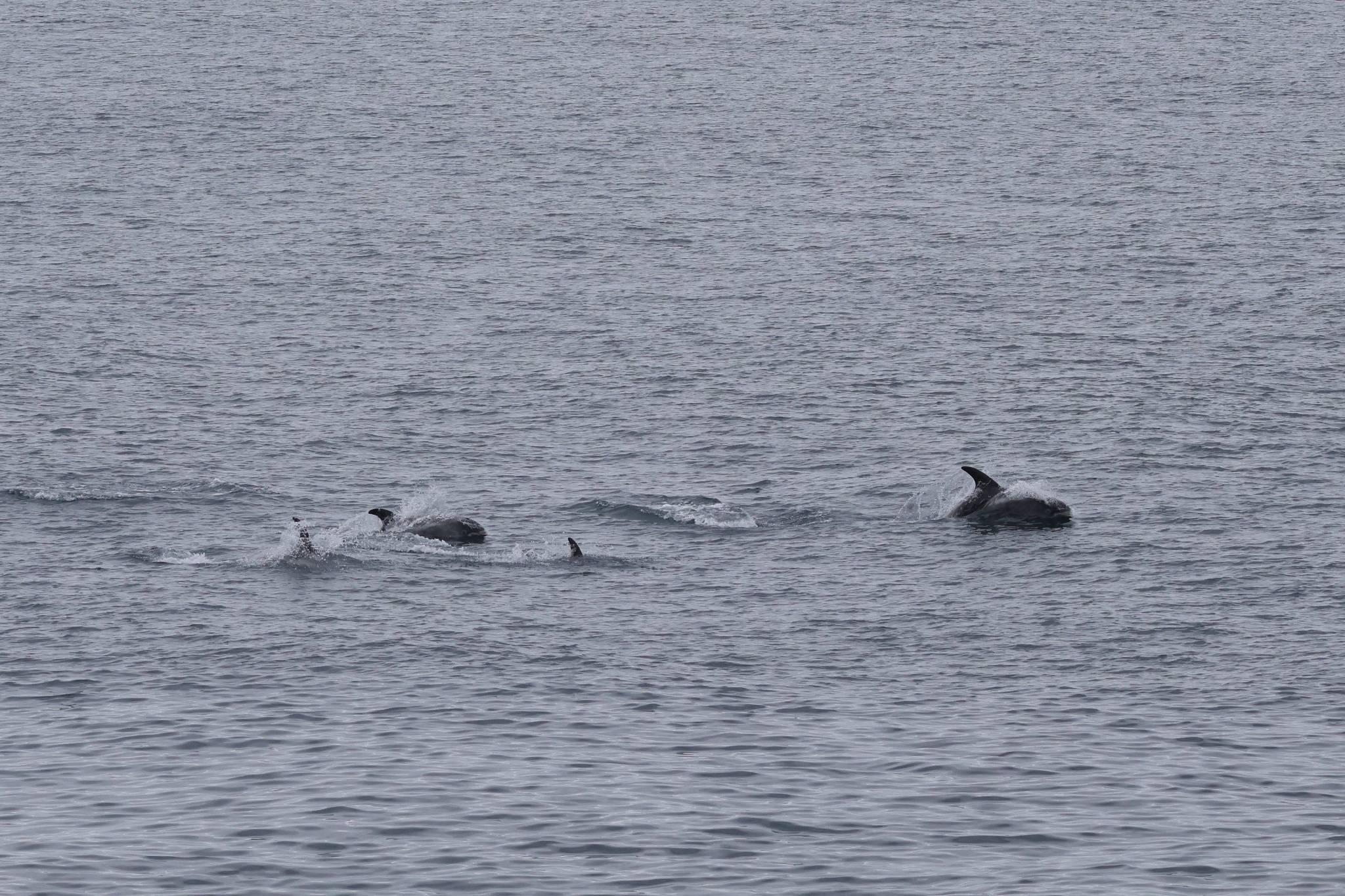
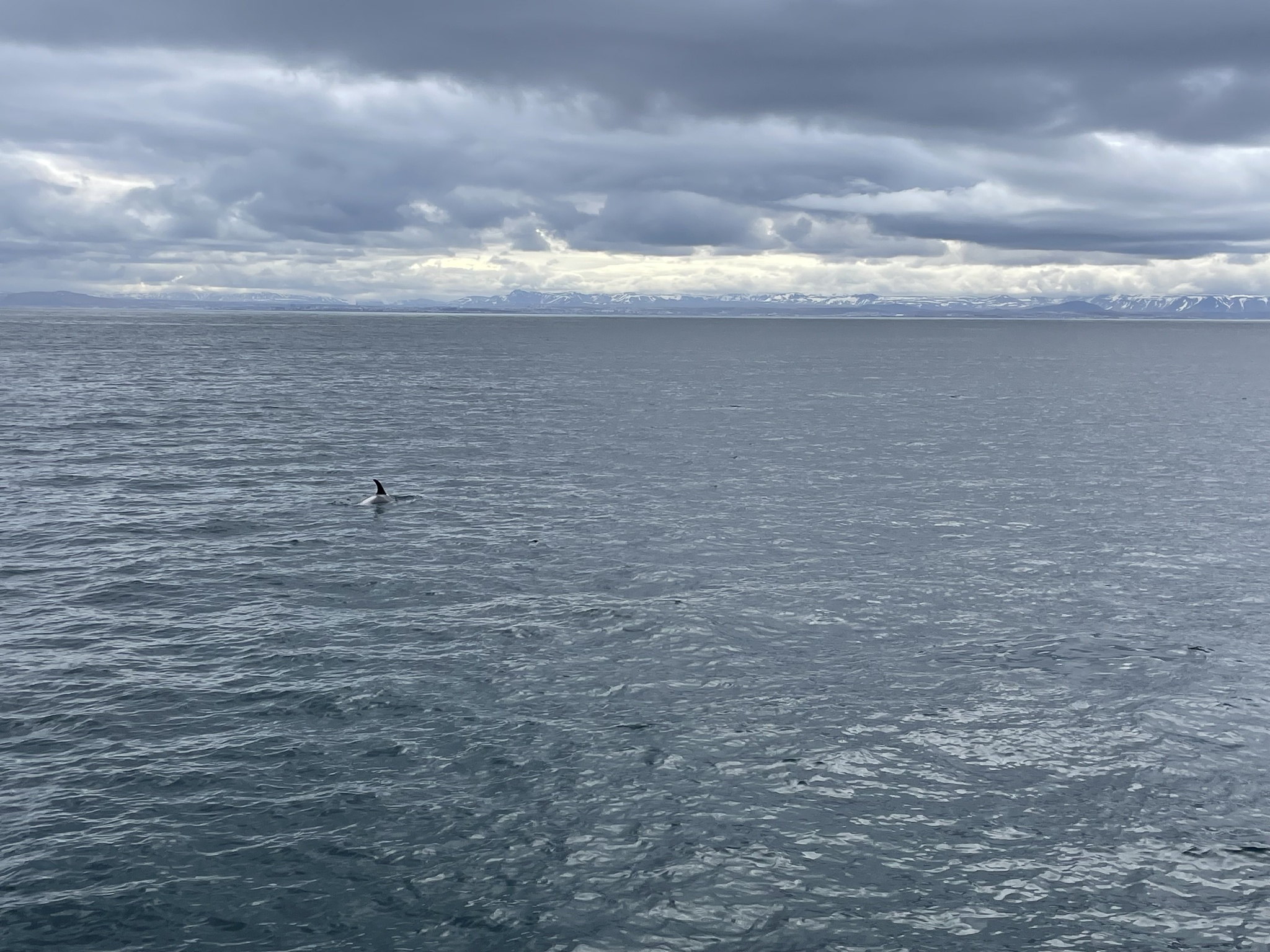
The coloration is contrasting. The back and upper surface are dark grey to blackish, the flanks carry broad pale grey areas and, above all, a pale “saddle” clearly visible behind the dorsal fin; the belly is white. The common name is partly misleading: according to the data assembled by NAMMCO, only about 7% of adults have an entirely white rostrum, most showing a speckled pale grey beak, or even dark grey in older individuals. Newborns carry two to four vibrissae on each side of the rostrum, which then disappear.
The most frequent confusion is with the Atlantic white-sided dolphin (Leucopleurus acutus), which shares the same waters. The latter is more slender, its short rostrum is dark and it bears on the rear flank a distinct ochre to yellowish band, absent in the white-beaked dolphin, which is recognised instead by its pale dorsal saddle. At a distance, the massive outline and the imposing dorsal fin can also suggest a common bottlenose dolphin (Tursiops truncatus), more uniformly grey and lacking the pale saddle, or a common dolphin (Delphinus delphis), far more slender and marked with a yellow hourglass on the forward flank.
The white-beaked dolphin belongs to the family Delphinidae and was described by the British naturalist John Edward Gray in 1846; it is the type species of the genus Lagenorhynchus. That genus long brought together six open-sea dolphins of similar appearance, but the molecular analyses carried out since the late 1990s have shown it to be an artificial assemblage, uniting morphologically convergent but unrelated species. The 2018 IUCN assessment already noted that the Society for Marine Mammalogy’s Committee on Taxonomy preferred to retain the older nomenclature provisionally, in the absence of consensus. That consensus has now been reached: following the phylogenomic work of Galatius et al. (2025), the Committee on Taxonomy’s reference list, updated in April 2026, restricts the genus Lagenorhynchus to the single species albirostris. The Atlantic white-sided dolphin is reclassified in Leucopleurus acutus, and other former “lagenorhynchs” move to the genera Aethalodelphis and Cephalorhynchus. No subspecies is recognised, but morphological differences exist between the eastern and western Atlantic, and the most recent genomic data (Gose et al., 2024, from 169 samples collected between 1992 and 2021, France included) reveal marked structuring, with North Sea and British and Irish populations clearly differentiated from the others.
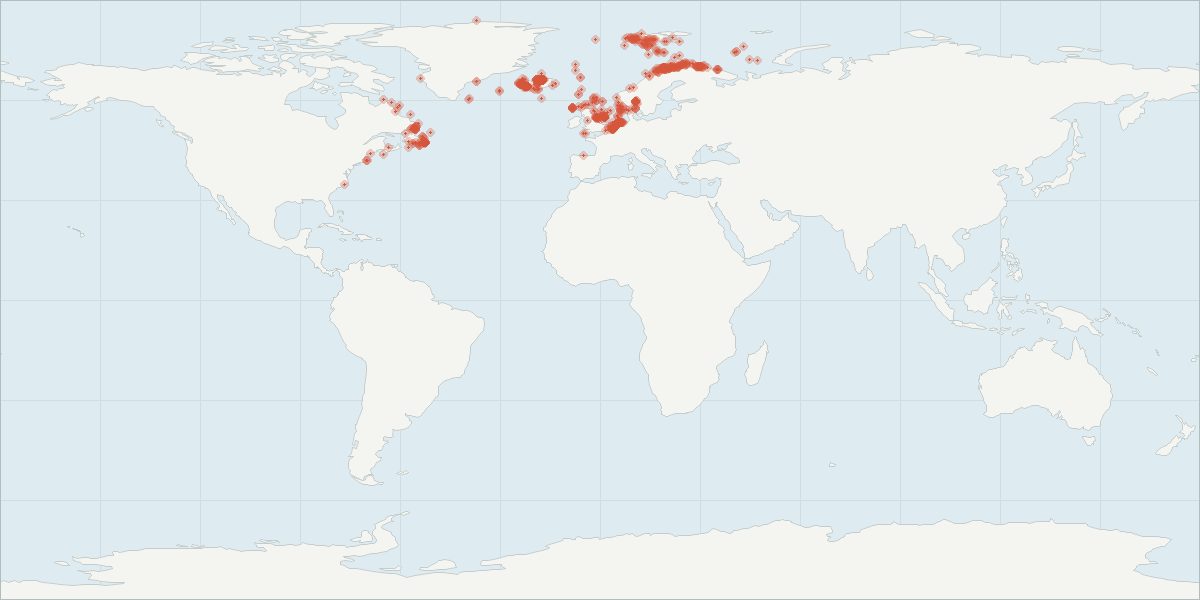
The species is endemic to the cold North Atlantic, cold temperate to subarctic, and occurs nowhere else in the world. Its range extends, to the west, from Cape Cod and the Gulf of St Lawrence to the middle of the Davis Strait and southern Greenland; it takes in Iceland, the Faroe Islands, the British Isles, the North Sea, Scandinavian waters and Svalbard, and continues eastwards as far as Novaya Zemlya in Russia. A few vagrant individuals enter the Baltic Sea. It is an animal of the continental shelf, the shelf edge and the slope: it occurs mainly over depths of less than 200 m, often between 50 and 100 m. Water temperature strongly structures its presence, with a marked preference for waters below 13 °C and an extreme thermal limit estimated at around 18 °C. The species is entirely absent from the Mediterranean.
France is among the range states recognised by the IUCN, in both the global and the European assessment, northern France forming the southern limit of the regular range on the eastern seaboard. Its presence there nonetheless remains marginal and concentrated in the eastern English Channel and the southern North Sea. The Réseau national échouages, coordinated by the Observatoire Pelagis, recorded 28 strandings between 1990 and 2020 on the mainland French coast: 26 in the English Channel and only 2 in the Atlantic, of which 75% (21 of 28 cases) in the Hauts-de-France region alone. Reports are more numerous from November to spring. The species is also present off Saint-Pierre-et-Miquelon.
Sociable and demonstrative, the white-beaked dolphin most often travels in groups of fewer than ten to around thirty individuals; gatherings of several hundred animals are observed where prey concentrates, exceptionally up to fifteen hundred. Groups are sometimes structured by age and sex. It is a fast swimmer, able to reach some thirty kilometres per hour, which readily breaches and comes to ride the bow wave of vessels. Documented dives remain modest, of the order of at least 45 m, consistent with a way of life on the shelf. Acoustically, echolocation clicks peak at around 115 kHz and social whistles at around 35 kHz, audible to conspecifics up to some ten kilometres away.
Feeding is remarkably specialised on gadids. In the Netherlands, 25 fish species have been identified in stomachs, but gadids accounted for 98% of the ingested mass, whiting and cod foremost; in Scotland, haddock, whiting and cod dominate. In Iceland, the species also exploits capelin, which it hunts alongside seabirds and humpback whales. Hunts are often collective, sometimes in association with rorquals, humpback whales or killer whales, and take place both near the surface and near the bottom.
Breeding is seasonal: mating in summer, gestation of about 11 months and births concentrated from June to September, with a few calvings reported as early as May. The calf measures 1.1 to 1.2 m and weighs some forty kilograms. Females reach sexual maturity at around 6 to 10 years, males somewhat later, at around 8 to 12 years. The generation length adopted by the IUCN is 18 years, and longevity exceeds 30 years.
The species has been classified as Least Concern (LC) on the global Red List since the assessment of March 2018, on the grounds of a wide distribution and large numbers: the sum of the available estimates then exceeded 100,000 individuals, and NAMMCO puts forward a total of more than 300,000 for the North Atlantic as a whole. Around Iceland, estimates vary widely from one survey to the next, 31,653 individuals in 2001, 91,277 in 2007, 59,966 in the most recent aerial survey of 2016, with very wide confidence intervals; the NASS 2015 survey also estimated 159,000 animals (CV = 0.63) for the central North Atlantic as a whole. The SCANS surveys in the North Sea produced 23,716 individuals in 1994, 37,689 in 2005 and 36,287 in 2016 (39,535 when SCANS-III and ObSERVE are combined); the SCANS-IV survey of summer 2022 arrives at the highest estimate in the series, 67,138 animals (CV = 0.33). The trend analysis over 1994-2022 shows no statistically significant change (+1.63% per year; 95% CI: -5.72 to 9.55; p = 0.45), the data being able to detect only a decline of at least 2% per year. The north-western seaboard is far more modest: about 2,000 individuals in United States waters. The European regional assessment of 2023 confirms the LC status and a stable trend, while stressing the uncertainty over the delimitation of populations.
The pressures identified are, first, a small-scale and opportunistic hunt, long-standing and non-commercial, practised in Greenland, Iceland, the Faroes, Norway and Canada; some 366 animals a year were taken in the early 1980s in twelve Labrador ports. Then come incidental catches in gillnets and trawls, poorly documented but judged rare at the scale of the range, contamination by chemical pollutants and heavy metals, underwater noise from shipping traffic and pile driving, and above all the warming of the water. A cold-water species confined to the shelf, it is seeing its suitable habitat shrink from the south without being able to move indefinitely northwards: a northward shift has been demonstrated from strandings in the North Sea between 1991 and 2017, and a partial replacement by the common dolphin is documented west of Scotland.
The species is listed in Appendix II of CITES and in Appendix II of CMS, for its North Sea and Baltic Sea populations only, covered by the ASCOBANS agreement and by Annex IV of the Habitats Directive. In France it has full protection: capture, intentional disturbance and destruction of its habitat are prohibited.
Iceland offers the best chances of a sighting: the white-beaked dolphin is the commonest dolphin there, present all year round, and regularly accompanies trips leaving Reykjavík in Faxaflói Bay and Húsavík in Skjálfandi Bay, where it readily comes to play in the bow wave. It is also seen along the Norwegian coast, in the Minch west of Scotland and on the east coast of Scotland, where numbers peak from June to September, with a maximum in August. In metropolitan France, a sighting at sea is exceptional: knowledge of the species rests almost entirely on strandings along the Hauts-de-France coast and the eastern English Channel. Any stranded animal, alive or dead, must be reported to the Réseau national échouages and left unhandled.
As with any cetacean, the approach is made with care: navigate parallel to the animals’ course, at a constant speed, with no pursuit and no cutting across their path, at a distance of at least a hundred metres, for a limited observation time, and swimming with them is prohibited. If the dolphins choose of their own accord to come and ride the bow wave, it is enough to hold a steady course and speed.
Not always, far from it. According to NAMMCO’s reviews, only about 7% of adults have an entirely white rostrum. In most individuals it is speckled pale grey, and it can turn dark grey with age. The most reliable criterion in the field remains the pale saddle behind the tall dorsal fin.
Very rarely. France is indeed part of its range, but the species is no more than a visitor to the eastern English Channel and the southern North Sea. Between 1990 and 2020, the Observatoire Pelagis recorded 28 strandings on the mainland French coast, 26 of them in the English Channel and 21 in the Hauts-de-France region alone. The species is entirely absent from the Mediterranean, and therefore from the Pelagos Sanctuary.
The Atlantic white-sided dolphin (Leucopleurus acutus) is more slender, its short rostrum is dark and it carries on the rear flank a very characteristic ochre to yellowish band. The white-beaked dolphin, more massive, lacks it and shows in its place a pale grey saddle behind the dorsal fin.
NAMMCO puts forward more than 300,000 individuals for the North Atlantic as a whole, but regional estimates vary greatly from one survey to the next. In the North Sea, the SCANS surveys gave 23,716 animals in 1994, 37,689 in 2005, 36,287 in 2016 and 67,138 in 2022 (CV = 0.33), the highest value in the series. The trend analysis over 1994-2022 shows no statistically significant change (+1.63% per year; 95% CI: -5.72 to 9.55; p = 0.45): the precision of the surveys would allow only a decline of at least 2% per year to be detected.
Least Concern (LC) on the global IUCN Red List since the assessment of March 2018, with an unknown population trend, and Least Concern too in the European regional assessment of January 2023, with a trend judged stable. In France, the national Red List of 2017 classifies it as Near Threatened (NT) as a visiting species. The species is listed in Appendix II of CITES and in Appendix II of CMS for its North Sea and Baltic Sea populations only.
There is no commercial hunt, but small-scale, opportunistic takes continue in Greenland, Iceland, the Faroe Islands, Norway and Canada. In the early 1980s, about 366 animals a year were caught in twelve Labrador ports. These removals remain largely unmonitored, which the IUCN identifies as a priority research need.
It is a cold-water species confined to the continental shelf, which favours temperatures below 13 °C and whose extreme thermal limit is close to 18 °C. Because it cannot cross deep water to move northwards, its suitable habitat is shrinking from the south. A northward shift has already been demonstrated in the North Sea between 1991 and 2017, and a partial replacement by the common dolphin is documented west of Scotland.
Fact sheet compiled from authoritative scientific sources (IUCN, NOAA Fisheries, specialist literature) and reviewed for factual accuracy.
According to the open data of the GBIF, 836 georeferenced sightings of Lagenorhynchus albirostris are recorded in our photographic index.
| Country | Notes |
|---|---|
| Iceland | 336 |
| Norway | 181 |
| Netherlands | 90 |
| United Kingdom of Great Britain and Northern Ireland | 77 |
| Canada | 73 |
| Svalbard and Jan Mayen | 61 |
| Denmark | 12 |
| Russian Federation | 11 |
| Greenland | 9 |
| United States of America | 6 |

Monthly distribution of 860 dated sightings (all years combined): the maximum is reached in juillet.
| Month | Notes |
|---|---|
| janvier | 20 |
| February | 26 |
| mars | 57 |
| avril | 60 |
| mai | 121 |
| juin | 120 |
| juillet | 200 |
| August | 137 |
| septembre | 61 |
| octobre | 22 |
| novembre | 15 |
| December | 21 |
These figures reflect survey effort (more boaters and more surveys in summer) as much as the actual presence of the species: to be interpreted with caution.


Photographs from GBIF under a Creative Commons licence. The author and the licence of each photograph are given; please respect them if you reuse them.
Automatic selection of the most cited works mentioning the species (source: Crossref).