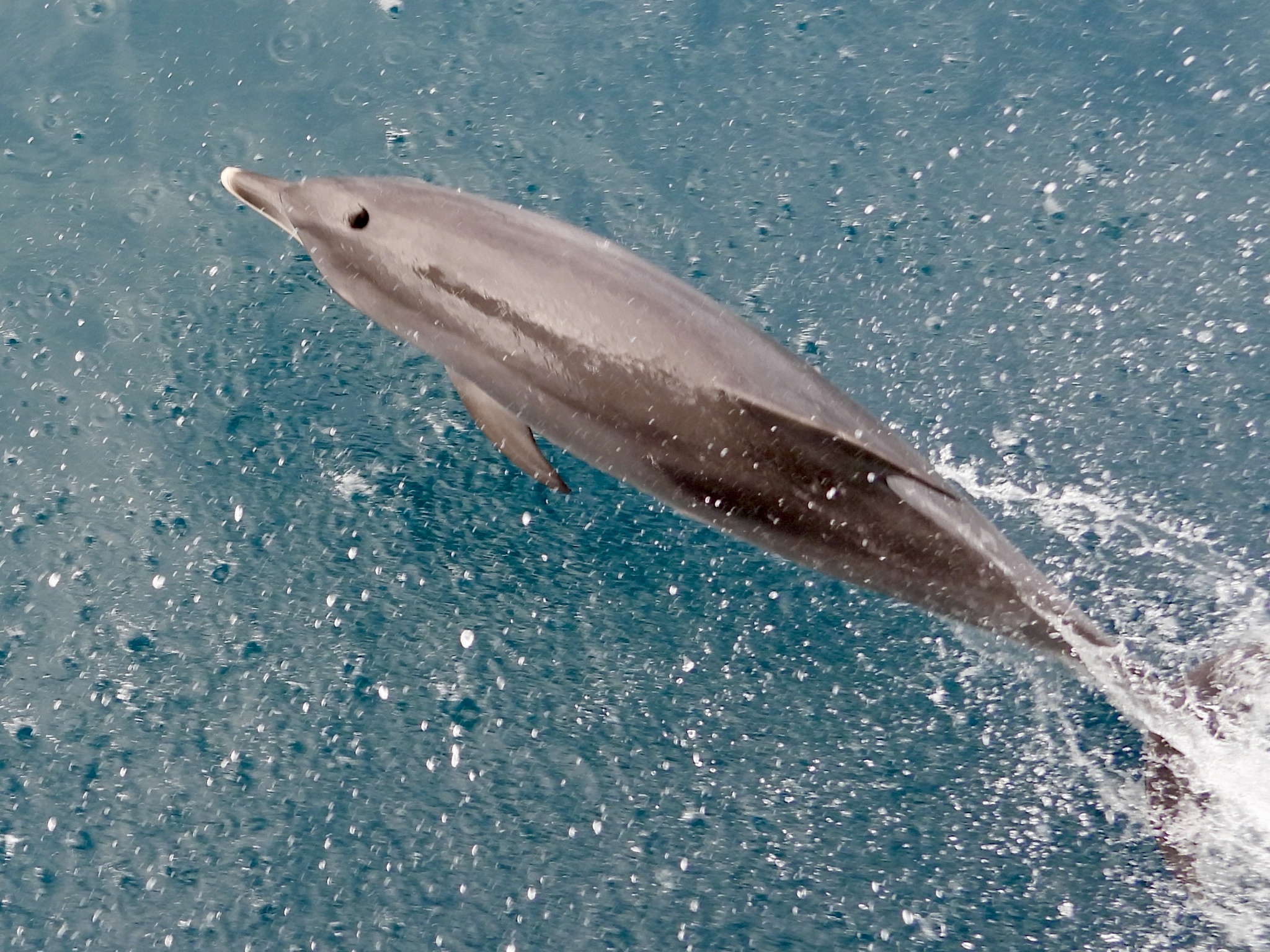
| Scientific name | Stenella frontalis (G. Cuvier, 1829) |
|---|---|
| Other names | Dauphin de Pernetty, dauphin du Gulf Stream, dauphin bridé (French); Atlantic spotted dolphin (English); originally described under the name Delphinus frontalis. |
| Size | 1.6 to 2.3 m in adults (newborn: 0.8 to 1.2 m) |
| Weight | 100 to 143 kg |
| Longevity | Poorly established; around twenty years is cited in the compilations, but individuals identified in the Bahamas have been followed for more than thirty years |
| Diet | Small fish (pelagic schools offshore, benthic and reef fish near the coast), cephalopods (squid, octopus) and benthic invertebrates |
| IUCN status | Least Concern (LC), assessment of 2018 (Braulik & Jefferson); the species was previously listed as “Data Deficient” (DD), a status still relayed by some older entries |
The Atlantic spotted dolphin is a medium-sized delphinid endemic to the warm-temperate and tropical Atlantic Ocean, where it occurs mainly over the continental shelf and its margins. Its coat changes with age: plain during the first years, it gradually becomes covered with pale spots on the back and dark spots on the belly, to the point where old adults appear almost mottled. Listed as Least Concern by the IUCN, it is present in the French waters of the Antilles and French Guiana, but absent from the Mediterranean.
The Atlantic spotted dolphin is a robust, compact delphinid, more heavily built than most of its congeners in the genus Stenella. Adults measure 1.6 to 2.3 m for 100 to 143 kg, the largest individuals measured reaching about 2.26 m in males and 2.29 m in females. Geographical variability is marked: a male from the Azores measured 1.66 m, a female from Panama 2.29 m. The rostrum is long, narrow and clearly set off from the melon; the dorsal fin, falcate, is tall, with a broad base and a rounded tip; the flippers are pointed. The upper jaw carries 32 to 42 pairs of small conical teeth, the lower jaw 30 to 40 pairs.
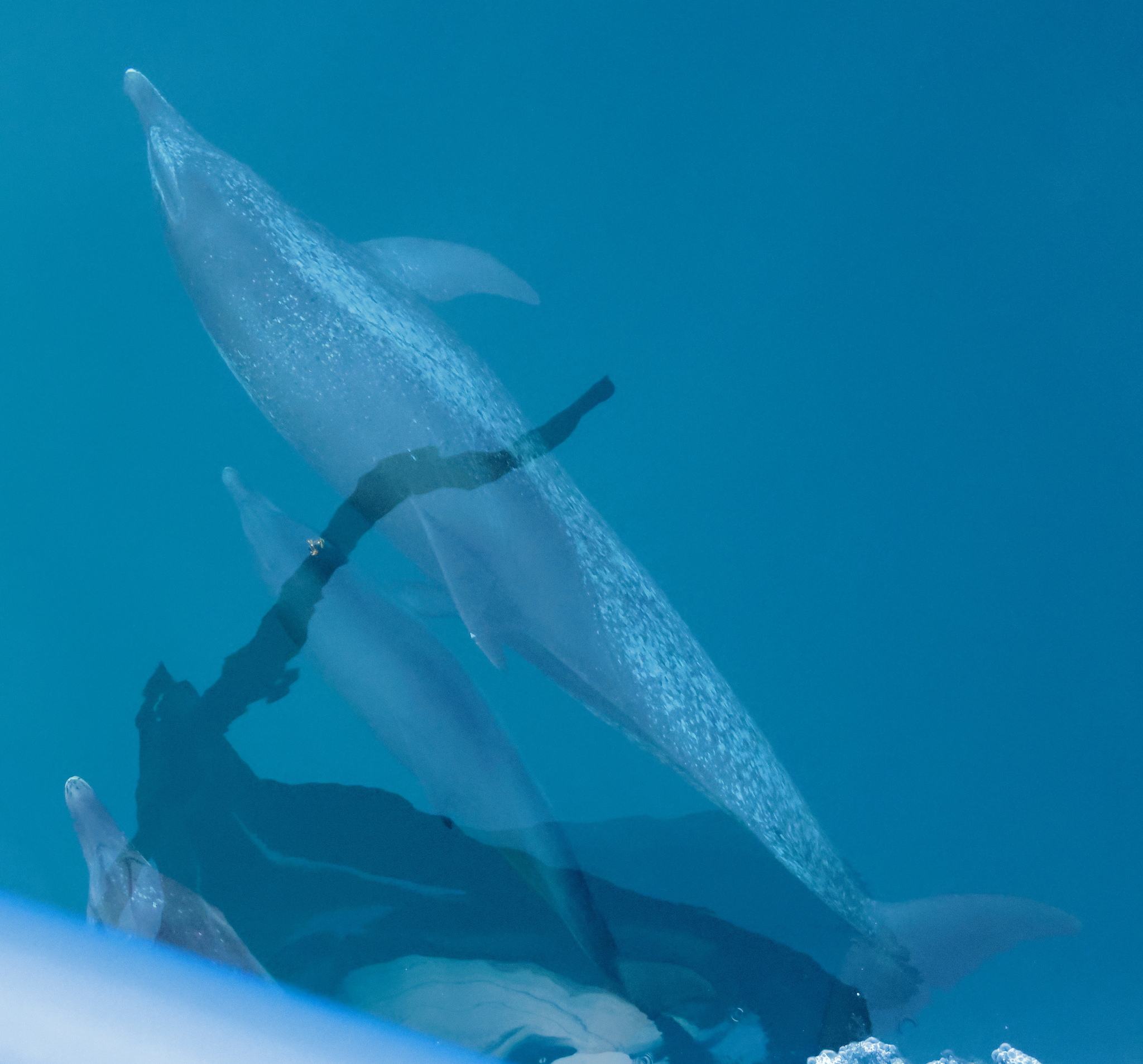
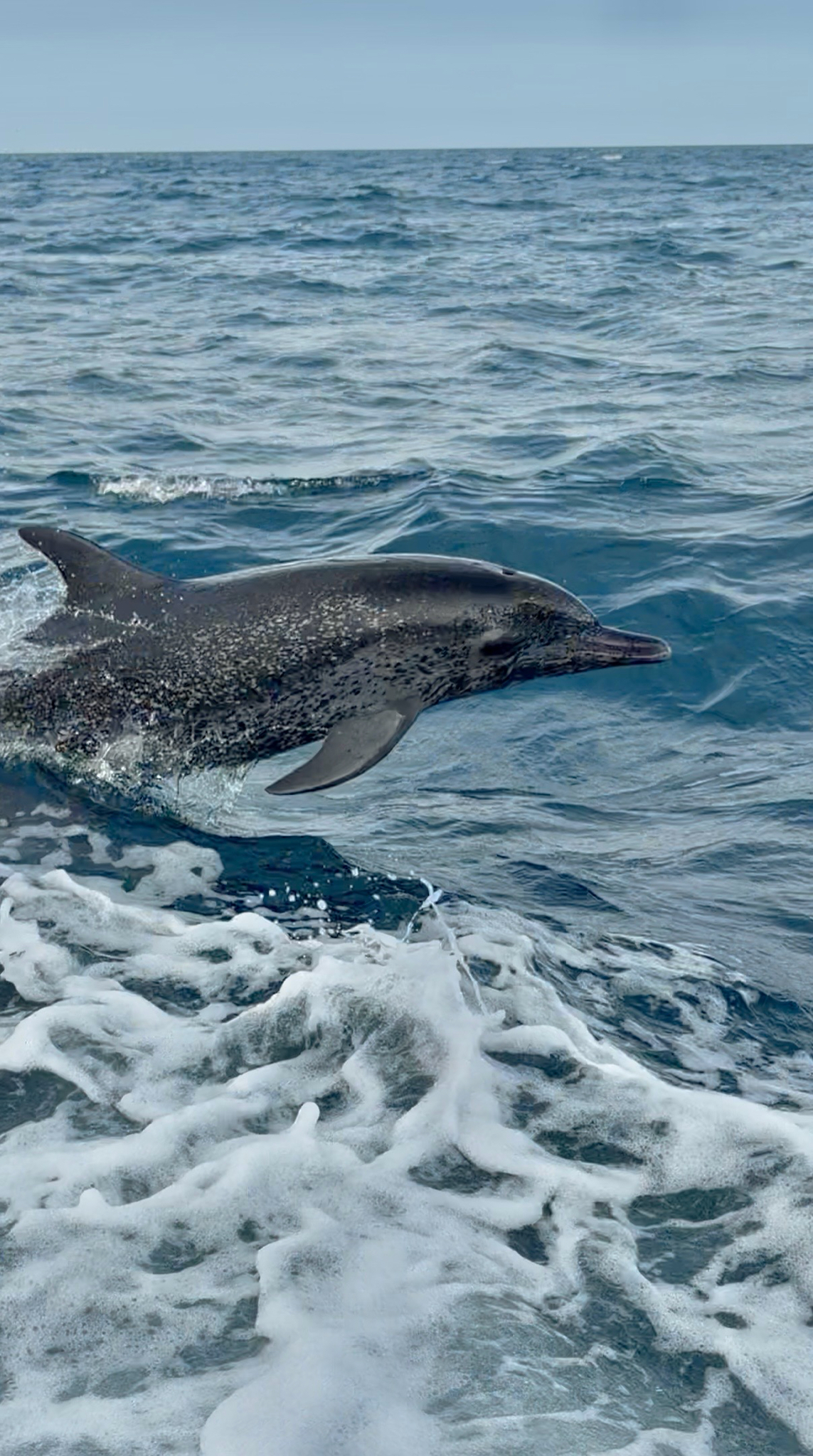
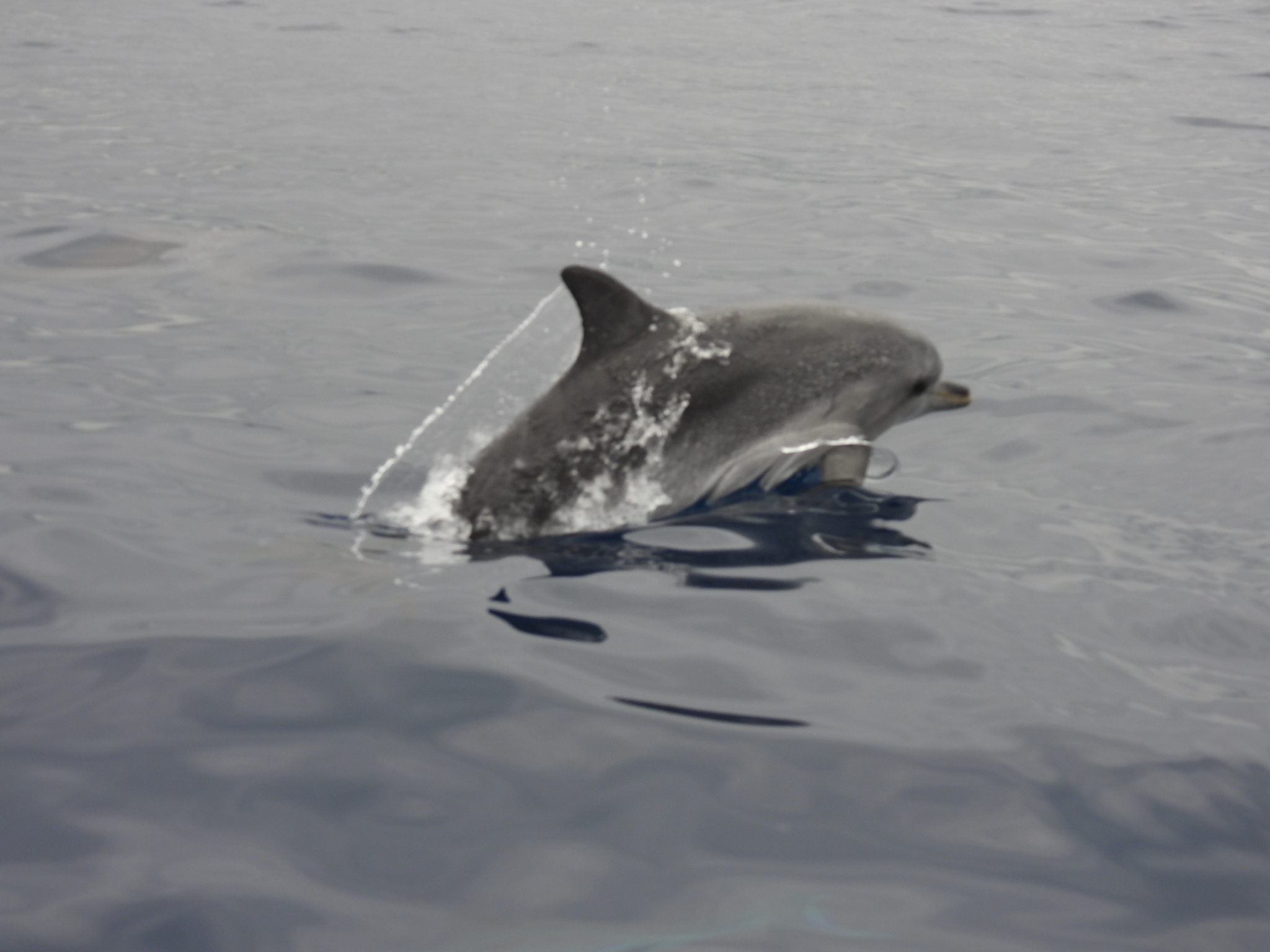
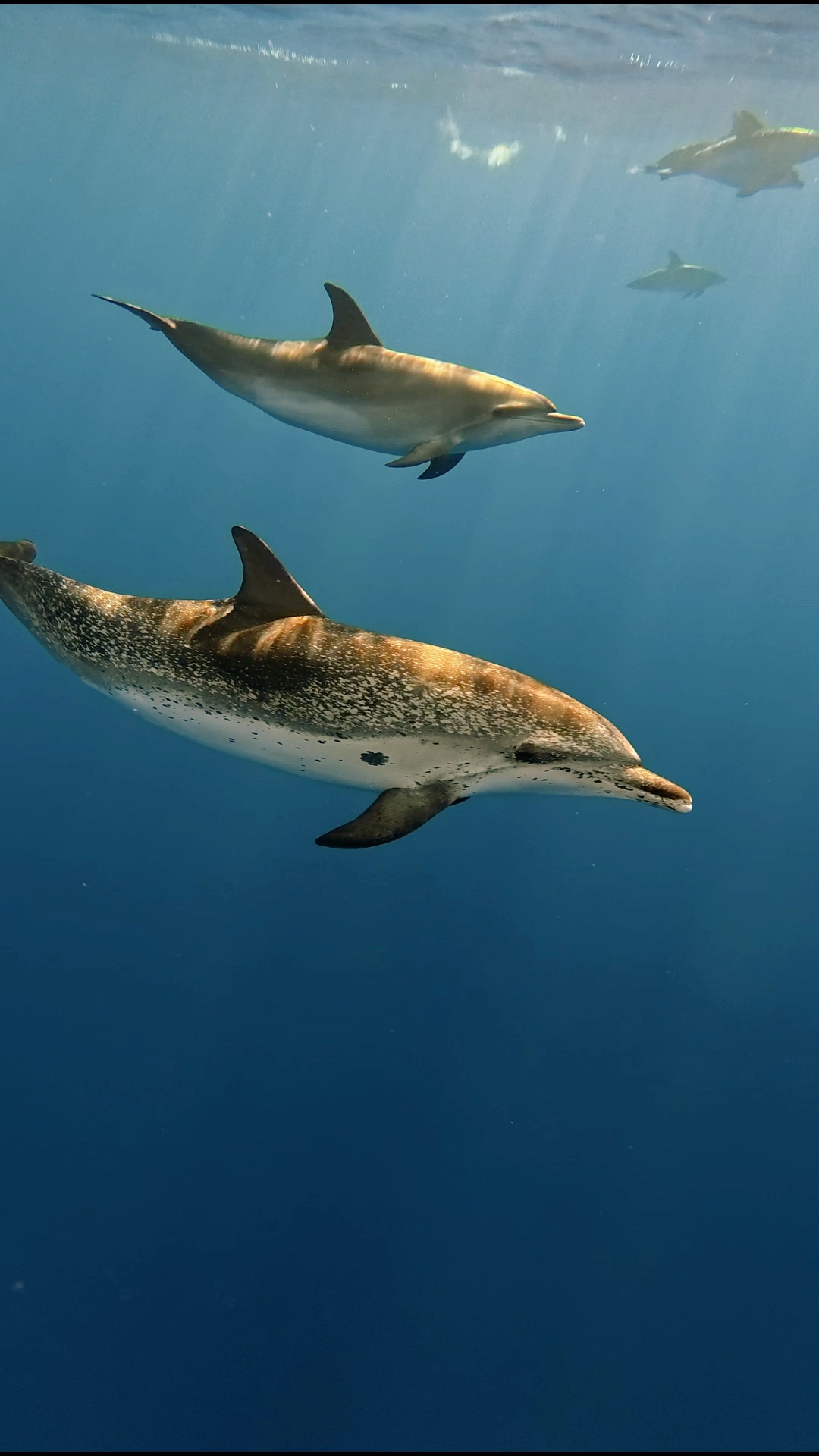
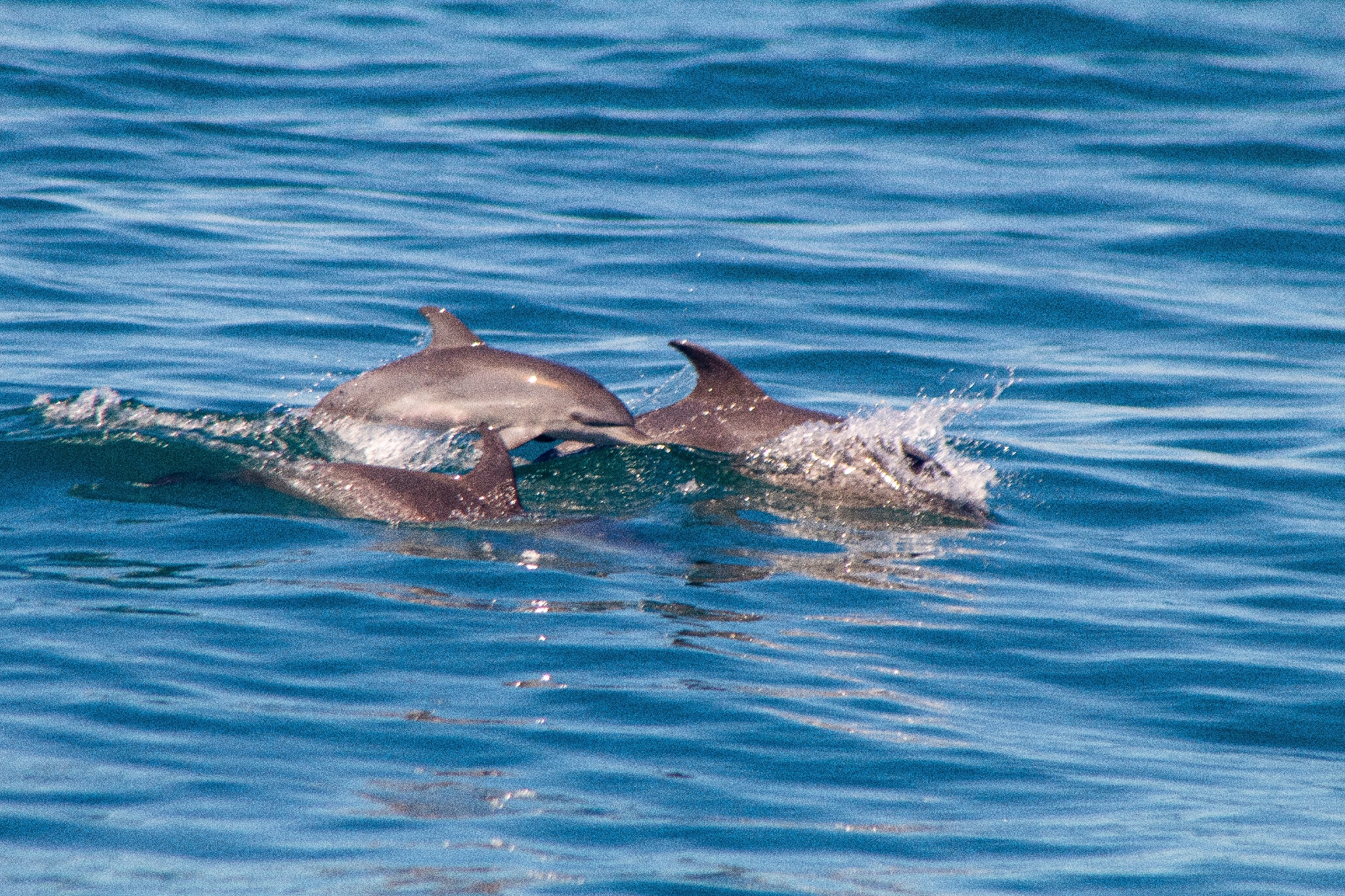
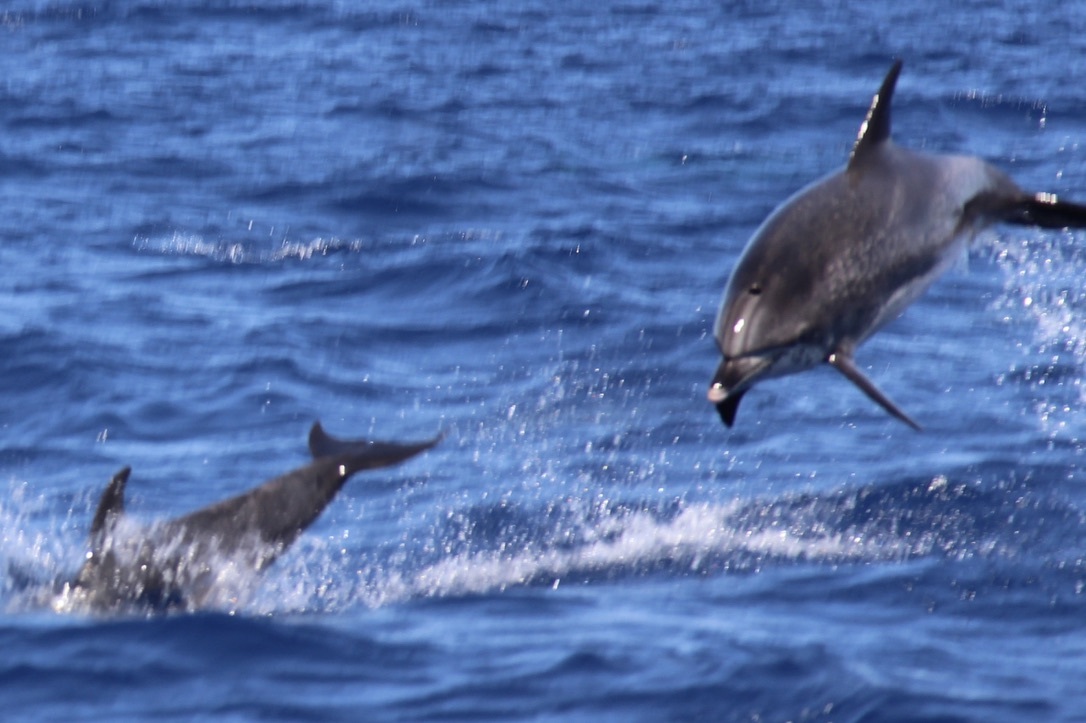
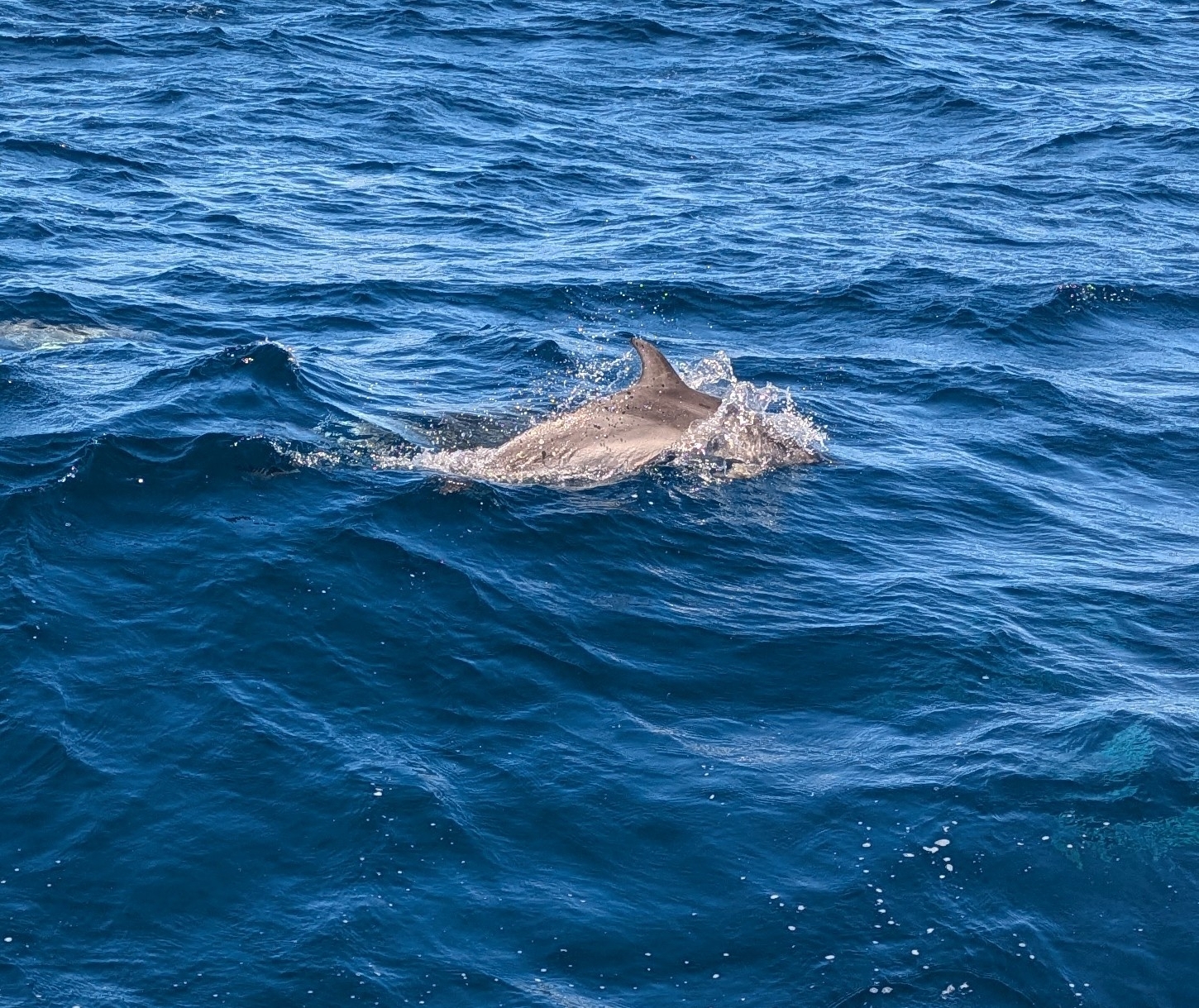
The basic coat is three-toned: dark grey dorsal cape, medium grey flanks, whitish belly. The most useful character in the field is the pale “blaze” that rises from the grey flank and enters the dark cape in the direction of the dorsal fin. The spots, for their part, are not present at birth: newborns are plain and remain so for several years. Speckling develops only around weaning, between two and four years (unspotted young, known as “two-tone”, remain so until about four years), first as dark points on the belly, then on the flanks; it then spreads and intensifies throughout life, passing through successive stages, speckled (about 4 to 9 years), mottled (about 10 to 16 years), then fused (from about 16 years), until old animals take on a dark appearance peppered with pale points. The spot pattern, specific to each individual, is stable over time and serves as the basis for photo-identification.
Confusion is frequent. The pantropical spotted dolphin (Stenella attenuata), sympatric over part of the range, is slimmer and more slender; the unspotted juveniles of the two species are practically indistinguishable at sea. A young Atlantic spotted dolphin, still plain, may also be taken for a small common bottlenose dolphin (Tursiops truncatus), the latter being larger, however, and with a shorter rostrum. The spinner dolphin (S. longirostris), the striped dolphin (S. coeruleoalba, which has no spots) and the Clymene dolphin (S. clymene) complete the list of possible look-alikes.
Described by Georges Cuvier in 1829 under the name Delphinus frontalis, the species belongs to the family Delphinidae and to the subfamily Delphininae. No subspecies is formally recognised to date, but two morphologically distinct forms are commonly described and could in time receive a taxonomic status: a continental shelf form, large and heavily spotted, confined to within or close to the 200 m isobath, and an island and offshore form, smaller and less spotted; this second form is not known from the Gulf of Mexico.
The genus Stenella itself is problematic: molecular work shows that it is not monophyletic, as is also the case for Tursiops, and no satisfactory phylogenetic solution has yet established itself. The taxonomy committee of the Society for Marine Mammalogy has chosen to maintain the current nomenclature provisionally for as long as more decisive morphological and genetic studies have not settled the fate of these “problematic” genera.
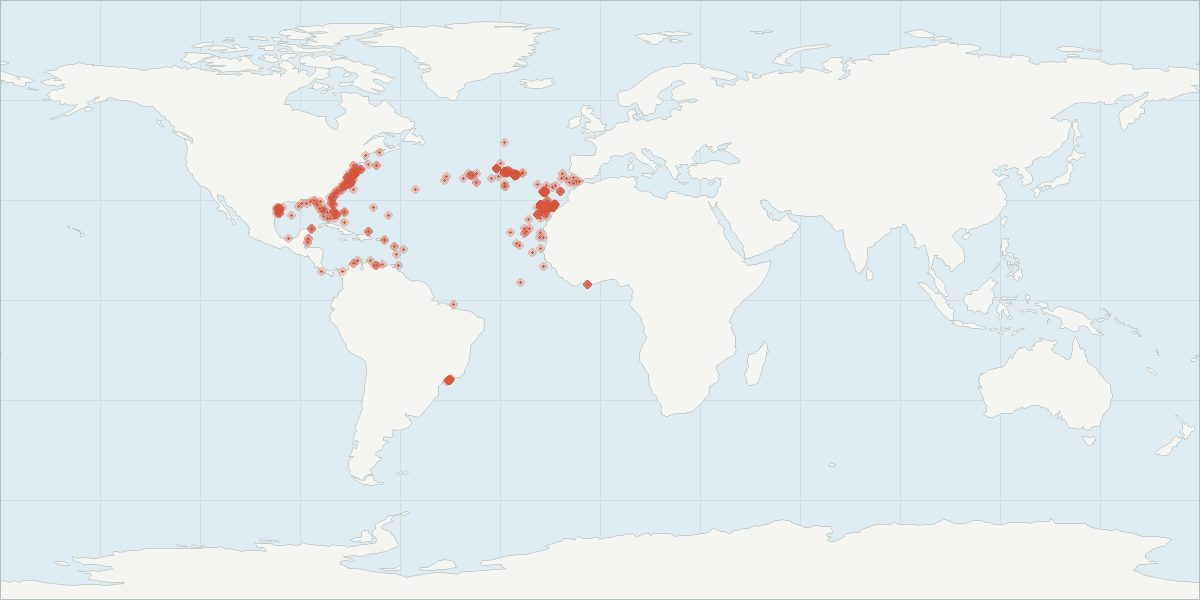
The species is strictly Atlantic. Its range extends approximately between 50°N and 25°S, in warm-temperate and tropical waters. In the western Atlantic, it is reported from southern New England and Cape Cod as far as southern Brazil (Rio Grande do Sul), with strong concentrations in the Gulf of Mexico and on the Bahama banks. In the eastern Atlantic, it is regular around the Azores, Madeira, the Canaries and Saint Helena, as well as along the coasts of West Africa as far as Gabon. It is absent from the Mediterranean Sea.
The preferred habitat corresponds to the continental shelf and its margins, in 20 to 250 m of water, including 250-350 km from the coast; in the Bahamas, the animals also use very shallow sandy bottoms, of 6 to 12 m. Distribution is influenced by warm water masses, in particular the Gulf Stream, along which sightings are regularly made.
In France, the Atlantic spotted dolphin frequents the Atlantic overseas waters: the French Antilles, where it is among the more than twenty cetacean species recorded in the Agoa sanctuary (23 according to the sanctuary, 26 according to the OFB), and French Guiana. French sources diverge on its status in metropolitan France: the portal of the Office français de la biodiversité mentions it in the maritime areas of metropolitan France and of the overseas territories, while the sighting syntheses regard it as confined to the Atlantic overseas territories. It is in any case not a common species of the metropolitan coasts.
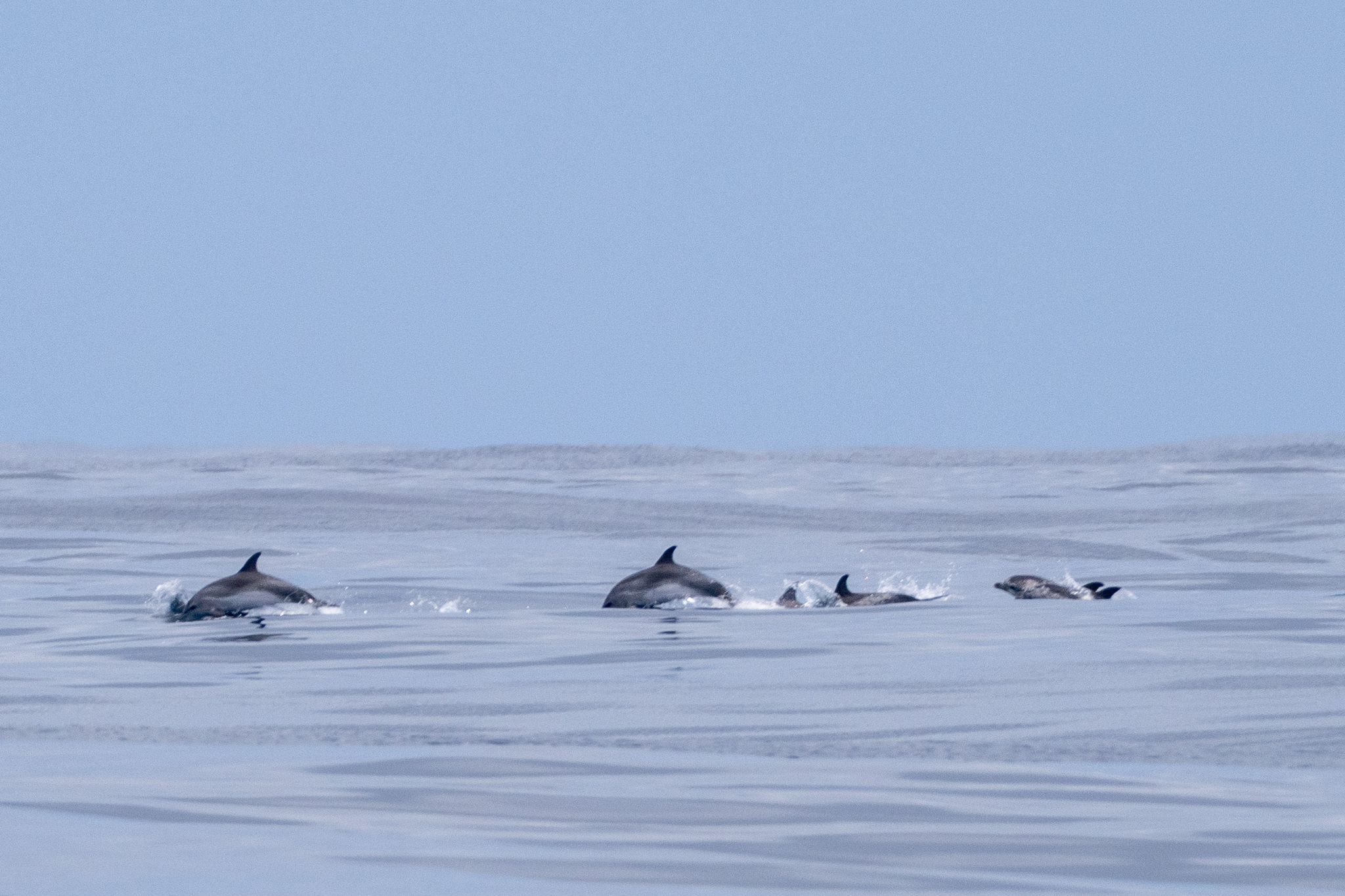
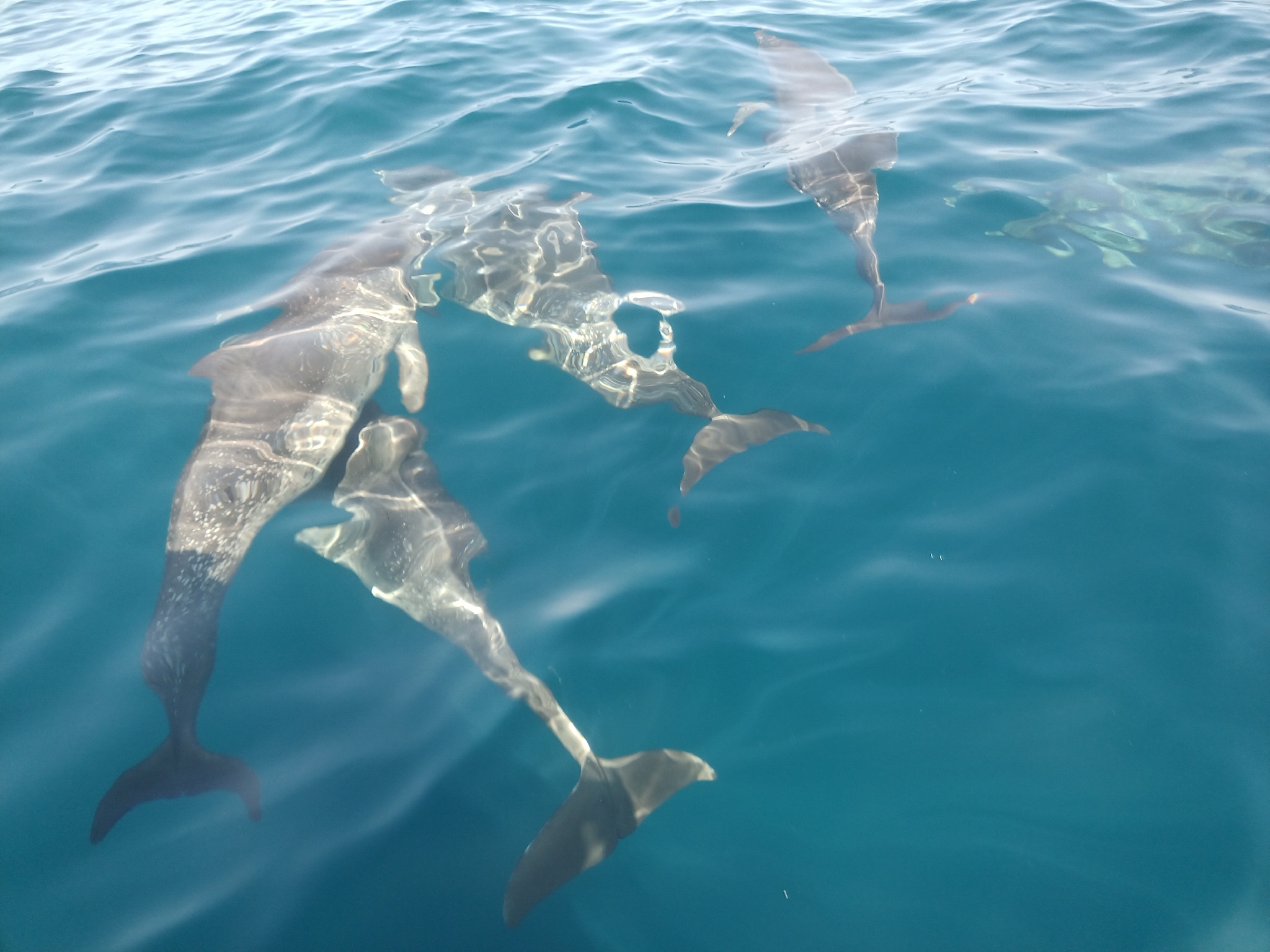
Gregarious, the Atlantic spotted dolphin lives in groups whose size varies greatly with habitat: 5 to 15 individuals near the coast, 25 to 50 offshore, with gatherings occasionally exceeding 200 animals. Mixed associations with the common bottlenose dolphin are frequent and give rise to sometimes lively interactions, including chases and bites, behaviours that are rarer between conspecifics, where visual intimidation dominates.
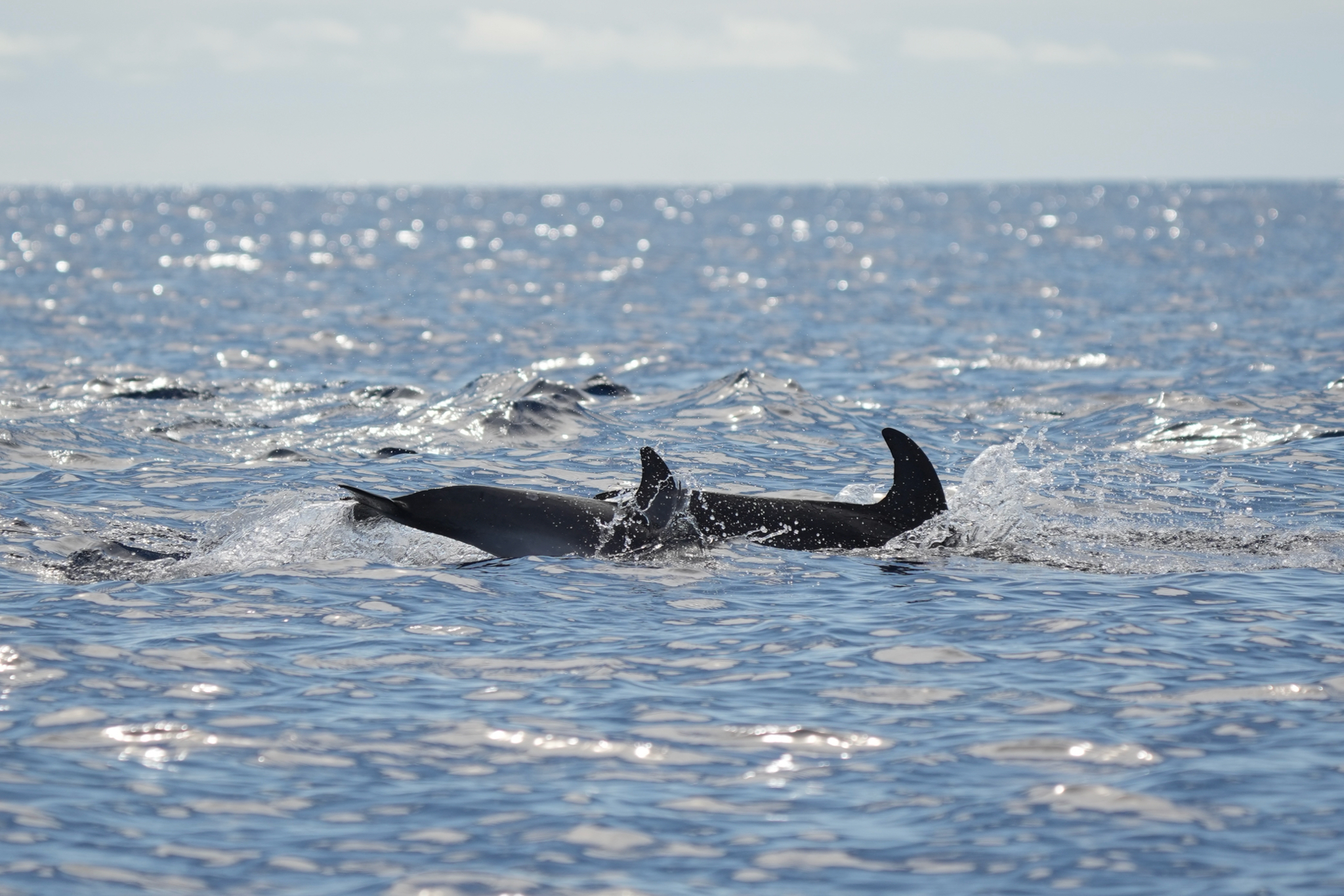
The species is known for its surface activity: fast swimming, repeated leaps, acrobatics and bow-riding. Ordinary dives are shallow, of the order of 10 m for less than two minutes; the reported maxima lie around 40 to 60 m, with breath-holds that may reach six to ten minutes depending on the source.
The diet reflects the habitat. Coastal groups take benthic and reef fish, crustaceans and invertebrates, and they sometimes probe the sand with the rostrum to flush out buried prey. Offshore groups exploit schools of pelagic fish, herring, anchovy, sardine, mackerel, and squid. Hunting is often co-operative, the group encircling the schools, and part of the feeding activity takes place at night. The regurgitations collected during monitoring yield squid beaks and fish vertebrae, valuable for reconstructing the menu.
The acoustic repertoire combines echolocation clicks, whistles and pulsed sounds in bursts; about ten vocal types have been described, among them signature whistles used in particular to initiate contact. Bubble emissions also take part in communication.
Gestation lasts 11 to 12 months and produces a single calf, born between spring and autumn, from May to September according to French data. The interval between two births is on average three to four years, values of one to five years being reported. Lactation lasts from one year to several years, and the young remains associated with its mother until about three to five years, the female being relieved by other members of the group; it is also around weaning that the first spots appear. Sexual maturity is reached between 8 and 15 years. Maximum longevity remains poorly known: NOAA Fisheries states that it is not established, the compilations put forward around twenty years, and the photo-identification monitoring carried out in the Bahamas since 1985 has made it possible to recognise the same individuals for more than thirty years, over four generations and more than 220 animals catalogued. The main natural predators are large sharks (tiger shark, bull shark) and the killer whale.
This long-term monitoring has also documented a remarkable episode: in 2013, about half of the resident community of the Little Bahama Bank left its usual waters to settle some 160 km further south, on the Great Bahama Bank, off Bimini. This movement followed a marked fall in surface temperature and in chlorophyll a, suggesting a local collapse of the food web; social integration with the local resident community took place slowly.
The IUCN Red List classifies Stenella frontalis as Least Concern (LC), under the 2018 assessment conducted by G. Braulik and T. A. Jefferson. This status succeeds an earlier listing as “Data Deficient” (DD), still taken up by several entries that have not been updated and by some national red lists. No estimate of the world population is available. The most solid regional assessments come from the United States, where NOAA Fisheries gives about 31,500 individuals for the Western North Atlantic stock and about 21,500 for that of the northern Gulf of Mexico, the size of the Puerto Rico and US Virgin Islands stock remaining unknown.
The threats identified are first of all fishery-related: bycatch in bottom-set and drifting gillnets, pelagic longlines and shrimp trawls, with documented cases off Brazil, Venezuela and West Africa. Direct takes, by harpoon or net, persist in some islands of the Caribbean, in South America and in West Africa. To these are added underwater noise of human origin, which masks communication and echolocation and can cause hearing loss, as well as illegal feeding and harassment by sea users, which make the animals lose their natural wariness.
The species is listed in Appendix II of CITES and in Annex II of the SPAW protocol for the wider Caribbean region; it also comes under the CMS memorandum of understanding for the conservation of marine mammals of West Africa and Macaronesia. In the United States, it is protected by the Marine Mammal Protection Act. In France, it is a protected and regulated species; in the French Antilles, it benefits from the Agoa sanctuary, a marine protected area of 143,256 km² created in 2010 and recognised as a specially protected area under the SPAW protocol in 2012. Its very high mortality in tanks explains why it is not kept in dolphinaria.
Curious and demonstrative, the Atlantic spotted dolphin is among the delphinids easiest to watch where it occurs: it readily comes to the bow of boats, leaps and surfs in the wake. In the north-east Atlantic, the Azores, Madeira and the Canaries are the best sectors; the season differs from one archipelago to another, the species being reported there rather from autumn to the end of spring in the Canaries, and from spring to autumn in Madeira. In the Bahamas, the shallow sandy banks offer exceptional watching conditions, which have allowed forty years of continuous underwater research. In French waters, it is in the Antilles, Guadeloupe, Martinique, Saint-Barthélemy, Saint-Martin, and in French Guiana that the species should be sought; it is, on the other hand, absent from the Mediterranean.
Watching is strictly regulated. In the Agoa sanctuary, deliberate approach of cetaceans to less than 300 m is prohibited, including below the surface (divers) and above it (drones). Swimming with cetaceans, entering the water, contact, feeding and the emission of noise in the presence of the animals are forbidden. Only operators trained by the sanctuary and holding a derogation may approach to within 100 m, observing precise rules of approach and observation. Elsewhere, good practice remains the same: leave the initiative to the animals, never cut across the path of a group or separate a female from her calf, limit the duration of observation and give nothing to eat. Since a young spotted dolphin still without spots, which remains the case until about four years, is easily confused with other species, photographing the flank and the dorsal fin remains the best way to confirm an identification, and usefully feeds the naturalist databases.
The Atlantic spotted dolphin is distinctly more robust and stocky, with a thicker rostrum, whereas the pantropical (Stenella attenuata) is slender and streamlined. The best clue remains the pale “blaze” that rises from the flank and enters the dark cape towards the dorsal fin in S. frontalis. Note: the unspotted juveniles of the two species are practically impossible to separate at sea.
Because the spots are not present at birth. Newborns are plain and remain so for several years: speckling appears only around weaning, between two and four years (the stage known as “two-tone” until about four years), first on the belly then on the flanks, before spreading and intensifying throughout life. An animal without spots is therefore a young one of less than about four years, or an individual of the offshore form, generally less spotted than that of the continental shelf.
The IUCN lists it as Least Concern (LC) since the 2018 assessment. This status replaced an earlier listing as “Data Deficient” (DD), which is still found on entries that have not been updated. No world population is estimated; the only robust figures concern US waters, with about 31,500 individuals in the Western North Atlantic and 21,500 in the northern Gulf of Mexico.
The species is absent from the Mediterranean. In France, it frequents the Atlantic overseas waters: the French Antilles, within the perimeter of the Agoa sanctuary, and French Guiana. It is not a common species of the metropolitan coasts of the Atlantic or of the English Channel.
No. In the Agoa sanctuary, swimming with cetaceans is prohibited, as are entering the water, contact and feeding. Deliberate approach to less than 300 metres is forbidden, including for divers and drones; only trained operators holding a derogation may approach to within 100 metres.
Its ordinary dives are short and shallow: about 10 metres for less than two minutes. The maximum depths reported lie around 40 to 60 metres, with breath-holds that may reach six to ten minutes depending on the source.
Entry compiled from authoritative scientific sources (IUCN, NOAA Fisheries, specialist literature) and reviewed for factual checking.
According to the open data of the GBIF, 1,003 georeferenced sightings of Stenella frontalis are recorded in our photographic index.
| Country | Notes |
|---|---|
| Portugal | 493 |
| United States of America | 234 |
| Spain | 177 |
| Brazil | 22 |
| Bahamas | 12 |
| Mexico | 10 |
| unknown or invalid | 7 |
| Morocco | 7 |
| Cabo Verde | 6 |
| Côte d’Ivoire | 5 |

Monthly distribution of 1,028 dated sightings (all years combined): the maximum is reached in juillet.
| Month | Notes |
|---|---|
| janvier | 24 |
| February | 39 |
| mars | 65 |
| avril | 52 |
| mai | 85 |
| juin | 96 |
| juillet | 238 |
| August | 190 |
| septembre | 116 |
| octobre | 67 |
| novembre | 33 |
| December | 23 |
These figures reflect survey effort (more boaters and more surveys in summer) as much as the actual presence of the species: to be interpreted with caution.


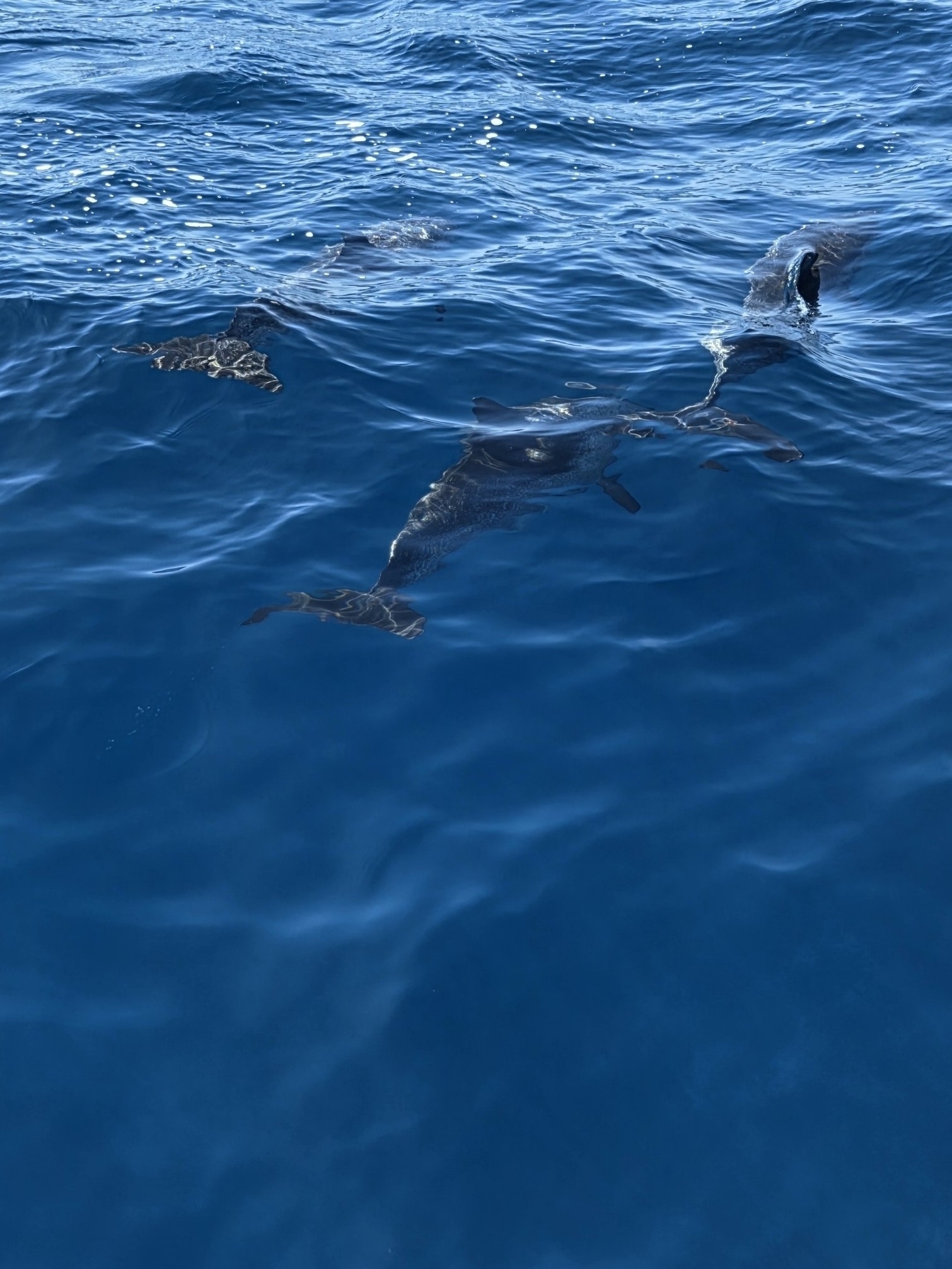
Photographs from GBIF under a Creative Commons licence. The author and the licence of each photograph are given; please respect them if you reuse them.
Automatic selection of the most cited works mentioning the species (source: Crossref).