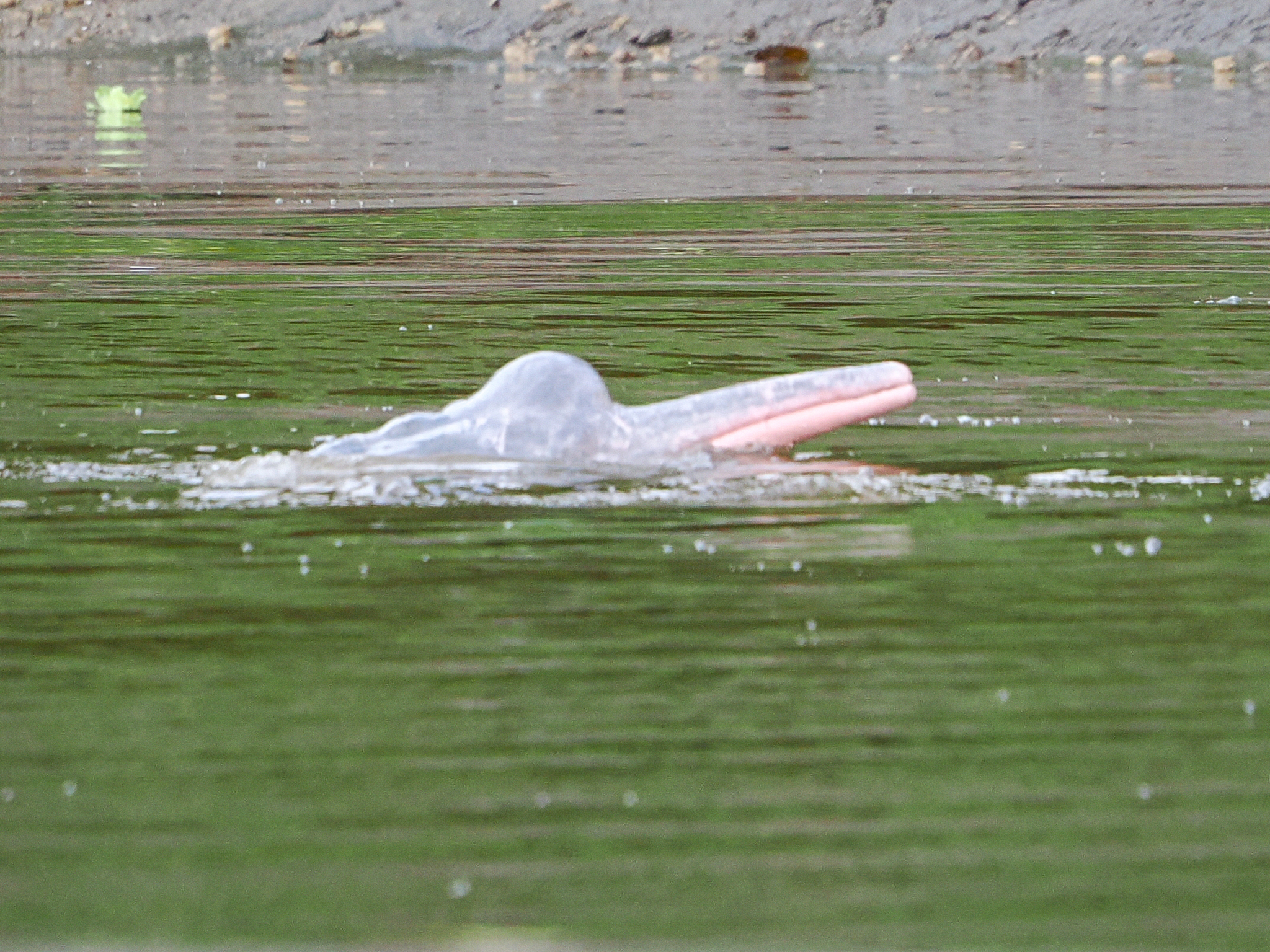
| Scientific name | Inia geoffrensis (Blainville, 1817) |
|---|---|
| Other names | Boto, bufeo, Geoffroy’s dolphin, Amazon dolphin, pink river dolphin; boto cor-de-rosa (Portuguese); dauphin rose de l’Amazone, boutou, inie de Geoffroy (French) |
| Size | Males up to 2.50 to 2.55 m (exceptionally close to 2.7 m); females 2.15 to 2.25 m. Newborn: 0.80 to 0.84 m. |
| Weight | Males up to 185 kg, with individuals measured at more than 200 kg; females 140 to 155 kg. Newborn: 7 to 12 kg. |
| Longevity | Poorly documented: longevity in the wild is unknown and generally estimated at around thirty years. In captivity, healthy individuals live 10 to 26 years, with a documented maximum of 31.3 years; “Baby”, a boto held at Duisburg Zoo, nonetheless reached at least 46 years. |
| Diet | Generalist piscivore: at least 43 fish species across 19 families (up to 53 according to some compilations), prey from 5 to 80 cm (mean ~20 cm), supplemented by freshwater turtles and crabs. Daily ration estimated at between 2.5% and 5.5% of body mass. |
| IUCN status | Endangered (EN), 2018 assessment, decreasing population trend; the status still in force in the 2025-2 edition of the Red List. No subpopulation is assessed separately at global level; in Venezuela, the 2015 national assessment lists the species as “Vulnerable”. |
The Amazon river dolphin, or boto, is the largest of the freshwater dolphins: up to 2.5 m and close to 200 kg in the largest males. Its mobile neck, long rostrum and deformable melon make it a specialist hunter of the flooded forest, able to thread its way between trunks and roots. Endemic to the Amazon and Orinoco basins, it is listed as “Endangered” on the IUCN Red List, with populations declining by about 5% a year where monitoring has run longest.
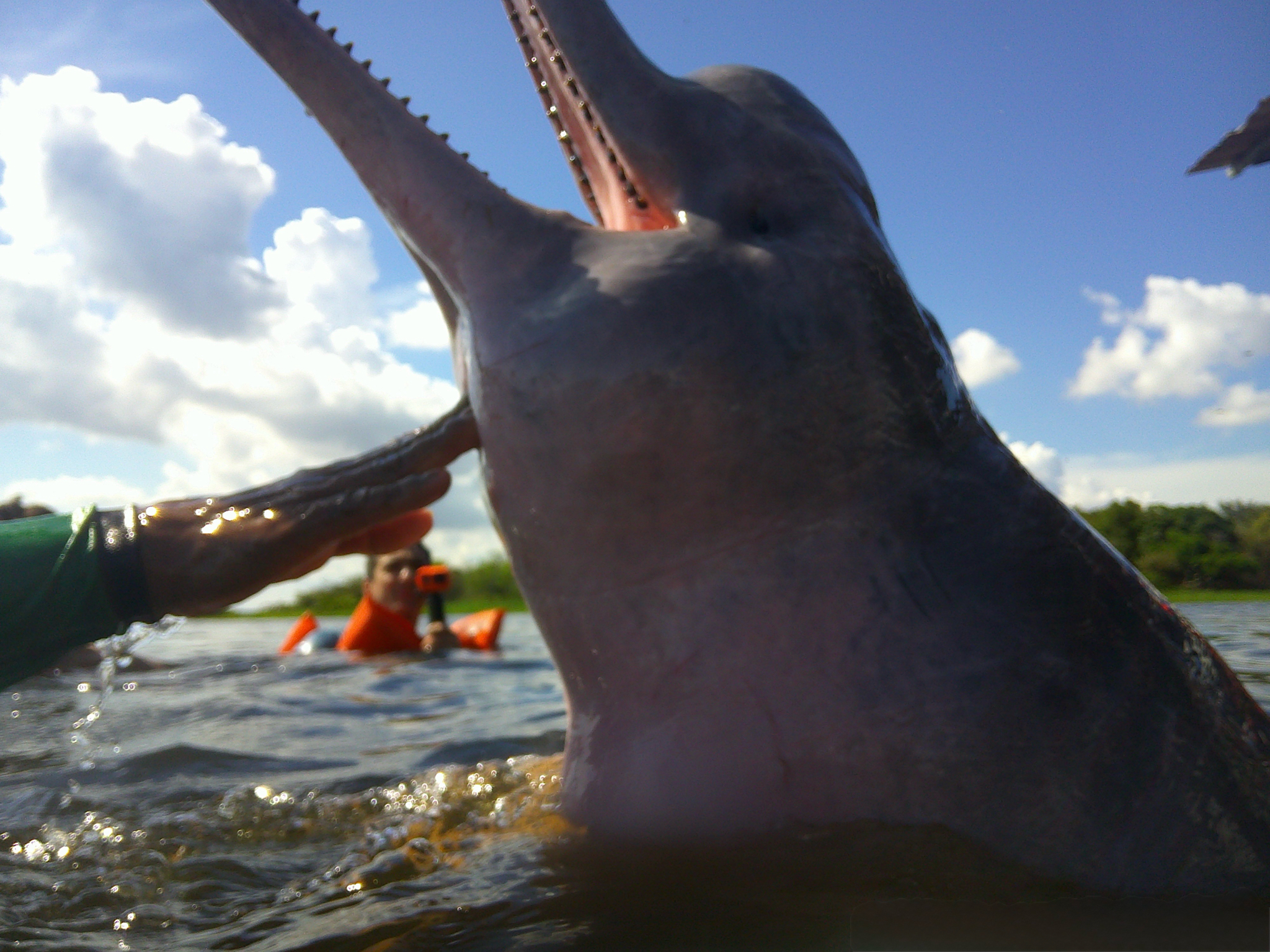
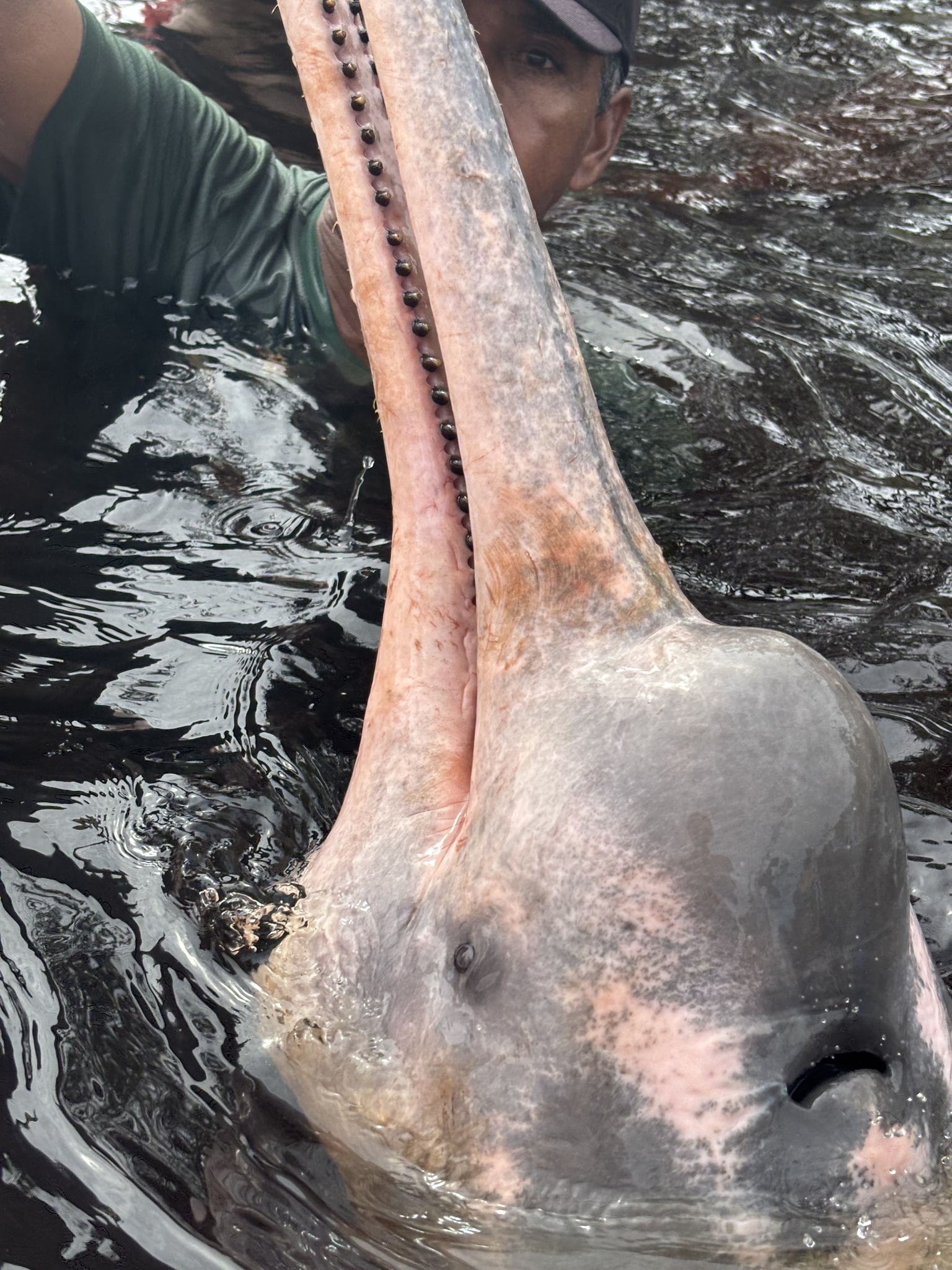
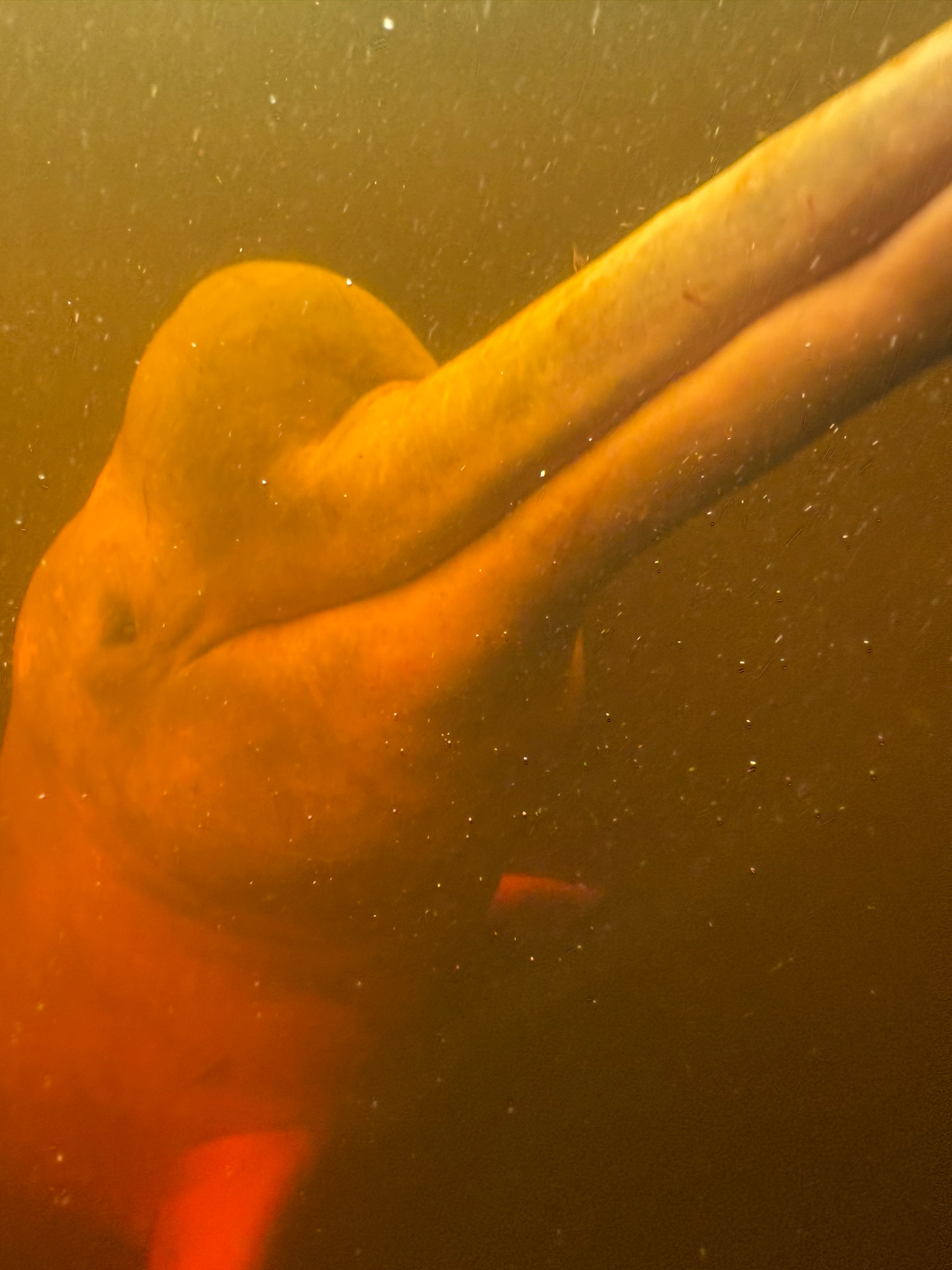
The boto is recognised first of all by its outline, very different from that of marine dolphins. The body is stocky and supple, with no true dorsal fin: it is replaced by a long low ridge, 30 to 61 cm in length, running along the rear of the back. The flippers are broad and paddle-shaped, and highly mobile, which allows the animal to manoeuvre almost on the spot. The rostrum is long, narrow and set with short sensory bristles; it carries about 24 to 34 teeth per half-jaw, heterodont, conical at the front for seizing prey and broadened at the back for crushing it. The forehead is taken up by a bulky, supple melon, which the animal can deform in order to steer its sonar. The eyes are small: in these sediment-laden waters, it is echolocation that guides most of the hunt. Finally, the cervical vertebrae are not fused, a feature rare among cetaceans, which allows a rotation of the head of up to 90°.
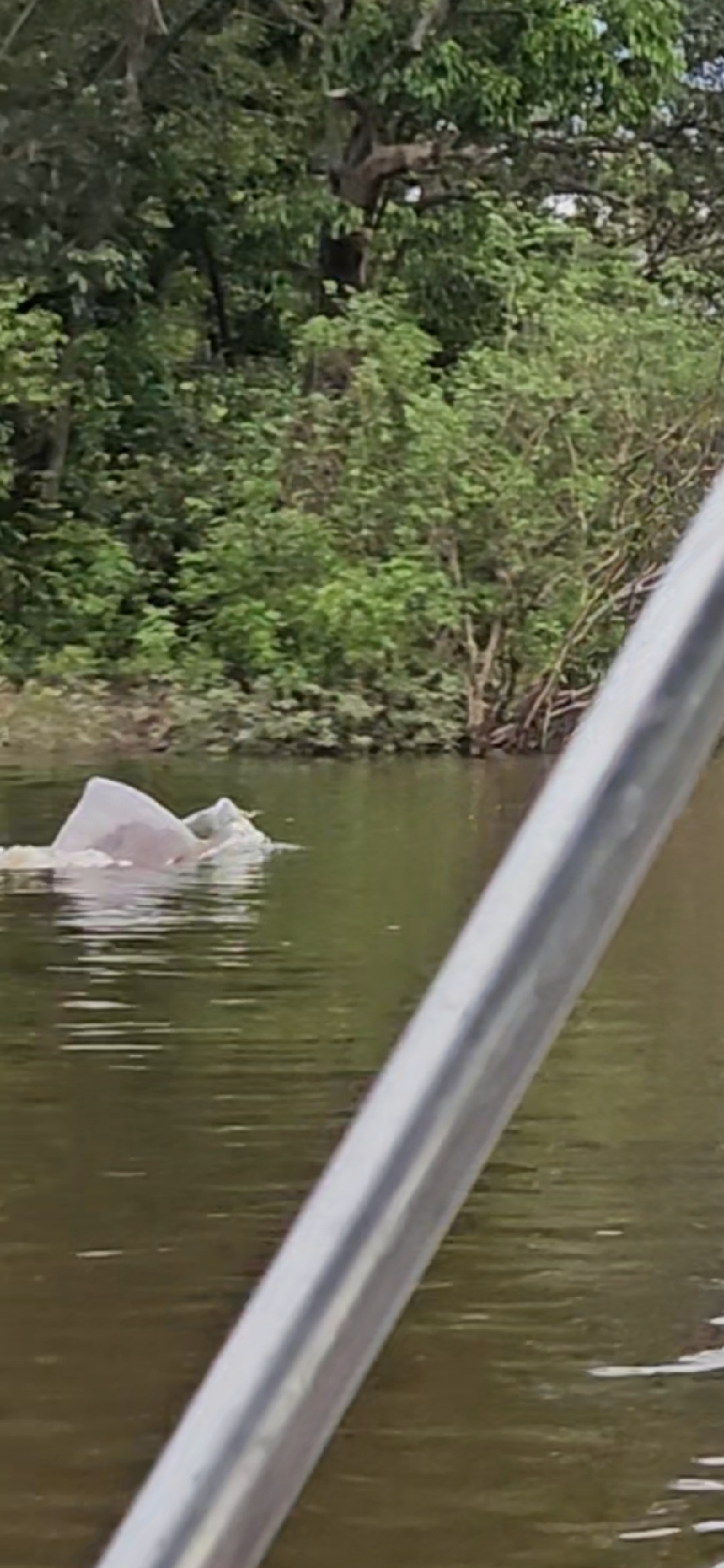
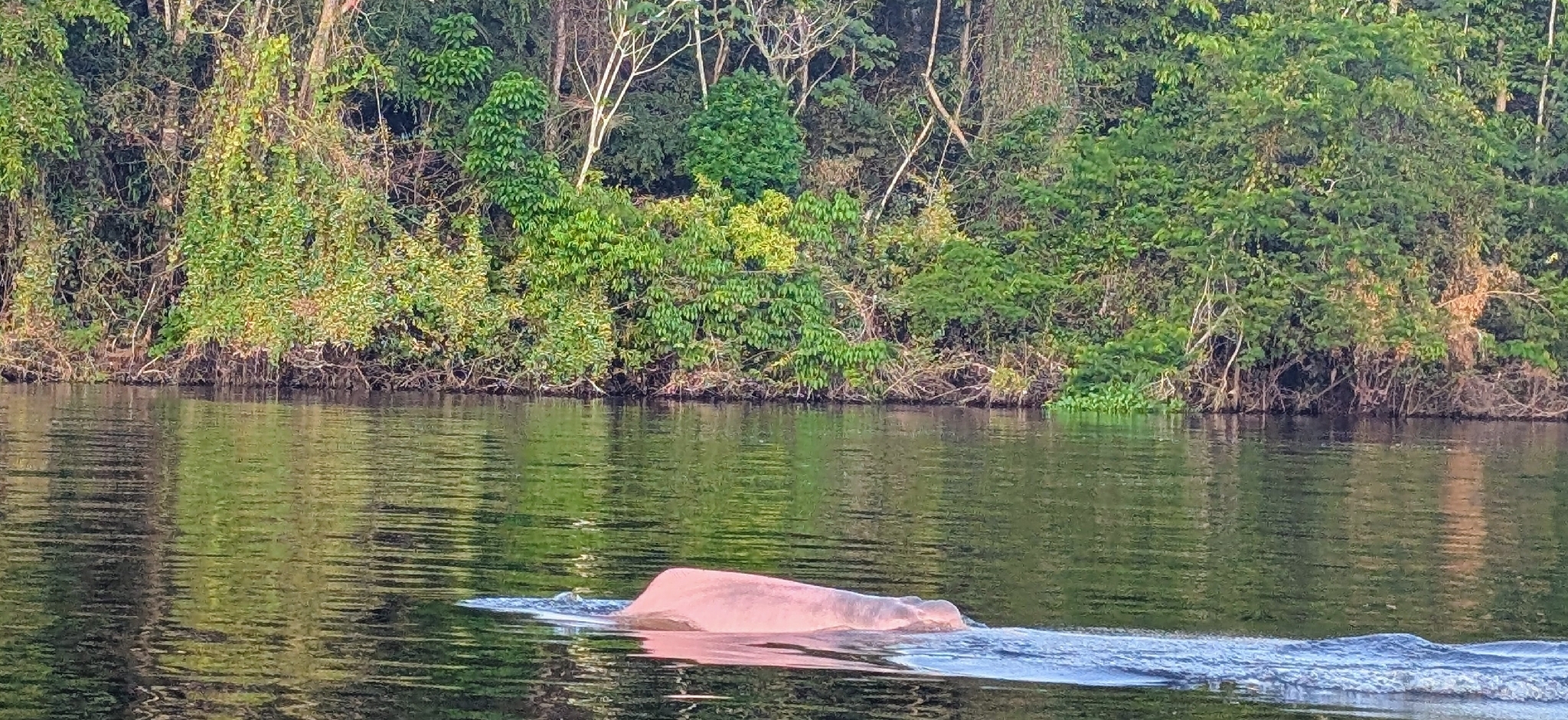
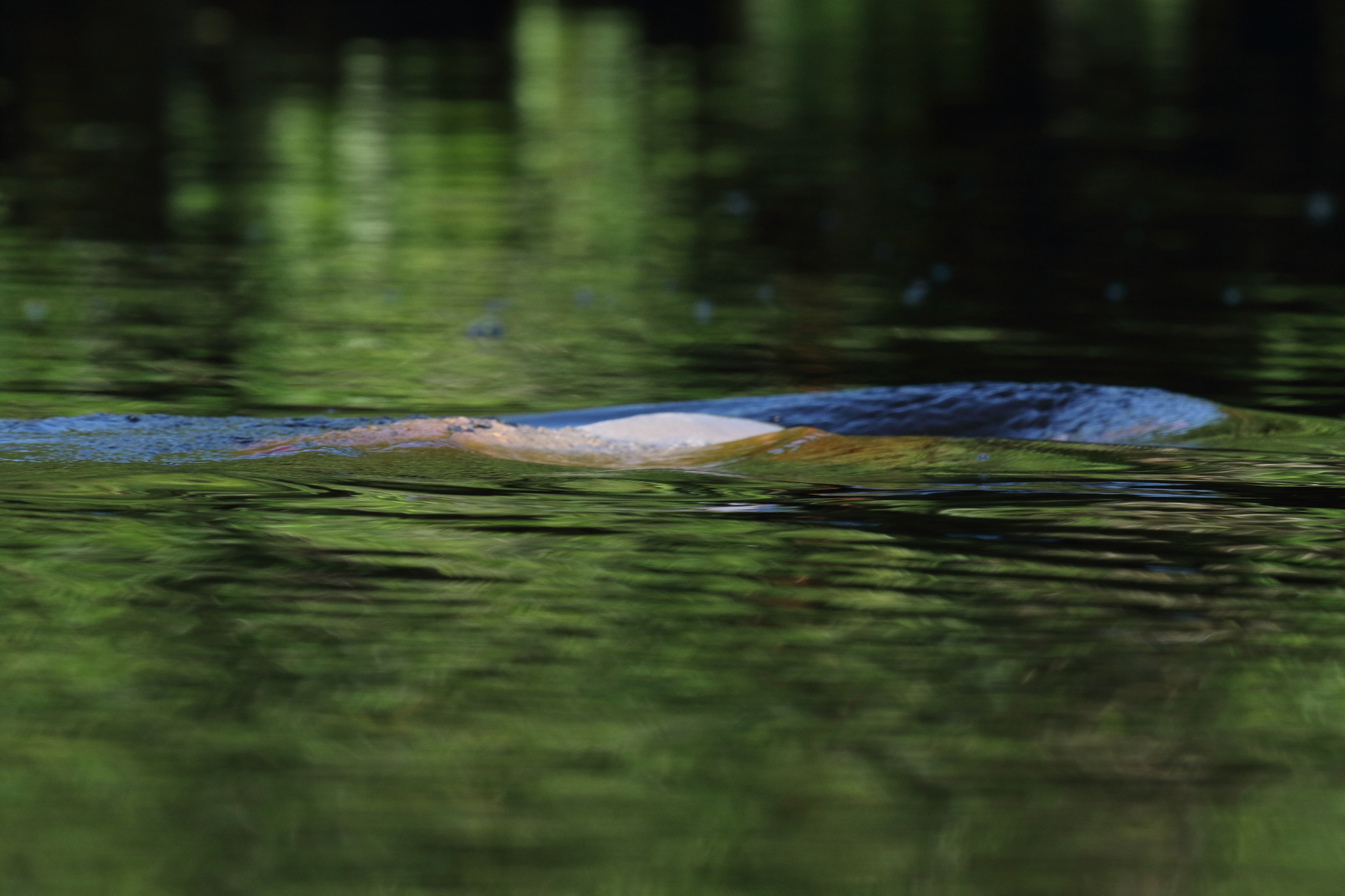
Colour is the species’ best-known trait, and the most variable. Newborns are dark grey, lighten during adolescence, then in the adult take on tints ranging from pinkish grey to bright pink, sometimes almost white with bluish reflections. Males are markedly pinker than females, the coloration being attributed to scar tissue accumulated during fights between males; water temperature, water clarity and locality also influence the shade. Sexual dimorphism is extreme for a cetacean: males are on average 16% longer and 55% heavier than females. At the surface the boto swims slowly, blows discreetly and almost never breaches: often all that can be seen is a pink back and a dorsal ridge rolling briefly past.
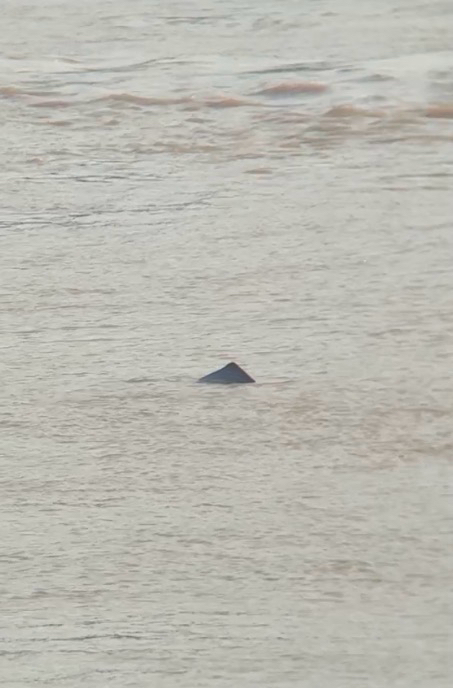
Confusion is possible with the tucuxi (Sotalia fluviatilis), which shares a large part of its range. The tucuxi is far smaller, uniformly grey, with a rounded melon, a short rostrum and a true triangular dorsal fin; it breaches readily and swims faster, two behaviours the boto does not adopt. Nor should it be confused with the Guiana dolphin (Sotalia guianensis), a coastal and estuarine species of the Guianas and Brazil, or with the South Asian river dolphins or the La Plata dolphin, which belong to other families. Local vernacular names keep the ambiguity alive: depending on the region, “bufeo” or “boto” may refer to one species or the other.
Order Cetacea, suborder Odontoceti, family Iniidae, genus Inia, the only living genus in the family. Species: Inia geoffrensis (Blainville, 1817), with two recognised subspecies, I. g. geoffrensis and I. g. boliviensis.
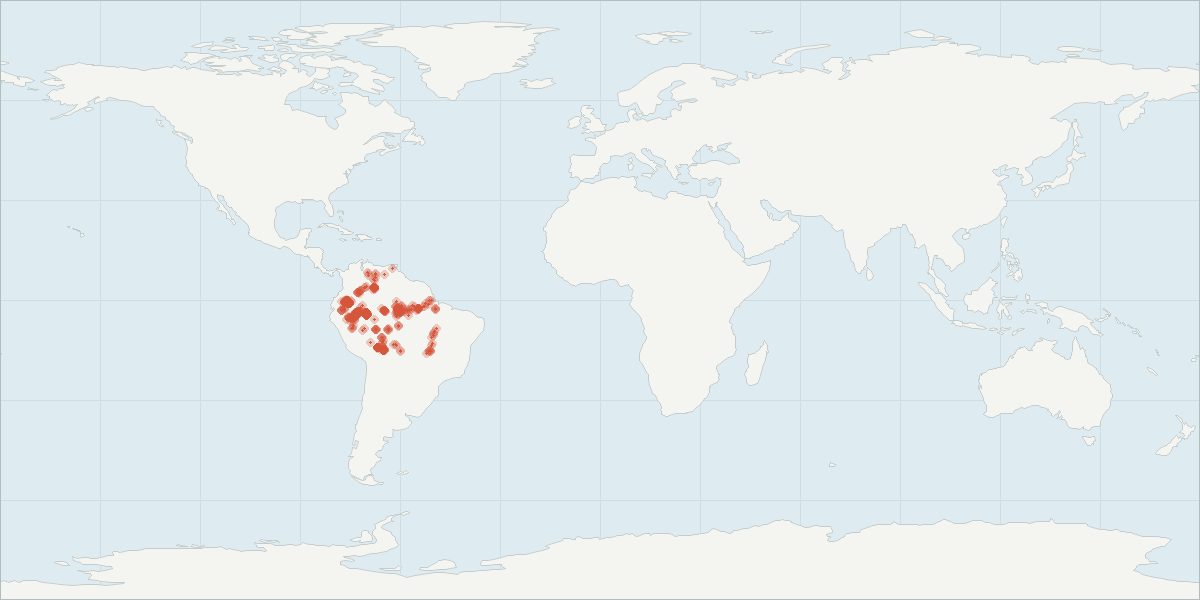
The species is strictly freshwater: it never leaves fresh water. It occupies the Amazon and Orinoco basins, linked to one another by the Casiquiare channel, as well as the Tocantins-Araguaia system, an area of the order of 7 million km² spread across six countries: Bolivia, Brazil, Colombia, Ecuador, Peru and Venezuela; photographic sightings have also been reported from Guyana. Waterfalls and rapids form the main natural barriers between populations. The boto frequents main channels as readily as tributaries, lakes and confluences and, at high water, the flooded forest. This hydrological rhythm structures its whole ecology: at low water the animals concentrate in the channels and the deep zones, where recorded densities run from 0.08 to 0.33 individuals/km²; at high water they disperse into the floodplains, where local densities can reach 18 individuals/km², among the highest measured for any cetacean.
The species is absent from France. It frequents neither the Mediterranean, nor the Bay of Biscay, nor the English Channel, since it does not live in the sea. It is also absent from the French overseas territories: in French Guiana, the Maroni, Mana, Approuague and Oyapock rivers belong neither to the Amazon basin nor to the Orinoco basin, and the small cetacean seen there in the estuaries and along the coast is the Guiana dolphin (Sotalia guianensis), a coastal marine species protected under French regulations.
The boto has the most diverse diet of all the odontocetes. Stomach-content analyses record at least 43 fish species belonging to 19 families, and up to 53 species according to the broadest compilations: sciaenids, cichlids, characids, catfish and piranhas are among the favoured prey, supplemented by freshwater turtles and crabs. Prey size ranges from 5 to 80 cm, for a mean of around 20 cm, and the daily ration is estimated at between 2.5% and 5.5% of body mass depending on the study. Hunting continues by day and by night, with activity peaks documented in the early morning (about 06:00 to 09:00) and in the middle of the afternoon (about 15:00 to 16:00). The sonar emits low-amplitude clicks, in a range running from about 16 to 170 kHz, a signature suited to the confined and cluttered environments where stray echoes are numerous. The boto sometimes associates with the tucuxi or the giant otter during episodes of coordinated hunting.
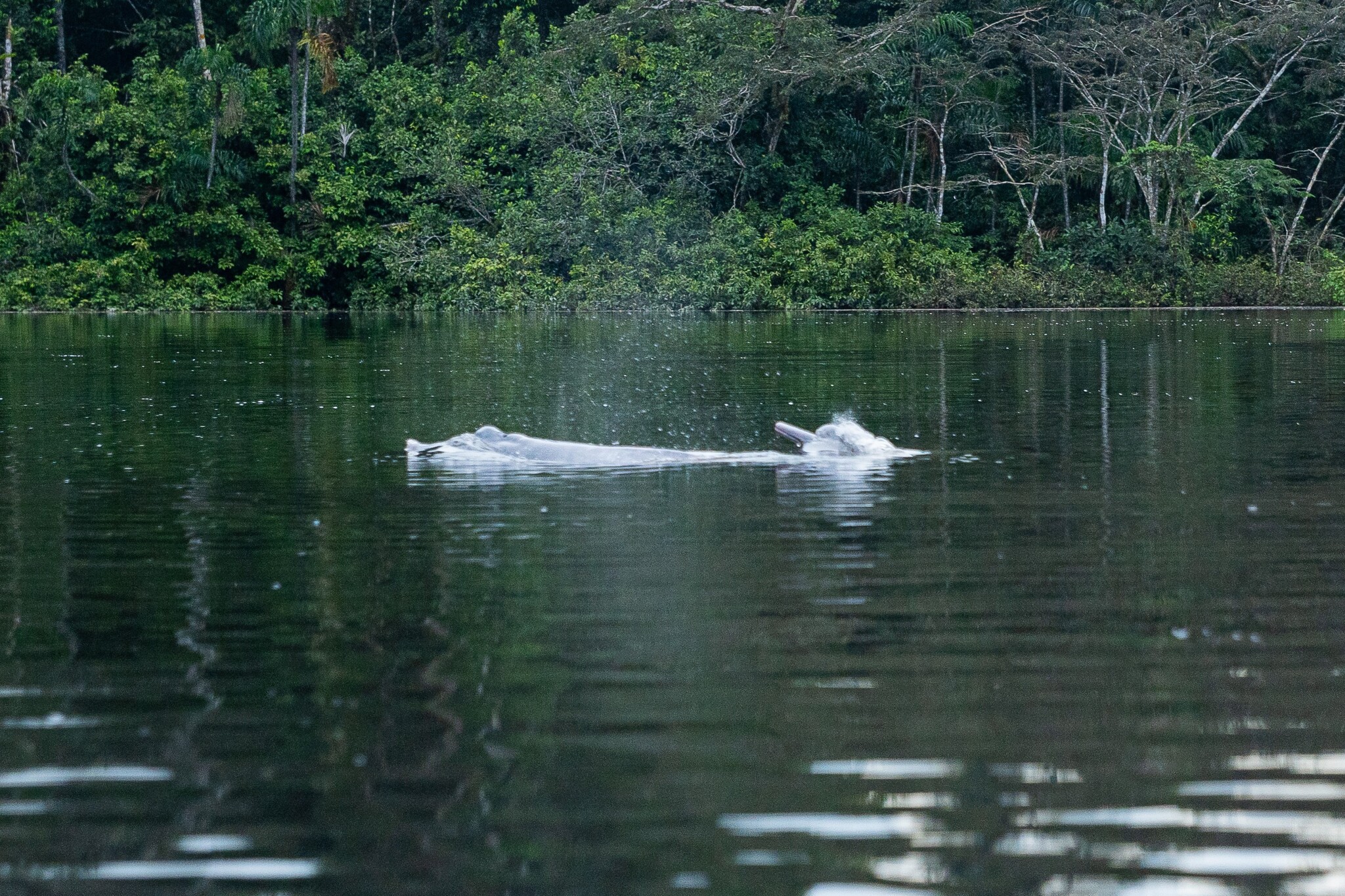
Social life is unobtrusive. The animal is most often solitary or in a pair, and groups rarely exceed three individuals; temporary gatherings of up to 35 animals have nonetheless been observed around concentrations of fish. Cruising speed is slow, 1.5 to 3.2 km/h, with bursts measured at between 14 and 22 km/h. Males practise a remarkable socio-sexual display: they carry branches, tufts of vegetation or balls of clay at the surface. Bite scars and damaged fins, very frequent in adult males, attest to intense competition and to a polygynous mating system.
Gestation lasts about 11 months and produces a single calf, births being concentrated in the high-water period and the beginning of the falling water, between May and September depending on the region. The newborn measures 0.80 to 0.84 m for 7 to 12 kg. Lactation continues beyond one year and the interval between two births is estimated at 15 to 36 months, the young acquiring their independence only after two to three years. Females reach sexual maturity at around 1.60 to 1.75 m, at about five to six years, but first calving comes on average later, at around ten years; males mature at around 2 m. Longevity in the wild remains poorly documented: it is unknown and generally estimated at around thirty years. In captivity, healthy individuals live 10 to 26 years, with a documented maximum of 31.3 years, and one resident of Duisburg Zoo passed 46 years, whereas the mean survival of animals captured for North American dolphinaria did not exceed a few years (about 33 months). The boto has no confirmed natural predator.
Inia geoffrensis is listed as “Endangered” (EN) on the global IUCN Red List, following the assessment carried out in 2018 by da Silva and colleagues, with a decreasing population trend; this is the status that still appears in the 2025-2 edition of the Red List. No estimate of numbers exists for the species as a whole, its range being too vast to be covered; the data come from regional monitoring. The longest of these, run from 1994 to 2017 in the Mamirauá Sustainable Development Reserve (Amazonas, Brazil) on more than 650 individually identified animals and over 6,000 km², documents a mean decline of 5.48% a year, that is a population halving roughly every ten years, and projects a loss of 95% of the animals in fifty years if nothing changes. The tucuxi is declining in parallel at a slightly faster rate still, 7.4% a year, its population halving every nine years.
Bycatch in gillnets, monofilament ones in particular, is the leading cause of mortality, compounded by the deliberate killing of animals to serve as bait for the piracatinga fishery (Calophysus macropterus), a scavenging catfish. To this are added mercury contamination linked to artisanal and industrial gold mining, with muscle concentrations reaching several milligrams per kilogram in some individuals analysed in Colombia, Bolivia and Brazil; the fragmentation of watercourses by dams, notably on the Madeira; deforestation and pollution; and, increasingly, extreme droughts and heatwaves. The Lake Tefé episode, in September and October 2023, saw the collection of more than 200 carcasses of botos and tucuxis while the water temperature exceeded 40°C, with a peak measured at 41°C.
On the regulatory side, the species is listed in Appendix II of CITES and in Appendix II of the Convention on Migratory Species. Brazil prohibits the capture, the disturbance and the killing of the boto, and has imposed a moratorium on the fishing and marketing of piracatinga: announced in 2014, in force from 1 January 2015, it has been extended three times, most recently on 3 July 2023, with no expiry date but with a review planned within three years. Enforcement remains difficult, piracatinga continuing to be sold under other names. Bolivia made the boto a national heritage species in 2012, and Brazil adopted in 2019 a national action plan for threatened Amazonian aquatic mammals. Finally, the Global Declaration for River Dolphins, signed in Bogotá on 23 and 24 October 2023 by the South American and Asian states concerned, commits the signatories to reducing gillnets and pollution, extending protected areas and strengthening research. Captive breeding is not considered a viable option, because of intraspecific aggression and the high mortality of the animals held.
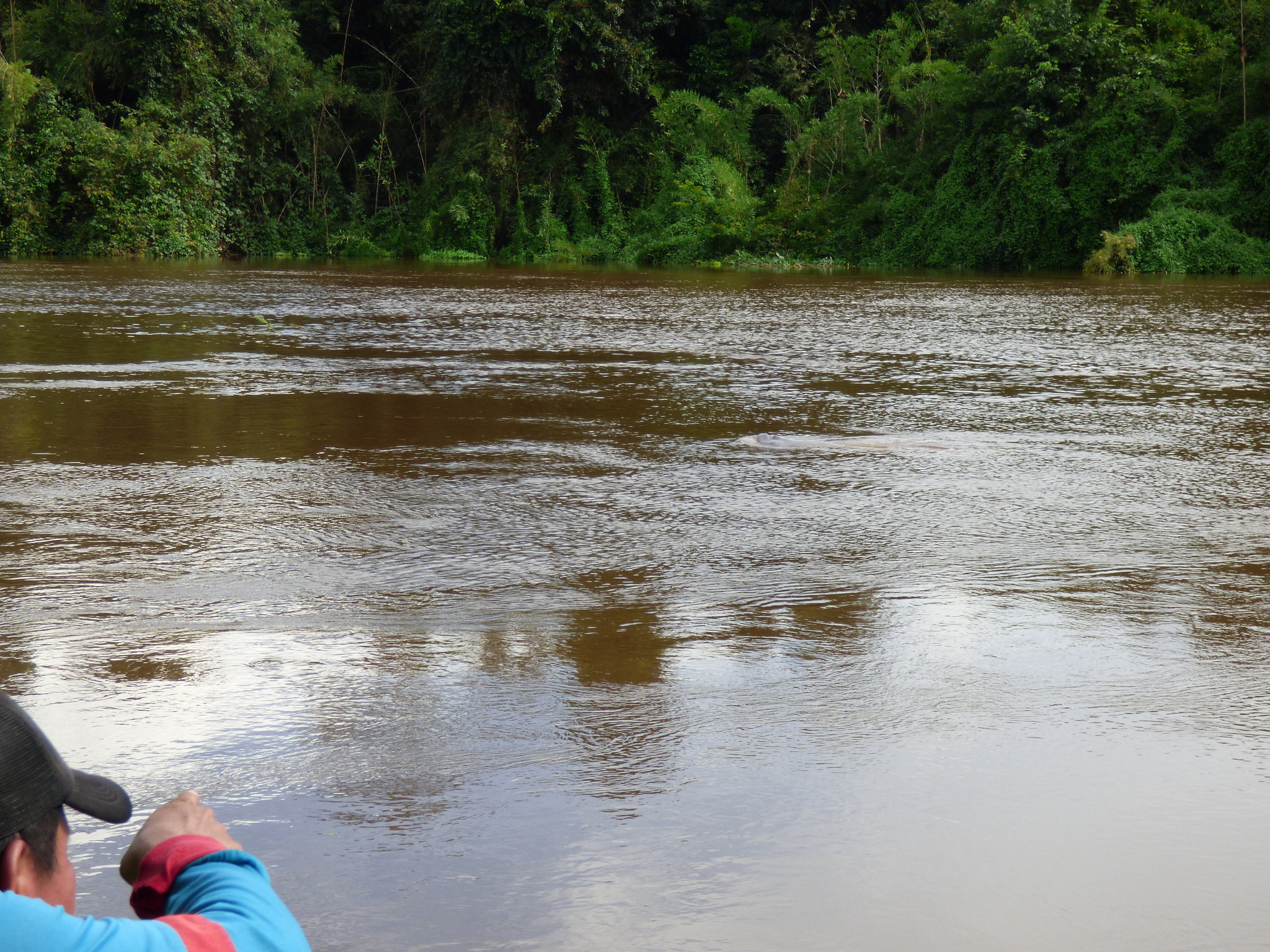
The best opportunities for watching are to be found in Brazil, notably in the Mamirauá Reserve, on the lower Rio Negro and in Anavilhanas National Park near Novo Airão, as well as in several municipalities of Pará such as Cametá, Mocajuba and Santarém; the species can also be seen in Colombia, Peru, Ecuador, Bolivia and Venezuela. The season counts for as much as the place: at low water the animals concentrate in the channels, the confluences and the entrances to lakes, which makes encounters a great deal easier, whereas at high water they disperse into the flooded forest and become far harder to spot. The boto offers no acrobatic display: what has to be looked for is a pink back rolling at the surface, a brief and discreet blow, often near the banks or rafts of vegetation. A slow boat, engine idling, in the early morning or the middle of the afternoon, the periods when hunting activity is at its most sustained, and a pair of binoculars are enough.
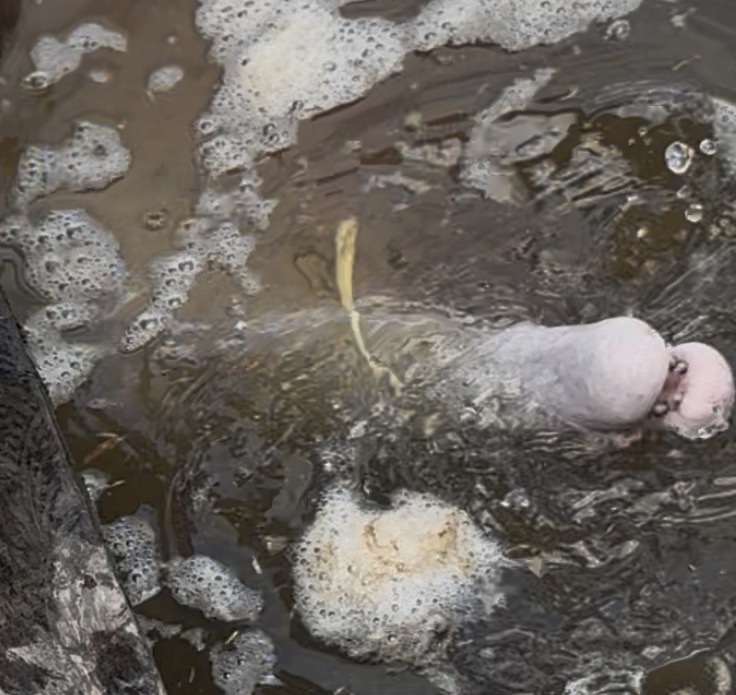
The ethics of watching is a subject in its own right here. The feeding of botos, which began accidentally in 1998 in the Anavilhanas area, has spread to half a dozen sites on the lower Rio Negro and to three localities in Pará, where tourists have been able to feed, touch and swim with the animals. Work carried out at these sites documents harmful effects: changes in diet and behaviour, ingestion of unsuitable food, aggressive interactions between dolphins, an increased risk of collision with boats, and bites inflicted on visitors. The activity is now regulated: a 2012 ICMBio instruction prohibits visitors from feeding the dolphins in Anavilhanas National Park, and a resolution of the Amazonas state environmental council of January 2018 sets out the procedures applicable to interactive tourism. Good practice comes down to a few simple rules: do not feed, do not touch, do not swim with the animals, never chase them, and favour operators working at a distance.
Newborns are dark grey and lighten with age. The pink tint of adults is attributed for the most part to scar tissue accumulated during fights: this is why males, far more combative, are markedly pinker than females. Water temperature, water clarity and locality also modulate the colour, which ranges from pinkish grey to bright pink, sometimes almost white.
The boto reaches 2.5 m, has a stocky body, a long narrow rostrum, a domed melon and no more than a low dorsal ridge; it swims slowly and does not breach. The tucuxi (Sotalia fluviatilis) is far smaller, uniformly grey, with a short rostrum, a rounded melon and a true triangular dorsal fin; it is lively and breaches readily. The two species coexist across a large part of the Amazon basin.
There is no reliable estimate for the species as a whole: the range covers about 7 million km² and cannot be surveyed in full. Regional monitoring does, on the other hand, give clear trends. In the Mamirauá Reserve, in Brazil, the population declined by 5.48% a year between 1994 and 2017, that is a halving of numbers roughly every ten years.
Longevity in the wild is unknown: the available monitoring does not allow it to be established, and the usual estimate is around thirty years. In captivity, individuals in good health live 10 to 26 years, the documented maximum being 31.3 years; a boto at Duisburg Zoo, “Baby”, nonetheless reached at least 46 years. Conversely, animals captured for North American dolphinaria survived on average only about 33 months.
No. The Amazon river dolphin lives exclusively in fresh water, in the Amazon and Orinoco basins, and has never frequented French waters. It is also absent from French Guiana: the Guianese rivers do not belong to those basins. The small cetacean that can be seen in the Guianese estuaries is the Guiana dolphin (Sotalia guianensis), a coastal marine species.
Dolphins are killed to serve as bait in the piracatinga fishery, a heavily marketed scavenging catfish. Brazil has imposed a moratorium on this fishery, in force from 1 January 2015 and extended for the third time on 3 July 2023, but enforcement remains difficult, the fish continuing to be sold under other names. To this are added accidental drownings in gillnets, which remain the leading cause of mortality.
Yes. The studies carried out at the lower Rio Negro and Pará sites show that feeding alters the diet and the behaviour of the animals, encourages aggressive interactions, increases the risk of collision and causes bites among visitors. Feeding by visitors has been prohibited in Anavilhanas National Park since 2012 and regulated by rules of the state of Amazonas since January 2018. Favour watching at a distance, with no contact and no feeding.
Profile compiled from authoritative scientific sources (IUCN, NOAA Fisheries, specialist literature) and reviewed for factual accuracy.
According to the open data of the GBIF, 812 georeferenced sightings of Inia geoffrensis are recorded in our photographic index.
| Country | Notes |
|---|---|
| Brazil | 304 |
| Peru | 193 |
| Ecuador | 149 |
| Colombia | 86 |
| Bolivia (Plurinational State of) | 80 |
| Venezuela (Bolivarian Republic of) | 18 |
| unknown or invalid | 1 |

Monthly distribution of 820 dated sightings (all years combined): the maximum is reached in August.
| Month | Notes |
|---|---|
| janvier | 64 |
| February | 44 |
| mars | 52 |
| avril | 44 |
| mai | 64 |
| juin | 65 |
| juillet | 107 |
| August | 134 |
| septembre | 69 |
| octobre | 59 |
| novembre | 81 |
| December | 37 |
These figures reflect survey effort (more boaters and more surveys in summer) as much as the actual presence of the species: to be interpreted with caution.


Photographs from GBIF under a Creative Commons licence. The author and the licence of each photograph are given; please respect them if you reuse them.
Automatic selection of the most cited works mentioning the species (source: Crossref).