Dusky dolphin (Aethalodelphis obscurus)

Key facts
Scientific name Aethalodelphis obscurus (J. E. Gray, 1828), genus erected in 2025. Synonyms still very widely used: Lagenorhynchus obscurus, Sagmatias obscurus.
Other names Dusky dolphin, Fitzroy’s dolphin; in French: dauphin obscur, lagénorhynque obscur, dauphin sombre; delfín oscuro (Spanish), Schwarzdelfin (German)
Size 1.65 to 2.10 m in adults; newborn about 0.90 m
Weight 70 to 85 kg on average; up to about 100 kg in the largest individuals (Peru)
Longevity 26 to 30 years
Diet Schooling pelagic fish (anchovies, sardines, lanternfish, hake, jack mackerel, hoki, red cod) and squid; incidentally shrimp and other crustaceans
IUCN status Least Concern (LC) at the global scale, assessment published in 2019 (2020 errata version) and still in force in the current edition of the Red List; the Peruvian and Chilean subspecies Lagenorhynchus obscurus posidonia has been assessed as Vulnerable (VU) since December 2019

In brief

The dusky dolphin is a small delphinid of the Southern Hemisphere, famous for its acrobatic leaps and for gatherings that can exceed a thousand animals. It frequents the cold, productive waters of the great upwellings, from the coasts of Peru to Patagonia and from southern Africa to New Zealand. Listed as “Least Concern” at the global scale, it remains locally very exposed to gillnets, in particular off Peru, where the local subspecies is judged vulnerable.

Identification

The dusky dolphin is a small delphinid with a stocky, muscular body, measuring 1.65 to 2.10 m for 70 to 85 kg. The largest individuals, recorded off Peru, slightly exceed 2 m and may approach 100 kg. There is no marked sexual dimorphism: in New Zealand, females measure 1.67 to 1.78 m for 69 to 78 kg, males 1.65 to 1.75 m for 70 to 85 kg. The rostrum is very short and clearly set off, the forehead evenly rounded; each half-jaw carries 27 to 36 small conical teeth, that is a total of the order of 108 to 144 teeth. The dorsal fin, tall and markedly falcate, offers one of the best identification criteria at a distance: it is dark along its leading edge and lightens distinctly towards the rear, forming a characteristic two-tone fin.

The coloration combines three tones. The back, the area around the eye and the rostrum are dark grey to bluish black; the belly is white; between the two runs a broad pale grey panel that stretches from the flank towards the rear and rises in the direction of the blowhole, forming two pale forked bands that are particularly visible when the animal leaps. The flippers are pale grey edged with dark. This three-zone architecture, strongly contrasted, makes the species recognisable even in mid-leap.

Confusion is mainly possible with Peale’s dolphin, which shares Patagonian and Chilean waters but has a distinctly dark face and throat as well as a white patch in the armpit of the flipper. The hourglass dolphin, more southerly and more oceanic, bears a much sharper hourglass pattern. The Pacific white-sided dolphin, its closest relative, resembles it closely but lives exclusively in the North Pacific: no overlap of range is possible; the skull of the dusky dolphin is more slender and its pale blaze shorter. Finally, it should not be confused with the two North Atlantic species long placed in the genus Lagenorhynchus, the Atlantic white-sided dolphin (Leucopleurus acutus, formerly Lagenorhynchus acutus) and the white-beaked dolphin (Lagenorhynchus albirostris), the only species remaining in that genus today, which is found in the Bay of Biscay and the English Channel, and whose similar French name regularly gives rise to error.

Taxonomy

The species was described by John Edward Gray in 1828 under the name Delphinus obscurus, then placed for nearly two centuries in the genus Lagenorhynchus. Molecular work has shown that this genus was polyphyletic, that is, that it brought together species with no real close kinship. A 2019 revision proposed transferring the dusky dolphin, the Pacific white-sided dolphin, the hourglass dolphin and Peale’s dolphin to the resurrected genus Sagmatias, and returning the Atlantic white-sided dolphin to the resurrected genus Leucopleurus: only the white-beaked dolphin (Lagenorhynchus albirostris), the type species, thus remains in Lagenorhynchus. A phylogenomic study published in 2025 by Galatius and colleagues in Molecular Phylogenetics and Evolution showed that this enlarged Sagmatias was not itself monophyletic and erected a new genus, Aethalodelphis, for the dusky dolphin and the Pacific white-sided dolphin; this name is taken up by the taxonomy committee of the Society for Marine Mammalogy. The binomial Lagenorhynchus obscurus nevertheless remains very widely used in the literature and in databases.

These two sister species are thought to have diverged about two million years ago. Three subspecies are recognised: the African form (L. o. obscurus), the South American Atlantic form known as Fitzroy’s dolphin (L. o. fitzroyi, Waterhouse, 1838) and the Peruvian and Chilean form (L. o. posidonia, Philippi, 1893). The New Zealand population, which is distinct, has received no formal name. Hybrids with the common dolphin and the southern right whale dolphin have been reported.

Distribution and habitat

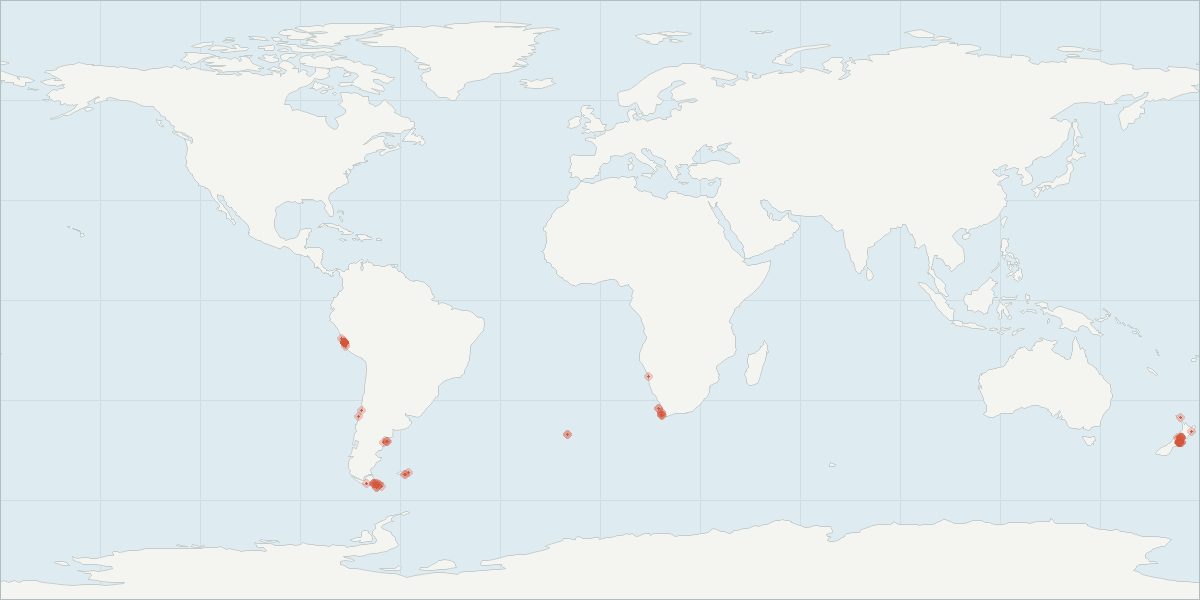
The dusky dolphin occupies a discontinuous belt of cool temperate waters in the Southern Hemisphere, never crossing the equator. In South America it follows the Pacific seaboard from Peru to Cape Horn and extends up the Atlantic to about 36°S, off Argentina. In southern Africa it is present from Lobito Bay, in Angola, to the Cape region of South Africa. It is common around New Zealand, above all off the South Island and the lower part of the North Island, as far as the Chatham, Auckland and Campbell Islands. In southern Australia, in Tasmania and in Bass Strait, sightings remain rare and could involve vagrant individuals.

The species also frequents several isolated oceanic archipelagos: Tristan da Cunha, the Prince Edward Islands, the Crozet Islands, Amsterdam Island and Saint Paul Island. As the last of these belong to the French Southern and Antarctic Lands, the dusky dolphin is among the cetaceans of the French overseas territories, Amsterdam Island being explicitly cited within the range of the African subspecies. Sightings there are nevertheless too few to estimate numbers. In mainland French waters, on the other hand, the species is entirely absent: neither the Mediterranean and the Pelagos Sanctuary, nor the Bay of Biscay, nor the English Channel host it.

Ecologically, the dusky dolphin is tied to cool waters, between 10 and 18 °C, and to the great upwelling systems: the Humboldt Current, the Benguela Current, the New Zealand coastal upwellings. It mainly exploits the continental shelf and its edge, and makes seasonal movements, such as those documented between Kaikōura and Admiralty Bay in New Zealand.

Biology and ecology

The diet is dominated by schooling pelagic fish and squid: anchovies, sardines, lanternfish, hake, jack mackerel, hoki, red cod, squid of the genera Nototodarus, Todarodes and Loligo, with shrimp as a supplement. Hunting strategies vary with region and season. By day, groups herd fish shoals into tight balls, using the surface as a wall, circling the prey and startling it with sounds or with the flash of their white belly; the larger the group, the more effective the herding. By night, in the Kaikōura canyon for example, the dolphins exploit the deep scattering layer in small units of a few individuals. Routine dives last about twenty seconds, feeding dives exceed 90 seconds, and depths of about 130 m have been recorded. The animal can reach 10 m/s, that is 36 km/h. These hunts often bring together seabirds, fur seals and sea lions, sharks and other cetaceans, some of which merely steal the gathered prey.

Society is of the fission-fusion type: individuals move between groups whose composition changes constantly, most associations being weak even though lasting bonds exist. Group size ranges from a few animals to more than a thousand at Kaikōura, whereas at Admiralty Bay gatherings peak at around fifty individuals. Nursery groups, bringing together females with calves, keep apart from mating groups. The acoustic repertoire comprises broadband echolocation click trains, showing two peaks towards 40-50 kHz and 80-110 kHz, bursts of 2 to 14 closely spaced clicks used for communication, and whistles emitted above all in the presence of other dolphin species.

Sexual maturity is reached between four and eight years depending on the region. The mating system is polygynandrous: males and females mate with several partners, and males have very large testes, a sign of strong sperm competition. Gestation lasts from eleven to thirteen months depending on the study. Births take place in the austral spring, from August to October in Peru, and in summer, from November to February, in Argentina, South Africa and New Zealand. Weaning occurs at around twelve to eighteen months. Young animals gradually learn to hunt and to leap, moving from noisy leaps to clean leaps, then coordinated and finally acrobatic ones: this virtuosity is acquired, it is not innate. Longevity is estimated at 26-30 years. Natural predators are the killer whale and large sharks, in the face of which the dolphins take refuge in shallow water.

Status and conservation

At the global scale, the dusky dolphin is listed as Least Concern (LC) on the IUCN Red List, in an assessment published in 2019 and corrected in 2020. This listing succeeds a Data Deficient (DD) status and follows both from new IUCN guidance on the use of the DD category and from the finding that most of the recognised forms are abundant and without documented decline. The Peruvian and Chilean subspecies, L. o. posidonia, is an exception: it was assessed as Vulnerable (VU) in December 2019. The species is listed in Appendix II of CITES and comes under the Convention on Migratory Species. In New Zealand the national classification is “Not Threatened”, with a resident population estimated at between 12,000 and 20,000 individuals; more than 6,500 animals have been counted between Península Valdés and Puerto Deseado in Argentina, and the Golfo Nuevo population increased by about 4% a year between 2004 and 2022.

The main threat, historical and current, comes from fisheries. Off Peru, tens of thousands of small cetaceans were caught each year in artisanal driftnets, with a peak estimated at 15,000-20,000 animals a year in the late 1980s and the early 1990s; a substantial share was used as shark bait or eaten. The dusky dolphin is among the species most affected: in the monitoring carried out at the port of Salaverry it accounted for nearly 30% of bycatch. Despite the legal ban on catching small cetaceans in Peru, illegal takes persist. Elsewhere, mortality comes mainly from gillnets and trawls, from disturbance by vessels and from underwater noise, and locally from shellfish farms: at Admiralty Bay, the installation of mussel farms was accompanied by a fall in the number and the size of groups, the dolphins feeding there less and rarely entering the area. In another respect, dusky dolphins show lower concentrations of persistent organic pollutants and DDT than those measured in marine mammals of the Northern Hemisphere.

Observing this species

The dusky dolphin is one of the easiest cetaceans to observe in the Southern Hemisphere, precisely because it is coastal, active by day and spectacular. The leading site worldwide is Kaikōura, on the South Island of New Zealand, where groups of a hundred to more than a thousand individuals are present all year round and where marine wildlife watching is the primary motivation for the majority of visitors. Península Valdés and Golfo Nuevo, in Argentina, as well as the coasts of Chile, Peru and Namibia, also offer good chances of an encounter. The animal readily approaches the bows of vessels and surfs in a ship’s waves, and its leaps, slapping, clean, coordinated in twos or more, or frankly acrobatic with spins and somersaults, are visible from afar.

This accessibility calls for precautions. Research carried out at Kaikōura has shown that groups change their behaviour in the presence of tourist vessels, and that the energy spent interacting with boats or avoiding them is not neutral. The New Zealand recommendations call for approaching the animals from the side, at reduced speed and without creating a wake within a radius of 300 m, never cutting through a group or separating a female from her calf, limiting the time spent nearby and letting the animals decide on the approach. These rules hold everywhere else, in the absence of local regulation. Nursery groups and animals resting during the day deserve particular care, daytime rest governing the effectiveness of night-time hunting.

Frequently asked questions

Can the dusky dolphin be seen in France?

Not in mainland France: the species is strictly southern and is present neither in the Mediterranean, nor in the Bay of Biscay, nor in the English Channel. It is, however, reported in the French Southern and Antarctic Lands, in particular around Amsterdam Island and Saint Paul Island, as well as at the Crozet Islands, but sightings there are too rare to estimate numbers. The “lagenorhynchs” seen off Brittany or in the Bay of Biscay are other species: the Atlantic white-sided dolphin (Leucopleurus acutus) and the white-beaked dolphin (Lagenorhynchus albirostris) of the North Atlantic.

What exactly is its conservation status?

The dusky dolphin is listed as Least Concern (LC) on the IUCN Red List, in an assessment published in 2019 and corrected in 2020; it previously came under the “Data Deficient” category. The Peruvian and Chilean subspecies, Lagenorhynchus obscurus posidonia, is on the other hand listed as Vulnerable (VU) since December 2019, because of bycatch and of the illegal takes that persist in Peru. The species is listed in Appendix II of CITES.

Why does its scientific name change from one source to another?

Because the genus Lagenorhynchus proved to be polyphyletic: it grouped together species that are not all close relatives. A 2019 revision proposed the genus Sagmatias for the dusky dolphin and several southern species, leaving only the white-beaked dolphin in Lagenorhynchus; a phylogenomic study in 2025 then created the genus Aethalodelphis for the dusky dolphin and the Pacific white-sided dolphin, a name adopted by the taxonomy committee of the Society for Marine Mammalogy. The three combinations are still in circulation, but they designate the same animal, described by Gray in 1828.

Why does it leap so much?

Leaps fulfil several functions. Clean leaps, entering the water without a splash, appear to be linked to feeding; noisy leaps, with head, side or tail slaps, raise the activity level of the group; leaps coordinated between several animals often mark the end of a hunting sequence. Acrobatic leaps, somersaults and spins, appear above all in a social context. This range is learned over the course of youth rather than being innate.

What does it eat and how does it hunt?

It eats schooling pelagic fish, anchovies, sardines, lanternfish, hake, jack mackerel, hoki, and squid, with shrimp as a supplement. By day, groups cooperatively herd shoals into tight balls against the surface, often in the company of seabirds, fur seals and sea lions, and other cetaceans. By night, they exploit the deep scattering layer in small units. Ordinary dives last about twenty seconds, feeding dives exceed 90 seconds, down to about 130 m deep.

How long does it live and at what rate does it breed?

Estimated longevity is 26 to 30 years. Sexual maturity is reached between four and eight years depending on the population. Gestation lasts from eleven to thirteen months depending on the study, and births are concentrated from August to October in Peru and from November to February in Argentina, South Africa and New Zealand. The newborn measures about 0.90 m and weaning occurs between twelve and eighteen months.

How many teeth does the dusky dolphin have?

Each half-jaw carries 27 to 36 small conical teeth, that is a total of the order of 108 to 144 teeth. This high number of fine, pointed teeth is typical of delphinids that seize slippery prey, pelagic fish and squid, swallowed whole rather than chewed.

Sources

Profile compiled from authoritative scientific sources (IUCN, NOAA Fisheries, specialist literature) and reviewed for factual accuracy.

Observed distribution

According to the open data of the GBIF, 100 georeferenced sightings of Lagenorhynchus obscurus are recorded in our photographic index.

Main countries of observation
CountryNotes
Peru44
New Zealand37
South Africa13
Chile13
Argentina12
Falkland Islands (Malvinas)6
unknown or invalid3
Saint Helena, Ascension and Tristan da Cunha2
United States of America1
Namibia1

Distribution map: Dusky dolphin (Lagenorhynchus obscurus)

Distribution map: Dusky dolphin (Lagenorhynchus obscurus), 100 georeferenced sightings from GBIF
100 georeferenced sightings of Lagenorhynchus obscurus. Base map Natural Earth, public domain. GBIF data.
🗺️ Open the interactive mapTo zoom and pan. It uses the OpenStreetMap/CARTO base maps and the GBIF occurrence densities: no data is sent to these services before you click.

Presence through the year

Monthly distribution of 102 dated sightings (all years combined): the maximum is reached in December.

290janvier : 7janfévrier : 13febmars : 15maravril : 8avrmai : 0maijuin : 0juinjuillet : 5juilaoût : 4Augustseptembre : 5sepoctobre : 8octnovembre : 8novdécembre : 29dec
Sightings by month
MonthNotes
janvier7
February13
mars15
avril8
mai0
juin0
juillet5
August4
septembre5
octobre8
novembre8
December29

These figures reflect survey effort (more boaters and more surveys in summer) as much as the actual presence of the species: to be interpreted with caution.

En images

Lagenorhynchus obscurus
© Marcel Vogel, CC BY-NC-ND, 2026
Lagenorhynchus obscurus
© louis blommestein, CC BY-NC-ND, 2025
Lagenorhynchus obscurus
© Frank Sellke, CC BY-NC-ND, 2025
Lagenorhynchus obscurus
© Marcel Vogel, CC BY-NC-ND, 2025
Lagenorhynchus obscurus
© Frank Sellke, CC BY-NC-ND, 2025
Lagenorhynchus obscurus
© Wim Vermeulen, CC BY-NC, 2025
Lagenorhynchus obscurus
© Jelmer de Jong, CC BY-NC-ND, 2025
Lagenorhynchus obscurus
© louis blommestein, CC BY-NC-ND, 2025
Lagenorhynchus obscurus
© auteur non précisé, CC BY, 2025
Lagenorhynchus obscurus
© Gerrit Assink, CC BY-NC-ND, 2024
Lagenorhynchus obscurus
© Gerrit Assink, CC BY-NC-ND, 2024
Lagenorhynchus obscurus
© Hans Verdaat, CC BY-NC-ND, 2024

Photographs from GBIF under a Creative Commons licence. The author and the licence of each photograph are given; please respect them if you reuse them.

Scientific references

  1. Au W., Würsig B. (2004) Echolocation signals of dusky dolphins (Lagenorhynchus obscurus) in Kaikoura, New Zealand, The Journal of the Acoustical Society of America
  2. Pearson H. (2009) Influences on dusky dolphin (Lagenorhynchus obscurus) fission-fusion dynamics in Admiralty Bay, New Zealand, Behavioral Ecology and Sociobiology
  3. Lundquist D., Gemmell N., Würsig B. (2012) Behavioural Responses of Dusky Dolphin Groups (Lagenorhynchus obscurus) to Tour Vessels off Kaikoura, New Zealand, PLoS ONE
  4. Van Waerebeek K., Read A. (1994) Reproduction of Dusky Dolphins, Lagenorhynchus obscurus, from Coastal Peru, Journal of Mammalogy
  5. Manzanilla S. (1989) The 1982–1983 El Niño event recorded in dentinal growth layers in teeth of Peruvian dusky dolphins (Lagenorhynchus obscurus), Canadian Journal of Zoology
  6. Wursig B., Bastida R. (1986) Long-Range Movement and Individual Associations of Two Dusky Dolphins (Lagenorhynchus obscurus) off Argentina, Journal of Mammalogy
  7. Orbach D., Packard J., Kirchner T., Würsig B. et al. (2015) Evasive behaviours of female dusky dolphins (Lagenorhynchus obscurus) during exploitative scramble competition, Behaviour
  8. Weir J., Fiori L., Orbach D., Piwetz S. et al. (2018) Dusky Dolphin (Lagenorhynchus obscurus) Mother–Calf Pairs: An Aerial Perspective, Aquatic Mammals

Automatic selection of the most cited works mentioning the species (source: Crossref).