| Scientific name | Stenella clymene (Gray, 1850) |
|---|---|
| Other names | In French: dauphin clymène, sténelle de Clymène. In English: Clymene dolphin, short-snouted spinner dolphin, Atlantic spinner dolphin, helmet dolphin, Senegal dolphin. In German: Clymene-Delfin. |
| Size | 1.7 to 2 m (males up to about 2 m, females about 1.9 m); newborn about 1.2 m |
| Weight | 50 to 90 kg depending on the source, most often 75 to 80 kg; newborn about 10 kg |
| Longevity | Unknown; one individual aged 16 years has been documented from a stranding |
| Diet | Small pelagic and mesopelagic fish (in particular lanternfish, Myctophidae) and cephalopods, caught mainly at night |
| IUCN status | Least Concern (LC), assessment of 13 February 2018 published the same year; population trend unknown. No subpopulation is assessed separately. On the French regional Red Lists, the species is classed as “Not Evaluated” in Martinique (2020) and Guadeloupe (2022). |
The Clymene dolphin is a small offshore delphinid, endemic to the tropical and subtropical waters of the Atlantic Ocean, where it frequents oceanic waters beyond the continental shelf. Measuring 1.7 to 2 m for 50 to 90 kg, it is the smallest member of the genus Stenella; its three-banded grey and white livery, its black lips and its short rostrum distinguish it from its relatives. It is the only confirmed case of speciation by hybridisation in a marine mammal, and it remains, despite a global status of Least Concern, one of the most poorly known oceanic dolphins.
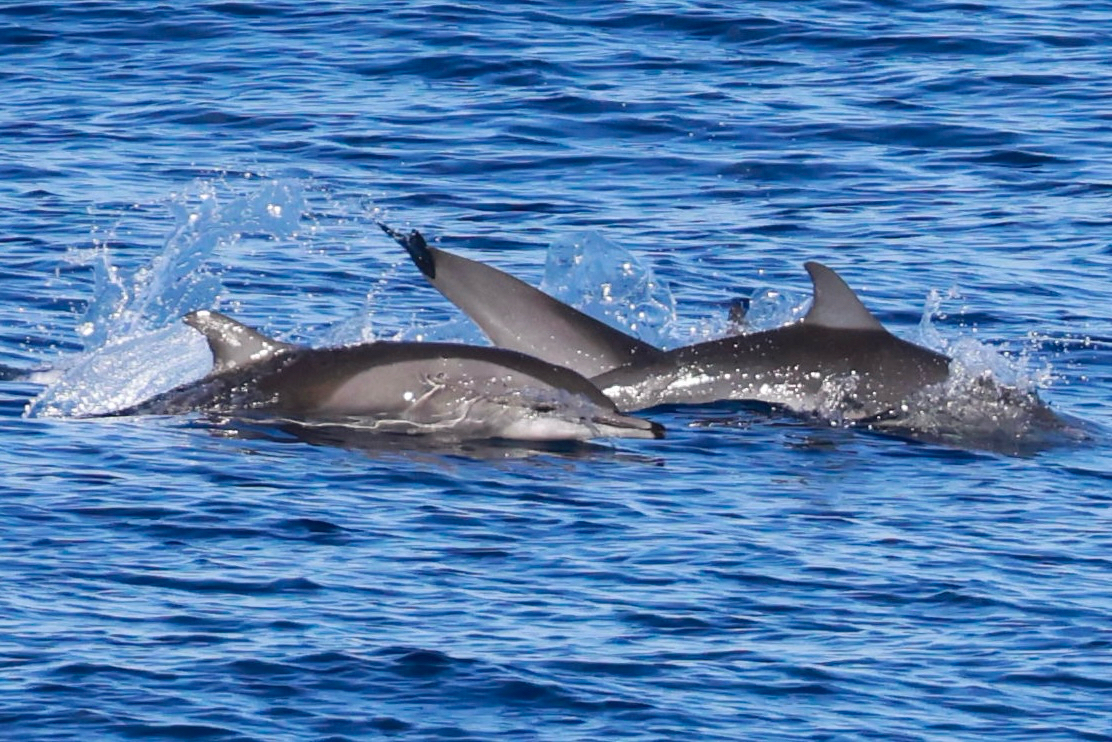
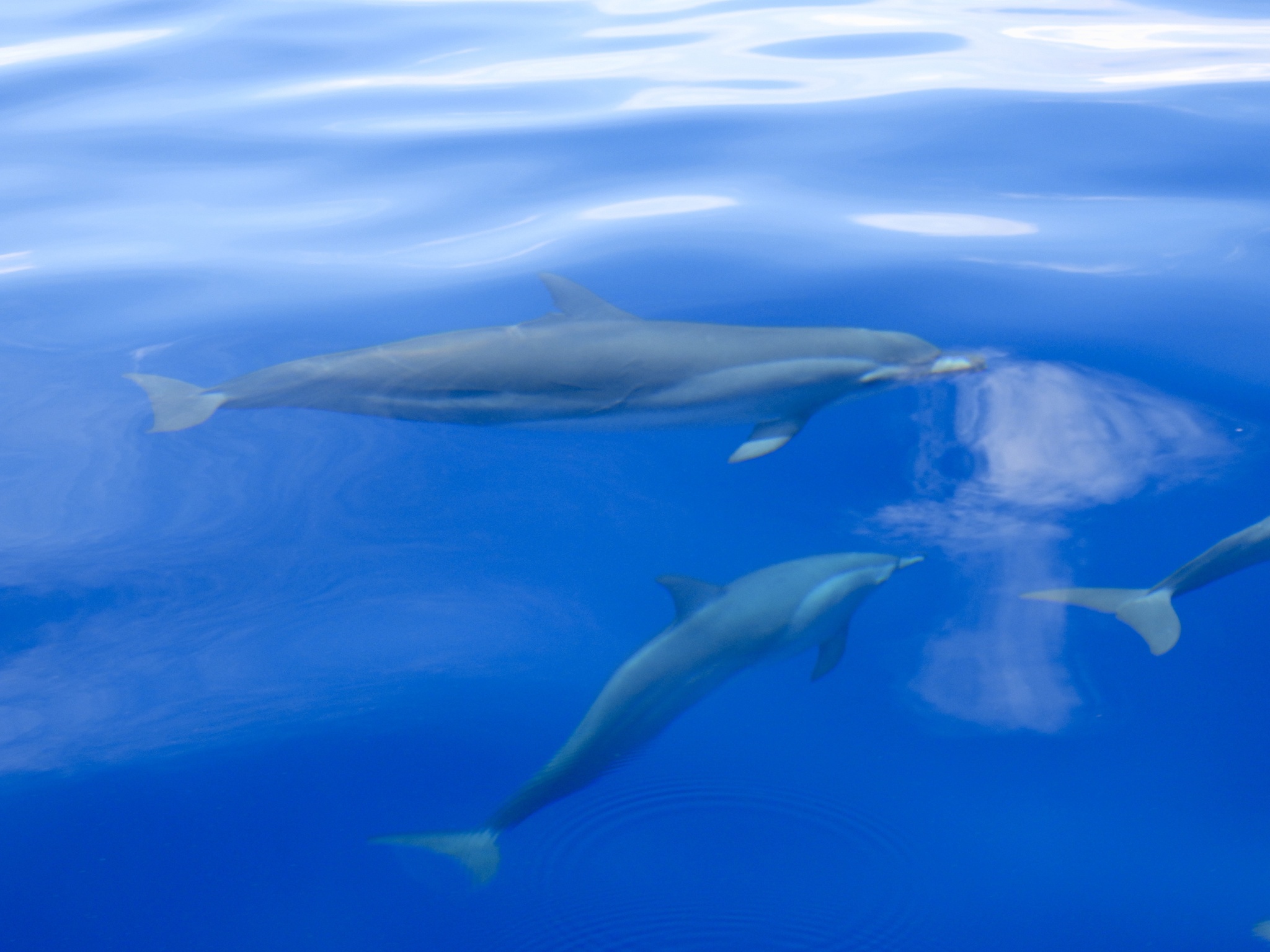
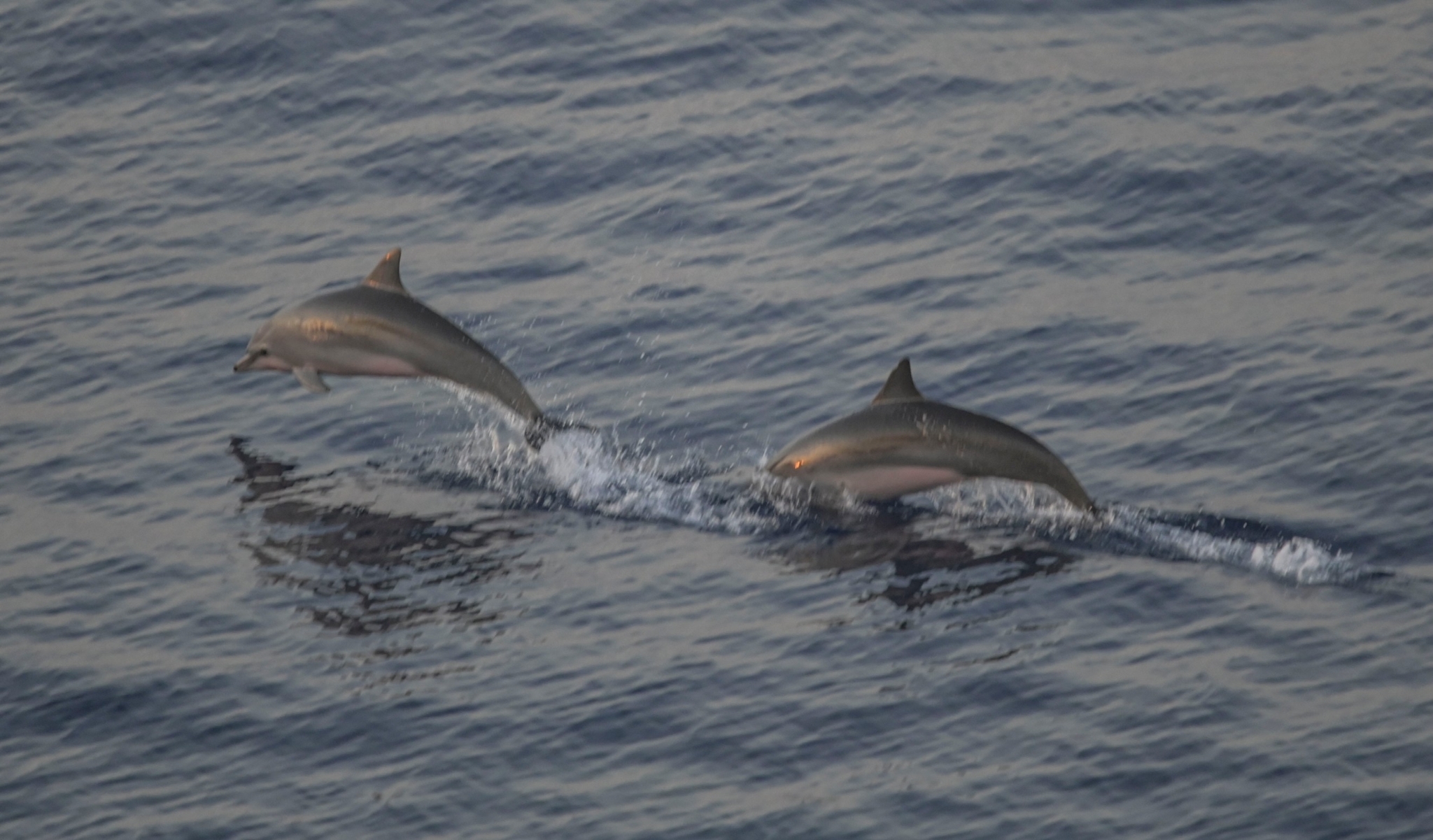
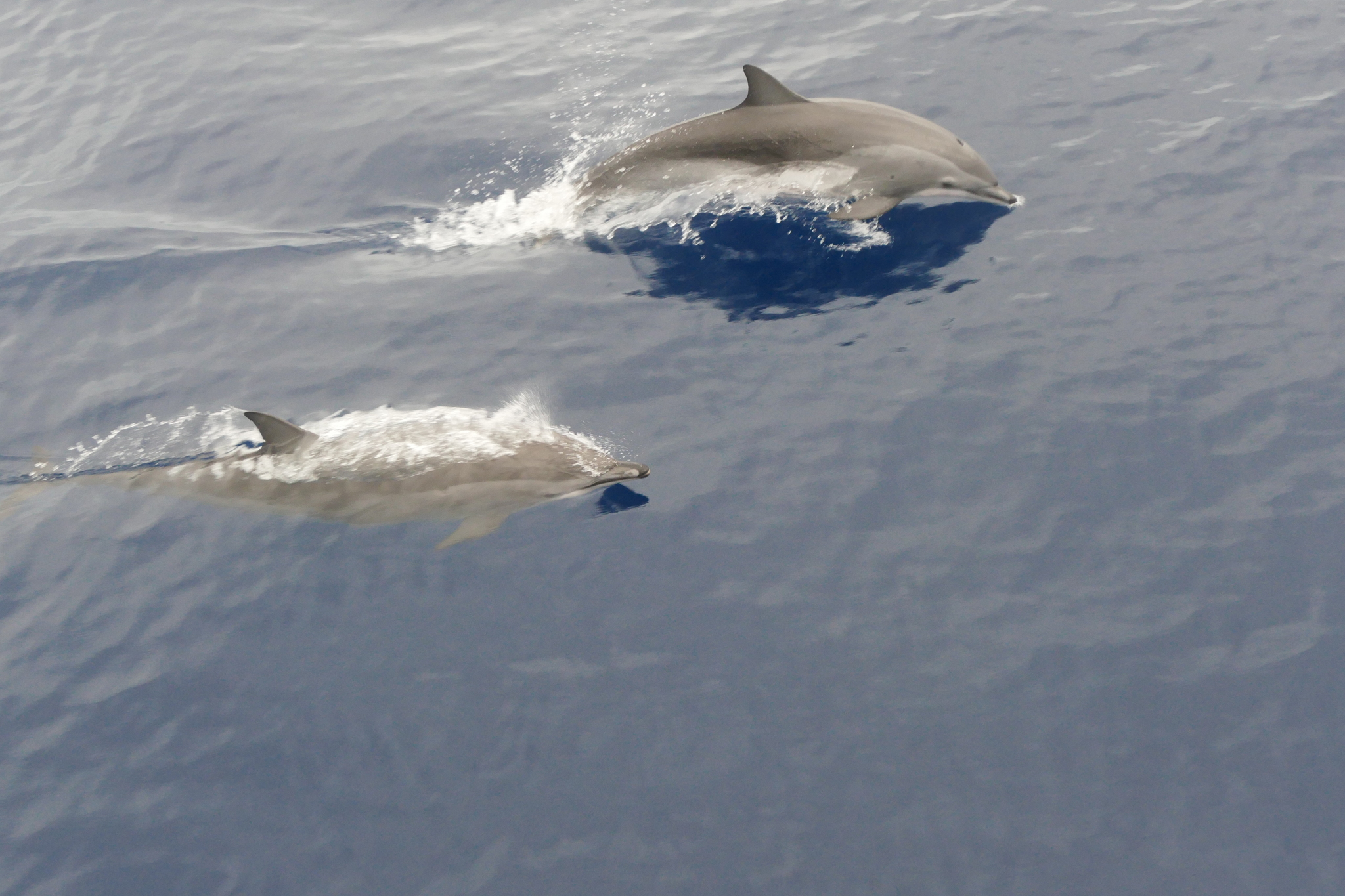
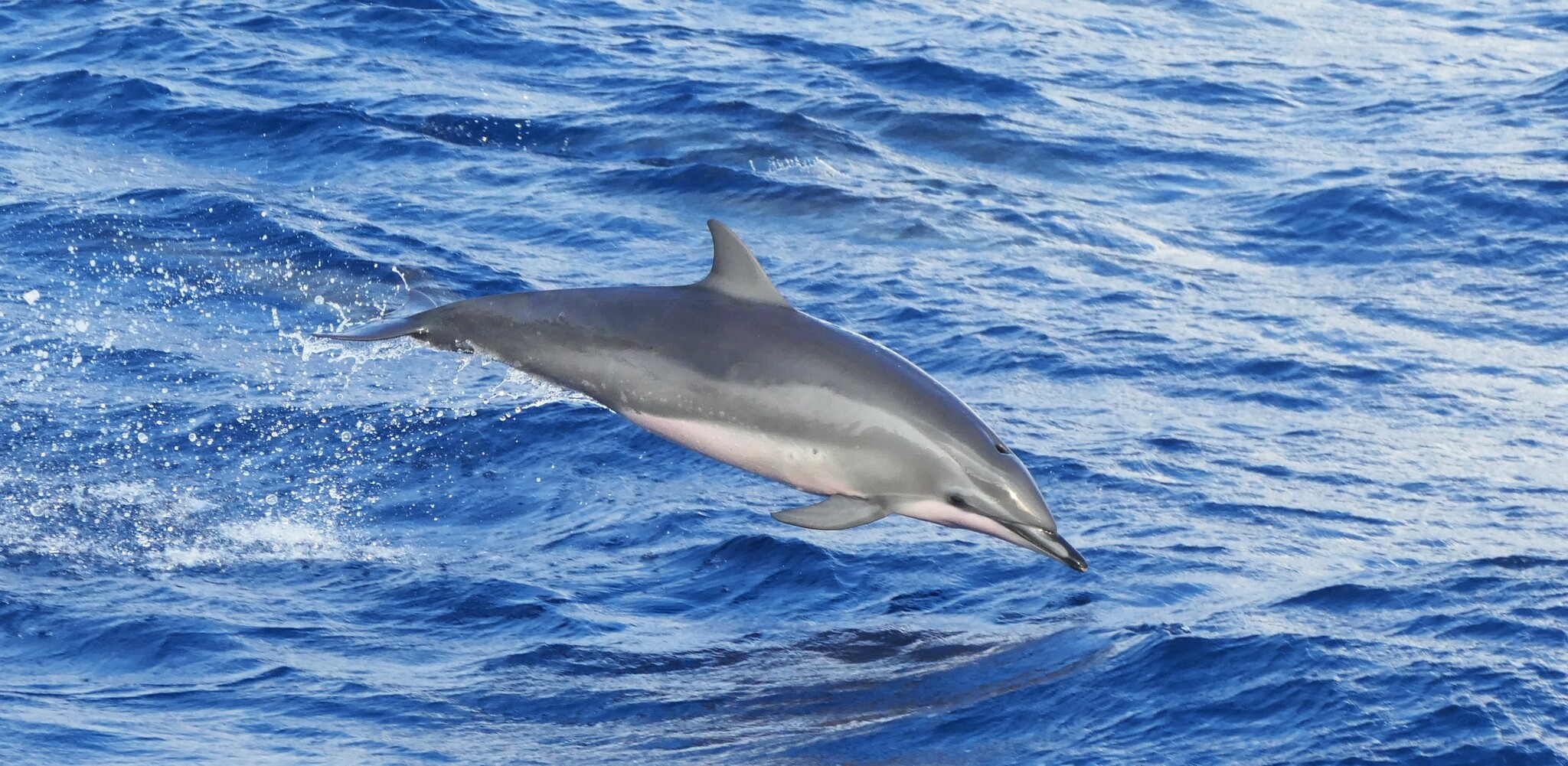
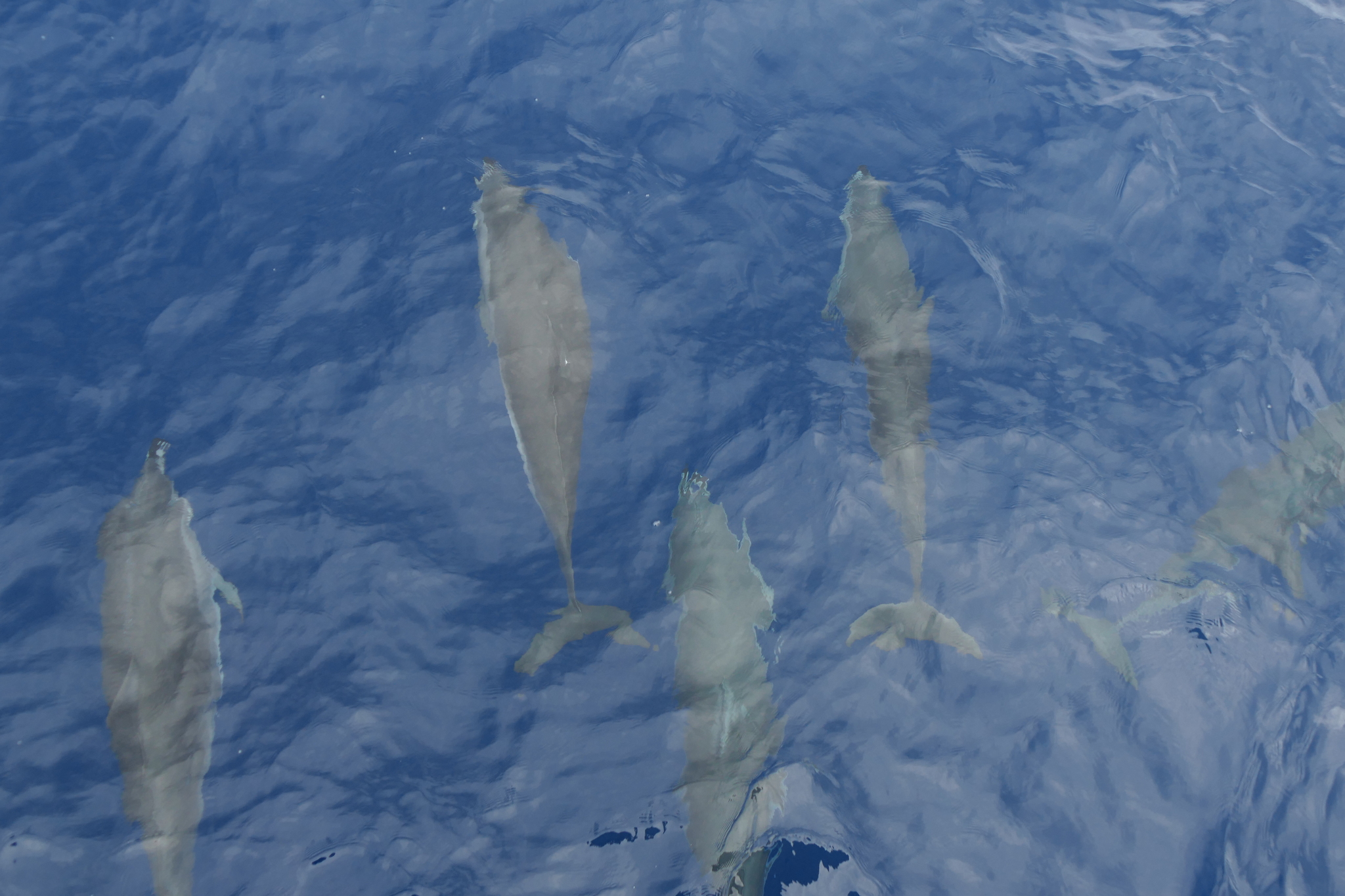
The Clymene dolphin is a stocky but elegant animal, measuring 1.7 to 2 m for a mass put, depending on the source, at between 50 and 90 kg, the most frequently cited values lying around 75 to 80 kg. Its coloration is tiered in three levels, sometimes nicknamed “Neapolitan”: a dark grey cape running from the forehead to the tail region and dipping above the eyes, light grey flanks forming a broad lateral band from the rostrum to the tail stock, and a white underside. The rostrum is short and clearly set off from the melon by a marked crease; its lips and its tip are black, drawing a kind of highly characteristic moustache, while a dark line links the eye to the flipper. The dorsal fin, tall and slightly falcate, rises at mid-back. The jaw bears 39 to 52 small conical teeth on each side, suited to seizing slippery prey.
Confusion is frequent, since three other Stenella species share part of its range. The spinner dolphin (Stenella longirostris) is the look-alike hardest to rule out: its rostrum is distinctly longer and finer, its dorsal fin straighter, almost triangular, and its aerial spins are far more frequent and more complete. The striped dolphin (Stenella coeruleoalba) also occupies the tropical Atlantic, but it is appreciably larger (up to 2.4-2.6 m) and its flanks carry pale “blazes” rising towards the back, together with a sharply defined dark band running from the eye to the anus, markings absent in the Clymene dolphin. The spotted dolphins (Stenella frontalis and Stenella attenuata) are recognised, in the adult, by their spotting. At a distance, the silhouette alone is generally not enough: the shape of the rostrum and the pattern of the black lips remain the most reliable criteria.
Sexual dimorphism is slight. Newborns measure about 1.2 m for some ten kilograms, and sexual maturity appears to be reached at around 1.8 m in length.
The Clymene dolphin belongs to the family Delphinidae, subfamily Delphininae, and to the genus Stenella, which also brings together the spinner dolphin, the striped dolphin and the two spotted dolphins. The British naturalist John Edward Gray described the animal in the middle of the nineteenth century; the binomial accepted today is attributed to him with the date 1850. Several names circulated before the nomenclature settled, among them Clymene normalis, Clymenia normalis and Prodelphinus clymene. The species was long ranked as a mere subspecies of the spinner dolphin, until the work of Perrin and his collaborators, in 1981, restored its rank as a full species.
A major genetic discovery has overturned the understanding of its origins: the analyses published in 2014 in PLoS ONE by Amaral and co-authors showed that the Clymene dolphin arose from natural hybridisation between the spinner dolphin and the striped dolphin. This is the only confirmed case of hybrid speciation in a marine mammal, a phenomenon well documented in plants, fish and birds but extremely rare in mammals. The species is today genetically distinct from its two parents, even if low levels of introgression may perhaps persist. Its name honours Clymene, an Oceanid of Greek mythology, daughter of Oceanus and Tethys.
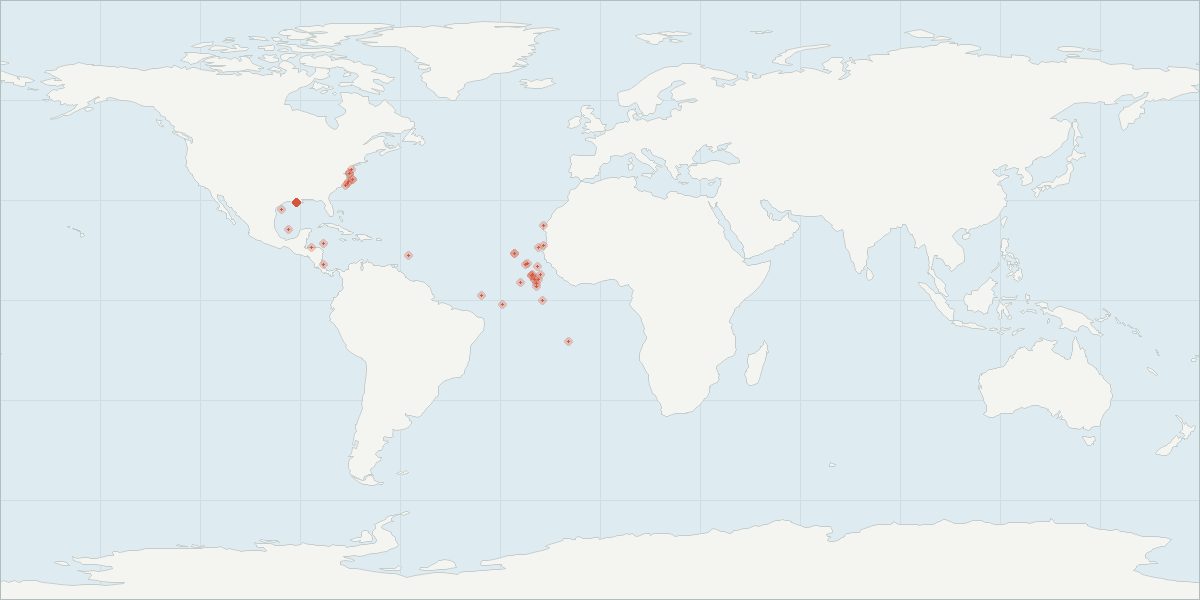
The species is strictly endemic to the Atlantic Ocean. In the western Atlantic, it is reported from New Jersey in the north as far as southern Brazil, including the Gulf of Mexico and the whole of the Caribbean Sea. In the eastern Atlantic, its range extends from southern Morocco and Mauritania to Angola, with a marked presence in the Gulf of Guinea and around the Cape Verde islands. It is absent from the Mediterranean Sea, which places it outside the scope of the Pelagos Sanctuary and of Mediterranean conservation concerns.
This is a resolutely oceanic dolphin. It frequents deep water beyond the continental shelf, generally over depths of 250 to 5,000 m, and ventures only exceptionally into shallow coastal sectors. This pelagic ecology largely explains the scarcity of sightings and the weakness of the available data.
In France, documented presence concerns the Atlantic overseas territories alone. The species is sighted occasionally in the waters of the French Antilles, Guadeloupe, Martinique, Saint-Martin and Saint-Barthélemy, covered by the Agoa Sanctuary, a marine protected area created on 5 October 2010 and recognised under the SPAW Protocol of the Cartagena Convention on 23 October 2012, which extends over the 143,256 km² of the French Antilles exclusive economic zone and is managed by the Office français de la biodiversité. A few strandings have been recorded there, as have some in French Guiana. No presence is documented in the English Channel, the North Sea or the Bay of Biscay.
The diet combines small pelagic and mesopelagic fish, among which the lanternfish of the family Myctophidae hold a notable place, and cephalopods, mainly squid. Hunting takes place above all at night, or at depth in the dimly lit mesopelagic zone, when the prey of the deep scattering layer rise towards the surface. Dives reaching about 200 m have been reported. This nocturnal rhythm has a direct consequence for its vulnerability: it exposes the animals to fishing gear set or drifting at night.
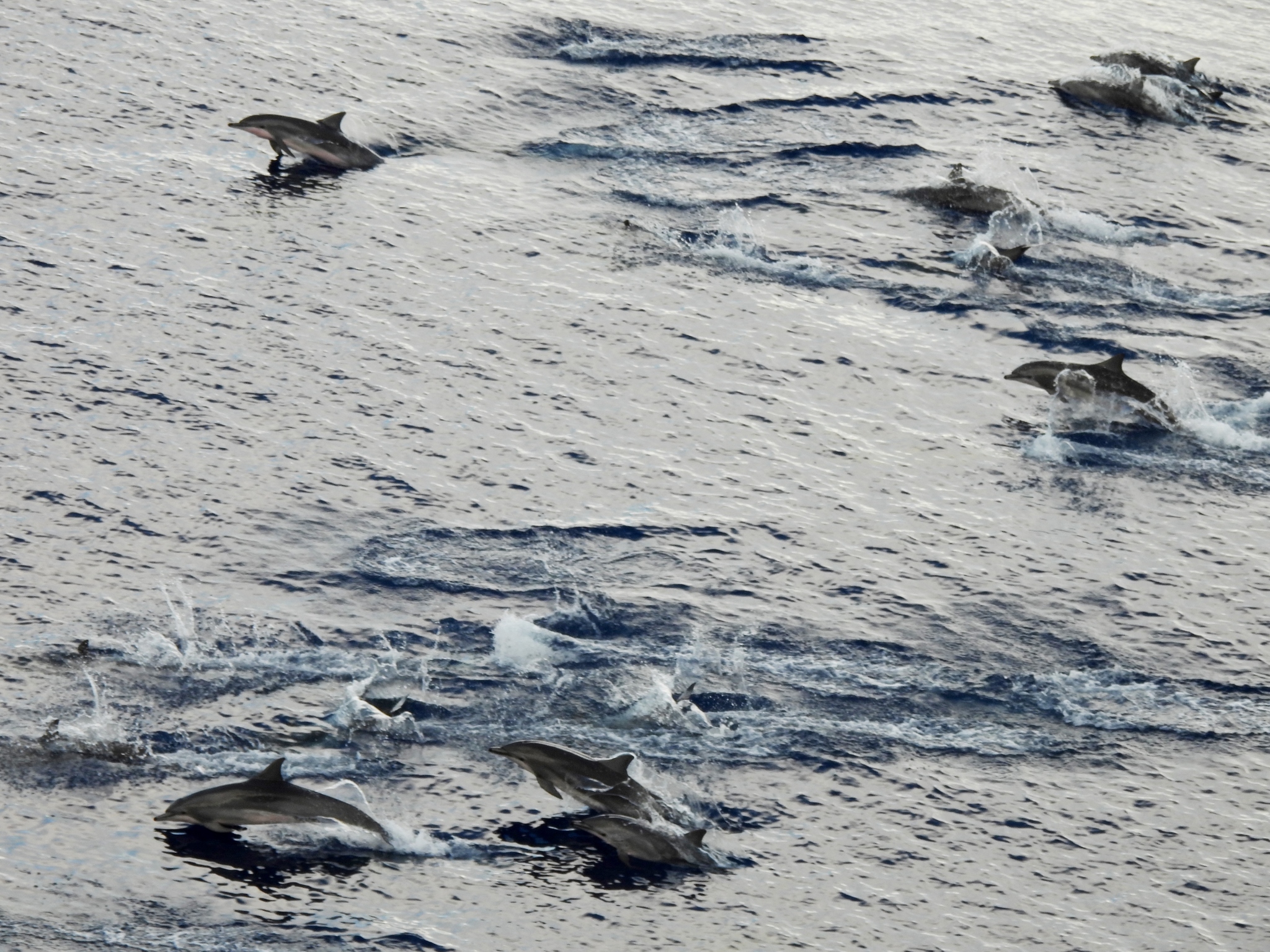
The species is gregarious. Groups most often number a few dozen individuals, typically forty to eighty, but gatherings of four to one hundred and fifty animals have been described, and exceptionally up to two hundred. Remarkably, many of these groups appear to be segregated, bringing together individuals of the same sex or the same age class. Mixed associations are regularly noted with the spinner dolphin and the common dolphin.
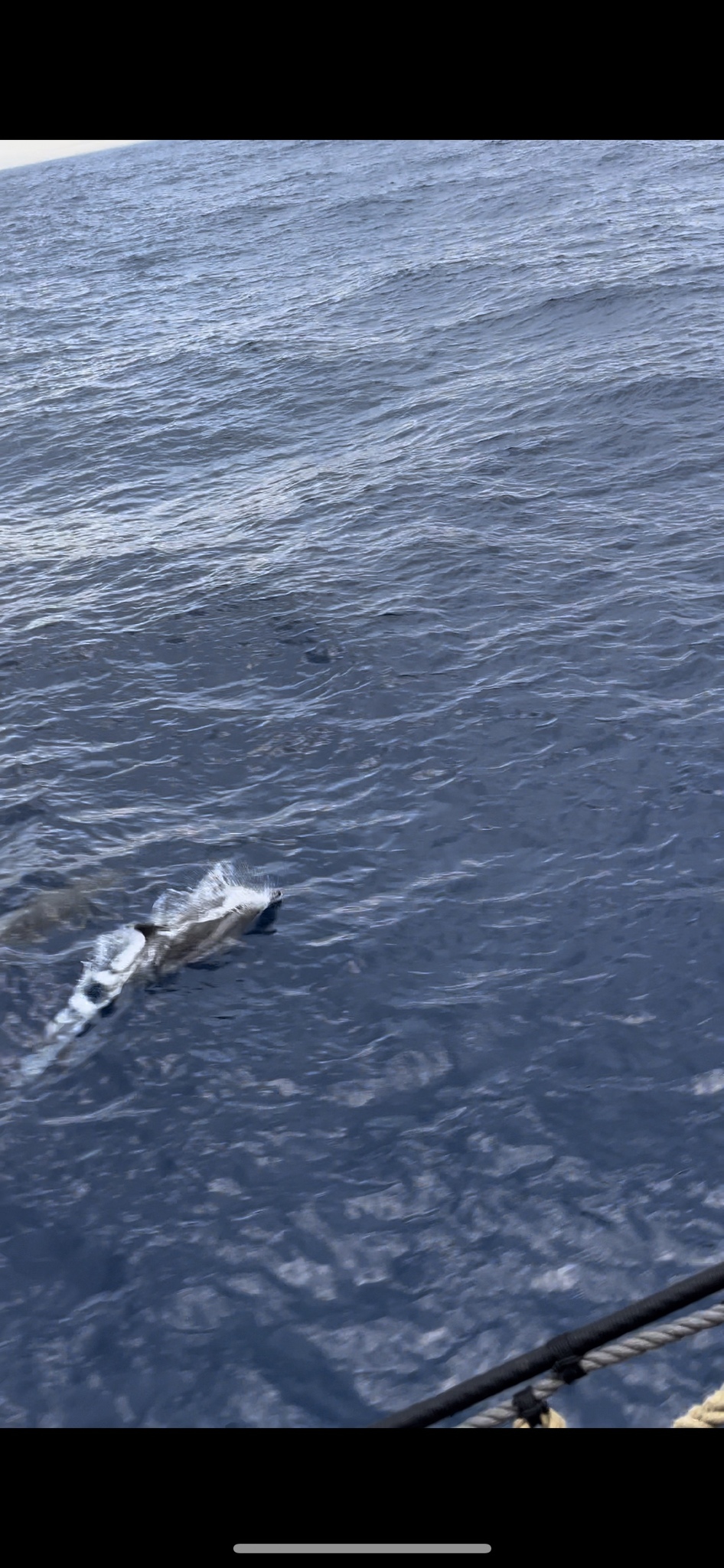
The Clymene dolphin is acrobatic. It leaps clear of the water and performs spins about its longitudinal axis, a behaviour shared with the spinner dolphin, but one it practises less regularly and less spectacularly. It readily approaches vessels and rides bow waves. It is also a highly vocal species, whose whistles lie in a range of 6 to 19 kHz.
Reproduction remains very poorly documented: the duration of gestation, that of lactation and the age at maturity have not been established, and it is only assumed that they differ little from what is known in the other Stenella species. Females give birth to a single calf, weighing some ten kilograms. Longevity is not known; a sixteen-year-old individual was identified during a stranding.
The International Union for Conservation of Nature classes the Clymene dolphin as Least Concern (LC), on the basis of an assessment carried out on 13 February 2018 and published the same year. The population trend is given as unknown, and the assessment itself is presented as provisional, pending better data: the species is extremely poor in information across its whole range.
The global population size has not been estimated. In the United States, NOAA distinguishes two stocks. The Western North Atlantic stock is assessed at 21,778 individuals, with a high coefficient of variation of 0.72, from the summer 2021 surveys at sea; the minimum population estimate adopted is 12,622 animals and the potential biological removal is set at 126. The northern Gulf of Mexico stock is estimated at about 513 individuals, but estimates there have varied widely from one survey to the next. As encounters are rare, no trend can be discerned.
The threats identified are first of all fishery-related. Bycatch in drifting gillnets, tuna purse seines and pelagic longlines is established, on an unknown scale, in many parts of the range. In Ghana, the species is the cetacean most frequently taken as bycatch in the pelagic fisheries. Directed harpoon hunting persists in the Lesser Antilles, in particular at Saint Vincent, the meat and the oil being destined for consumption. To these are added chemical pollution by PCBs and organochlorine pesticides, the risks of accidental pollution linked to oil and gas exploration and production in the Gulf of Mexico and the Caribbean, and underwater noise of human origin, which interferes with communication, echolocation and orientation.
The species is listed on Appendix II of CITES, on Appendix II of the Bonn Convention for the West African population, and on Annex II of the SPAW Protocol for the Caribbean region. It is protected by the Marine Mammal Protection Act in United States waters. In France, it enjoys full protection as a protected marine mammal: capture, destruction and intentional disturbance, including pursuit and harassment, are prohibited. The regional Red Lists of Martinique (2020) and Guadeloupe (2022) class it as “Not Evaluated”, for want of sufficient data.
Seeing a Clymene dolphin is a matter of luck and calls for going far from the coast: the species lives over depths of several hundred to several thousand metres and is practically never visible from the shore. The most favourable sectors are the deep waters of the Lesser Antilles, the Gulf of Mexico, the approaches to Cape Verde and the Gulf of Guinea. In the French Antilles, the watching trips organised within the Agoa Sanctuary encounter it occasionally, most often offshore of the drop-offs.
In the field, a few clues help to decide: leaps accompanied by spins less ample than those of the spinner dolphin, a tall and discreetly falcate dorsal fin, and above all, if the animal comes to the bow, the tip of the rostrum and the frankly black lips on a short rostrum. Its small size, the most modest in the genus Stenella, also helps to separate it from the striped dolphin, which is distinctly larger. A profile photograph is often needed to confirm the identification, so alike are the Stenella species at sea.
The approach must remain respectful. French regulations prohibit any intentional disturbance, which includes pursuit and harassment. In practice, it is right to keep a sufficient distance, never to cut across the path of a group or to split it, to hold a slow and steady speed, to limit the length of the observation and not to enter the water with the animals. Reporting sightings to the local naturalist networks is a valuable contribution, since every record counts for a species as poorly documented as this one.
Yes. Genetic analyses published in 2014 in PLoS ONE showed that it descends from natural hybridisation between the spinner dolphin (Stenella longirostris) and the striped dolphin (Stenella coeruleoalba). It is the only confirmed case of speciation by hybridisation in a marine mammal. The species is today genetically distinct from its two parents.
Only in the Atlantic overseas territories. It is sighted occasionally in the waters of the French Antilles (Guadeloupe, Martinique, Saint-Martin, Saint-Barthélemy), within the Agoa Sanctuary, created on 5 October 2010 and recognised under the SPAW Protocol on 23 October 2012, and strandings have been recorded in French Guiana. The species is absent from the Mediterranean and is not documented in the English Channel or the Bay of Biscay.
The rostrum of the Clymene dolphin is distinctly shorter and is set off from the melon by a marked crease; its lips and the tip of its rostrum are black. Its dorsal fin is less straight, more falcate, than that of the spinner dolphin, which is almost triangular. Lastly, although it too performs spins in the air, it does so less regularly and less spectacularly.
Size is the first clue: the Clymene dolphin scarcely exceeds 2 m and 80 kg, whereas the striped dolphin reaches 2.4 to 2.6 m and more than 150 kg. The livery is also telling: the striped dolphin carries on its flanks pale “blazes” rising towards the back and a sharply defined dark band running from the eye to the anus, markings absent in the Clymene dolphin, whose coloration is divided into three horizontal bands and whose lips are black.
The IUCN classes it as Least Concern (LC) since the assessment of 13 February 2018, with an unknown population trend. That assessment is explicitly regarded as provisional, the species being very poor in data. No global population estimate exists.
The longevity of the species has not been established; the oldest documented individual, found stranded, was sixteen years old. The dives reported reach about 200 m, consistent with nocturnal hunting on mesopelagic prey that rise towards the surface at nightfall.
Bycatch in drifting gillnets, tuna purse seines and pelagic longlines comes first; in Ghana, it is the cetacean most often taken in the pelagic fisheries. To these are added directed harpoon hunting in the Lesser Antilles, chemical pollution, the risks linked to the oil and gas industry in the Gulf of Mexico and the Caribbean, and underwater noise.
Profile compiled from authoritative scientific sources (IUCN, NOAA Fisheries, specialist literature) and read back for factual checking.
According to the open data of the GBIF, 81 georeferenced sightings of Stenella clymene are recorded in our photographic index.
| Country | Notes |
|---|---|
| United States of America | 55 |
| Cabo Verde | 2 |
| Honduras | 2 |
| Barbados | 1 |
| Brazil | 1 |
| Costa Rica | 1 |
| Guinea-Bissau | 1 |
| Mauritania | 1 |
| Mexico | 1 |
| Senegal | 1 |

Monthly distribution of 36 dated sightings (all years combined): the maximum is reached in mai.
| Month | Notes |
|---|---|
| janvier | 2 |
| February | 1 |
| mars | 2 |
| avril | 6 |
| mai | 7 |
| juin | 2 |
| juillet | 2 |
| August | 2 |
| septembre | 3 |
| octobre | 4 |
| novembre | 5 |
| December | 0 |
These figures reflect survey effort (more boaters and more surveys in summer) as much as the actual presence of the species: to be interpreted with caution.


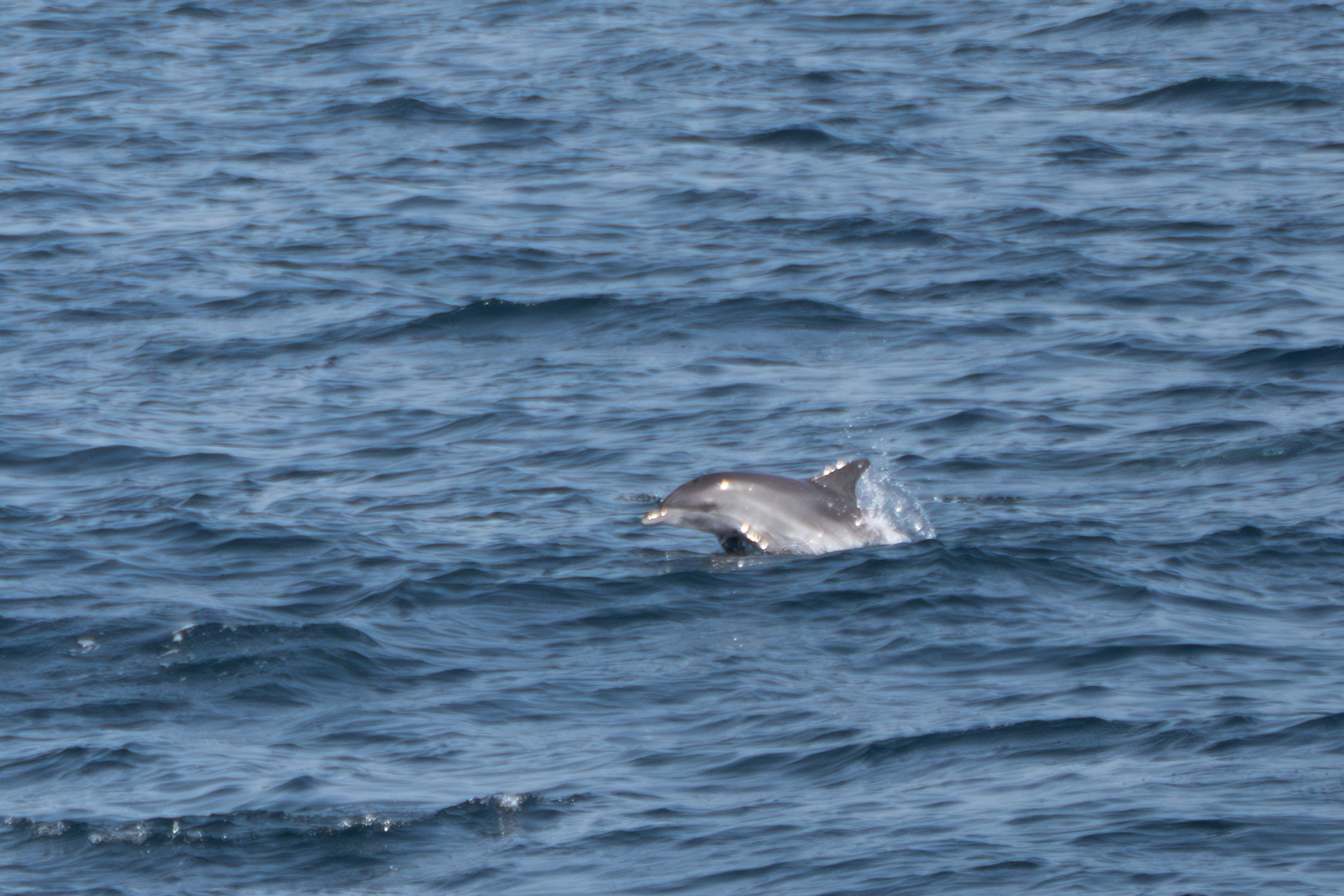
Photographs from GBIF under a Creative Commons licence. The author and the licence of each photograph are given; please respect them if you reuse them.
Automatic selection of the most cited works mentioning the species (source: Crossref).