Burrunan dolphin (Tursiops australis): a proposed species, not recognised

Key facts
Scientific name Tursiops australis Charlton-Robb, Gershwin, Thompson, Austin, Owen & McKechnie, 2011. Taxon not recognised: the taxonomy committee of the Society for Marine Mammalogy does not accept it and assigns these animals to the Indo-Pacific bottlenose dolphin (Tursiops aduncus) or to the common bottlenose dolphin (Tursiops truncatus).
Other names Burrunan dolphin; dauphin de Burrunan, dauphin Burrunan (French); Tursiops aduncus australis (the combination used by authors who treat it as a subspecies of the Indo-Pacific bottlenose dolphin)
Size 2.27 to 2.78 m (adults average about 2.57 m)
Weight No reference mass specific to the taxon has been published; for comparison, the Indo-Pacific bottlenose dolphin, of similar size (about 2.6 m), reaches 230 kg
Longevity Not specifically documented; the related species of the genus Tursiops exceed 40 years
Diet Opportunistic predator of coastal fish and cephalopods (squid, cuttlefish)
IUCN status Not evaluated at the global scale: the taxon has no account of its own on the IUCN Red List, for want of international taxonomic recognition and of sufficient data. Depending on the placement adopted, the animals concerned fall under the assessments of the common bottlenose dolphin Tursiops truncatus (Least Concern, 2019 assessment) or of the Indo-Pacific bottlenose dolphin Tursiops aduncus (Near Threatened, 2019 assessment). In Australia, a subnational assessment carried out in 2013 under IUCN criteria version 3.1 (Advisory List of Threatened Vertebrate Fauna in Victoria) classified it as Endangered (EN); the State of Victoria then listed it as Critically Endangered under the Flora and Fauna Guarantee Act 1988 in October 2021, on criterion C (fewer than 250 mature individuals with a continuing decline). It is not listed under the Australian federal EPBC Act.

In brief

The Burrunan dolphin is a bottlenose dolphin of the coastal waters of southern and south-eastern Australia, described in 2011 from specimens from Victoria and Tasmania. Intermediate in size between the common bottlenose dolphin and the Indo-Pacific bottlenose dolphin, it is recognised by its three-banded coloration and by its short, stocky rostrum. Its taxonomic validity remains contested, but the two known resident populations, in Port Phillip Bay and the Gippsland Lakes, together total fewer than 200 individuals and have been classified as “critically endangered” by the State of Victoria since October 2021.

Identification

The Burrunan dolphin is a robust delphinine whose adults measure 2.27 to 2.78 m, for a mean length of about 2.57 m. It thus lies between its two congeners: smaller than the common bottlenose dolphin, larger than the Indo-Pacific bottlenose dolphin. The skull follows the same pattern, with a mean length of 493.6 mm (470 to 513 mm). The dentition numbers 94 teeth on average, made up of 24 teeth in each upper half-jaw and 23 in each lower half-jaw.

The most useful character in the field is the coloration, described as “tri-banded” and strongly contrasting: the back and the sides of the head and body are dark blue-grey, a light grey band runs along the midline and widens into a pale patch (the “shoulder blaze”) on the flank, below the dorsal fin, and the underside is off-white, this pale tone extending in some individuals above the eye and as far as above the flipper. The rostrum is short and stocky, with a mean length of 10.8 cm (9.4 to 12 cm), while the dorsal fin is tall and falcate, fairly similar to that of the common bottlenose dolphin. On the skull, the suture between the palatine and the maxilla forms a characteristic elongated triangle, and the maxilla meets the premaxilla without the “pinch” seen in Tursiops truncatus.

The risks of confusion are real and concern first of all the two other bottlenose dolphins, which occur in the same Australian waters: the common bottlenose dolphin, bulkier, with a longer rostrum and a less sharply marked coloration, and the Indo-Pacific bottlenose dolphin, smaller, with a more slender rostrum and often developing dark ventral spotting in older adults, spotting that is absent in the Burrunan. In practice, no external character is entirely diagnostic, and reliable identification rests on genetics or on examination of the skull. Researchers do, on the other hand, identify individuals one by one from the natural notches and nicks on the trailing edge of the dorsal fin, as personal as fingerprints.

Taxonomy

The Burrunan dolphin was described in 2011 in the journal PLOS ONE by Kate Charlton-Robb and her collaborators at Monash University, from a holotype held at the Queen Victoria Museum and Art Gallery (specimen QVMAG 1365), a female collected on 11 November 1914 in the North Esk River, near Launceston in Tasmania, and long left misidentified in the collections. Twenty paratypes from Victorian and Tasmanian waters complete the description. The epithet australis means “southern” in Latin; the vernacular name “Burrunan” is borrowed from the Boonwurrung, Woiwurrung and Taungurung Aboriginal languages, in which it denotes a “large sea fish of the porpoise kind”. As the taxon was described from the outset in the genus Tursiops, the authority citation is written without parentheses: Tursiops australis Charlton-Robb, Gershwin, Thompson, Austin, Owen & McKechnie, 2011.

The arguments put forward in 2011 combined cranial morphology, external coloration and mitochondrial genetics: 48 fixed differences over 1,086 base pairs of cytochrome b and 10 fixed differences over 418 base pairs of the control region separate the Burrunan from the common bottlenose dolphin, that is a divergence of 5.5% for the control region, rising to 9.1% with respect to the Indo-Pacific bottlenose dolphin. The evolutionary separation is estimated at about one million years.

This validity nevertheless remains contested. The taxonomy committee of the Society for Marine Mammalogy has never accepted the taxon in its annual revisions, faulting the original description for small sample sizes, for measurements that overlap and for morphological comparisons limited to the Australian bottlenose dolphins alone. A morphometric study published in 2020 in the Canadian Journal of Zoology, covering 264 skulls analysed in two and three dimensions, concluded that the skulls attributed to the Burrunan fell within the variability of Tursiops truncatus. In the same year, a phylogenomic analysis based on RADseq sequencing assigned the South Australian forms to Tursiops aduncus. The American Society of Mammalogists today treats it as a subspecies of the Indo-Pacific bottlenose dolphin, under the combination Tursiops aduncus australis, the genus remaining unchanged, and there too the authority citation stays without parentheses. The debate is therefore not settled, and it sets two alternative placements against each other rather than pointing to a single consensus.

Distribution and habitat

The taxon is endemic to the coastal waters of southern and south-eastern Australia. Its presence is established in the State of Victoria, in Tasmania and in South Australia. The known limits of its range are sharp: no haplotype has been attributed to it north of the border between Victoria and New South Wales, nor west of St Francis Island, in South Australia, even though more recent genetic work points to a possible extension towards Western Australia.

It is a strictly coastal and estuarine animal, occurring in semi-enclosed bays, in lagoons and in shallow brackish lake systems, often in immediate contact with built-up areas, commercial ports and fisheries. Only two resident populations are formally described, both in Victoria: that of Port Phillip Bay, estimated at between 90 and 120 individuals depending on the source and the year, and that of the Gippsland Lakes, estimated at between 50 and 65 individuals. The whole remains below 200 animals. These two nuclei are genetically distinct, with very little exchange of individuals between them, and show low genetic diversity, marked by a very small number of haplotypes. Haplotypes assigned to the taxon have also been reported along the east coast of Tasmania and in the Spencer Gulf region, in South Australia.

No data indicate the presence of this dolphin in French waters, neither in mainland France (the Mediterranean and the Pelagos Sanctuary, the Bay of Biscay, the English Channel) nor overseas: its range is confined to the coastal shelf of southern Australia. In mainland France, the bottlenose dolphin observed is the common bottlenose dolphin, Tursiops truncatus.

Biology and ecology

An opportunistic predator, the Burrunan dolphin feeds on coastal fish and on cephalopods such as squid and cuttlefish, whose availability varies widely in the bays and lagoons it frequents. Like the other bottlenose dolphins, it combines echolocation with coordinated manoeuvres to herd and capture its prey, and adapts its techniques to the substrate and to the type of habitat.

Social life is organised in small groups, often of about ten individuals, with occasionally larger gatherings. Site fidelity is strong: in Port Phillip Bay, certain recognisable individuals have been monitored since the mid 2000s and have raised several generations of young there, which confirms the resident, non-migratory character of these communities. The behavioural repertoire documented during monitoring includes foraging, resting, “milling” (disordered movements at the surface), large breaches, lobtailing and mate-guarding sequences linked to breeding.

The breeding parameters specific to the Burrunan remain poorly known, no long-term demographic monitoring having been published on this point. In bottlenose dolphins generally, gestation lasts about twelve months, the newborn measures between 0.84 and 1.5 m, weaning occurs at around a year and a half to two years and the young may remain with its mother for up to five years, with intervals between calvings of several years. The longevity specific to the taxon has not been established; the related species exceed forty years. Likewise, the available data do not allow dive depths and durations to be specified: the habitats occupied, shallow bays and lagoons, in practice imply short dives.

Status and conservation

The combination of a very small population, a restricted range, impoverished genetic diversity and a peri-urban habitat makes these populations particularly vulnerable. The 2013 subnational assessment had adopted the category Endangered for Victoria; in October 2021, the taxon was listed as Critically Endangered under that State’s Flora and Fauna Guarantee Act 1988, on the ground of criterion C, namely a population estimated at fewer than 250 mature individuals together with a continuing decline. It is, on the other hand, neither listed under the federal EPBC Act nor assessed on the global IUCN Red List, both absences stemming at once from the lack of data and from the taxonomic dispute.

Fresh water skin disease is the best documented threat. It arises when a marine dolphin undergoes prolonged exposure, from several weeks to several months, to water that has become hyposaline, typically a rapid fall from more than 30 grams of salt per litre to less than 5. The result is target-shaped skin lesions, ulcerated and secondarily infected by fungi and bacteria, then an electrolyte imbalance that can lead to organ failure. The Gippsland Lakes went through a first episode in October and November 2007, following a one-in-a-hundred-year flood that occurred in June of the same year: three adults were found dead within ten days and about 40% of the photographed survivors bore lesions. A second episode began in 2020, in a context of above-normal rainfall.

To these are added chemical contamination, the catchment of the Gippsland Lakes having been marked by the historical use of mercury in gold extraction and then by industrial discharges, with analyses also reporting pesticides and perfluorinated compounds, disturbance by vessels, underwater noise, entanglement in fishing gear and plastic waste, as well as the changes in salinity linked to engineering works and to climate change. A study carried out in the Gippsland Lakes between July 2017 and January 2018 showed that 77% of dolphin sightings took place in the presence of at least one vessel within 400 m, with 56 recorded violations of the approach rules and a summer peak of 4.54 violations per hour; these interactions alter activity budgets, at the expense of feeding and resting.

Watching this species

The two reliable watching sites are in the State of Victoria, in Australia: Port Phillip Bay, in particular around Sorrento, Queenscliff and the entrance to the bay, and the Gippsland Lakes, in the vicinity of Lakes Entrance. Commercial trips are offered there all year round, the most favourable conditions corresponding to the calm seas of late spring and of the austral summer, that is from November to March. As the animals are resident, encounters are possible in any season, but they involve small groups, often unobtrusive and busy feeding.

Given numbers below 200 individuals, watching ethics are not an optional refinement but a condition of survival for these communities. The initiative should be left to the animals, the path of a group should never be cut across, nor should anyone come between a female and her calf; speed should be kept constant and low, the length of the encounter limited, and the approach distances set by the Victorian marine mammal regulations respected, stricter still in the presence of young. The disturbance documented in the Gippsland Lakes shows that the mere accumulation of vessels, even without contact, is enough to interrupt feeding and resting phases. Photographs of the dorsal fin, taken from the side and without pursuing the animal, are of real scientific value: they feed the photo-identification catalogues used for the demographic monitoring of these populations.

Frequently asked questions

Is the Burrunan dolphin a species in its own right?

That is precisely the question that divides opinion. Described as a new species in 2011 on the basis of mitochondrial genetics, of coloration and of the skull, it has never been validated by the taxonomy committee of the Society for Marine Mammalogy. A 2020 morphometric study of 264 skulls places it back within the variability of the common bottlenose dolphin, while a phylogenomic analysis from the same year and the American Society of Mammalogists assign it to the Indo-Pacific bottlenose dolphin, at subspecies rank. The name Tursiops australis remains widely used in Australia, in particular in the protection instruments of the State of Victoria.

How many Burrunan dolphins are left?

The only two formally described resident populations live in Port Phillip Bay, with 90 to 120 individuals according to the estimates, and in the Gippsland Lakes, with 50 to 65 individuals. The known total therefore remains below 200 animals, which is what justified the critically endangered listing under criterion C, reserved for populations of fewer than 250 mature individuals in continuing decline.

How can it be told from the other bottlenose dolphins?

Its size is intermediate, from 2.27 to 2.78 m, with a markedly short and stocky rostrum, about 11 cm, and a coloration in three sharply marked bands: dark blue-grey on the back and the sides of the head, light grey along the midline with a pale patch on the flank below the dorsal fin, off-white underneath. It does not show the dark ventral spotting of older Indo-Pacific bottlenose dolphins. At sea, however, none of these criteria is decisive on its own, and certain identification goes through genetics or through examination of the skull.

What is the fresh water skin disease affecting this population?

It is a condition brought on by prolonged exposure to water that has become too little saline, generally after a major flood: when salinity falls from more than 30 grams per litre to less than 5 over several weeks, the skin develops ulcerated target-shaped lesions, secondarily infected, and the animal may die of electrolyte imbalance. The Gippsland Lakes went through an episode in October and November 2007, after a one-in-a-hundred-year flood, with three adults dead within ten days and about 40% of the photographed survivors bearing lesions, then a second episode from 2020 onwards.

Can this dolphin be seen in France?

No. The taxon is endemic to southern and south-eastern Australia, between St Francis Island in South Australia and the border between Victoria and New South Wales, Tasmania included. It is absent from French waters, both in the Mediterranean and the Pelagos Sanctuary and in the Bay of Biscay, the English Channel and overseas. The bottlenose dolphin observed in mainland France is Tursiops truncatus.

Where does the name “Burrunan” come from?

It is borrowed from the Boonwurrung, Woiwurrung and Taungurung Aboriginal languages of south-eastern Australia, in which it denotes a large marine animal of the porpoise kind. The Boonwurrung frequented and documented Port Phillip Bay long before the scientific description. The Latin name australis means simply “southern”, in reference to the austral distribution of the taxon.

Sources

Species account compiled from authoritative scientific sources (IUCN, NOAA Fisheries, specialist literature) and reviewed for factual accuracy.

Observed distribution

According to the open data of the GBIF, 1 observation géolocalisée de Tursiops australis are recorded in our photographic index.

Main countries of observation
CountryNotes
Australia1

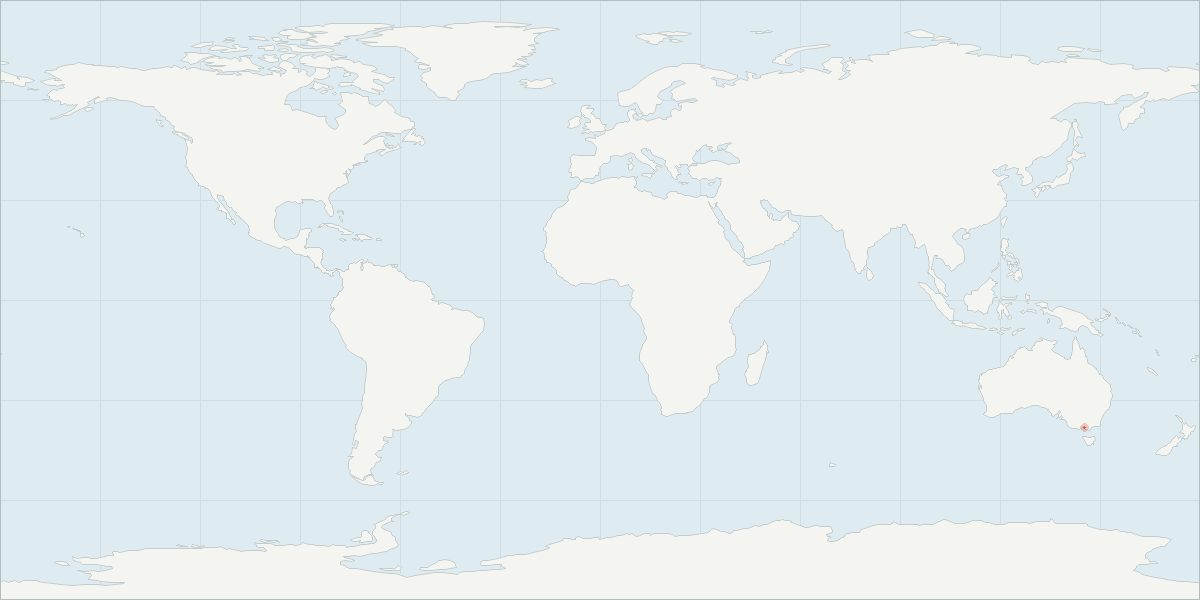
Distribution map: Burrunan dolphin (Tursiops australis)

Distribution map: Burrunan dolphin (Tursiops australis), 1 georeferenced sightings from GBIF
1 georeferenced sightings of Tursiops australis. Base map Natural Earth, public domain. GBIF data.
🗺️ Open the interactive mapTo zoom and pan. It uses the OpenStreetMap/CARTO base maps and the GBIF occurrence densities: no data is sent to these services before you click.

Presence through the year

Monthly distribution of 1 dated sightings (all years combined): the maximum is reached in juin.

10janvier : 0janfévrier : 0febmars : 0maravril : 0avrmai : 0maijuin : 1juinjuillet : 0juilaoût : 0Augustseptembre : 0sepoctobre : 0octnovembre : 0novdécembre : 0dec
Sightings by month
MonthNotes
janvier0
February0
mars0
avril0
mai0
juin1
juillet0
August0
septembre0
octobre0
novembre0
December0

These figures reflect survey effort (more boaters and more surveys in summer) as much as the actual presence of the species: to be interpreted with caution.

En images

Tursiops australis
© Tim Bawden, CC BY-NC-SA, 2016

Photographs from GBIF under a Creative Commons licence. The author and the licence of each photograph are given; please respect them if you reuse them.

Scientific references

  1. Charlton-Robb K., Gershwin L., Thompson R., Austin J. et al. (2011) A New Dolphin Species, the Burrunan Dolphin Tursiops australis sp. nov., Endemic to Southern Australian Coastal Waters, PLoS ONE
  2. Filby N., Stockin K., Scarpaci C. (2014) Long-term responses of Burrunan dolphins ( Tursiops australis ) to swim-with dolphin tourism in Port Phillip Bay, Victoria, Australia: A population at risk, Global Ecology and Conservation
  3. Charlton-Robb K., Taylor A., McKechnie S. (2014) Population genetic structure of the Burrunan dolphin (Tursiops australis) in coastal waters of south-eastern Australia: conservation implications, Conservation Genetics
  4. Diaz-Aguirre F., Parra G., Passadore C., Möller L. et al. (2018) Kinship influences social bonds among male southern Australian bottlenose dolphins (Tursiops cf. australis), Behavioral Ecology and Sociobiology
  5. Howes L., Scarpaci C., Parsons E. (2012) Ineffectiveness of a marine sanctuary zone to protect burrunan dolphins (Tursiops australissp.nov.) from commercial tourism in Port Phillip Bay, Australia, Journal of Ecotourism
  6. Monk A., Charlton-Robb K., Buddhadasa S., Thompson R. et al. (2014) Comparison of Mercury Contamination in Live and Dead Dolphins from a Newly Described Species, Tursiops australis, PLoS ONE
  7. Pratt E., Beheregaray L., Bilgmann K., Zanardo N. et al. (2018) Hierarchical metapopulation structure in a highly mobile marine predator: the southern Australian coastal bottlenose dolphin (Tursiops cf. australis), Conservation Genetics
  8. Filby N., Christiansen F., Scarpaci C., Stockin K. et al. (2017) Effects of swim-with-dolphin tourism on the behaviour of a threatened species, the Burrunan dolphin Tursiops australis, Endangered Species Research

Automatic selection of the most cited works mentioning the species (source: Crossref).