| Scientific name | Stenella coeruleoalba (Meyen, 1833) |
|---|---|
| Other names | Streaker dolphin; in French dauphin bleu et blanc, dauphin rayé, dauphin bleu, dauphin de Téthys, dauphin d'Euphrosyne, stenelle rayée; in Spanish delfín listado, in German Blau-Weißer Delfin, in Portuguese golfinho riscado, in Japanese suji iruka. |
| Size | 1.9 to 2.6 m (males up to ~2.6 m, females ~2.4 m; 1.8-2.2 m in the Mediterranean); newborn ~0.9 to 1 m |
| Weight | 80 to 160 kg in adults; newborn ~10 kg |
| Longevity | Commonly 40 to 50 years, up to 55-58 years |
| Diet | Small pelagic and mesopelagic fish (lanternfish, anchovy, sardine, hake), cephalopods and, incidentally, crustaceans; hunting mainly at night by echolocation, dives to about 700 m |
| IUCN status | Least Concern (LC) globally, assessment published in 2019. Mediterranean subpopulation: Least Concern (LC) since the update published in 2022, after a Vulnerable (VU) listing in 2012. Gulf of Corinth subpopulation: Endangered (EN), 2022. Red List of the mammals of metropolitan France (2017): Least Concern (LC). |
The striped dolphin is a medium-sized oceanic delphinid, recognisable by the fine dark stripes running back from the eye and by the pale “blaze” that sweeps along the flank towards the rear, as far as below the dorsal fin. Cosmopolitan in warm temperate and tropical waters, it is the most abundant cetacean in the Mediterranean, with more than 400,000 individuals estimated during the 2018 aerial survey. Listed as Least Concern globally, it remains exposed to bycatch, chemical contaminants and morbillivirus epizootics.
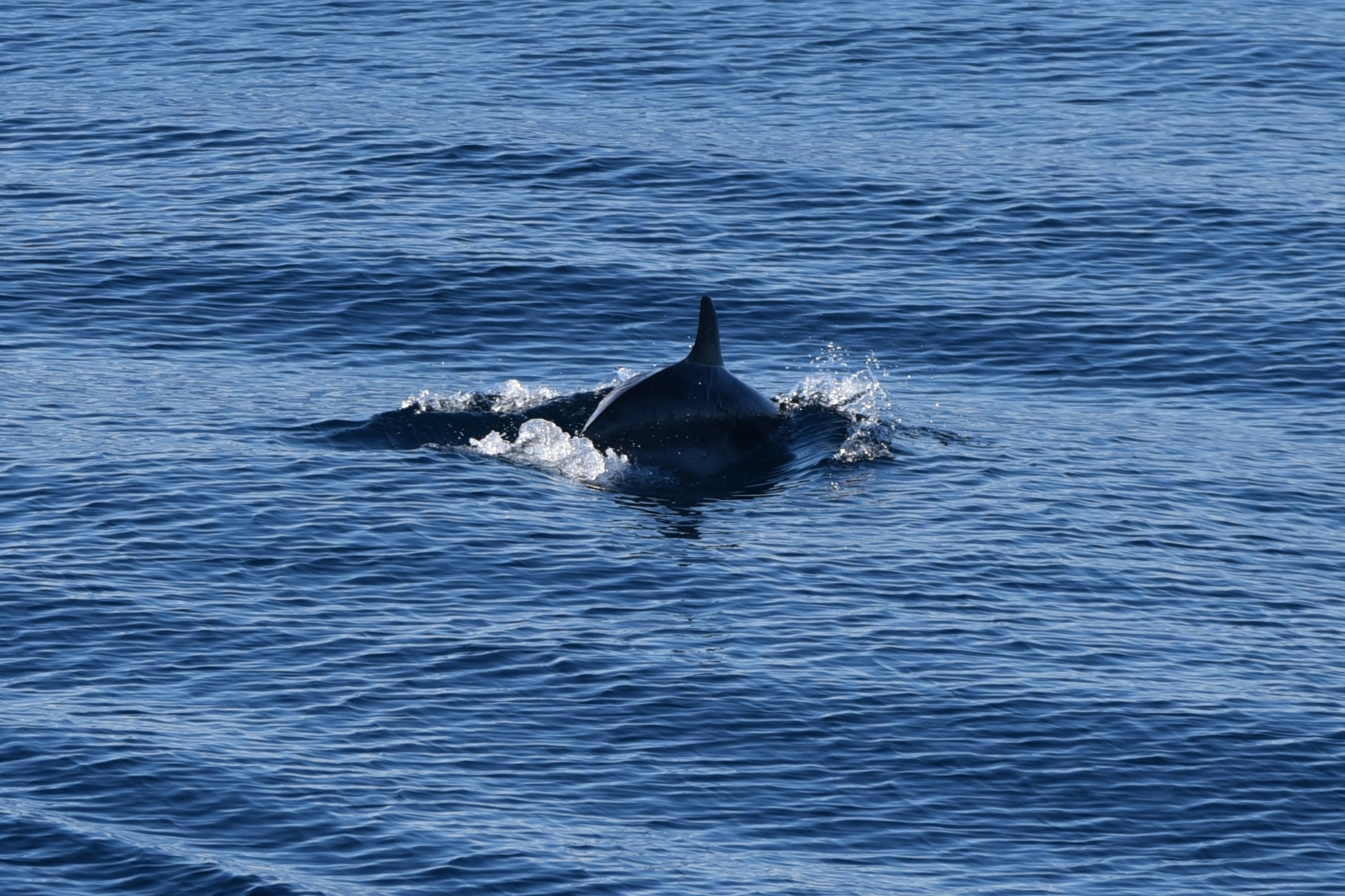
The striped dolphin is a slender, fusiform delphinid, with a clearly demarcated beak of medium length and a rounded melon. Adults measure 1.9 to 2.6 m depending on the source and the region, males being slightly larger than females (about 2.6 m against 2.4 m); in the Mediterranean, the animals are often smaller, around 1.8 to 2.2 m. Adult weight ranges from 80 to 160 kg. The dorsal fin, tall and markedly falcate, is set at mid-back; the flippers are slim and pointed. Each jaw carries 43 to 50 pairs of small, sharp conical teeth.
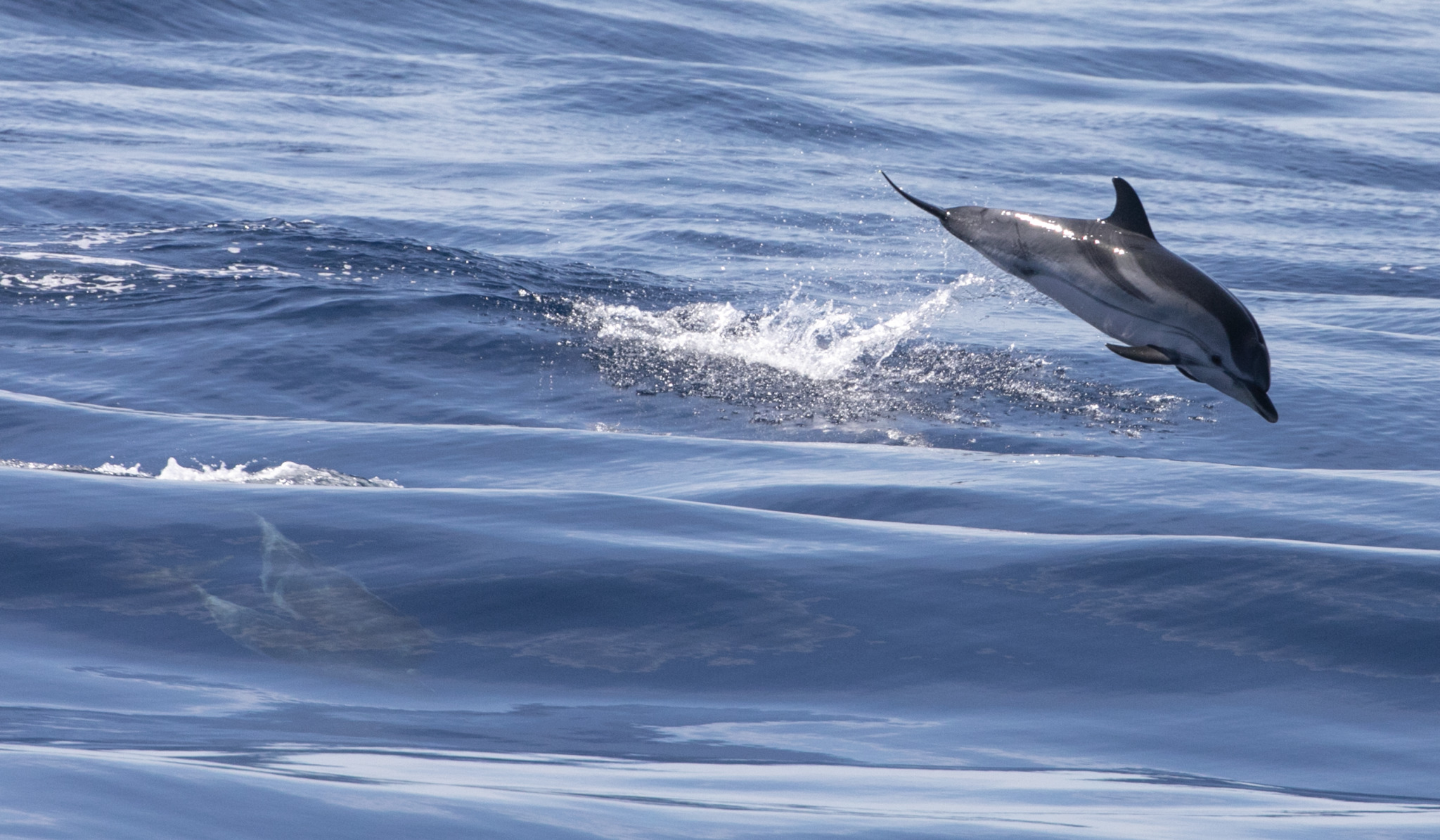
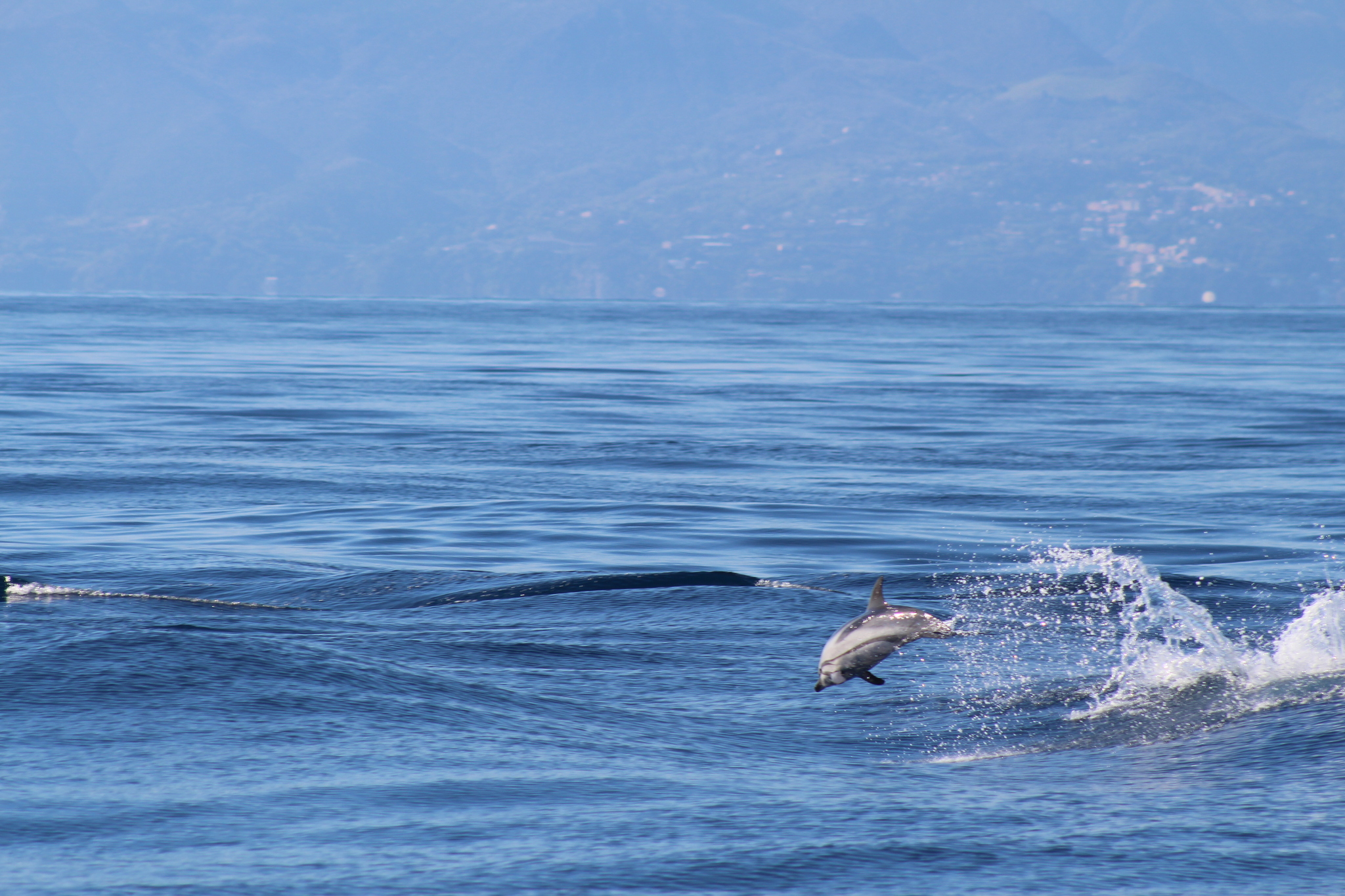
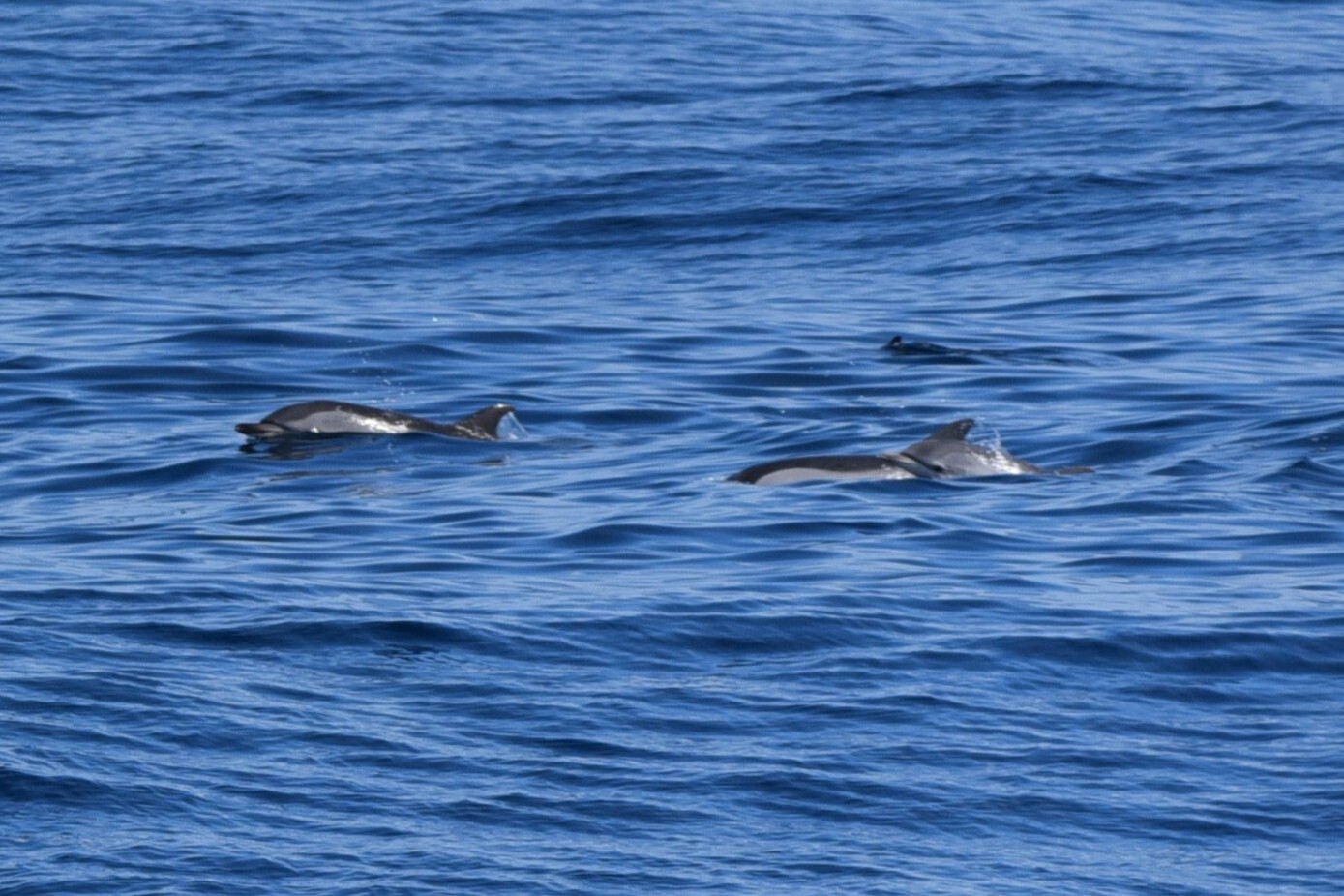
It is the colour pattern that marks out the species, and that earns it its scientific name (from the Latin caeruleus, dark blue, and albus, white). The back is bluish grey to dark grey, the flanks pale grey and the belly white to pinkish. One or two fine black lines run from the eye: one descends towards the flipper, the other runs along the flank as far as the anal region. Above all, a long pale “blaze” (spinal blaze) begins on the flank, behind the eye, and rises towards the rear, working its way into the dark cape as far as the level of the dorsal fin: this brushstroke of a marking, visible even at a distance when the animal leaps, is the best field character.
The most frequent confusions involve the common dolphin (Delphinus delphis), which shares the same waters but displays an hourglass pattern with a broad ochre-yellow patch on the forward part of the flank, absent in the striped dolphin. The Atlantic spotted dolphin (Stenella frontalis) is distinguished by the spotting it acquires with age, the Clymene dolphin (Stenella clymene) by the absence of a dorsal blaze and by a wavy pale band, and the spinner dolphin (Stenella longirostris) by its very long beak and its often triangular dorsal fin. The common bottlenose dolphin (Tursiops truncatus), bulkier and uniformly grey, is scarcely open to confusion.
Described in 1833 by the German naturalist Franz Meyen, the striped dolphin belongs to the family Delphinidae and to the subfamily Delphininae, which includes in particular the genera Stenella, Delphinus, Tursiops, Sousa and Lagenodelphis. Its generic placement is unstable: molecular analyses and morphological analyses alike converge in showing that the genus Stenella is paraphyletic, its species not forming a natural group. Data from the mitochondrial cytochrome b gene place Stenella coeruleoalba as the sister group of the Clymene dolphin (S. clymene), itself considered to have arisen from an ancient hybridisation between S. coeruleoalba and S. longirostris. A revision proposed in 2013 suggested placing the whole of the Delphininae in the genus Delphinus; it has not been adopted, the community preferring to wait for more complete analyses. The combination Stenella coeruleoalba (Meyen, 1833) therefore remains the reference in use.
The species is cosmopolitan in the warm temperate, subtropical and tropical waters of the three major oceans, approximately between 50°N and 40°S according to the compilations, the zone of regular presence being narrower (of the order of 40°N to 30°S). It seeks sea surface temperatures between 10 and 26 °C, with an optimum often lying between 18 and 22 °C. It is an animal of the open sea: it frequents oceanic waters beyond the continental slope, approaching the coast mainly where the sea floor drops away quickly, submarine canyons included. The world population is estimated at more than two million individuals.
In Europe, the species is present all year round around the British Isles and in the Bay of Biscay, with occasional incursions towards Norway, Iceland, the Faroe Islands and Greenland; European Atlantic waters are thought to hold on the order of 372,000. The Mediterranean is a stronghold: the synoptic aerial survey of the ACCOBAMS Survey Initiative, carried out in the summer of 2018, yielded an estimate of 426,744 individuals (CV = 0.13), making the striped dolphin by far the most abundant cetacean in the basin.
In France, the species is the cetacean most frequently encountered in the Mediterranean, where it is sometimes nicknamed the “sparrow of the Mediterranean”. The Pelagos Sanctuary, in the north-western Mediterranean, holds several tens of thousands of them in summer. A rather coastal population, faithful to certain sectors such as the approaches to Antibes or the Île du Levant, coexists there with a highly mobile oceanic population. On the Atlantic seaboard, the species frequents the Bay of Biscay and, more rarely, the English Channel. It is also reported in French overseas waters, in particular in the French Antilles, at Mayotte, at Réunion and around the Îles Éparses.
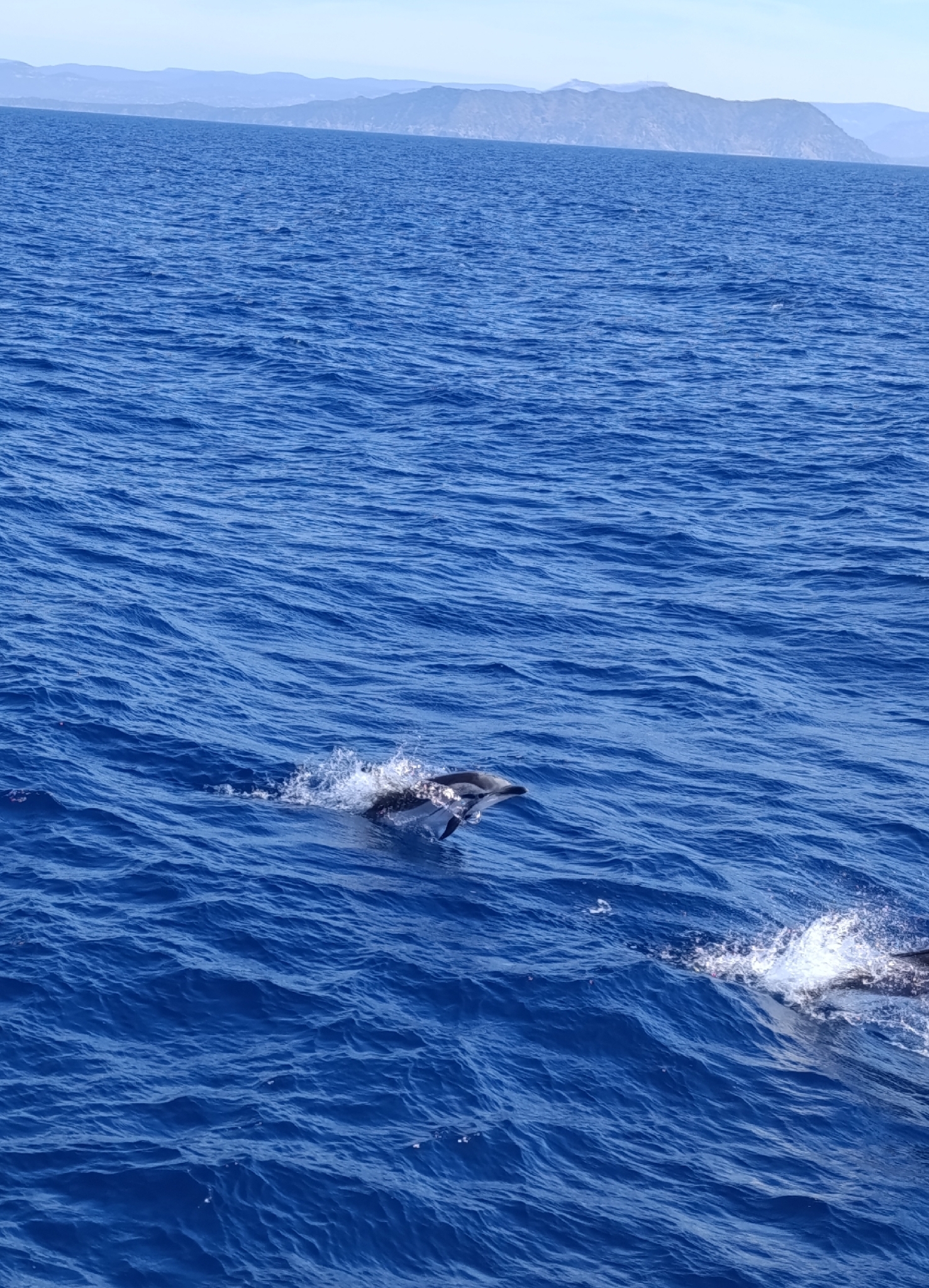
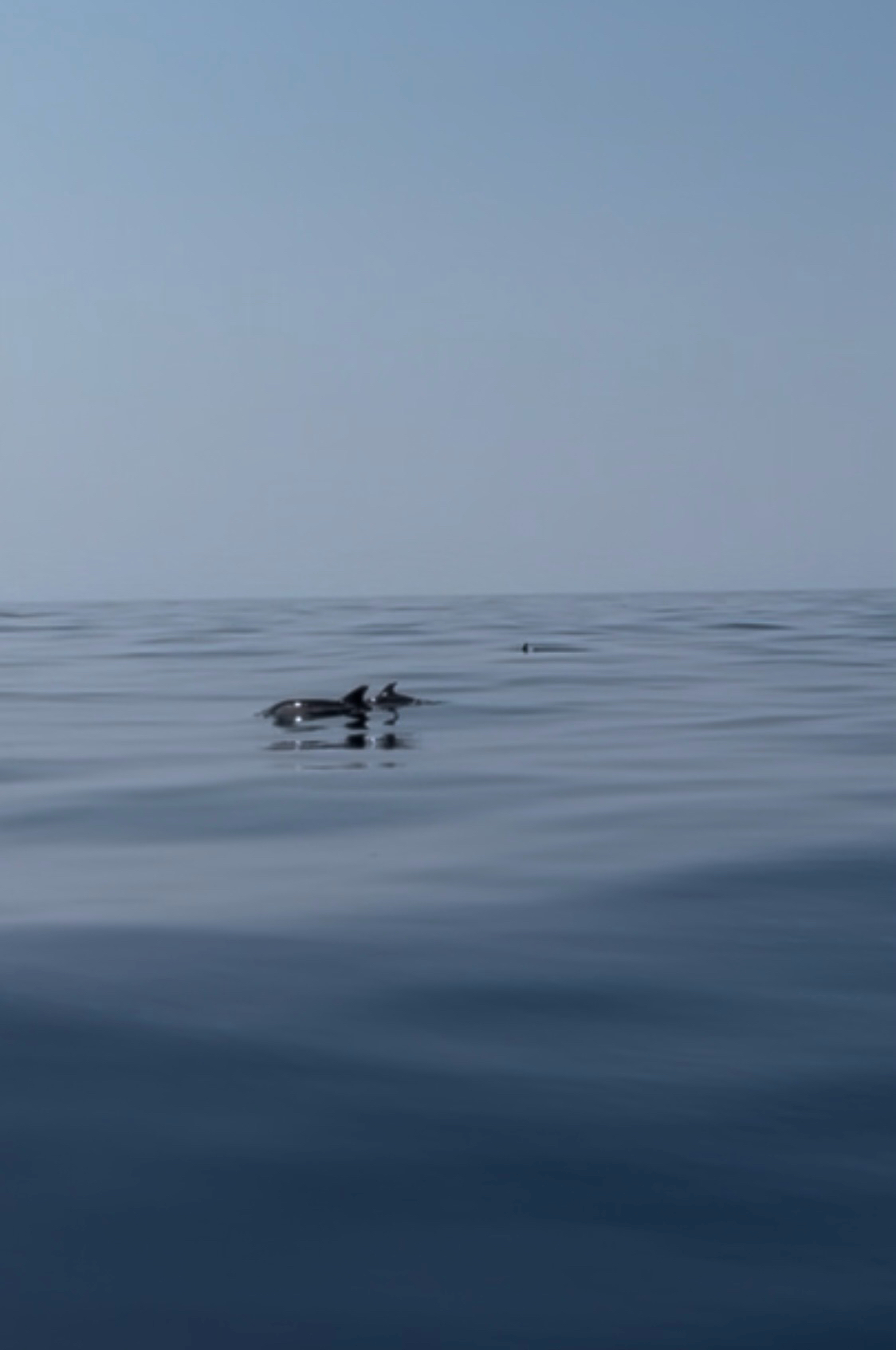
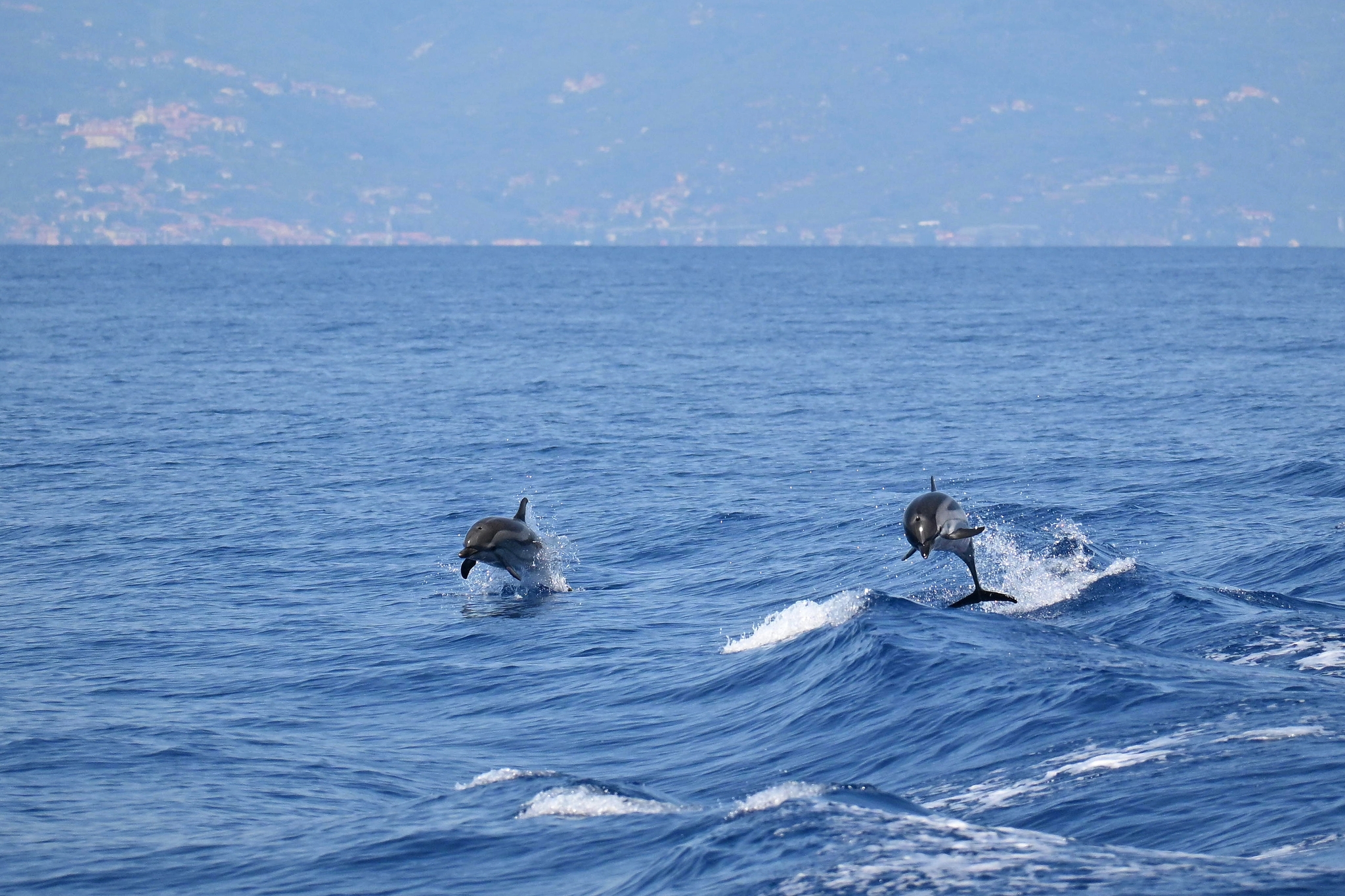
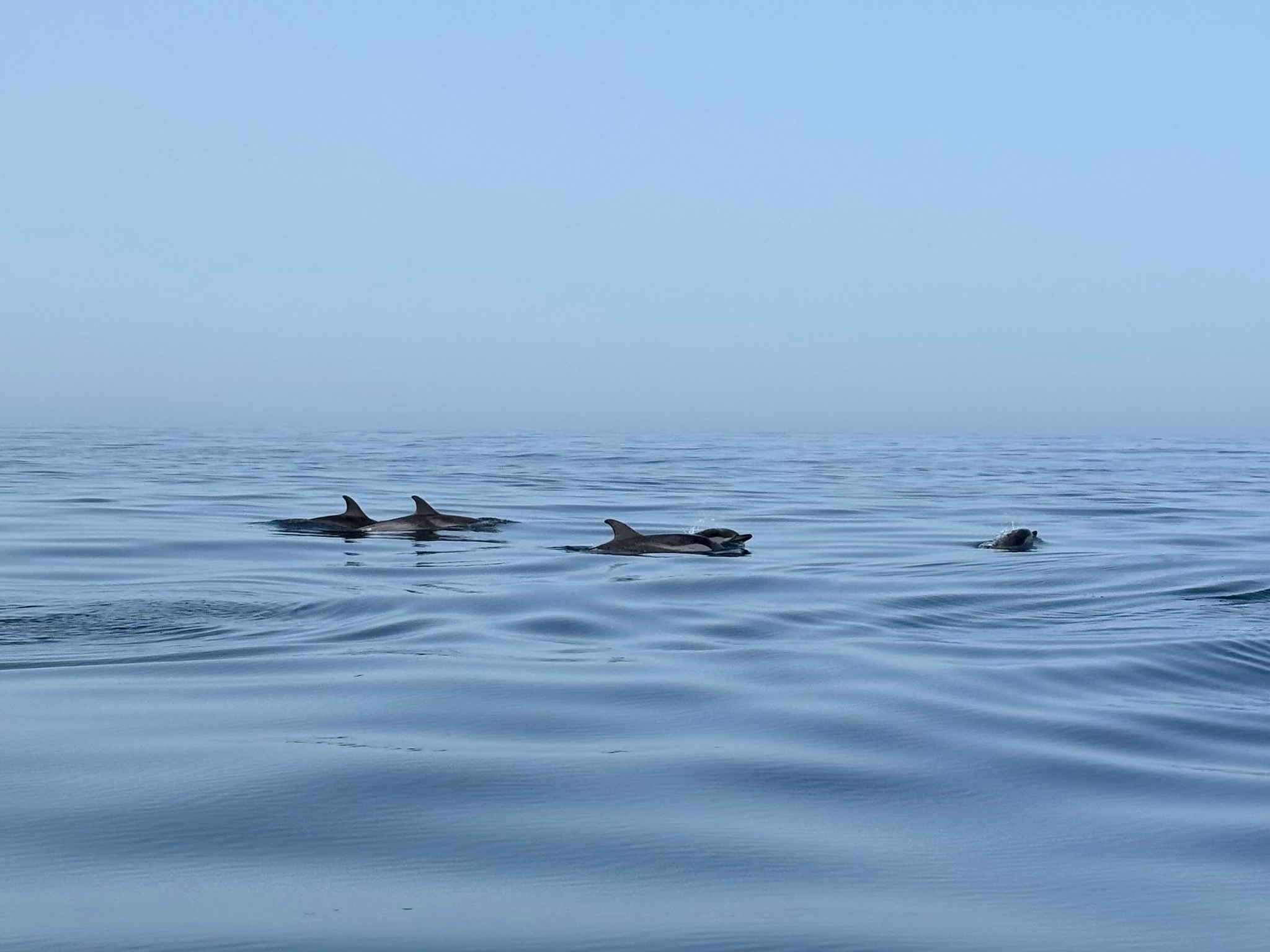
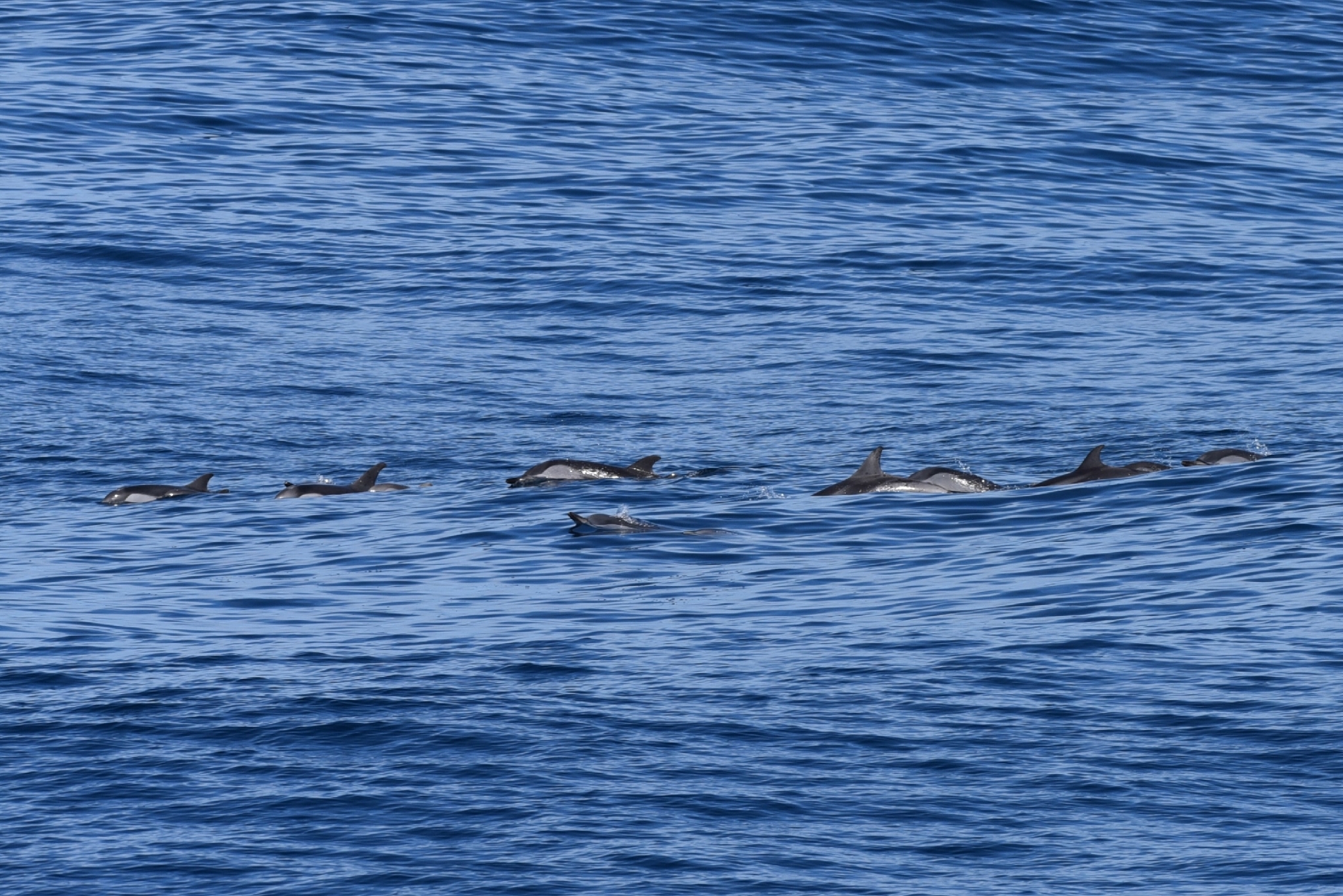
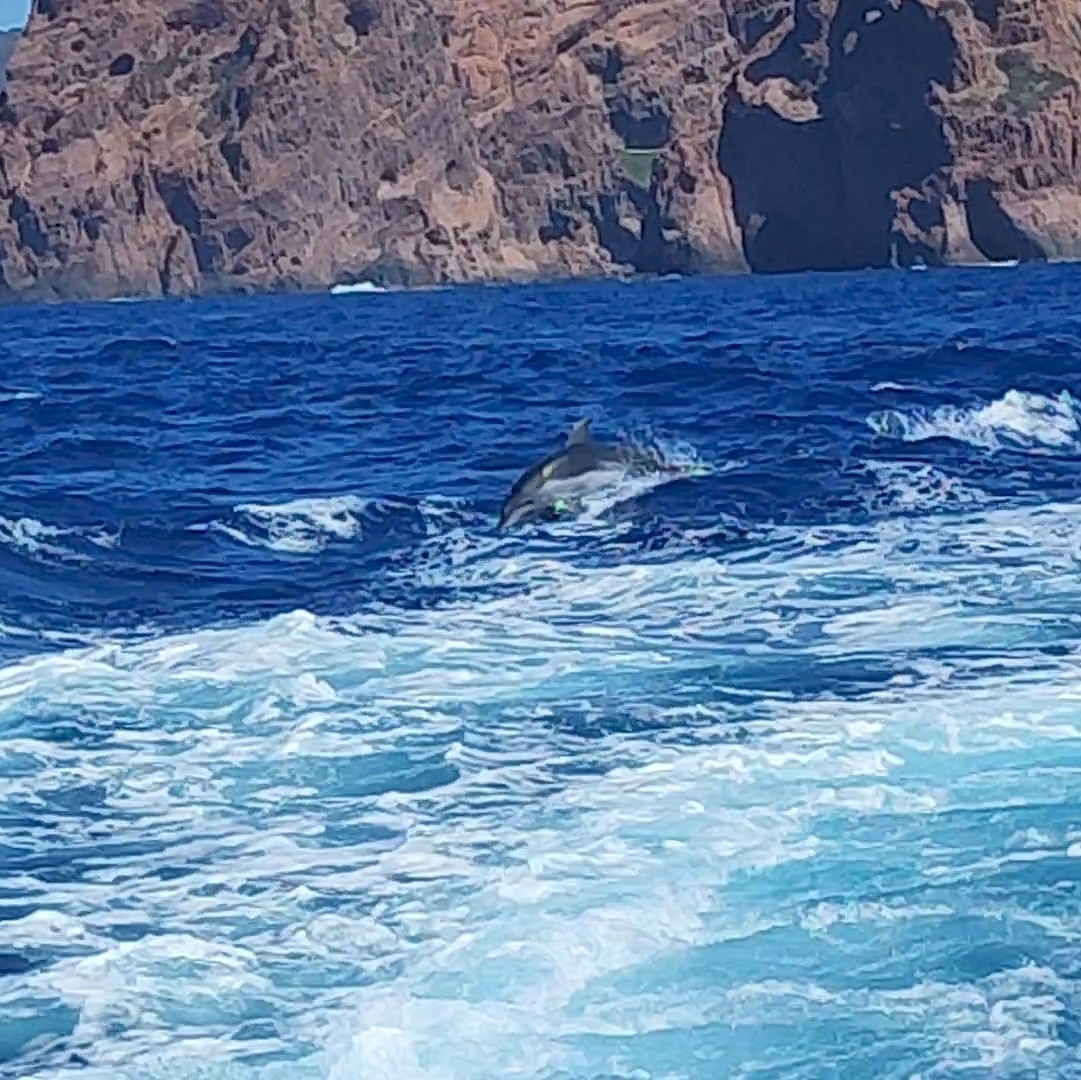
A gregarious species par excellence, the striped dolphin lives in groups whose size varies widely: most often ten to a hundred animals, but gatherings of several hundred to several thousand individuals are documented. In the north-western Mediterranean, groups number about twenty individuals on average, with marked segregation by age class and by status: groups of breeders, groups of females accompanied by newborns in summer, groups of particularly demonstrative juveniles. A fast swimmer and an acrobat, the species makes repeated leaps and performs “roto-tailing”, a rotation of the body about the axis of the tail at full stretch. Its behaviour towards vessels is variable: it will readily come and bow-ride, but it sometimes moves away quickly, which earned it the nickname “streaker” in the eastern tropical Pacific.
The diet is opportunistic and made up of small pelagic and mesopelagic fish, cephalopods and, more incidentally, crustaceans. Lanternfish (myctophids) dominate in the North Atlantic, while Mediterranean populations make extensive use of cephalopods as well as hake, anchovy and sardine. Hunting, guided by echolocation, takes place mainly at night and in the early morning, the groups dispersing at that time into small units. Dives typically last 5 to 10 minutes and reach several hundred metres, with descents documented to about 700 m.
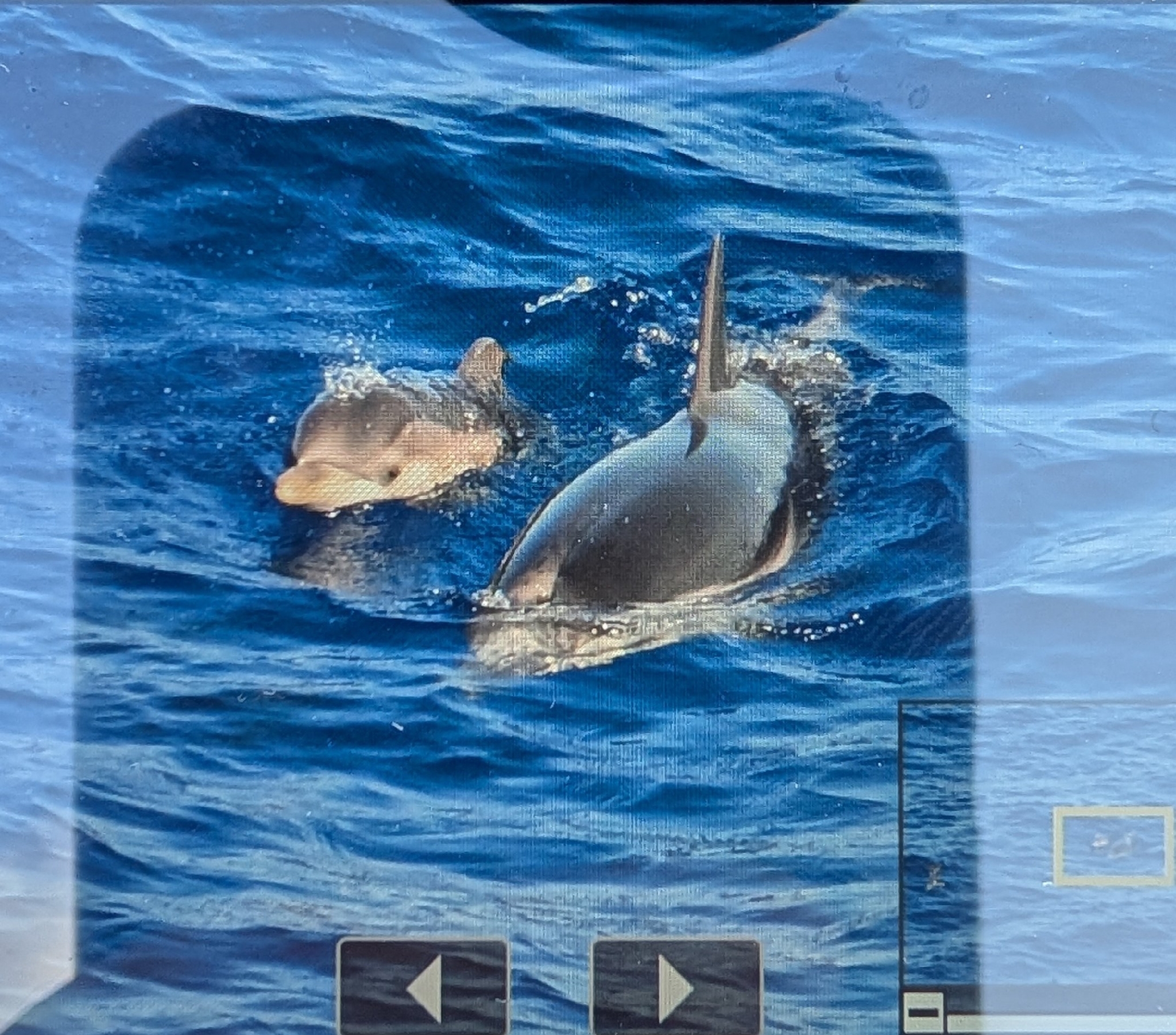
Sexual maturity is reached between 5 and 13 years in females and between 7 and 15 years in males, the mean age varying between populations: about 12 years for Mediterranean females, 7 to 9 years in the Pacific. Gestation lasts 12 to 14 months and gives rise to a single calf of about 1 m and 10 kg, most often in summer or autumn. Lactation continues for 12 to 18 months and the interval between two births is generally 3 to 4 years. The longevity commonly observed is 40 to 50 years, with individuals estimated at up to 55-58 years.
Globally, the striped dolphin is listed as Least Concern (LC) on the IUCN Red List, an assessment published in 2019. The Mediterranean subpopulation, listed as Vulnerable in 2012, has been reassessed and now appears as Least Concern in the update published in 2022; the small isolated subpopulation of the Gulf of Corinth, in Greece, geographically and genetically separated, is by contrast listed as Endangered (EN) since that same update. On the Red List of the mammals of metropolitan France, published in 2017, the species is listed as Least Concern; the Office français de la biodiversité nevertheless reports a more fragile situation for Mediterranean waters than for the Atlantic-Channel-North Sea seaboard.
The main direct threat remains bycatch in fishing gear: driftnets, gillnets, pelagic trawls and purse seines. The ban on driftnets has sharply reduced this mortality in the western Mediterranean, but bycatch persists. Chemical contaminants are a second major factor: a long-lived species and a top predator, it accumulates high loads of persistent organic pollutants that weaken immunity and reproduction. This combination played a part in the dolphin morbillivirus epizootics: the outbreak of 1990-1992, which began in the Gulf of Valencia in the summer of 1990 and then spread to Italian and Greek waters, killed several thousand animals, with more than a thousand carcasses examined; a resurgence struck the Spanish and French coasts again in 2007-2008. To these are added underwater noise, shipping traffic, the depletion of prey and, outside Europe, direct hunting (Japan, Sri Lanka, the Caribbean), Japanese takes having fallen from 8,000 to 9,000 animals a year at the height of the hunt, with a record year of about 21,000 individuals, to a few hundred today.
The species benefits from extensive protection: Appendix II of CITES, Appendix II of the Convention on Migratory Species, the ACCOBAMS and ASCOBANS agreements, Appendix II of the Bern Convention and Annex IV of the “Habitats” Directive. In France, it appears on the list of protected marine mammals set by the order of 1 July 2011: killing, capture, mutilation and intentional disturbance are prohibited, and bycatch must be reported.
In metropolitan France, the best observation window is in the north-western Mediterranean, in the Pelagos Sanctuary, from late spring to autumn, when the sea is calm and the groups gather offshore. The species should be looked for beyond the 200 m isobath, on the slope and above the submarine canyons, rather than close inshore. The detection cues are repeated leaps, the spray thrown up by a group travelling fast and the seabirds associated with shoals of prey. In the Bay of Biscay, encounters likewise take place offshore, on the outer shelf and the slope.
Observation must remain non-disturbing. French regulations prohibit the intentional disturbance of marine mammals, and approach to within less than 100 m is forbidden throughout French Mediterranean territorial waters under maritime prefectoral orders, following on from the ministerial order of 3 September 2020 that came into force on 1 January 2021. The code of conduct promoted by ACCOBAMS and the Pelagos Agreement, to which operators certified High Quality Whale-Watching subscribe, recommends keeping at least 100 m away, never cutting across the path of a group or encircling it, limiting observation to around thirty minutes, not feeding the animals and not swimming with them. Choosing a trained and certified operator is the best guarantee of a respectful trip. Sightings can be passed on to naturalist networks, and any stranded animal must be reported without being handled.
The two species occur side by side in the Mediterranean and the Atlantic, but the markings on their flanks separate them clearly. The common dolphin carries an hourglass pattern with a broad ochre-yellow patch on the forward part of the flank; the striped dolphin has no yellow area at all, but fine black lines running from the eye towards the flipper and towards the anal region, and above all a long pale grey “blaze” that starts on the flank behind the eye and rises towards the rear, as far as below the dorsal fin.
Yes. It is the most abundant cetacean in the French Mediterranean, in particular in the Pelagos Sanctuary, where several tens of thousands of individuals are present in summer. It also frequents the Bay of Biscay and, more rarely, the English Channel, as well as several overseas waters: the French Antilles, Mayotte, Réunion and the Îles Éparses.
The species is listed as Least Concern (LC) globally, an assessment published in 2019. The Mediterranean subpopulation, formerly listed as Vulnerable in 2012, has been reassessed as Least Concern in the update published in 2022. Only the isolated subpopulation of the Gulf of Corinth, in Greece, is listed as Endangered.
The first synoptic survey of the basin, carried out by aircraft during the summer of 2018 under the ACCOBAMS Survey Initiative, yielded an estimate of 426,744 individuals (coefficient of variation of 0.13). It is by far the most abundant cetacean in the Mediterranean.
Bycatch in fishing gear remains the leading cause of mortality of human origin. To this are added the accumulation of chemical contaminants, which weakens immunity, the morbillivirus epizootics that struck the Mediterranean in 1990-1992 and then in 2007-2008, underwater noise, shipping traffic and, outside Europe, direct hunting. In Japan, takes reached 8,000 to 9,000 animals a year at the height of the hunt, with a record year of about 21,000 individuals, and are limited today to a few hundred.
Rarely: it is a species of the open sea, generally encountered beyond the 200 m isobath, on the slope and above the submarine canyons. Survey trips with a trained operator are the most reliable way of seeing it. Regulations prohibit approach to within less than 100 m in French Mediterranean territorial waters, and the ACCOBAMS-Pelagos code of conduct limits observation to around thirty minutes, with no swimming with the animals and no feeding them.
Fact sheet compiled from authoritative scientific sources (IUCN, NOAA Fisheries, specialist literature) and reviewed for factual accuracy.
According to the open data of the GBIF, 1,170 georeferenced sightings of Stenella coeruleoalba are recorded in our photographic index.
| Country | Notes |
|---|---|
| Italy | 227 |
| Spain | 195 |
| United States of America | 152 |
| France | 147 |
| Portugal | 98 |
| Japan | 69 |
| Morocco | 38 |
| Netherlands | 36 |
| unknown or invalid | 35 |
| Ecuador | 21 |

Monthly distribution of 1,208 dated sightings (all years combined): the maximum is reached in August.
| Month | Notes |
|---|---|
| janvier | 74 |
| February | 69 |
| mars | 50 |
| avril | 115 |
| mai | 131 |
| juin | 137 |
| juillet | 158 |
| August | 195 |
| septembre | 114 |
| octobre | 84 |
| novembre | 50 |
| December | 31 |
These figures reflect survey effort (more boaters and more surveys in summer) as much as the actual presence of the species: to be interpreted with caution.


Photographs from GBIF under a Creative Commons licence. The author and the licence of each photograph are given; please respect them if you reuse them.
Automatic selection of the most cited works mentioning the species (source: Crossref).