| Scientific name | Lissodelphis peronii (Lacépède, 1804) |
|---|---|
| Other names | Southern right whale dolphin; in French: dauphin aptère austral, lissodelphe austral |
| Size | 2.2 to 2.5 m on average; maximum documented 2.97 m (males) and 2.30 m (females); newborn about 0.86 m |
| Weight | 60 to 100 kg on average, up to 116 kg; about 5 kg at birth |
| Longevity | Not established in the wild; about 42 years estimated by extrapolation from the sister species in the northern hemisphere |
| Diet | Mesopelagic fish (myctophids in particular) and squid, taken on dives below 200 m, with most feeding activity between 250 and 1,000 m |
| IUCN status | Least Concern (LC), global assessment of 20 March 2018 (Braulik G.T., 2018; e.T12126A50362558), described as provisional by the assessor; population trend unknown; previously listed as Data Deficient (DD) in 1996, 2008 and 2012, and as “Insufficiently Known” (K) in 1994. Regional statuses: DD in Australia and Chile, and in the French Southern and Antarctic Lands (French Red List, 2015); LC in South Africa (2016); “At Risk (Naturally Uncommon)” in New Zealand since the 2024 national assessment (previously DD) |
The only dolphin in the southern hemisphere with no dorsal fin, the southern right whale dolphin (Lissodelphis peronii) is a slender delphinid with a sharply contrasted black and white pattern, which travels in schools that are sometimes very large through the cold, deep waters of the far southern ocean. Its range is circumpolar, between the Subtropical Convergence and the Antarctic Convergence, and takes in the French waters of the Southern Lands, around Crozet and Kerguelen. The IUCN has listed it as Least Concern since 2018, an assessment that the assessors themselves describe as provisional, given how poorly known the species remains.
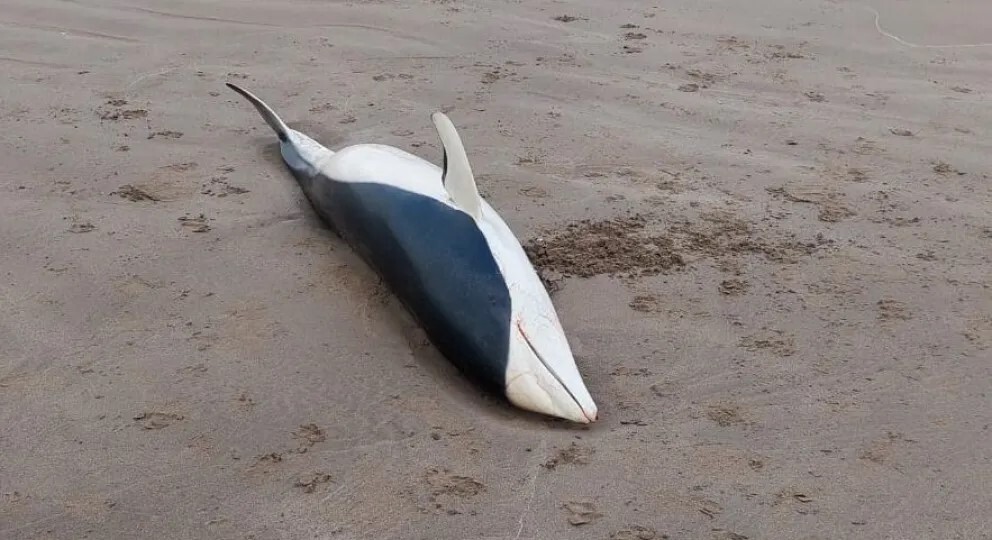
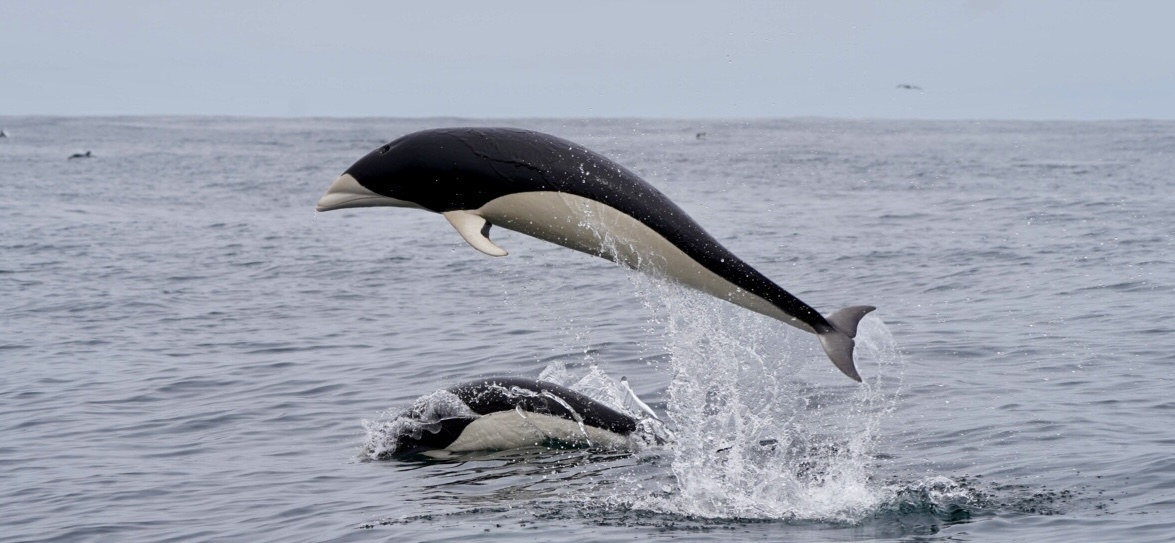
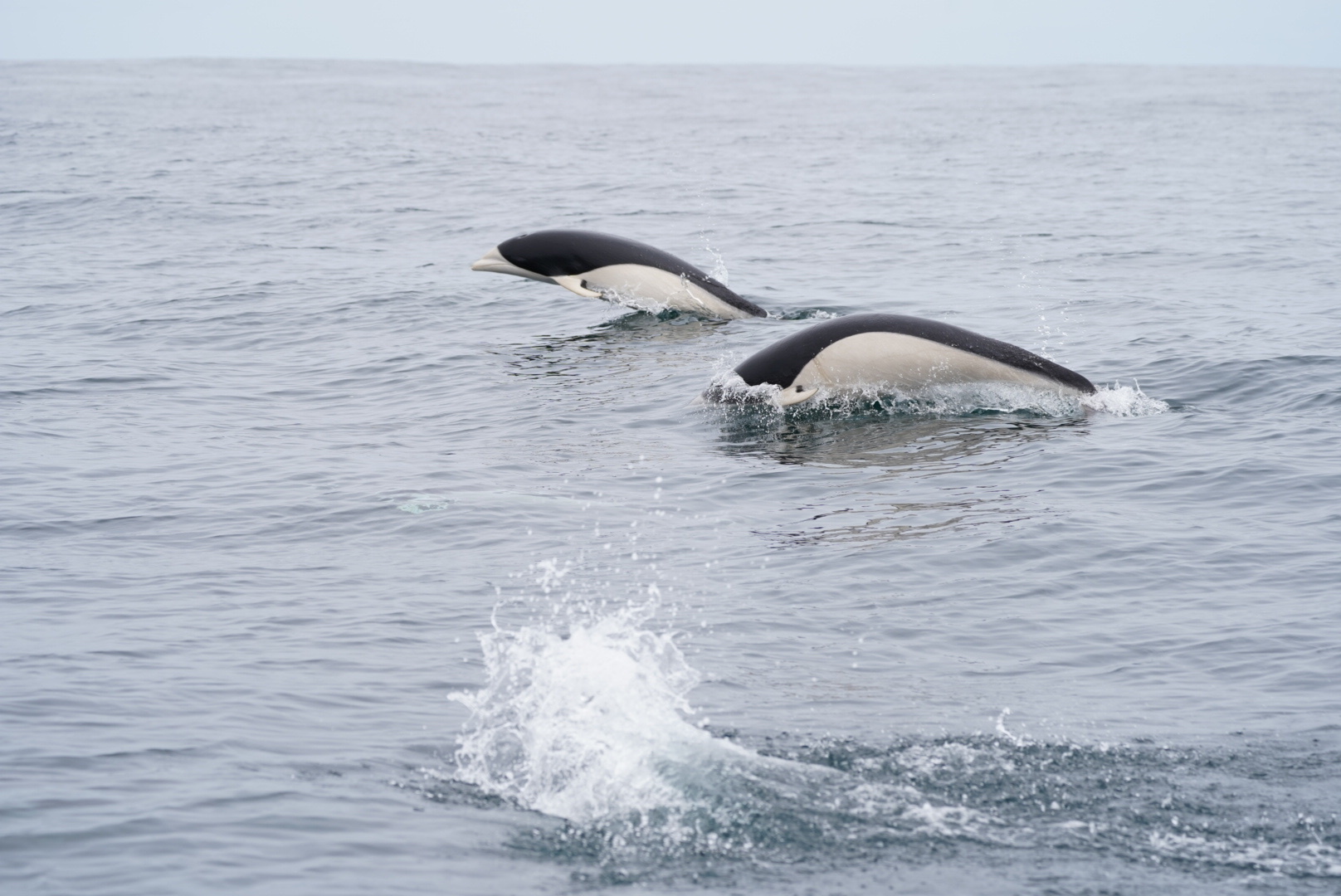
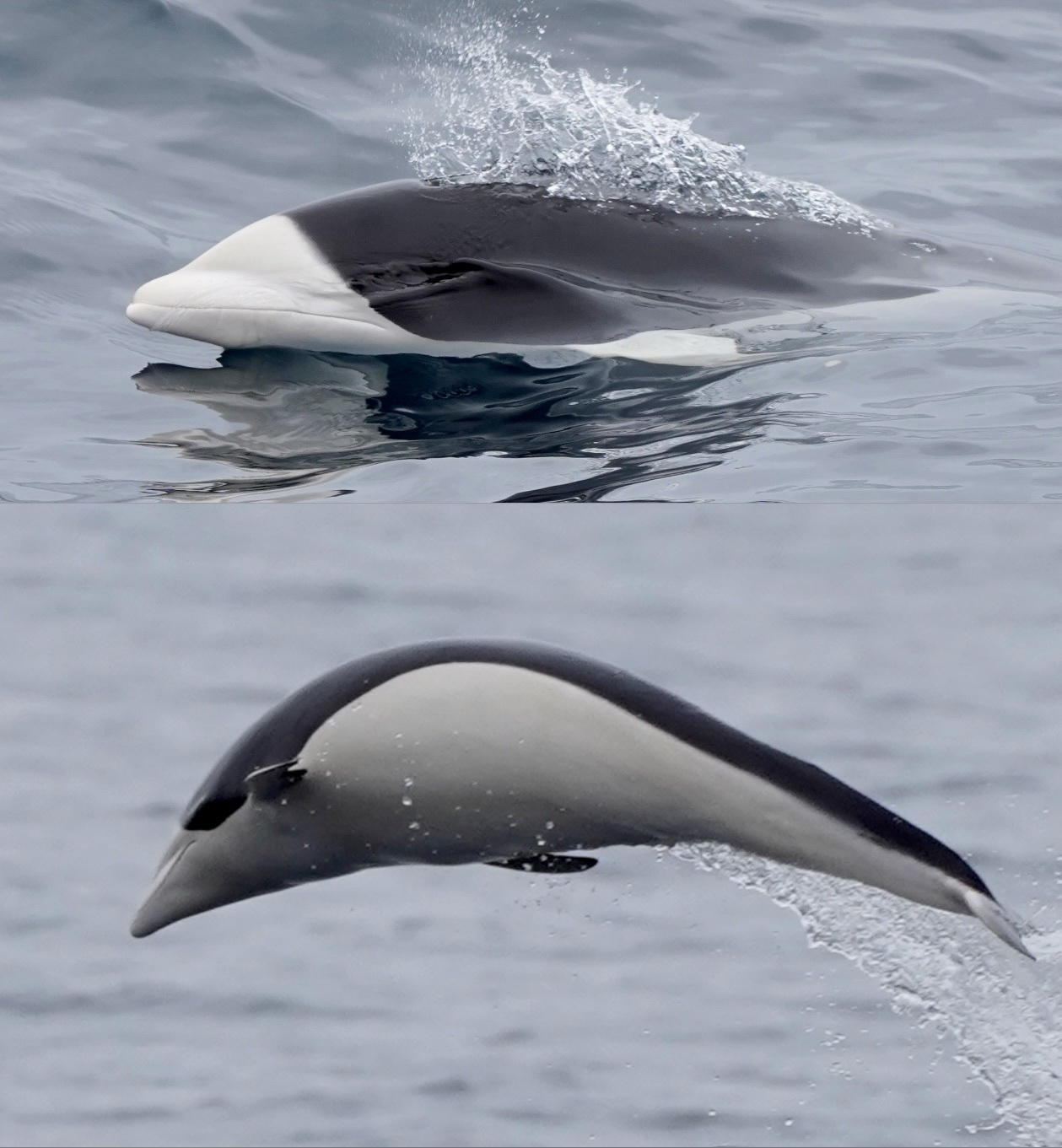
The southern right whale dolphin is recognised at once by what it lacks: it has neither a dorsal fin nor a dorsal ridge, a feature that makes it the only dolphin in the southern hemisphere in this position. The body is slim, streamlined and laterally compressed, extended by a short but clearly drawn beak bearing 39 to 50 teeth in each half of the jaw. Adults measure on average 2.2 to 2.5 m, the known records reaching 2.97 m in males and 2.30 m in females; the usual weight is 60 to 100 kg, with a documented maximum of 116 kg. Males are on average larger than females. The newborn measures about 0.86 m for some 5 kg.
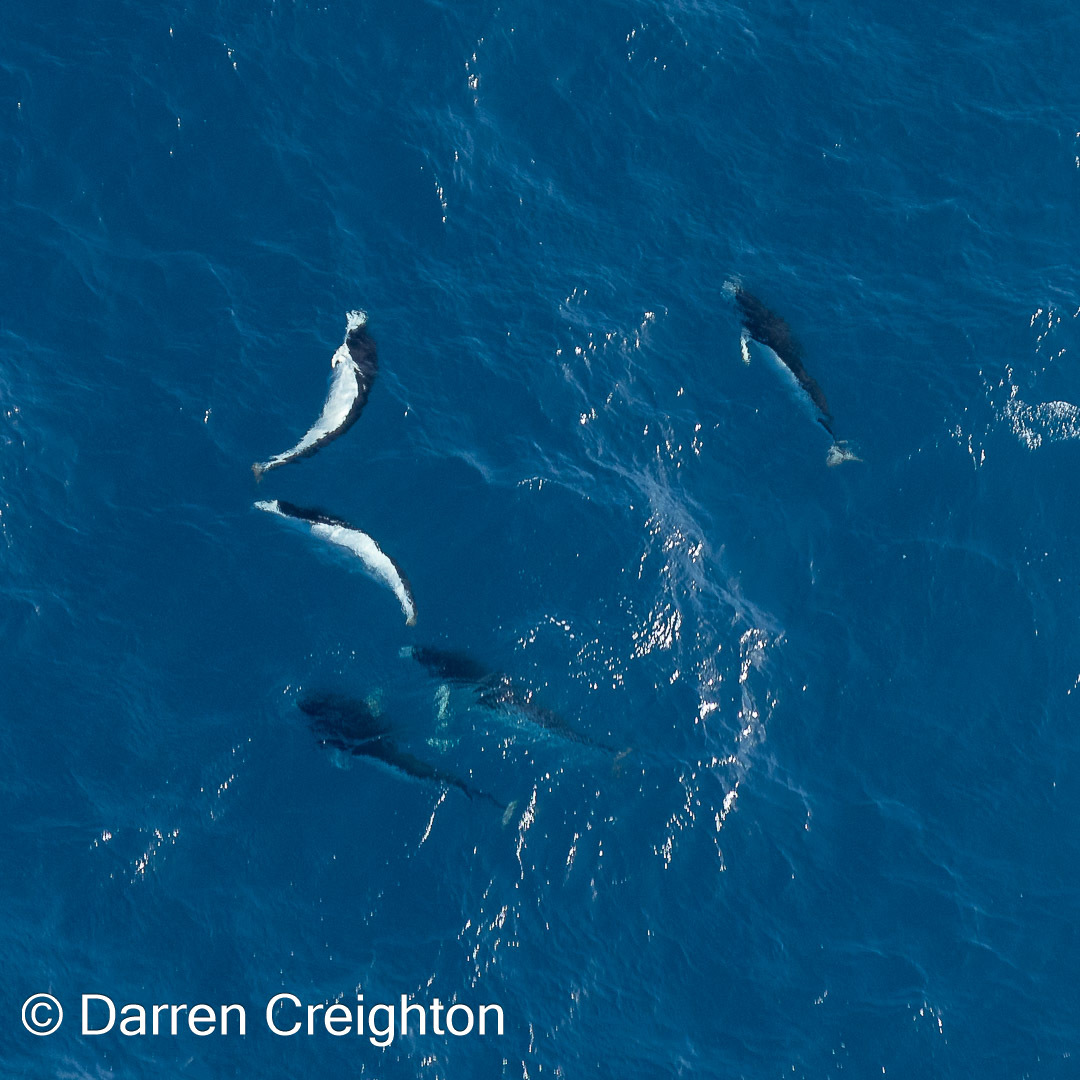
The coloration is striking and without equivalent among southern delphinids: the back is deep black, the belly a brilliant white, and a sharp dividing line runs from the base of the beak, passes below the eye, follows the flank above the insertion of the flippers and then rises onto the tail stock. The flippers and the beak are largely white. Calves are born in grey and brownish tones and acquire the adult contrast only at about one year of age. Individuals with abnormal pigmentation, entirely white or, on the contrary, melanistic, have been described.
The risk of confusion is limited. The only truly close species, the northern right whale dolphin (Lissodelphis borealis), is strictly confined to the northern hemisphere and shows a different colour pattern: the two ranges do not overlap. In the field, confusion more often arises from the species that accompany schools of right whale dolphins, dusky dolphins, hourglass dolphins, common dolphins and pilot whales, all of which have a clearly visible dorsal fin. A presumed hybrid between the southern right whale dolphin and the dusky dolphin (Aethalodelphis obscurus, formerly Lagenorhynchus obscurus), with intermediate morphological characters, was described in 2002. The absence of a dorsal fin and the offshore habitat explain how rarely the species is seen: it is hard to spot at sea, even where it is common.
The southern right whale dolphin belongs to the order Cetacea, suborder Odontoceti, and to the family Delphinidae. Where subfamilies are recognised, it is placed in the Lissodelphininae (Fraser & Purves, 1960), which bring together the genus Lissodelphis, the genus Cephalorhynchus and the southern lagenorhynchs (dusky dolphin, hourglass dolphin, Peale’s dolphin), rather than in the Delphininae, which group the common dolphins, the Stenella dolphins and the bottlenose dolphins. The genus Lissodelphis, from the Greek lissos, “smooth”, and delphis, “dolphin”, in reference to the back without a fin, holds only two species: Lissodelphis peronii in the southern hemisphere and Lissodelphis borealis in the North Pacific. The species was described by Lacépède in 1804; the brackets around the authority record that it had first been placed in another genus (Delphinus). The epithet peronii honours François Péron, the French naturalist who observed these dolphins off Tasmania during an expedition in 1802. In French the species is called dauphin aptère austral, the form adopted by the INPN and the Office français de la biodiversité, and, more rarely, lissodelphe austral.
The range is circumpolar in the southern hemisphere, roughly between 25°S and 65°S according to the IUCN assessment, with most of the area lying in the international waters of the Southern Ocean, between the Subtropical Convergence to the north and the Antarctic Convergence to the south. The species is reported in the exclusive economic zones of Argentina, Australia, Brazil, Chile, the Falkland Islands, Mozambique, Namibia, New Zealand, Peru, South Africa and Uruguay.
The great cold currents carry it appreciably further north: along South America the species is frequent from Cape Horn to northern Chile and southern Peru, with one extreme record at about 12°S; in southern Africa the Benguela Current brings it along the Namibian coast, with a year-round presence in the Lüderitz upwelling cell, while confirmed records on the South African coast remain exceptional. It is also seen south and south-west of Tasmania, in the Great Australian Bight, off south-western Australia, off south-eastern New Zealand, and around the Chatham Islands and the Falklands.
It is a thoroughly pelagic species, which frequents deep offshore waters and comes close to the coast only in upwelling areas. Associated surface temperatures run from 1 to 20 °C, the band most often cited being 8 to 19 °C.
In France, the southern right whale dolphin is absent from metropolitan waters: the Mediterranean, the Bay of Biscay and the English Channel lie in the northern hemisphere and outside its range. Its French occurrence concerns the subantarctic overseas territories alone, in the French Southern and Antarctic Lands, where the Office français de la biodiversité reports it around Kerguelen and Crozet. The Red List of threatened species in France devoted to the vertebrates of the TAAF (March 2015) lists it among the regular breeding marine mammals of the French Southern Lands, in the category “Data Deficient” (DD) and with an unknown population trend.
The diet combines mesopelagic fish, lanternfish (myctophids) in particular, and cephalopods. These prey live in the 200 to 1,000 m layer, and the dolphins dive regularly below 200 m to catch them; the Office français de la biodiversité places most feeding activity between 250 and 1,000 m depth. Prey vary from region to region, those of the Chilean populations differing from those recorded in New Zealand. Measured breath-holds last 10 to 75 seconds for an individual, but a whole school can stay submerged for up to 6.5 minutes.
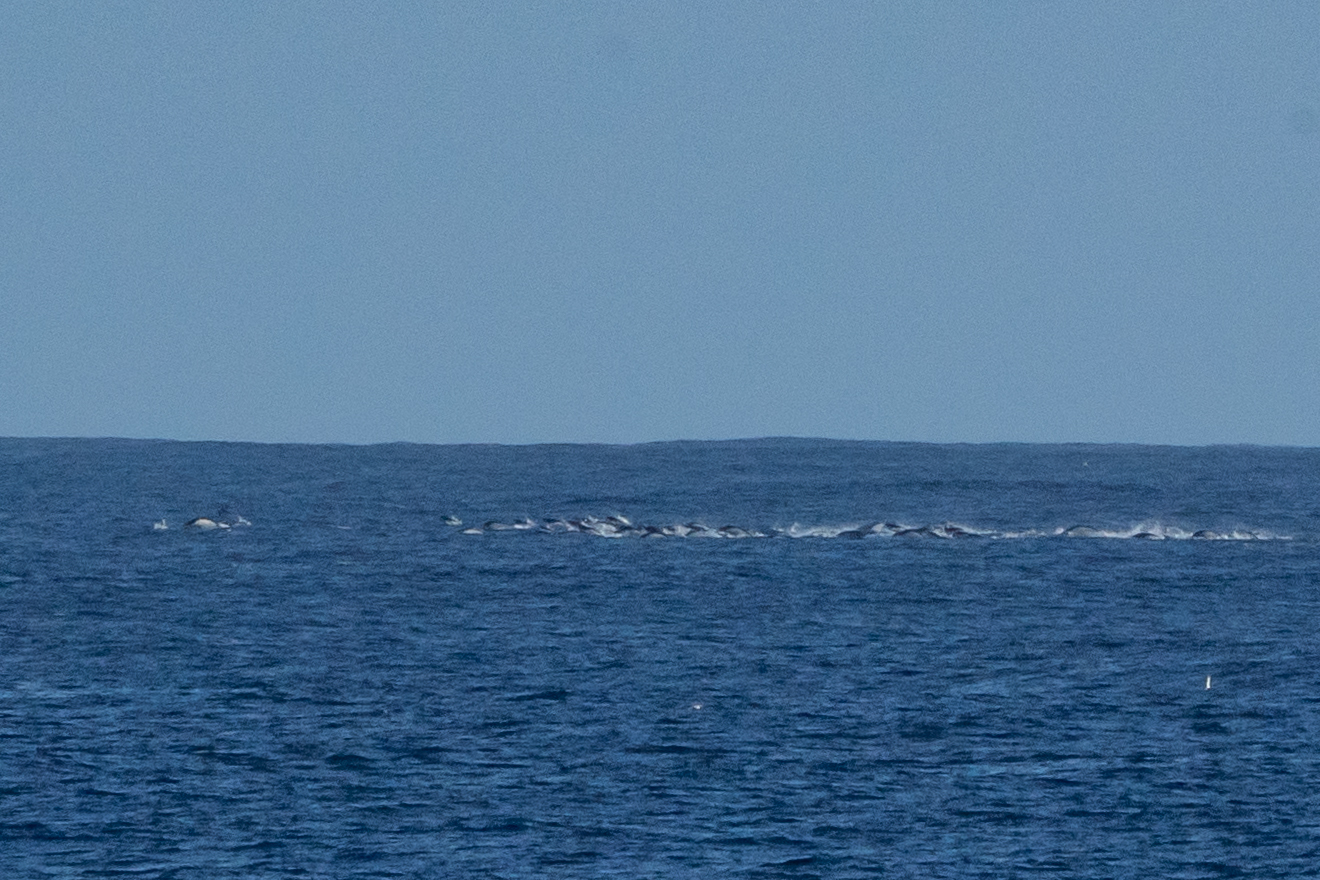
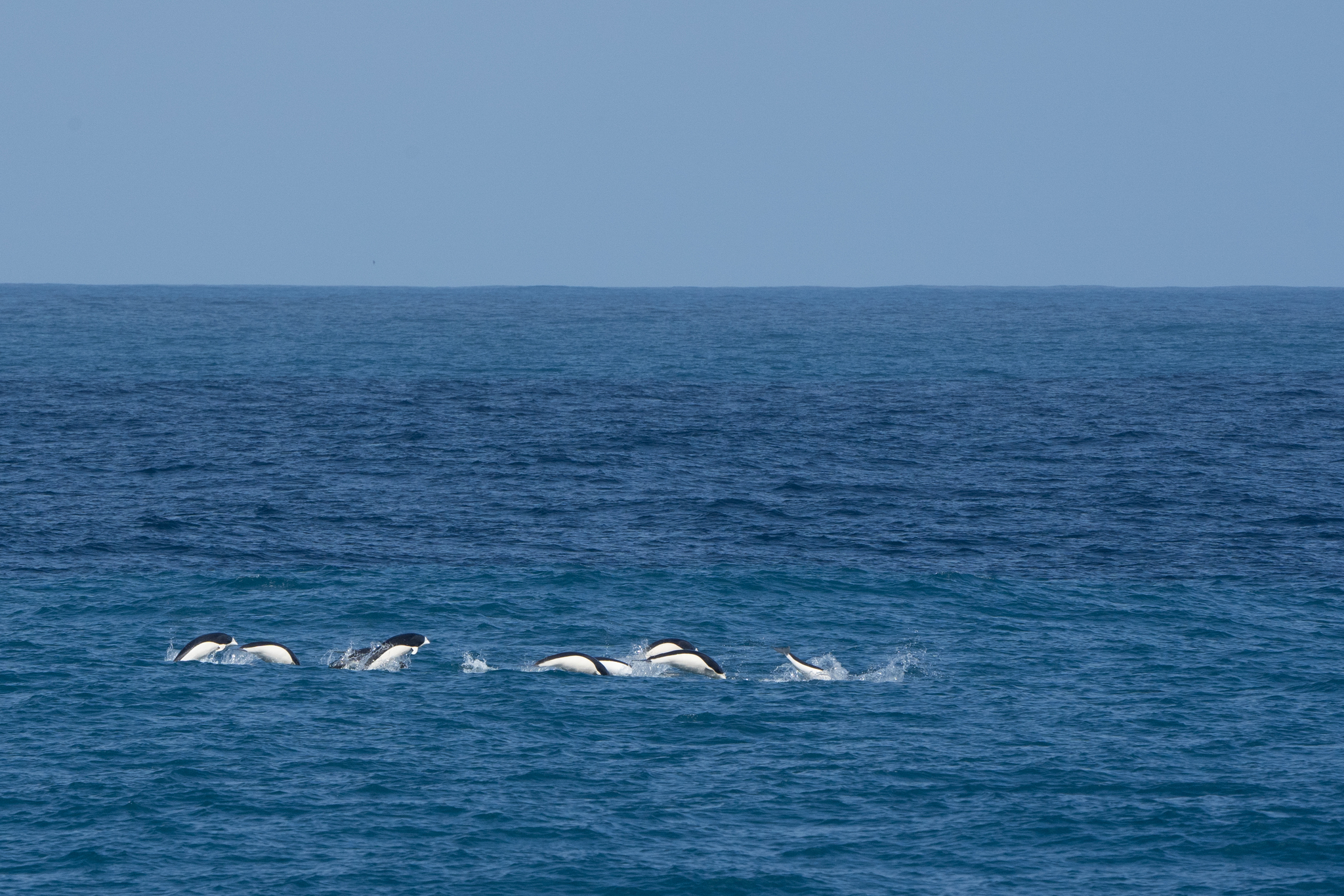
The species is highly gregarious. Schools often number fewer than a hundred individuals, but groups of 100 to 200 animals are frequent and gatherings of more than 1,000 individuals have been documented; off northern Chile, estimated mean group sizes range from 52 to 368 animals. Four school configurations have been described: dense swarms, scattered subgroups, V formations and line-abreast formations. Movement is strikingly elegant, with series of linked breaches, belly flops, flank slaps and tail slaps; a speed of 22 km/h has been reported. Some groups flee vessels, others approach and ride the bow wave. Associations with other cetaceans are very common: dusky dolphins, common dolphins, hourglass dolphins and pilot whales.
Breeding remains poorly known: only six stranded pregnant females have been documented. Sexual maturity is reached at about 212 to 220 cm in males and 206 to 212 cm in females. Most sightings of newborns fall in winter or in early austral spring, and the species is described as a slow breeder, with one calf every two to three years. Longevity in the wild has not been established; a figure of about 42 years is put forward by extrapolation from the sister species in the northern hemisphere. The few individuals held in captivity survived only a few weeks on average, the known maximum being fifteen months. Natural predators are not confirmed; the killer whale is among the most likely candidates.
The southern right whale dolphin is listed as Least Concern (LC) on the global IUCN Red List, an assessment carried out on 20 March 2018 (Braulik, 2018). This listing follows a status of “Data Deficient” (DD) adopted in the assessments of 1996, 2008 and 2012, the species having earlier been catalogued as “Insufficiently Known” (K) in 1994, under the former category system: it rests on the very large oceanic extent occupied, largely offshore and in subantarctic waters, and on the absence of any indication of decline. The assessors stress, however, that it should be treated as provisional, the species remaining extremely data-poor across its whole range. No global abundance estimate exists and the population trend is unknown, even though the species is judged fairly common, in particular off Chile. At regional level, Australia and Chile treat it as Data Deficient (DD), as does the French Red List for the TAAF (2015); South Africa assessed it as Least Concern in 2016; New Zealand, after long classing it as “Data Deficient”, has since the 2024 national assessment placed it among “At Risk (Naturally Uncommon)” species, that is, naturally uncommon ones.
The threats identified are first of all fishery-related. The most substantial bycatch has been recorded in the swordfish driftnet fishery of northern Chile, from the early 1980s onwards; bycatch in driftnets is also known off Peru, along with mortality linked to gillnets and longlines off southern Australia. Animals are taken in Chile and Peru for human consumption and as bait in crab pots, without the volumes being quantified. To these are added disturbance from seismic surveys for oil and gas, possible competition with pelagic trawlers targeting the same resources in southern Africa, and the effects of climate change on prey distribution and feeding ecology.
The species is listed in Appendix II of CITES. In France it has strict protection: killing, capture and intentional disturbance are prohibited, and offences carry fines of up to €150,000 and prison sentences.
Seeing a southern right whale dolphin is a matter of luck and of distance. The species lives offshore, often beyond the reach of coastal trips, and the absence of a dorsal fin makes it particularly inconspicuous: the low detection rates owe as much to the lack of survey effort as to the real difficulty of spotting it. The best opportunities come on offshore crossings or oceanographic cruises in the subantarctic belt, as well as off northern Chile and Peru in the Humboldt Current, off Namibia, where the Lüderitz upwelling zone offers the only known regular presence in southern Africa, all year round, while confirmed sightings on the South African coast remain exceptional, and off south-eastern New Zealand, off Kaikoura and around the Chatham Islands.
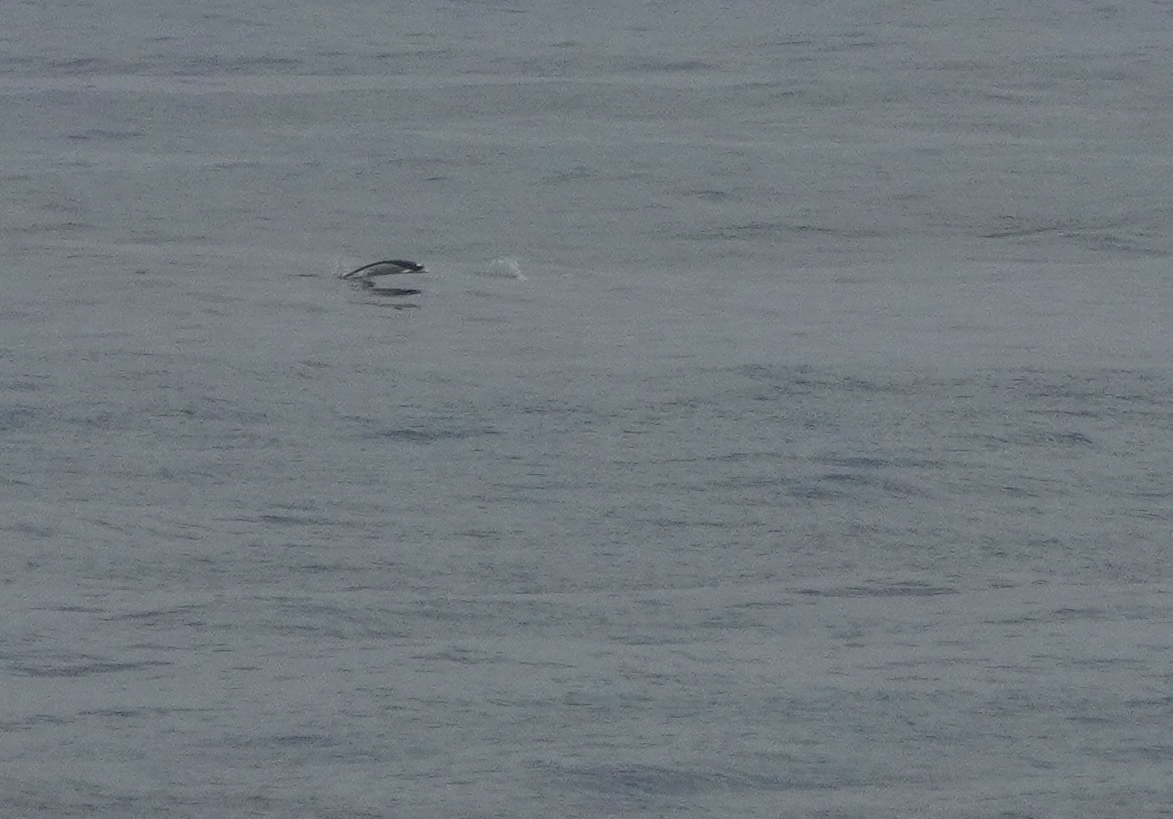
The most characteristic sign is a long series of grouped leaps, with never the black triangle of a dorsal fin. Since the schools readily mix with other delphinids, mixed groups are worth examining closely.
In French waters the species can be met only near Crozet and Kerguelen, areas belonging to the French Austral Lands and Seas inscribed on the UNESCO World Heritage List, access to which is strictly controlled. There as elsewhere, the rule is the same: never chase a group or cut across its path, slow down and hold a steady course, leave the initiative for any approach to the animals, some groups come and ride the bow wave, others deliberately avoid vessels. Sightings, dated photographs and GPS positions passed on to stranding networks and monitoring programmes have particular value here: for a species as poorly documented as this one, every validated record counts.
The complete absence of a dorsal fin and of a dorsal ridge characterises the whole genus Lissodelphis, which indeed owes its name to this feature (from the Greek lissos, “smooth”). In the southern hemisphere no other dolphin shows this character, which makes identification immediate. The evolutionary reasons for this loss have not been established.
The northern right whale dolphin (Lissodelphis borealis) is the only other species in the genus. The two differ first of all geographically: the northern species lives in the northern hemisphere, the southern one in the southern hemisphere, and their ranges do not overlap. Their colour patterns also differ, the southern species showing far more extensive white on the underside, rising well up the flanks and covering the beak and the flippers.
It has been listed as Least Concern by the IUCN since March 2018, mainly because it occupies an immense stretch of ocean far from the coast and because no decline has been demonstrated. This assessment is nevertheless presented as provisional: there is no global abundance estimate and the population trend remains unknown. Bycatch in the driftnets of South America could cause local declines. At national level, New Zealand has since its 2024 assessment placed it among “At Risk (Naturally Uncommon)” species, that is, naturally uncommon ones.
Not in metropolitan France: the species is strictly southern and occurs neither in the Mediterranean, nor in the Bay of Biscay, nor in the English Channel. It is, however, present in the French waters of the Southern and Antarctic Lands, around Kerguelen and Crozet, where the national Red List of TAAF vertebrates (2015) treats it as a regular breeding species, with a status of “Data Deficient”. There it is fully protected by French regulations.
Its diet combines mesopelagic fish, lanternfish in particular, and squid. Since these prey live between 200 and 1,000 m, the dolphins dive regularly below 200 m; most feeding activity is thought to take place between 250 and 1,000 m. An individual breath-hold lasts 10 to 75 seconds, but a whole school can stay submerged for up to about 6.5 minutes.
Yes, it is a highly gregarious species. Schools most often number fewer than a hundred individuals, but groups of 100 to 200 animals are frequent and gatherings of more than 1,000 individuals have been documented. These schools readily mix with other cetaceans, in particular dusky dolphins, common dolphins, hourglass dolphins and pilot whales.
It is a modestly sized and very slender delphinid: adults measure 2.2 to 2.5 m on average for 60 to 100 kg. The largest individuals measured reach 2.97 m in males and 2.30 m in females, with a documented maximum weight of 116 kg. The newborn measures about 0.86 m for some 5 kg.
Profile compiled from authoritative scientific sources (IUCN, NOAA Fisheries, specialist literature) and reviewed for factual accuracy.
According to the open data of the GBIF, 21 georeferenced sightings of Lissodelphis peronii are recorded in our photographic index.
| Country | Notes |
|---|---|
| Chile | 5 |
| New Zealand | 4 |
| Argentina | 3 |
| Falkland Islands (Malvinas) | 3 |
| Namibia | 3 |
| United States of America | 2 |
| French Southern Territories | 1 |

Monthly distribution of 21 dated sightings (all years combined): the maximum is reached in mars.
| Month | Notes |
|---|---|
| janvier | 4 |
| February | 1 |
| mars | 5 |
| avril | 0 |
| mai | 1 |
| juin | 1 |
| juillet | 2 |
| August | 0 |
| septembre | 0 |
| octobre | 1 |
| novembre | 4 |
| December | 2 |
These figures reflect survey effort (more boaters and more surveys in summer) as much as the actual presence of the species: to be interpreted with caution.


Photographs from GBIF under a Creative Commons licence. The author and the licence of each photograph are given; please respect them if you reuse them.
Automatic selection of the most cited works mentioning the species (source: Crossref).