Pacific white-sided dolphin (Aethalodelphis obliquidens)

Key facts
Scientific name Aethalodelphis obliquidens (Gill, 1865), genus erected in 2025. Synonyms still widely used: Lagenorhynchus obliquidens Gill, 1865, without parentheses under the original genus, and Sagmatias obliquidens.
Other names Lagénorhynque à flancs blancs du Pacifique, dauphin de Gill (in French); Pacific white-sided dolphin. Scientific names found depending on the reference database: Lagenorhynchus obliquidens, Sagmatias obliquidens, Aethalodelphis obliquidens.
Size 1.7 to 2.5 m (males up to 2.5 m, females up to about 2.3 to 2.4 m)
Weight 135 to 200 kg (males up to 200 kg, females about 150 kg)
Longevity Of the order of 36 to 40 years, with individuals documented up to 45 or 46 years
Diet Schooling fish (Pacific herring, capelin, sardine, anchovy, mackerel, hake) and cephalopods, squid in particular. Daily intake estimated at between about 9 and 16 kg depending on the source.
IUCN status Least Concern (LC), assessment published in 2018 (assessment dated 11 May 2018, by E. Ashe and G. Braulik; reference e.T11145A50361866). No subpopulation is assessed separately. In Canada, COSEWIC lists the species as “not at risk”. It is listed in Appendix II of CITES and protected in the United States by the Marine Mammal Protection Act.

In brief

The Pacific white-sided dolphin is a stocky and strikingly acrobatic delphinid of the cold temperate waters of the North Pacific, recognisable by its almost non-existent rostrum, its tall bicoloured falcate dorsal fin and the pale grey bands along its flanks. Gregarious in the extreme, it forms groups of a few dozen to several thousand animals and readily associates with other cetaceans. Listed as Least Concern by the IUCN since the 2018 assessment, it remains abundant after suffering very heavy bycatch in the high-seas driftnets until these were banned in 1993.

Identification

The Pacific white-sided dolphin is a medium-sized delphinid with a robust, streamlined body, measuring 1.7 to 2.5 m for 135 to 200 kg. Males are a little larger and heavier than females, which rarely exceed 2.3 to 2.4 m and 150 kg. The most immediately striking feature is the absence of a true beak: the rostrum is extremely short, barely set off from the melon, which gives the head a rounded profile very different from that of the common dolphin or the common bottlenose dolphin. The dorsal fin, tall, broad at the base and markedly falcate, looks oversized for the body; it is bicoloured, the dark forward part contrasting with a pale grey area at the rear, a character that is very useful at sea.

The coloration combines three tones. The back, the tail fluke and the area around the mouth are dark grey to black; the throat, the chin and the belly are creamy white; the flanks carry broad pale grey areas extended backwards by a light band that runs up from eye level to the tail stock. The flippers, short and curved, are bicoloured as well. Each jaw bears numerous small conical teeth, published counts ranging from about 21 to 36 pairs per row. Behaviour is part of the identification: the species swims fast, breaches frequently, performs somersaults and very readily comes to ride the bow wave of vessels.

The possible confusions are in the first place lexical. The Atlantic white-sided dolphin (Leucopleurus acutus) bears an almost identical name but lives in the North Atlantic and is recognised by the ochre yellow patch on its tail stock; the white-beaked dolphin (Lagenorhynchus albirostris) is also an Atlantic species. The dusky dolphin (Aethalodelphis obscurus), a very close relative and morphologically similar, occurs exclusively in the Southern Hemisphere: no overlap of range is possible. At sea, the most real confusion is with the northern right whale dolphin (Lissodelphis borealis), which has no dorsal fin and with which the Pacific white-sided dolphin frequently mixes in multi-species groups.

Taxonomy

Described by the American naturalist Theodore Gill in 1865, this dolphin belongs to the family Delphinidae. It was long placed in the genus Lagenorhynchus, which brought together six species of comparable outline. Molecular analyses have shown that this genus was polyphyletic, that is to say that it grouped species whose actual relatedness was far more distant than their resemblance suggested. A first revision led several reference databases, among them the World Register of Marine Species, to adopt the name Sagmatias obliquidens. In April 2025, a revision based on phylogenomic, morphological and acoustic data, published by Galatius and colleagues in Molecular Phylogenetics and Evolution, erected the genus Aethalodelphis for two species only, the Pacific white-sided dolphin and the dusky dolphin, while transferring Peale’s dolphin and the hourglass dolphin to the genus Cephalorhynchus. This combination, Aethalodelphis obliquidens, has been recognised as valid by the Society for Marine Mammalogy since 2025. The major management and conservation databases, in particular the IUCN Red List and NOAA, continue to use Lagenorhynchus obliquidens: the three names all designate the same animal.

These changes of genus explain the way the authority is written. The International Code of Zoological Nomenclature requires the author and the date to be placed in parentheses only when the species is placed in a genus different from that of the original description. One therefore writes Lagenorhynchus obliquidens Gill, 1865 without parentheses, since Gill described the species in that genus, but Sagmatias obliquidens (Gill, 1865) and Aethalodelphis obliquidens (Gill, 1865) with parentheses.

Distribution and habitat

The species is endemic to the cold temperate waters of the North Pacific. Its range extends roughly from the southern Bering Sea and the Gulf of Alaska (towards 60° north) to the Baja California Peninsula and the waters off Japan (towards 20 to 25° north), the highest densities on the high seas being concentrated in the band between 38° and 47° north. On the Asian side, it is present from Japan and the Sea of Japan to the Sea of Okhotsk, and occasionally moves up as far as the southern Bering Sea. On the American side, it frequents the Gulf of Alaska, the Kodiak region and the Aleutian Islands, British Columbia, then the coasts of Washington, Oregon and California as far as the Baja California Peninsula. It is essentially pelagic and favours the edge of the continental shelf, the slope and deep offshore water, while entering certain deep coastal inlets; it avoids very shallow water.

Its movements follow a marked seasonal rhythm. The animals are most numerous in the Southern California Bight in winter, from about November to April, then redistribute northwards, off Oregon and Washington, from May onwards. Further north, in the inside waters of British Columbia such as the Broughton Archipelago, sightings peak from October to January. In the Salish Sea the species remains generally uncommon, encounters being concentrated in the Strait of Juan de Fuca and usually taking the form of small groups rather than the large offshore schools.

In France the species is absent. Neither the English Channel, nor the Bay of Biscay, nor the Mediterranean, nor the overseas territories lie within its range, which is strictly limited to the North Pacific. The dolphins of the former Lagenorhynchus group that may be encountered in metropolitan French waters belong to distinct species: the Atlantic white-sided dolphin (Leucopleurus acutus), present in the North-East Atlantic as far as the Bay of Biscay and absent from the Mediterranean, and, far more rarely, the white-beaked dolphin (Lagenorhynchus albirostris), whose range extends down to the English Channel.

Biology and ecology

An opportunistic predator, the Pacific white-sided dolphin feeds on fish that form dense schools, Pacific herring, capelin, sardine, anchovy, mackerel and hake, and on cephalopods, squid holding an important place in its diet. Estimated daily requirements vary from the order of 9 to 16 kg depending on the author. Hunting is often collective: the dolphins encircle and compress the fish schools, and at night exploit the organisms of the deep scattering layer when it rises towards the surface. Feeding dives commonly exceed 100 m depth, immersions down to about 1,000 m having been reported, with breath-holds that can exceed six minutes. Echolocation relies on click trains whose frequencies range from a few tens to more than 100 kHz, complemented by whistles and by visual and tactile signals.

It is one of the most gregarious delphinids of the North Pacific. Groups most often number ten to a hundred animals, with a mean size frequently quoted at around 90 animals, but gatherings of several thousand are regular offshore, the documented maximum being close to 6,000 individuals. These schools are often structured by sex and by age class, and readily associate with other cetaceans, in particular the northern right whale dolphin. The species is noted for its liveliness: leaps clear of the water, somersaults, surfing on bow waves and in the wake of vessels.

Breeding is seasonal, matings being concentrated from summer to early autumn, between August and October depending on the region. After a gestation of 9 to 12 months, the female gives birth to a single calf of 0.9 to 1.2 m weighing about 14 to 15 kg. Lactation lasts from eight to eighteen months and the interval between two births is generally two to four years. Sexual maturity is reached at about 7 to 11 years in females and around 10 to 11 years in males. Longevity lies around 36 to 40 years, individuals of 45 to 46 years having been documented. Apart from humans, the main known predator is the killer whale.

Status and conservation

The IUCN Red List places the species in Least Concern (LC) in its 2018 assessment. That classification rests on a wide range and high numbers: the surveys carried out in the central North Pacific between 1987 and 1990 had produced an estimate of the order of 931,000 individuals, and no significant long-term trend is detected along the west coast of the United States. For the California, Oregon and Washington stocks, the surveys from 2008 to 2014 counted more than 21,000 animals, while distribution models fitted to the transects run from 1991 to 2018 arrive at close to 35,000 individuals for the year 2018. The trend of the North Pacific stock, off Alaska, remains unknown.

The heaviest historical pressure was bycatch in the large high-seas drift gillnets worked by the Japanese, Korean and Taiwanese fleets: several tens of thousands of animals died in them between the late 1970s and the early 1990s, published estimates for the period 1978-1990 ranging from 49,000 to 80,000 animals. The ban on large driftnets on the high seas, which came into force in 1993 following a United Nations resolution, put an end to that mass mortality and the populations have since been considered to be in good condition.

Present-day threats are more diffuse: entanglement in coastal gillnets, purse seines, trawls and longlines; coastal hunting in Japan, where the species is taken in small numbers, some of the captured animals also supplying dolphinariums; underwater noise pollution, which disturbs communication and behaviour; chemical contaminants; scarcer prey linked to overfishing; ingestion of plastic debris; and changes in the distribution of prey under the effect of climate change. The species is protected in the United States by the Marine Mammal Protection Act, listed in Appendix II of CITES and considered “not at risk” by COSEWIC in Canada.

Watching this species

The Pacific white-sided dolphin is among the cetaceans most easily approached from the west coast of North America, provided one is in the right place. The most favourable areas are British Columbia, in particular the Broughton Archipelago and the inside straits between October and January; the Gulf of Alaska, the Kodiak region and the Aleutian Islands in summer; the Strait of Juan de Fuca, where encounters are sporadic and rather autumnal; and California, with a stronger presence in southern waters from November to April, then a shift towards Oregon and Washington from May. Watching trips leaving from Monterey, Vancouver Island or Telegraph Cove offer the best chances.

On the water the species can be picked out from a distance: bursts of spray, repeated leaps and animals that come of their own accord towards the bow. This behaviour makes watching easy but does not remove the need for care. Good practice is to let the animals decide on the approach, to hold a constant speed and a predictable course, never to cut across the path of the group or to split it, not to come between a female and her calf, and to cut the encounter short as soon as signs of avoidance appear. In the United States, the Marine Mammal Protection Act prohibits any harassment of marine mammals, including deliberate pursuit and putting swimmers in the water near the groups.

In France no sighting of this species is possible: the dolphins of the former Lagenorhynchus group in French waters belong to distinct Atlantic species, the Atlantic white-sided dolphin (Leucopleurus acutus) and, far more rarely, the white-beaked dolphin (Lagenorhynchus albirostris).

Frequently asked questions

Is the Pacific white-sided dolphin a threatened species?

No. The IUCN Red List places it in Least Concern (LC) in its 2018 assessment. The species remains abundant in the North Pacific, with an estimate of the order of 931,000 individuals for the central North Pacific from the 1987-1990 surveys, and no significant declining trend is shown along the west coast of the United States. It is nevertheless listed in Appendix II of CITES and protected in the United States by the Marine Mammal Protection Act.

Can it be seen in French waters?

No. The species is strictly limited to the cold temperate waters of the North Pacific and is present neither in the English Channel, nor in the Bay of Biscay, nor in the Mediterranean, nor in French overseas waters. The dolphins of the former Lagenorhynchus group that can be seen off the French coast belong to different species: the Atlantic white-sided dolphin (Leucopleurus acutus), as far as the Bay of Biscay, and, far more rarely, the white-beaked dolphin (Lagenorhynchus albirostris), whose range extends down to the English Channel.

How can it be told from the Atlantic white-sided dolphin?

The two species are never found in the same waters, which settles the question in the field. Morphologically, the Atlantic species carries a characteristic ochre yellow patch on the tail stock, absent in the Pacific species, which is recognised by its very tall, markedly bicoloured falcate dorsal fin and by the broad pale grey areas on its flanks.

Why does its scientific name change from one source to another?

Because the genus Lagenorhynchus proved to be polyphyletic: it brought together species that resembled one another but were only distantly related. The species was first transferred to the genus Sagmatias, then a phylogenomic revision published in 2025 by Galatius and colleagues created the genus Aethalodelphis for it and the dusky dolphin, a combination recognised by the Society for Marine Mammalogy. The IUCN and NOAA still use Lagenorhynchus obliquidens: the three names designate the same animal. That is also why the authority is written without parentheses under the original genus (Lagenorhynchus obliquidens Gill, 1865) and in parentheses in the later combinations, Sagmatias obliquidens (Gill, 1865) and Aethalodelphis obliquidens (Gill, 1865).

How large are the groups, and how deep does it dive?

Groups most often number ten to a hundred animals, with a mean often quoted at around 90 animals, but gatherings of several thousand are regular offshore, the documented maximum approaching 6,000 individuals. Feeding dives commonly exceed 100 m, immersions down to about 1,000 m having been reported, with breath-holds that can exceed six minutes.

What are the main threats facing it today?

The mass mortality in the large high-seas driftnets, which killed several tens of thousands of animals between the late 1970s and 1990, ceased with the ban on that gear on the high seas that came into force in 1993. What remains today is bycatch in coastal gillnets, purse seines and trawls, a Japanese coastal hunt taking small numbers, noise pollution, chemical contaminants, scarcer prey and the effects of climate change.

Sources

Profile compiled from authoritative scientific sources (IUCN, NOAA Fisheries, specialist literature) and reviewed for factual accuracy.

Observed distribution

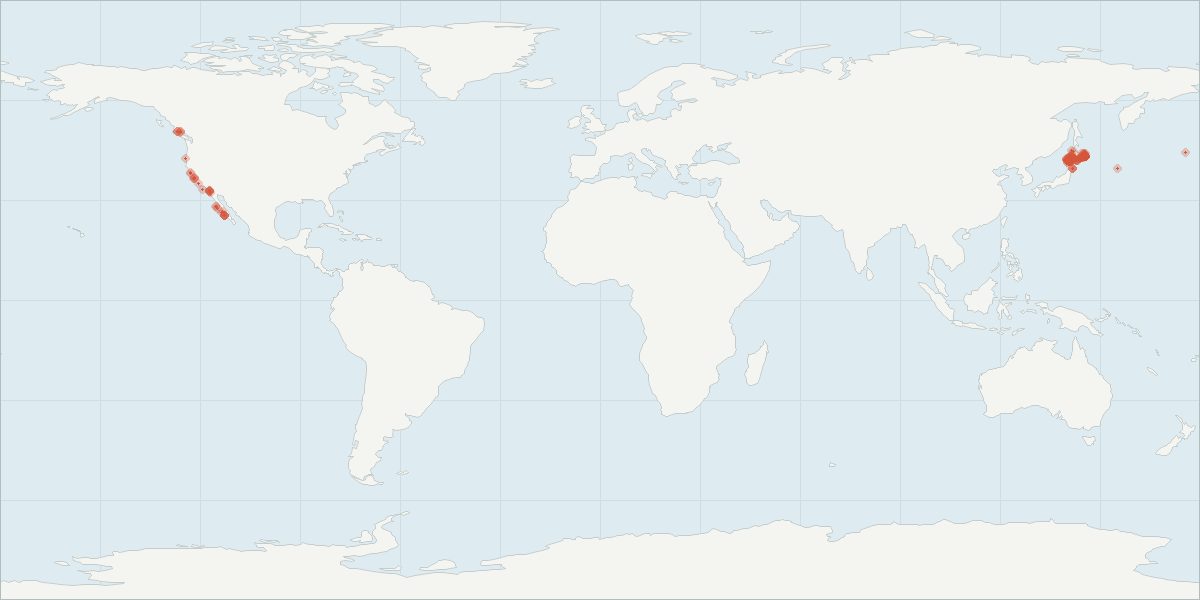
According to the open data of the GBIF, 219 georeferenced sightings of Lagenorhynchus obliquidens are recorded in our photographic index.

Main countries of observation
CountryNotes
Japan203
United States of America49
Mexico8
Canada6
unknown or invalid5

Distribution map: Pacific white-sided dolphin (Lagenorhynchus obliquidens)

Distribution map: Pacific white-sided dolphin (Lagenorhynchus obliquidens), 219 georeferenced sightings from GBIF
219 georeferenced sightings of Lagenorhynchus obliquidens. Base map Natural Earth, public domain. GBIF data.
🗺️ Open the interactive mapTo zoom and pan. It uses the OpenStreetMap/CARTO base maps and the GBIF occurrence densities: no data is sent to these services before you click.

Presence through the year

Monthly distribution of 248 dated sightings (all years combined): the maximum is reached in juillet.

570janvier : 8janfévrier : 11febmars : 15maravril : 6avrmai : 16maijuin : 23juinjuillet : 57juilaoût : 47Augustseptembre : 26sepoctobre : 10octnovembre : 14novdécembre : 15dec
Sightings by month
MonthNotes
janvier8
February11
mars15
avril6
mai16
juin23
juillet57
August47
septembre26
octobre10
novembre14
December15

These figures reflect survey effort (more boaters and more surveys in summer) as much as the actual presence of the species: to be interpreted with caution.

En images

Lagenorhynchus obliquidens
© Albert Fopma, CC BY-NC-ND, 2025
Lagenorhynchus obliquidens
© Albert Fopma, CC BY-NC-ND, 2025
Lagenorhynchus obliquidens
© Evert Doppenberg, CC BY-NC-ND, 2025
Lagenorhynchus obliquidens
© auteur non précisé, CC BY, 2024
Lagenorhynchus obliquidens
© Rowan Gibson, CC BY-NC-ND, 2024
Lagenorhynchus obliquidens
© auteur non précisé, CC BY, 2024
Lagenorhynchus obliquidens
© auteur non précisé, CC BY, 2024
Lagenorhynchus obliquidens
© auteur non précisé, CC BY, 2024
Lagenorhynchus obliquidens
© auteur non précisé, CC BY, 2024
Lagenorhynchus obliquidens
© auteur non précisé, CC BY, 2024
Lagenorhynchus obliquidens
© auteur non précisé, CC BY, 2024
Lagenorhynchus obliquidens
© auteur non précisé, CC BY, 2024

Photographs from GBIF under a Creative Commons licence. The author and the licence of each photograph are given; please respect them if you reuse them.

Scientific references

  1. Spong P., White D. (1971) Visual acuity and discrimination learning in the dolphin (Lagenorhynchus obliquidens), Experimental Neurology
  2. (2002) LAGENORHYNCHUS OBLIQUIDENS), Journal of Zoo and Wildlife Medicine
  3. Stacey P., Baird R. (1991) Status of the Pacific White-sided Dolphin, Lagenorhynchus obliquidens, in Canada, The Canadian field-naturalist
  4. Caldwell M., Caldwell D. (1970) STATISTICAL EVIDENCE FOR INDIVIDUAL SIGNATURE WHISTLES IN THE PACIFIC WHITESIDED DOLPHIN, LAGENORHYNCHUS OBLIQUIDENS
  5. Rechsteiner E. (2013) Seasonal Resting Metabolic Rate and Food Intake of Captive Pacific White-Sided Dolphins (Lagenorhynchus obliquidens), Aquatic Mammals
  6. Martin W., Haun C., Barrows H., Cravioto H. et al. (1970) Nematode Damage to Brain of Striped Dolphin, Lagenorhynchus obliquidens, Transactions of the American Microscopical Society
  7. Lewis R., Berry K. (1988) Brain Lesions in a Pacific White-sided Dolphin (Lagenorhynchus obliquidens), Journal of Wildlife Diseases
  8. Whitten J., Thomas J. (2001) Whistle repertoire of Pacific white-sided dolphins (Lagenorhynchus obliquidens) at the John G. Shedd Aquarium., The Journal of the Acoustical Society of America

Automatic selection of the most cited works mentioning the species (source: Crossref).