Baird's beaked whale (Berardius bairdii)

Key facts
Scientific name Berardius bairdii Stejneger, 1883
Other names Baird’s beaked whale, giant bottlenose whale, northern four-toothed whale; in French: bérardie de Baird, baleine à bec de Baird, baleine à bec géante du Pacifique Nord, baleine à quatre dents du Nord; in Japanese: tsuchikujira.
Size 9 to 13 m (females 11 to 12.8 m; males 10.7 to 11.9 m; confirmed maximum 13 m)
Weight 10 to 14 tonnes depending on the source
Longevity Up to 54 years in females and 84 years in males (maximum recorded ages)
Diet Deep-sea fish (gadiforms, morid cods, grenadiers, pollock, mackerel, sardine, saury) and cephalopods (squid of the families Gonatidae and Cranchiidae), taken by suction
IUCN status Least Concern (LC), IUCN assessment of 23 August 2020 (Taylor & Brownell), population trend unknown. Previous status: Data Deficient (DD, 2008), still mentioned by some sources that have not been updated. The assessment recognises three subpopulations in the western North Pacific (the Sea of Japan, the Sea of Okhotsk and the Pacific Ocean), but none has been the subject of a separate Red List assessment.

In brief

Baird’s beaked whale is the largest of the ziphiids and the world’s second largest toothed whale after the sperm whale, with adults of 9 to 13 m weighing 10 to 14 tonnes. Endemic to the cold, deep waters of the North Pacific, this unobtrusive diver works the continental slope and the seamounts beyond 1,000 m. Classed as Least Concern by the IUCN in 2020, it remains the only beaked whale to have been exploited commercially.

Identification

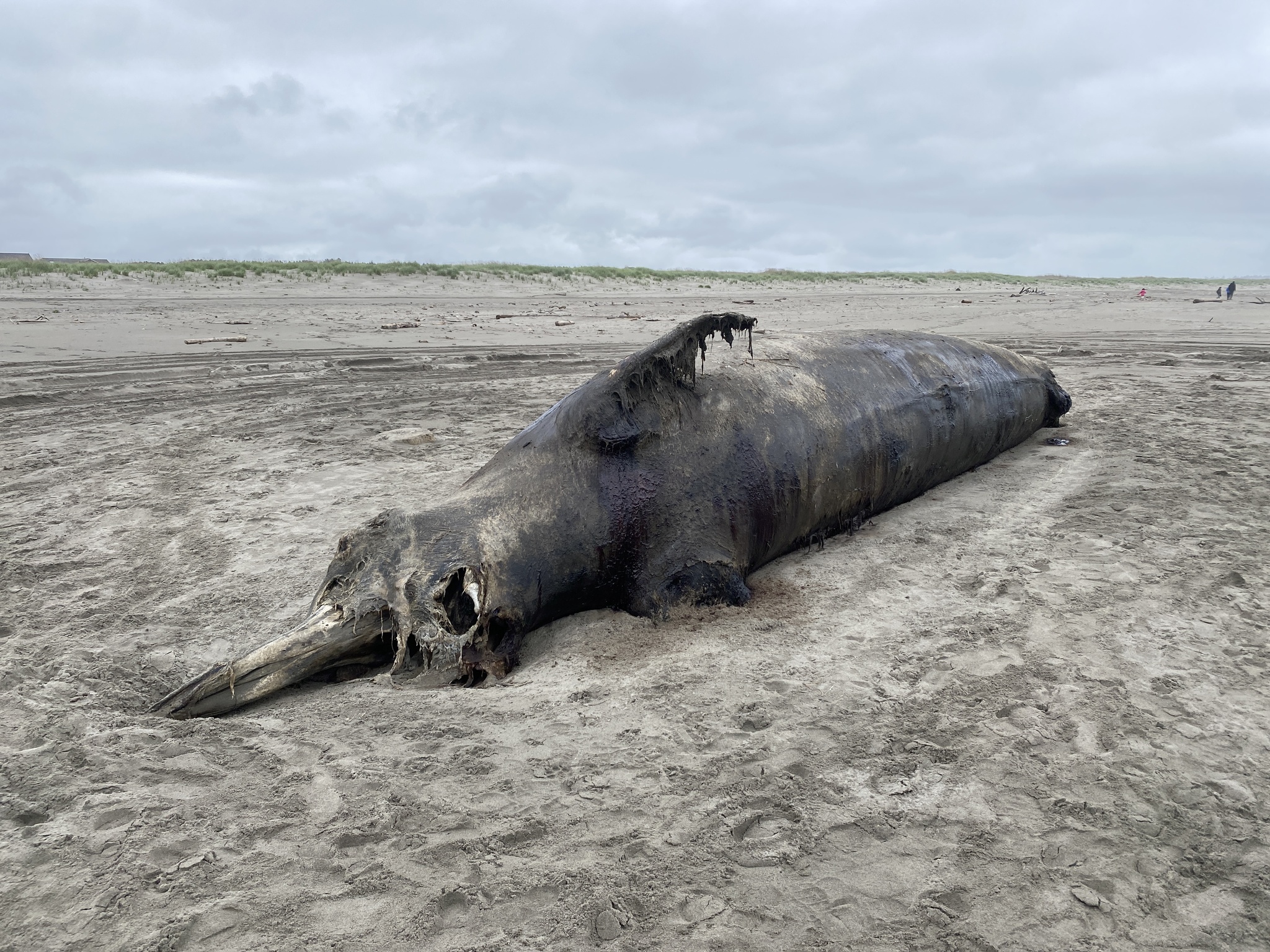
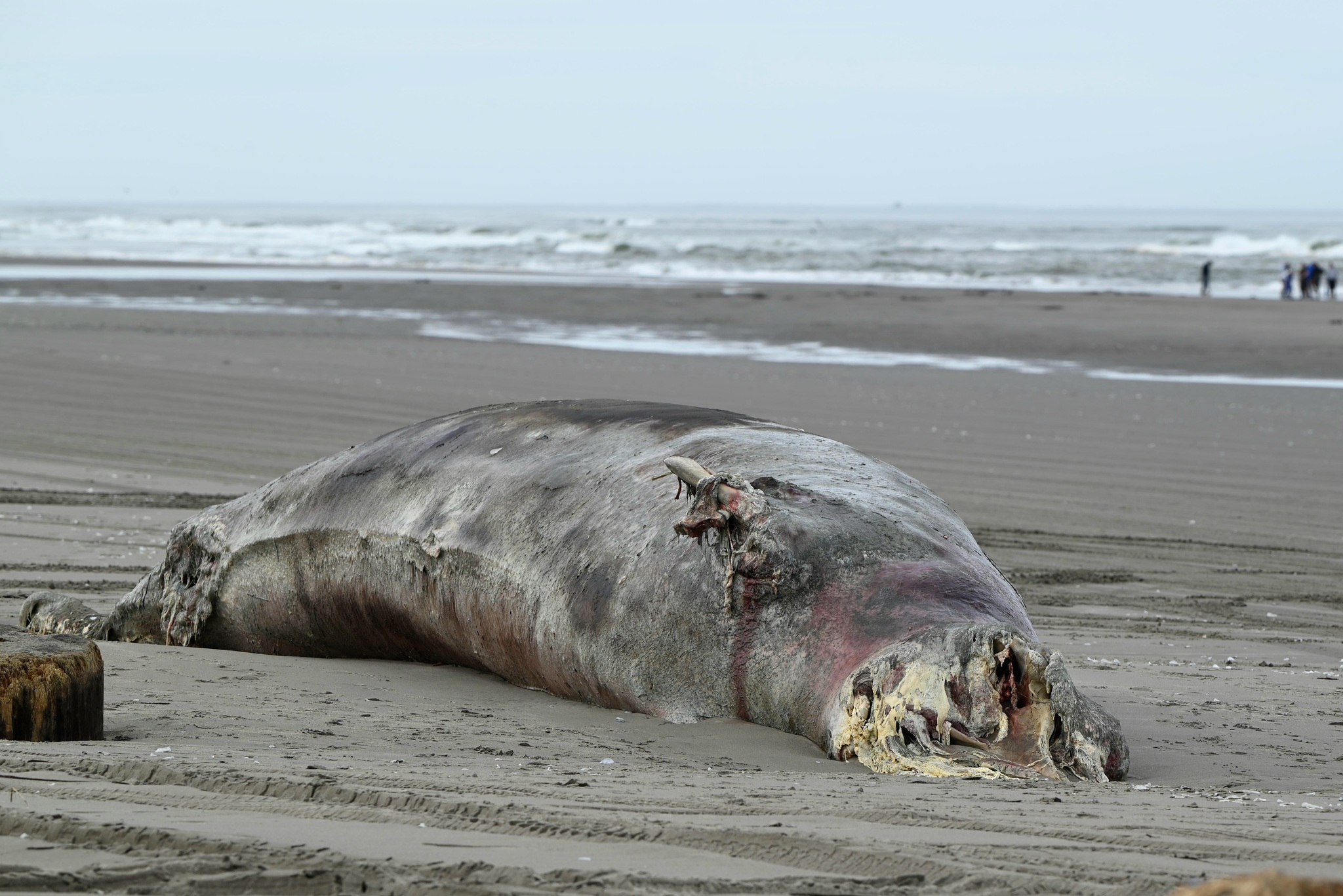
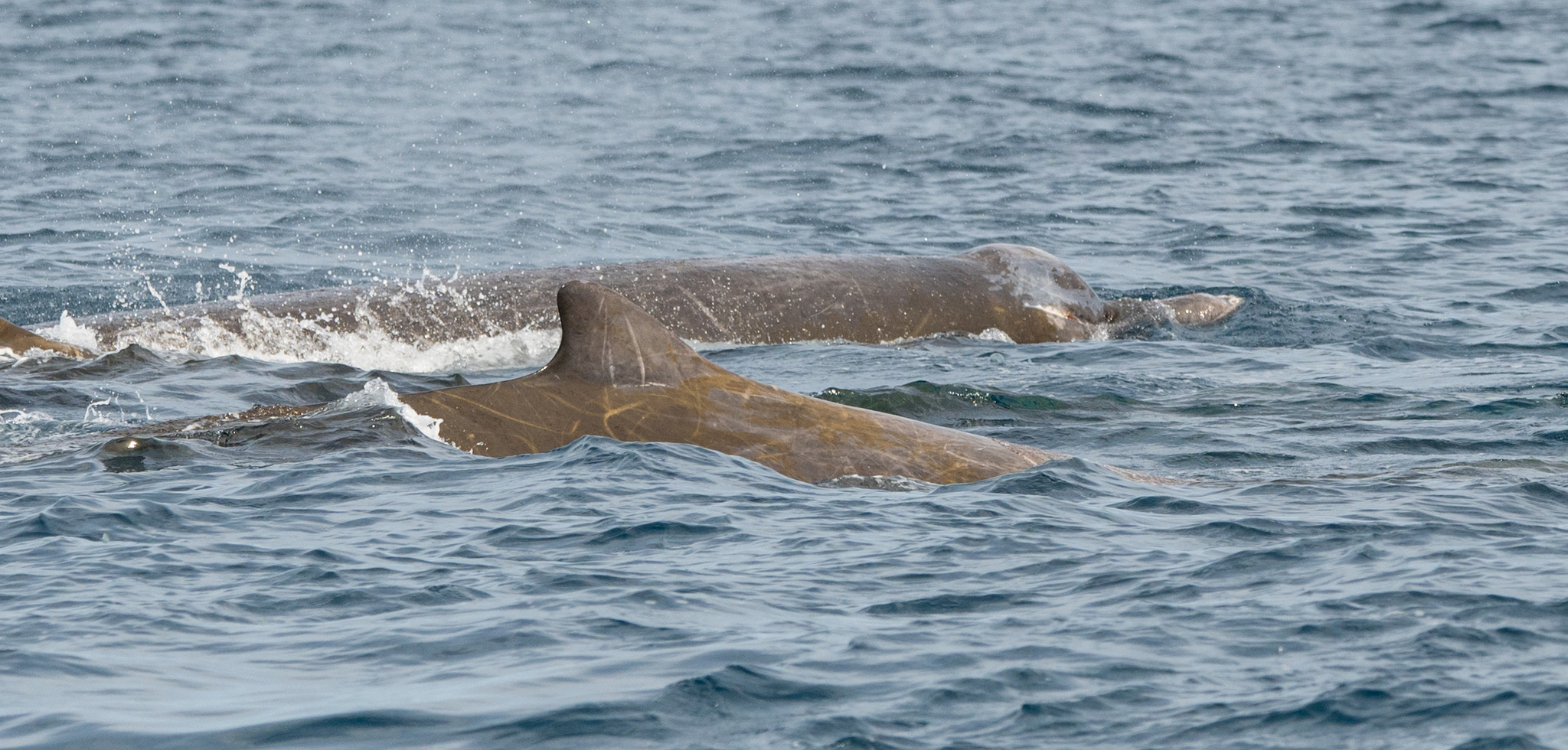
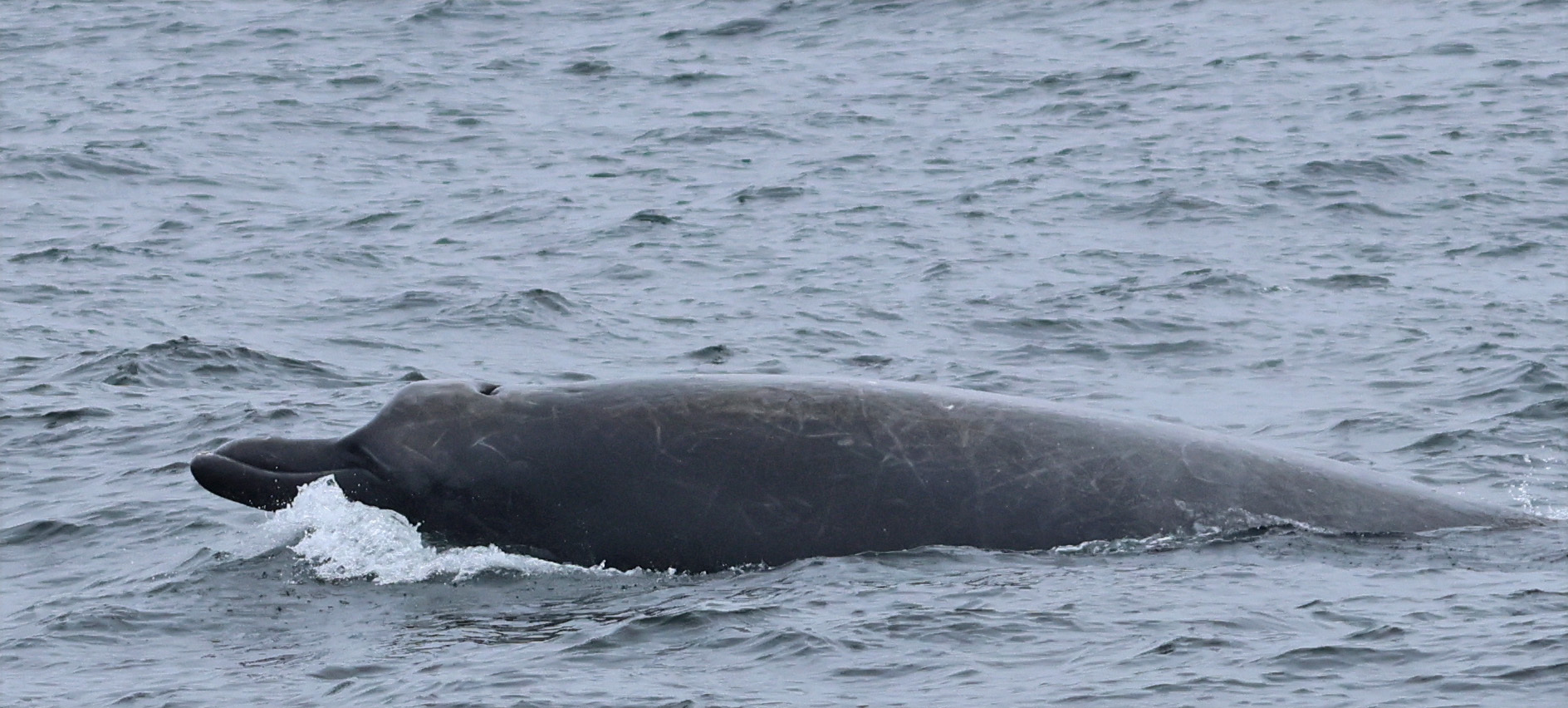
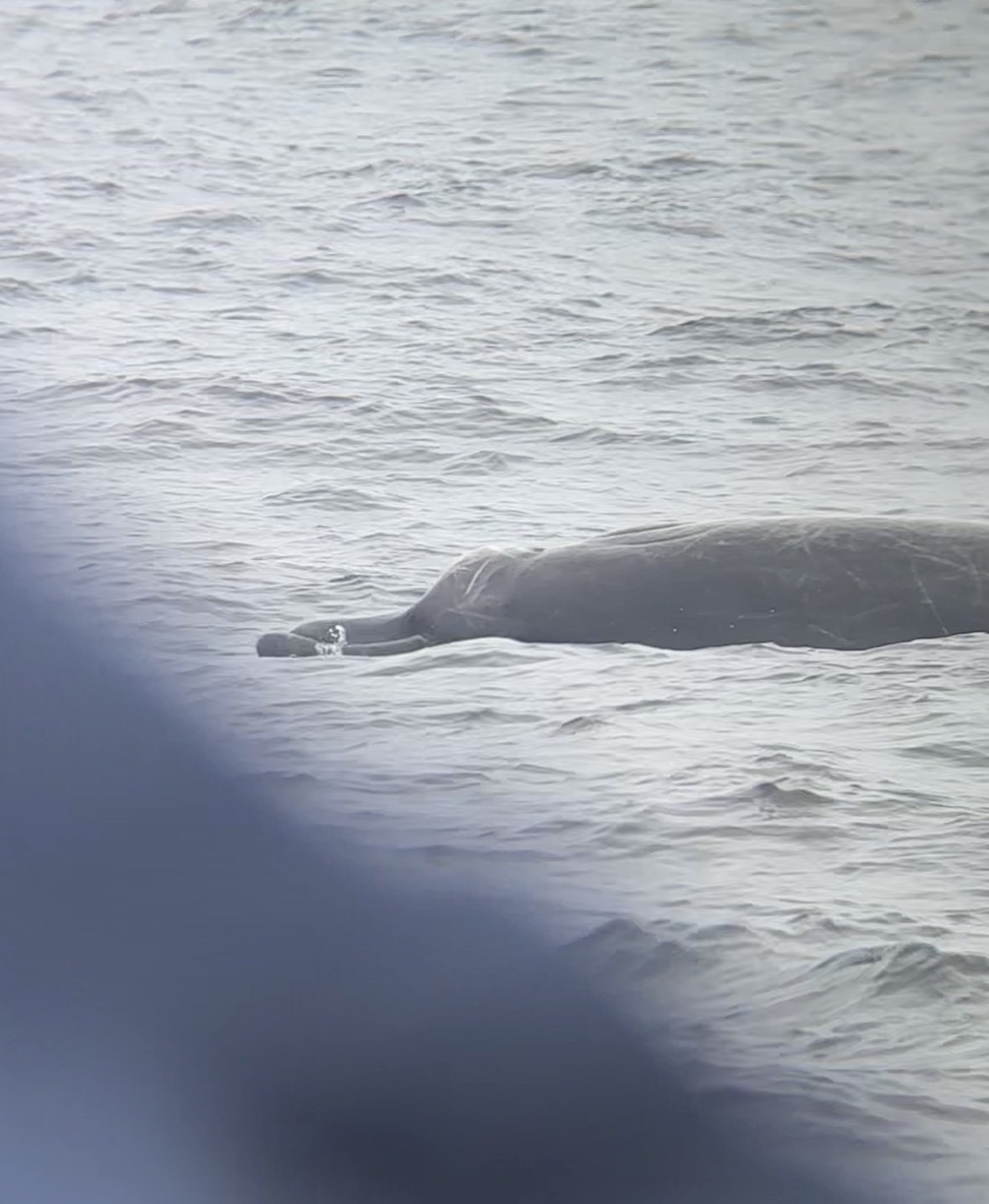
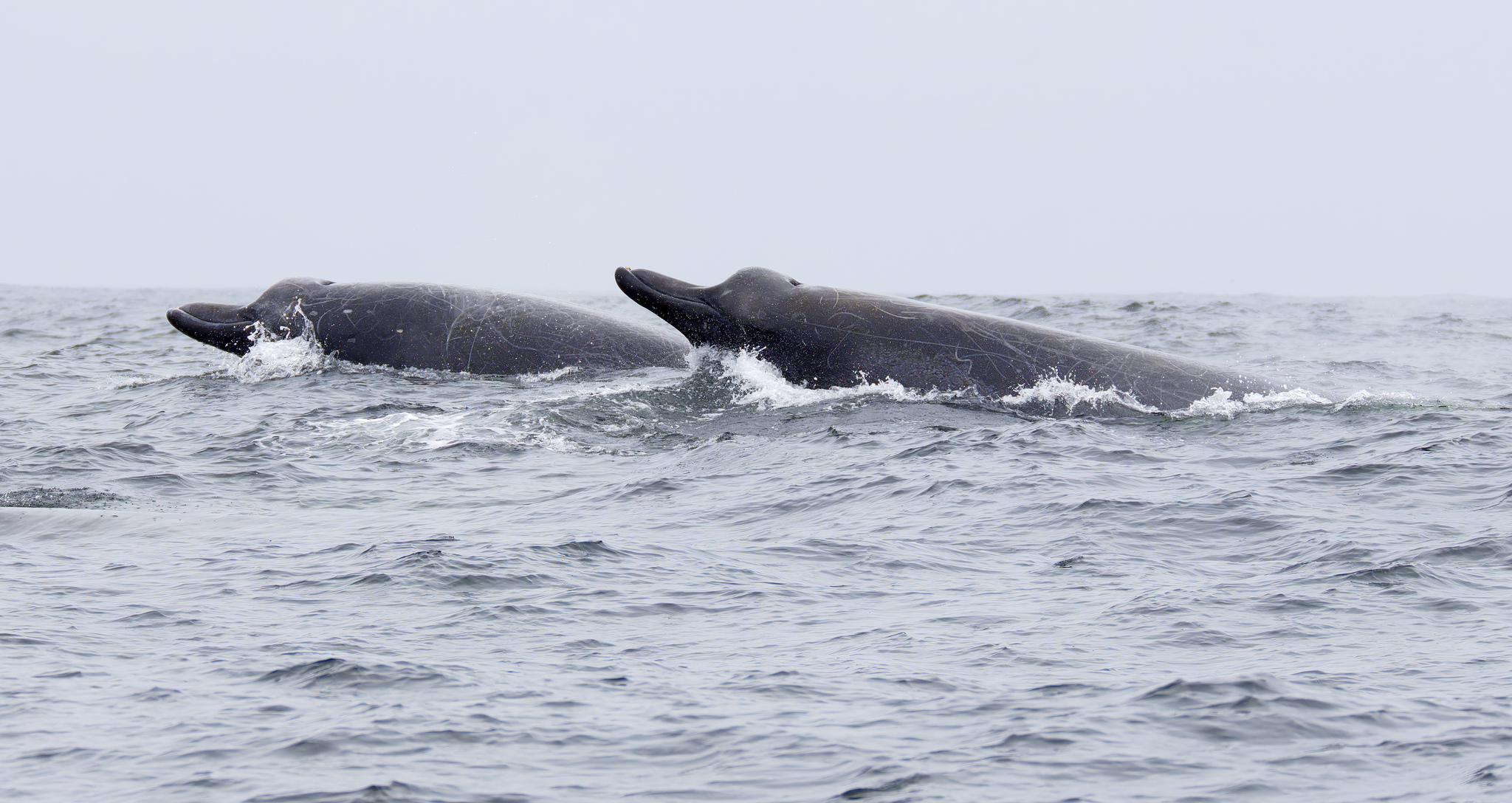
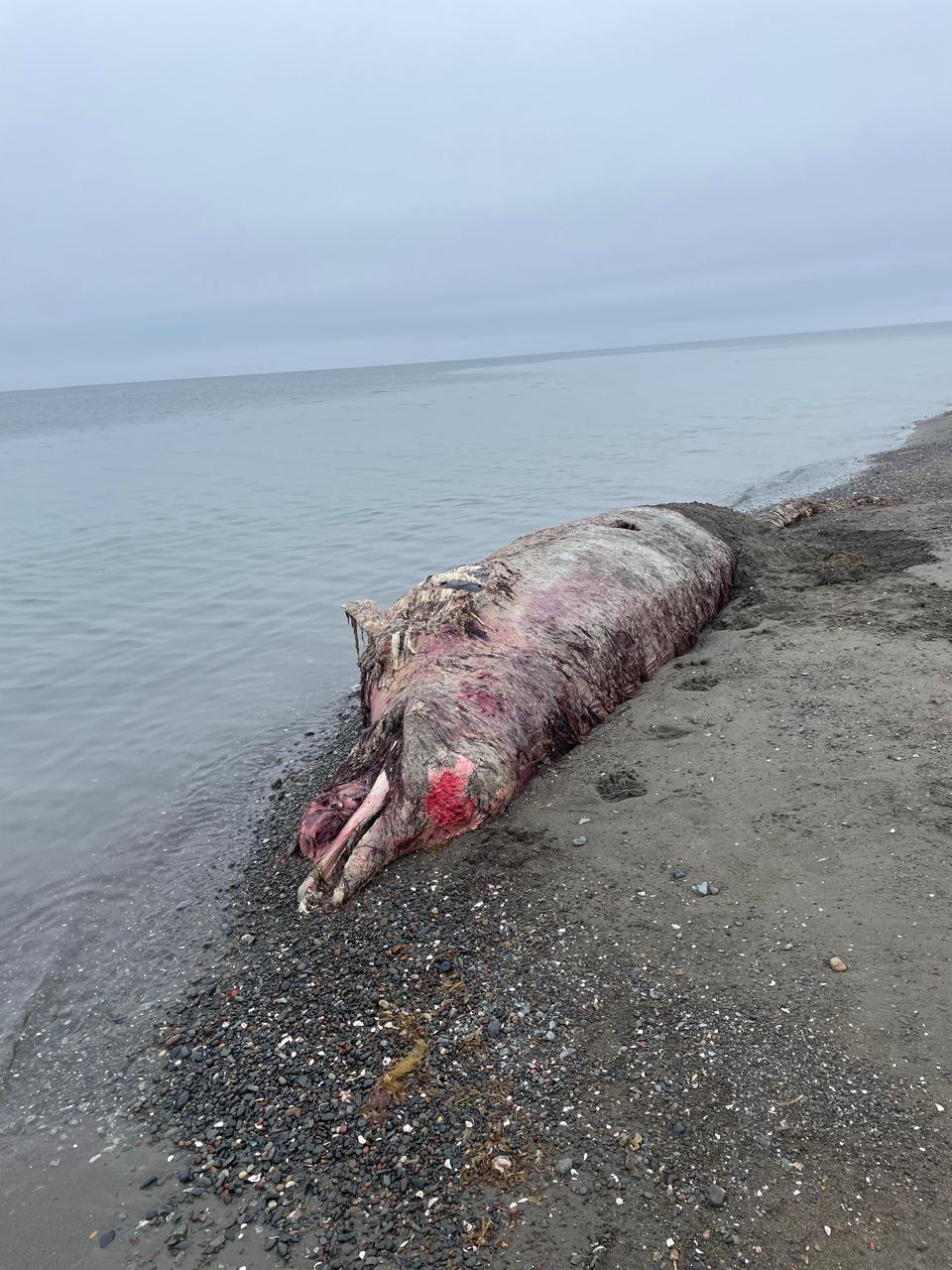
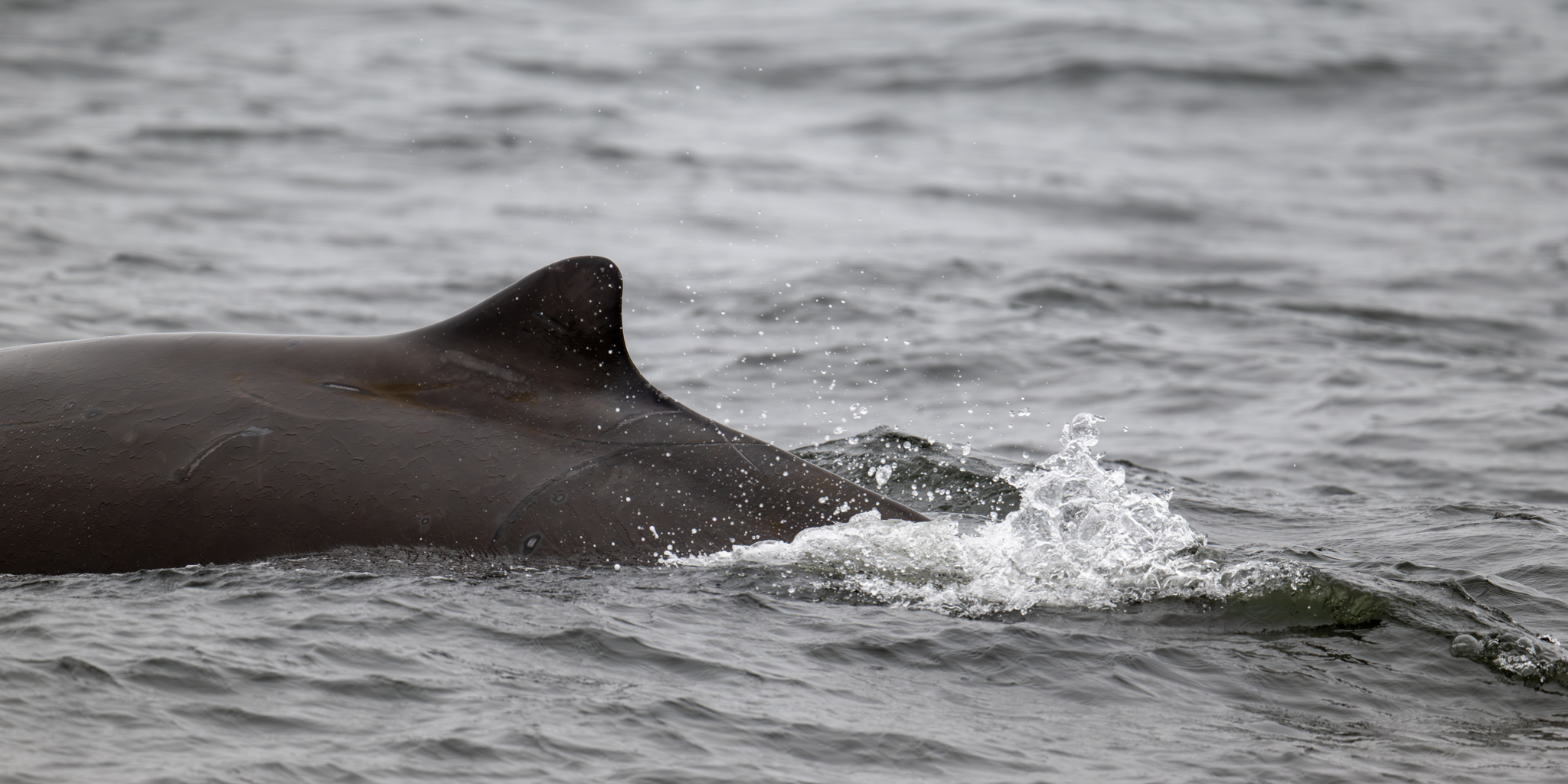
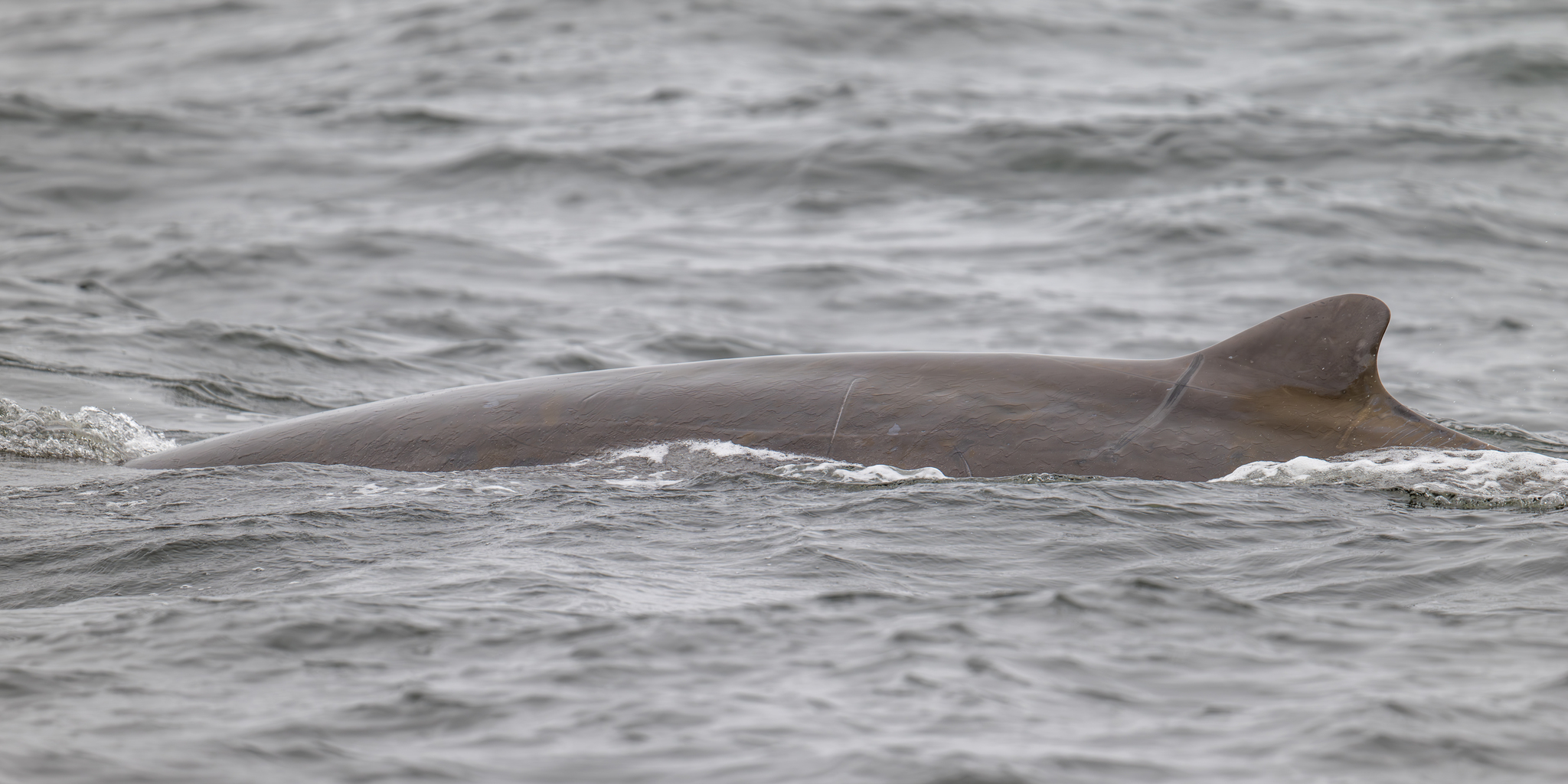
Baird’s beaked whale is recognised first of all by its size: no other ziphiid reaches such dimensions. The body is fusiform and very elongated, continued by a relatively small head whose bulbous melon runs into a long cylindrical rostrum, almost dolphin-like, often the first feature visible when the animal breaks the surface. The blowhole forms a crescent. The dorsal fin, small, low and slightly falcate, is set well back, at about two thirds of the body length. The coloration ranges from slate grey to dark brown, with a paler belly marked by irregular white patches. Adults carry countless whitish linear scars left by the teeth of other members of their species, as well as oval marks caused by cookiecutter sharks; old males, heavily marked, look distinctly paler from a distance.

The dentition is the diagnostic feature of the genus. The lower jaw bears two pairs of teeth at its tip; the front pair, large and triangular, erupts through the gum and remains visible when the mouth is closed, in both sexes, an unusual feature among ziphiids, in which normally only males have visible teeth. It is this characteristic that earns the species the name “four-toothed whale”. These “fighting teeth” are used in social confrontations, the source of the scars already mentioned. Unlike most cetaceans, females are slightly larger than males; physically mature individuals most often measure between 9.1 and 11.1 m.

The possible confusions are limited but real. Sato’s beaked whale (Berardius minimus), described in 2019, shares part of the range north of Hokkaido and towards the Aleutians: it is much smaller (6.3 to 6.9 m at physical maturity), almost uniformly black and has a markedly shorter rostrum, of the order of 4% of body length. Cuvier’s beaked whale (Ziphius cavirostris), also present in the North Pacific, scarcely exceeds 7 m and has a short beak with a gently sloping forehead. Arnoux’s beaked whale (Berardius arnuxii), morphologically very close, is confined to the southern hemisphere: no confusion is therefore possible in the field.

Taxonomy

The species was described in 1883 by the Norwegian-American zoologist Leonhard Stejneger, from a specimen from the Bering Sea, and dedicated to Spencer Fullerton Baird, then secretary of the Smithsonian Institution. It belongs to the odontocete suborder and to the family of ziphiids (Ziphiidae Gray, 1850), also designated Hyperoodontidae (Gray, 1846) in some classifications.

The genus Berardius today holds three species. Baird’s beaked whale occupies the North Pacific; Arnoux’s beaked whale (B. arnuxii) occupies southern waters. Their resemblance long fed the debate over their respective validity, but genetics and the strict geographical separation confirm two distinct species. The third, Sato’s beaked whale (B. minimus), was formally described in 2019 by Yamada and co-workers, from Japanese specimens that whalers had long known under the names kuro-tsuchi (“black tsuchi”) or karasu (“crow”), and that they already told apart from Baird’s beaked whales. This split has an important consequence: data collected before 2019 in the northern part of the range in all likelihood mix the two species.

Distribution and habitat

Baird’s beaked whale is endemic to the cold and temperate oceanic waters of the North Pacific and the adjacent seas. Its range covers the Sea of Okhotsk, the Bering Sea, the northern Sea of Japan as far as the approaches to the Korean Peninsula, the Aleutian Islands, the Gulf of Alaska and the Pacific seaboard of North America. The known eastern limit lies in the southern Gulf of California, in Mexico; to the west, the species reaches down to central Honshu, in Japan. The range states recorded are Canada, the United States, Japan, North Korea, South Korea, Mexico and Russia.

The habitat is that of the continental slope, submarine canyons and the surroundings of seamounts, in depths of 1,000 to 3,000 m; the southern limit of the range coincides with the 15 °C isotherm measured at 100 m depth. Seasonal movements are observed: off the Pacific seaboard of Japan, the animals move into continental slope waters from May to October; where they are in winter remains unknown.

The species is absent from France. Strictly North Pacific, it has been reported neither in the Mediterranean, nor in the English Channel, nor in the Bay of Biscay, nor in French overseas waters. The ziphiids seen in French waters belong to other species, in particular Cuvier’s beaked whale (Ziphius cavirostris), frequent in the Mediterranean, together with the northern bottlenose whale (Hyperoodon ampullatus) and Sowerby’s beaked whale (Mesoplodon bidens) in the north-east Atlantic.

Biology and ecology

The diet combines deep-sea fish and cephalopods, with strong regional variation. Off the Pacific seaboard of Honshu, stomach contents comprise about 82% fish to 18% cephalopods; in the southern Sea of Okhotsk the proportion is almost completely reversed, with 13% fish to 87% cephalopods. The prey identified include gadiforms, morid cods, grenadiers, pollock, mackerel, sardine and Pacific saury, as well as squid of the families Gonatidae and Cranchiidae; crustaceans, octopus, rays and sea cucumbers have also been reported. Capture is by suction, the gular musculature creating a reduced pressure that draws the prey in.

The species is a remarkable diver. The recordings distinguish deep dives beyond 1,000 m, intermediate dives between 100 and 1,000 m and series of shallow recovery dives. A recorder deployed off the Japanese Pacific documented 81 dives in some thirty hours, with a maximum depth of 1,777 m and a breath-hold of 64.4 minutes; dives reaching 81.7 minutes have been reported. Ordinary dives last rather 11 to 30 minutes, interspersed with resting phases at the surface that can reach about fifteen minutes.

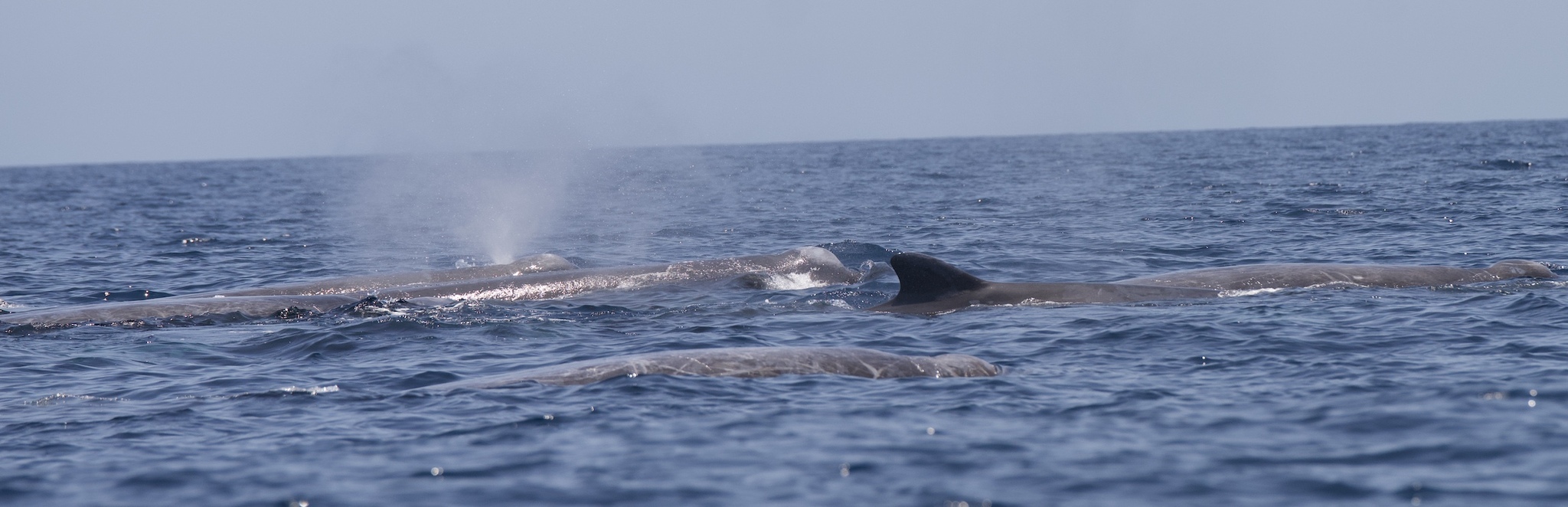
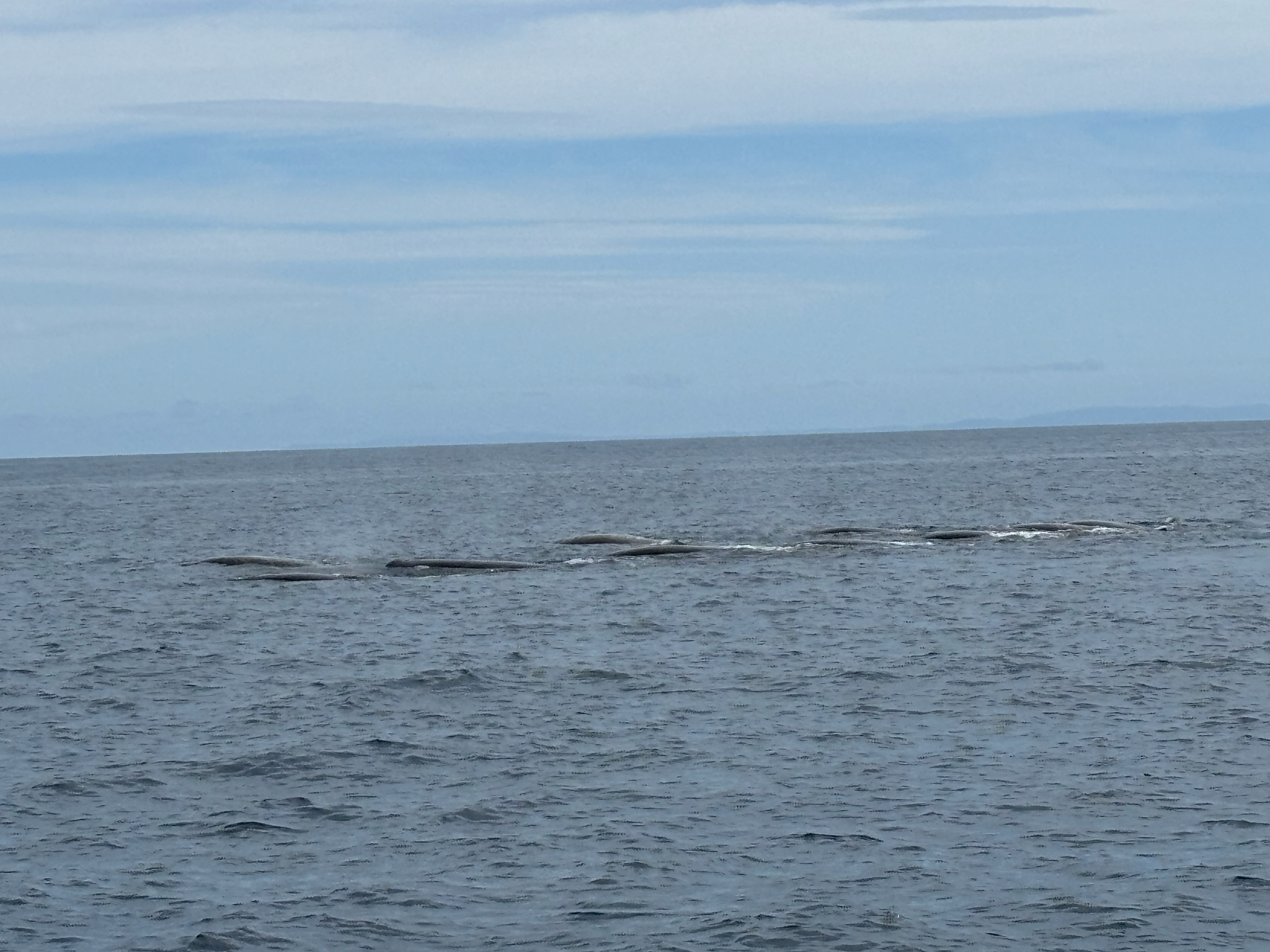
Social life rests on cohesive groups of 3 to 10 individuals, commonly 5 to 20, with gatherings of 50 animals and, exceptionally, of a hundred or so, pressed tightly against one another at the surface, behaviour that is probably defensive against the killer whale, its main predator. Spatial segregation between the sexes has been suggested.

Sexual maturity is reached at around 10 to 15 years in females and 6 to 11 years in males, whose testes continue to grow until 30 or 40 years of age. Gestation lasts about 17 months and ends in the birth of a single calf of about 4.5 m, mainly in March and April; females breed only once every three years at most and the young stay with their mother for a long time. Longevity is high and, unusually among mammals, favours males: 54 years at most in females against 84 years in males.

Status and conservation

The IUCN has classed Baird’s beaked whale as Least Concern (LC) since the assessment of 23 August 2020, the population trend being described as unknown. The previous status was Data Deficient (DD), still relayed by some profiles that have not been updated. There is no global estimate, but there are regional figures: about 7,100 individuals in Japanese waters around 2017, divided between the Pacific seaboard (5,029), the eastern Sea of Japan (1,468) and the southern Sea of Okhotsk (663), these values being considered underestimates; off the west coast of the United States, a trend analysis covering 1991-2014 gives 2,697 animals (CV = 0.60), while Barlow (2016) estimates abundance in the California Current at 5,394 individuals (CV = 0.83) for the 2008 survey and 7,960 (CV = 0.93) for that of 2014. The trend there appears stable, or even slightly increasing.

Baird’s beaked whale is the only beaked whale to have been the subject of commercial exploitation. Japanese whaling is attested from the beginning of the seventeenth century and peaked at more than 300 catches a year after the Second World War; in all, at least 4,000 animals have been killed, mainly by Japan, but also by the USSR, Canada and the United States. A quota of 66 animals a year applied between 2005 and 2013, and takes remain of the order of sixty individuals a year, Japan treating the species as a “small cetacean” falling outside the International Whaling Commission moratorium, a question of competence never settled, which became moot after Japan’s withdrawal from the IWC in 2019. The other pressures identified are bycatch in driftnets, anthropogenic noise (military sonars, seismic surveys), plastic ingestion, the accumulation of organochlorine and halogenated contaminants, and climate change.

The species is listed in Appendix I of CITES. In the United States it is protected by the Marine Mammal Protection Act, without being listed under the Endangered Species Act, and benefits from the Pacific Offshore Cetacean Take Reduction Plan: since acoustic deterrents were introduced in 1996, no beaked whale has been documented as caught in the driftnet fishery concerned.

Watching this species

Watching remains difficult and is often a matter of luck: an inconspicuous silhouette, a low bushy blow, long breath-holds and prolonged absences between surfacing bouts. The best window falls between May and October, when the animals come closer to the continental slope. The areas concerned are the Pacific seaboard of Japan and the waters around Hokkaido, the Sea of Okhotsk, the Aleutians and the Gulf of Alaska, as well as the deep canyons of the North American west coast, from California to British Columbia. The most characteristic sighting is that of a tight group of large grey-brown bodies covered in scars, the long beak coming out of the water as the animals surface and the small, set-back dorsal fin appearing late.

Ziphiids are among the cetaceans most sensitive to acoustic disturbance and actively avoid vessels. A responsible approach means keeping a good distance, never cutting across the path of a group or splitting it, reducing engine speed, doing without powerful echo sounders and sonars, and limiting how long the watch lasts. Sightings and strandings are best passed on to the national monitoring networks, which are one of the main sources of data on this still poorly known species.

Frequently asked questions

How large does Baird’s beaked whale grow?

It is the largest of the ziphiids and the second largest toothed whale after the sperm whale. Adults most often measure 9 to 12 m, with a confirmed maximum of 13 m, for a mass of 10 to 14 tonnes. Notably, females are a little larger than males: depending on the source, they reach 11 to 12.8 m against 10.7 to 11.9 m for males.

Can it be seen in France, in the Mediterranean or in the Bay of Biscay?

No. The species is endemic to the North Pacific and has been reported neither in the Mediterranean, nor in the English Channel, nor in the Bay of Biscay, nor in French overseas waters. In France, the beaked whales seen are other species, in particular Cuvier’s beaked whale (Ziphius cavirostris), frequent in the Mediterranean, together with the northern bottlenose whale and Sowerby’s beaked whale in the north-east Atlantic.

What is its current conservation status?

The IUCN classes it as Least Concern (LC) since the assessment of 23 August 2020, with an unknown population trend; it was previously Data Deficient (DD). The assessment distinguishes three subpopulations in the western North Pacific (the Sea of Japan, the Sea of Okhotsk and the Pacific Ocean), without any of them having been assessed separately on the Red List. The species appears in Appendix I of CITES and, in the United States, benefits from the Marine Mammal Protection Act. No global estimate exists, but there are about 7,100 individuals in Japanese waters and, off the west coast of the United States, from 2,700 to nearly 8,000 depending on the surveys considered: 2,697 animals for the 1991-2014 trend analysis, 5,394 for the 2008 survey and 7,960 for that of 2014 in the California Current.

How deep and for how long does it dive?

It regularly works waters of 1,000 to 3,000 m. A recorder deployed off Japan documented a maximum depth of 1,777 m and a breath-hold of 64.4 minutes; dives reaching 81.7 minutes have been reported. Ordinary dives are shorter, 11 to 30 minutes, followed by resting phases at the surface that can last about fifteen minutes.

Is it still hunted?

Yes. It is the only beaked whale to have been the subject of commercial exploitation. Japan treats it as a “small cetacean” outside the scope of the International Whaling Commission moratorium and takes some sixty a year; a quota of 66 animals a year applied between 2005 and 2013. Historically, at least 4,000 individuals have been killed, mainly by Japan, but also by the USSR, Canada and the United States.

How can it be told apart from Sato’s beaked whale (Berardius minimus)?

Sato’s beaked whale, described in 2019, is much smaller: 6.3 to 6.9 m at physical maturity, against 9.1 to 11.1 m for Baird’s beaked whale. It is almost entirely black, where Baird’s beaked whale is slate grey to brown, and its rostrum is proportionally much shorter, of the order of 4% of body length. The two species occur side by side north of Hokkaido and towards the Aleutians, so that data from before 2019 probably confuse them in part.

Sources

Profile compiled from authoritative scientific sources (IUCN, NOAA Fisheries, specialist literature) and reviewed for factual accuracy.

Observed distribution

According to the open data of the GBIF, 91 georeferenced sightings of Berardius bairdii are recorded in our photographic index.

Main countries of observation
CountryNotes
Japan98
United States of America52
Russian Federation6
Philippines1
unknown or invalid1
Canada1
Mexico1

Distribution map: Baird's beaked whale (Berardius bairdii)

Distribution map: Baird's beaked whale (Berardius bairdii), 91 georeferenced sightings from GBIF
91 georeferenced sightings of Berardius bairdii. Base map Natural Earth, public domain. GBIF data.
🗺️ Open the interactive mapTo zoom and pan. It uses the OpenStreetMap/CARTO base maps and the GBIF occurrence densities: no data is sent to these services before you click.

Presence through the year

Monthly distribution of 149 dated sightings (all years combined): the maximum is reached in August.

450janvier : 3janfévrier : 2febmars : 5maravril : 8avrmai : 9maijuin : 11juinjuillet : 44juilaoût : 45Augustseptembre : 16sepoctobre : 4octnovembre : 0novdécembre : 2dec
Sightings by month
MonthNotes
janvier3
February2
mars5
avril8
mai9
juin11
juillet44
August45
septembre16
octobre4
novembre0
December2

These figures reflect survey effort (more boaters and more surveys in summer) as much as the actual presence of the species: to be interpreted with caution.

En images

Berardius bairdii
© dhigareda, CC BY-NC, 2026
Berardius bairdii
© Danielle Sully, CC BY-NC, 2026
Berardius bairdii
© Kevin, CC BY-NC, 2026
Berardius bairdii
© adri13114, CC BY-NC, 2026
Berardius bairdii
© Don Roberson, CC BY-NC, 2026
Berardius bairdii
© xbugbiterx, CC BY-NC, 2026
Berardius bairdii
© figment_, CC BY-NC, 2026
Berardius bairdii
© markc666, CC BY-NC, 2026
Berardius bairdii
© stanislav1971, CC BY-NC, 2025
Berardius bairdii
© Xiang Gao (zasdfgbnm), CC BY-NC, 2024
Berardius bairdii
© Xiang Gao (zasdfgbnm), CC BY-NC, 2024
Berardius bairdii
© auteur non précisé, CC BY, 2024

Photographs from GBIF under a Creative Commons licence. The author and the licence of each photograph are given; please respect them if you reuse them.

Scientific references

  1. Stimpert A., DeRuiter S., Southall B., Moretti D. et al. (2014) Acoustic and foraging behavior of a Baird's beaked whale, Berardius bairdii, exposed to simulated sonar, Scientific Reports
  2. Walker W., Mead J., Brownell R. (2002) DIETS OF BAIRD'S BEAKED WHALES, BERARDIUS BAIRDII, IN THE SOUTHERN SEA OF OKHOTSK AND OFF THE PACIFIC COAST OF HONSHU, JAPAN, Marine Mammal Science
  3. OHIZUMI H., ISODA T., KISHIRO T., KATO H. et al. (2003) Feeding habits of Baird's beaked whale Berardius bairdii, in the western North Pacific and Sea of Okhotsk off Japan, Fisheries Science
  4. MINAMIKAWA S., IWASAKI T., KISHIRO T. (2007) Diving behaviour of a Baird’s beaked whale, Berardius bairdii, in the slope water region of the western North Pacific: first dive records using a data logger, Fisheries Oceanography
  5. NINOMIYA H., INOMATA T., SHIROUZU H., KATSUMATA E. et al. (2005) Microanatomy of the Terminal Air Spaces of Baird's Beaked Whale (Berardius bairdii) Lungs, Journal of Veterinary Medical Science
  6. Fedutin I., Filatova O., Mamaev E., Burdin A. et al. (2014) Occurrence and social structure of Baird's beaked whales, Berardius bairdii , in the Commander Islands, Russia, Marine Mammal Science
  7. DeAngelis A., Barlow J., Gillies D., Ballance L. et al. (2022) Echolocation depths and acoustic foraging behavior of Baird's beaked whales (Berardius bairdii) based on towed hydrophone recordings, Marine Mammal Science
  8. Kishiro T. (2023) Geographical variations in the external body proportions of Baird’s beaked whales (Berardius bairdii) off Japan, J. Cetacean Res. Manage.

Automatic selection of the most cited works mentioning the species (source: Crossref).