Pygmy right whale (Caperea marginata)

Key facts
Scientific name Caperea marginata (J. E. Gray, 1846)
Other names Pygmy right whale, dwarf right whale; in French: baleine pygmée, baleine franche pygmée, baleine franche naine, baleine naine.
Size Adults most often 6 to 6.5 m (some sources widen the range to 5 to 6.5 m); largest individuals measured: a male of 6.1 m and a female of 6.45 to 6.5 m, both stranded in Tasmania. Newborns: 1.6 to 2.2 m.
Weight About 3,000 to 3,500 kg; the heaviest documented individual weighed about 3,430 kg (a female of 6.21 m weighed 3,200 kg, a male of 5.47 m weighed 2,850 kg). A few sources give a maximum of 4,500 kg.
Longevity Unknown: no published age determination allows it to be established.
Diet Zooplankton: essentially copepods, supplemented by euphausiids (krill), according to the stomach contents of stranded animals.
IUCN status Least Concern (LC), global assessment published in 2018 (J. G. Cooke, IUCN Red List, e.T3778A50351626). No subpopulation is assessed separately. Earlier assessments classed the species as “Data Deficient” (DD), a status still relayed by profiles that have not been updated.

In brief

The pygmy right whale is the smallest of the baleen whales: about 6 to 6.5 m for 3 to 3.5 tonnes. The only living species in the family Neobalaenidae, it occurs exclusively in the temperate and cold waters of the southern hemisphere. Extremely unobtrusive, it remains one of the least known cetaceans in the world, most of the data coming from stranded animals.

Identification

At 6 to 6.5 m long and 3 to 3.5 tonnes, the pygmy right whale is by far the smallest of the mysticetes. The body is streamlined, dark grey on the back and paler, to whitish, on the belly, often with a pair of pale chevron-shaped markings behind the eyes. The head accounts for about a quarter of the total length; the rostrum is distinctly arched and the throat bears two grooves. The dorsal fin, falcate, is set very far back, at about three quarters of the way along the back, and is not always visible when the animal surfaces.

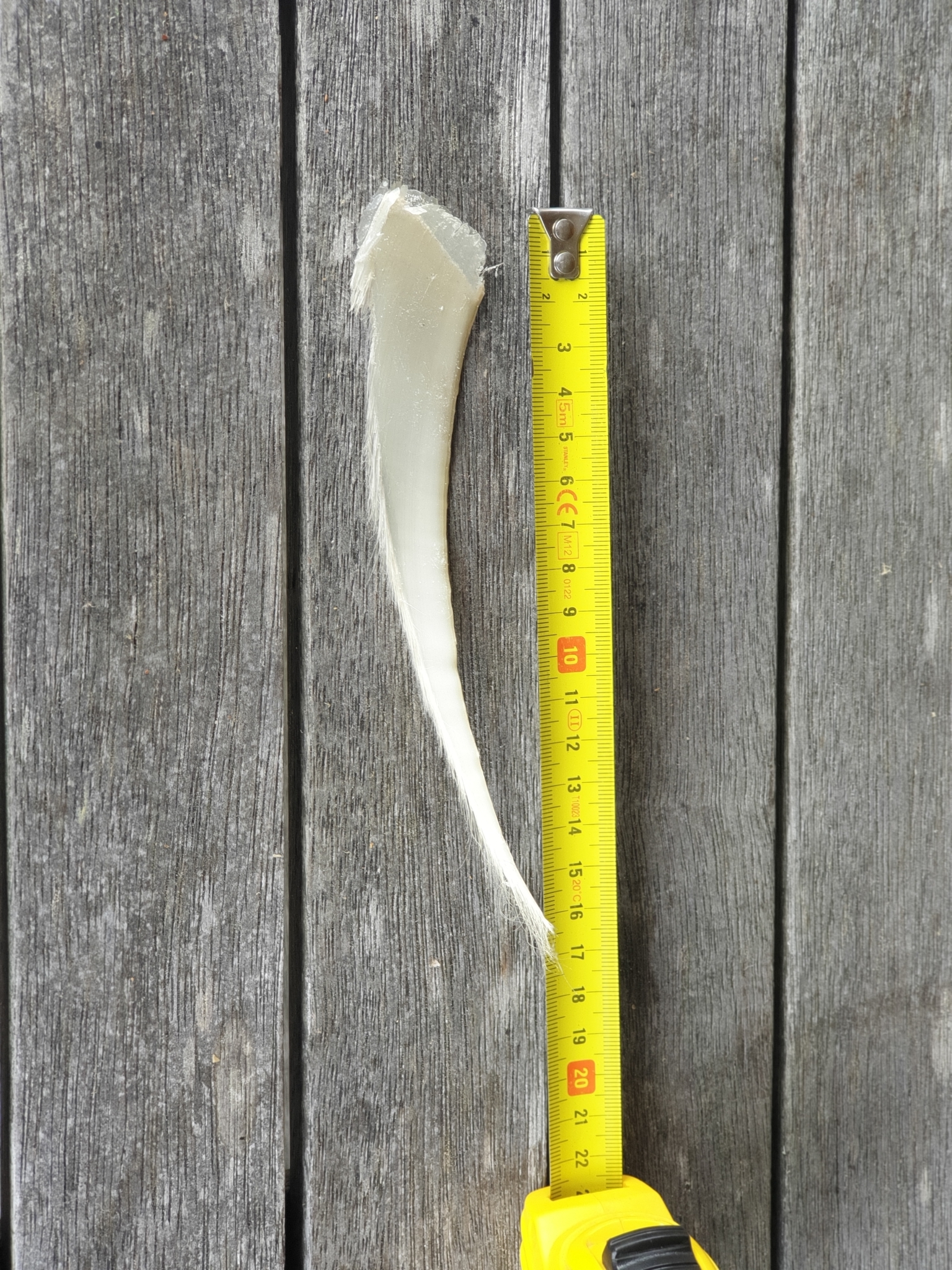
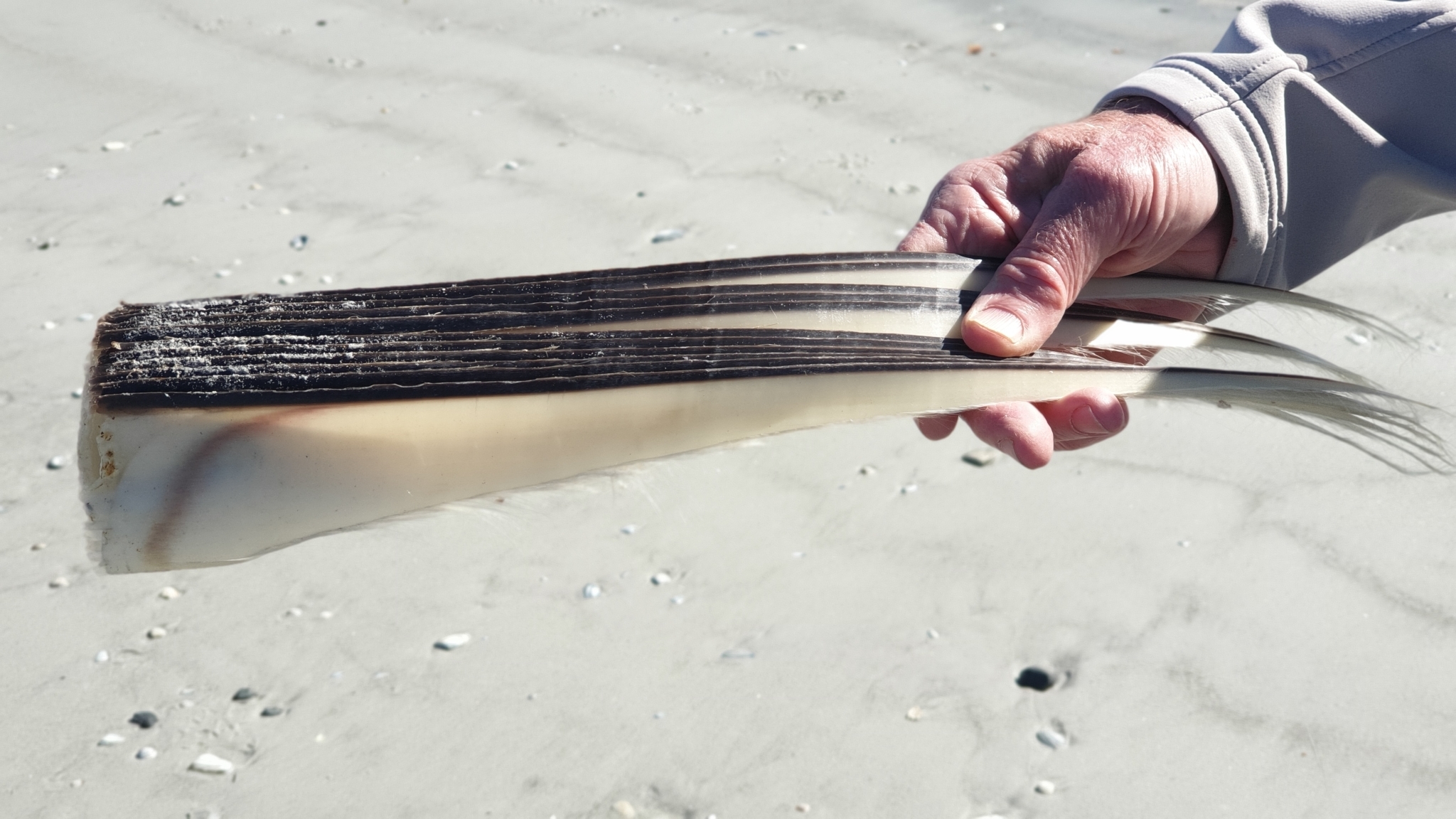
The mouth holds 210 to 230 baleen plates on each side, long, narrow and flexible, cream-white to yellowish and edged with a dark border in some individuals, hence the epithet marginata, “bordered”. The largest plates measure on the order of 70 to 85 cm depending on the source. The skeleton has no equivalent among living cetaceans: the seven cervical vertebrae are fused, the animal has only about 44 vertebrae, the lowest total known in cetaceans, but 18 pairs of broad, flattened ribs which cover 39% to 45% of the vertebral column, against about 33% in the other baleen whales. The flipper bears only four digits, the heart and the lungs are proportionally small, and the laryngeal sac is offset to the right of the midline, an arrangement unique among mysticetes.

At sea, confusion is easy with the Antarctic minke whale (Balaenoptera bonaerensis) and the dwarf form of the common minke whale (Balaenoptera acutorostrata), which are close in size and in colour pattern: the curvature of the jaw, less pronounced than in the true right whales, is not always enough to settle the question. The cream-coloured baleen with a white gum, visible when the mouth is open, remains the most reliable criterion. Unlike the right whales of the genus Eubalaena, the pygmy right whale bears no callosities. Its name should also not be confused with that of the pygmy sperm whale (Kogia breviceps), an unrelated odontocete.

Taxonomy

Order Cetacea, suborder Mysticeti (baleen whales), family Neobalaenidae, genus Caperea, species Caperea marginata (J. E. Gray, 1846); protonym Balaena marginata. The only living species of its genus and of its family; several recent studies place it within the Cetotheriidae.

Distribution and habitat

The pygmy right whale is strictly confined to the southern hemisphere, where its distribution is considered to be circumpolar, in a band lying between about 30° and 55° of southern latitude, the great majority of the records falling between 31° and 52° S. It frequents waters whose surface temperature lies between 5 and 20 °C, both offshore and over the continental shelf. Strandings and sightings are documented in Chile, Tierra del Fuego, Namibia, South Africa, Australia and New Zealand; a core of individuals could be present all year round off Tasmania.

An analysis of 196 Australian and New Zealand records covering 1884 to early 2007 shows that 69% come from Australia, that data exist for every month but peak in the austral spring and summer (75%), and that seven coastal “hotspots”, foremost among them south-eastern and north-western Tasmania, concentrate the majority of the localised sightings. All are associated with cold-water upwelling or with high concentrations of zooplankton. A single record is known for the northern hemisphere: a juvenile of about 2.70 m photographed stranded in the Gambia, at about 13° N, in January 1995, most probably having drifted there on the currents.

In France, the species is liable to be encountered only in the subantarctic waters of the French Southern and Antarctic Lands, Crozet, Kerguelen, Amsterdam and Saint-Paul, where the Red List of the vertebrates of the TAAF places it among the occasional species. It is absent from the Mediterranean, from the Bay of Biscay and from the English Channel.

Biology and ecology

The diet, reconstructed from the stomach contents of stranded animals, rests on zooplankton: copepods for the most part, supplemented by euphausiids. The animal in all likelihood filters the water by skimming the surface layer. The proportionally small heart and lungs suggest that it is not a deep diver, and the breath-holds reported rarely exceed four minutes. Swimming is slow and undulating, on the order of 3 to 5 knots, with bursts estimated at 6-8 knots (11 to 15 km/h). The blow is low and barely visible and the animal does not raise its tail fluke when diving: all reasons why it so easily goes unnoticed.

The pygmy right whale is most often solitary or in pairs, sometimes in the company of dolphins, pilot whales, minke whales or sei whales. Much larger gatherings have nevertheless been observed: fourteen individuals in 2001 at 46° S, some 450 km south-east of New Zealand, about eighty south-west of Cape Leeuwin in 1992, and more than a hundred off Portland, in the state of Victoria, in June 2007, in an upwelling area.

Reproduction remains poorly documented. Newborns measure 1.6 to 2.2 m; a foetus of about 2 m was observed in a female of 6 m stranded in Tasmania in 1982. Weaning is thought to occur at about five months, at 3-3.5 m, sexual maturity around 5 m and physical maturity towards 6 m. The gestation period, often estimated at 10-12 months, is not established with certainty, any more than the duration of lactation or the longevity. The killer whale is among the predators: the tail flukes, the blubber and the baleen of a calf were found in a killer whale of 7.47 m caught off South Africa.

Status and conservation

The pygmy right whale is classed as “Least Concern” (LC) on the global IUCN Red List, an assessment published in 2018. The global population size remains unknown, for want of dedicated abundance surveys, but nothing indicates a decline.

It is in all likelihood the only mysticete to have escaped industrial whaling: its small size and its diffuse distribution deprived it of commercial interest. The documented catches fit into a few lines, a male of 3.39 m taken off South Africa in 1917, a few individuals taken for scientific purposes by Soviet whalers in the South Atlantic in 1970. Rare instances of bycatch in nets are known, with no demonstrated effect on the population. The main uncertainties today bear on the long-term effects of oceanographic change on the concentrations of zooplankton on which the species depends.

On the regulatory side, the pygmy right whale is listed in Appendix I of CITES, which prohibits international trade for commercial purposes, and in Appendix II of the Bonn Convention on Migratory Species; it is also covered by the Memorandum of Understanding on the Conservation of Cetaceans of the Pacific Islands Region. In French waters, it benefits from the full protection granted to marine mammals.

Watching this species

Watching a pygmy right whale is exceptional: fewer than twenty-five sightings at sea had been reported up to 2008, and most of what is known comes from stranded animals. The best chances lie in the upwelling areas of southern Australia, in particular around Tasmania and off Portland (Victoria), as well as in New Zealand and South Africa, in the austral spring and summer. No commercial whale-watching trip targets the species.

On the water, look for a small mysticete with a low, diffuse blow and a falcate dorsal fin set very far back, which does not show its tail fluke when diving; the opening of the mouth, revealing cream-coloured baleen with a white gum, remains the decisive criterion. Any sighting or any stranding deserves to be reported to the local networks, with photographs in support: every record counts for a species as poorly documented as this one. As for any cetacean, a sufficient distance should be kept, the path of the animal should never be cut across, speed should be reduced and the length of the approach limited.

Frequently asked questions

Why is it called a “pygmy right whale” when it is not one?

Gray had placed it in 1846 in the genus Balaena, that of the right whales, because of its arched rostrum and its long baleen. Molecular data now show that it is closer to the rorquals and to the grey whale than to the Balaenidae, and the morphological work of 2012 places it within the Cetotheriidae. The vernacular name is a misleading historical legacy: the shorter form “pygmy whale” suits it better.

Can the pygmy right whale be seen in France?

Not in metropolitan France. The species is strictly southern and has never been reported in the Mediterranean, in the Bay of Biscay or in the English Channel. It is liable to be encountered only in the waters of the French Southern and Antarctic Lands (Crozet, Kerguelen, Amsterdam and Saint-Paul), where the regional Red List of vertebrates classes it among the occasional species.

Is it really the smallest of the baleen whales?

Yes. Adults most often measure 6 to 6.5 m for 3 to 3.5 tonnes, against 8 to 10 m for a common minke whale and more than 15 m for a southern right whale. The largest individual measured, a female stranded in Tasmania in 1981, reached 6.45 to 6.5 m.

How can it be told apart from a minke whale at sea?

The two species look very much alike: the same size range, a dark grey back, a pale belly. The pygmy right whale has a more arched rostrum, a falcate dorsal fin set very far back and sometimes invisible at the surface, and above all long, cream-coloured baleen with a very distinctive white gum when the mouth opens. It never bears callosities and does not show its tail fluke when diving.

How many pygmy right whales are left in the world?

No population estimate is available: the species has never been the subject of dedicated abundance surveys and its world population is given as unknown. Its classification as Least Concern in 2018 reflects the absence of any identified threat and of any detected decline, not a count.

Was it hunted by whalers?

Very marginally. Its small size and its diffuse distribution made it of no interest for industrial whaling. Only a small number of catches are known, among them a male of 3.39 m taken off South Africa in 1917 and a few individuals taken for scientific purposes by Soviet whalers in the South Atlantic in 1970.

What are its natural predators?

The killer whale is the only documented predator: the tail flukes, the blubber and the baleen of a pygmy right whale calf were found in the stomach of a killer whale of 7.47 m caught off South Africa. The available data do not make it possible to assess the real frequency of this predation.

Sources

Profile compiled from authoritative scientific sources (IUCN, NOAA Fisheries, specialist literature) and reviewed for factual accuracy.

Observed distribution

According to the open data of the GBIF, 8 georeferenced sightings of Caperea marginata are recorded in our photographic index.

Main countries of observation
CountryNotes
New Zealand16
Australia4
Argentina1
Gambia1

Distribution map: Pygmy right whale (Caperea marginata)

Distribution map: Pygmy right whale (Caperea marginata), 8 georeferenced sightings from GBIF
8 georeferenced sightings of Caperea marginata. Base map Natural Earth, public domain. GBIF data.
🗺️ Open the interactive mapTo zoom and pan. It uses the OpenStreetMap/CARTO base maps and the GBIF occurrence densities: no data is sent to these services before you click.

Presence through the year

Monthly distribution of 13 dated sightings (all years combined): the maximum is reached in juillet.

30janvier : 0janfévrier : 0febmars : 0maravril : 0avrmai : 1maijuin : 1juinjuillet : 3juilaoût : 0Augustseptembre : 3sepoctobre : 3octnovembre : 0novdécembre : 2dec
Sightings by month
MonthNotes
janvier0
February0
mars0
avril0
mai1
juin1
juillet3
August0
septembre3
octobre3
novembre0
December2

These figures reflect survey effort (more boaters and more surveys in summer) as much as the actual presence of the species: to be interpreted with caution.

En images

Caperea marginata
© chalikotheres, CC BY-NC, 2025
Caperea marginata
© soso, CC BY-NC, 2020
Caperea marginata
© soso, CC BY-NC, 2020
Caperea marginata
© Daniel Percy, CC BY-NC, 2019
Caperea marginata
© Mead, James G., licence spécifique, 2019
Caperea marginata
© Mead, James G., licence spécifique, 2014
Caperea marginata
© Lloyd Esler, CC BY-NC, 2011
Caperea marginata
© Mead, James G., licence spécifique, 2002
Caperea marginata
© Mead, James G., licence spécifique, 1996
Caperea marginata
© Mead, James G., licence spécifique, 1996
Caperea marginata
© Mead, James G., licence spécifique, 1995
Caperea marginata
© Mead, James G., licence spécifique, 1995

Photographs from GBIF under a Creative Commons licence. The author and the licence of each photograph are given; please respect them if you reuse them.

Scientific references

  1. Fordyce R., Marx F. (2013) The pygmy right whale Caperea marginata : the last of the cetotheres, Proceedings of the Royal Society B: Biological Sciences
  2. Dawbin W., Cato D. (1992) SOUNDS OF A PYGMY RIGHT WHALE (CAPEREA MARGINATA), Marine Mammal Science
  3. Buchholtz E. (2010) Vertebral and rib anatomy in Caperea marginata: Implications for evolutionary patterning of the mammalian vertebral column, Marine Mammal Science
  4. Sekiguchi K., Best P., Kaczmaruk B. (1992) NEW INFORMATION ON THE FEEDING HABITS AND BALEEN MORPHOLOGY OF THE PYGMY RIGHT WHALE CAPEREA MARGINATA, Marine Mammal Science
  5. Kemper C., Leppard P. (1999) ESTIMATING BODY LENGTH OF PYGMY RIGHT WHALES (CAPEREA MARGINATA) FROM MEASUREMENTS OF THE SKELETON AND BALEEN, Marine Mammal Science
  6. Tsai C., Fordyce R. (2015) Ancestor–descendant relationships in evolution: origin of the extant pygmy right whale, Caperea marginata, Biology Letters
  7. Park T., Marx F., Fitzgerald E., Evans A. et al. (2017) The cochlea of the enigmatic pygmy right whale Caperea marginata informs mysticete phylogeny, Journal of Morphology
  8. Kemper C. (2002) DISTRIBUTION OF THE PYGMY RIGHT WHALE, CAPEREA MARGINATA, IN THE AUSTRALASIAN REGION, Marine Mammal Science

Automatic selection of the most cited works mentioning the species (source: Crossref).