Humpback whale (Megaptera novaeangliae)

Key facts
Scientific name Megaptera novaeangliae (Borowski, 1781)
Other names Humpback whale; in French mégaptère, jubarte, rorqual à bosse (French-speaking Canada), baleine tampon, rorqual du Cap.
Size 13 to 16 m on average, with 17 to 18 m reported; females exceed males by 1 to 1.5 m. Newborn: 4 to 5 m.
Weight 25 to 40 tonnes in adults; about 600 to 900 kg at birth.
Longevity At least 50 years; sources diverge (about 70 years according to NAMMCO, 80 to 90 years according to NOAA). Documented record: 95 years.
Diet Krill (Euphausia superba in the Southern Ocean), copepods and small schooling fish: herring, capelin, sand eel, mackerel. Filter feeding by lunging, often using a cooperative bubble net.
IUCN status Least Concern (LC) globally, 2018 assessment, population trend increasing, about 135,000 individuals of which some 84,000 mature; the species was Vulnerable until 2008. Oceania and Arabian Sea subpopulations: Endangered (EN). No Mediterranean subpopulation is recognised, the species being no more than occasional in the Mediterranean. In France: Vulnerable on the Red List of Réunion, Vulnerable in Martinique (2020), Near Threatened in Guadeloupe (2022).

In brief

The humpback whale is a large rorqual of 13 to 16 m, recognisable by its outsized flippers and by its tubercle-covered head. A great migrant, it links each year the cold waters where it feeds to the shallow tropical waters where it gives birth. A survivor of industrial whaling, it is today listed as “Least Concern” (LC) by the IUCN, two subpopulations nevertheless remaining Endangered.

Identification

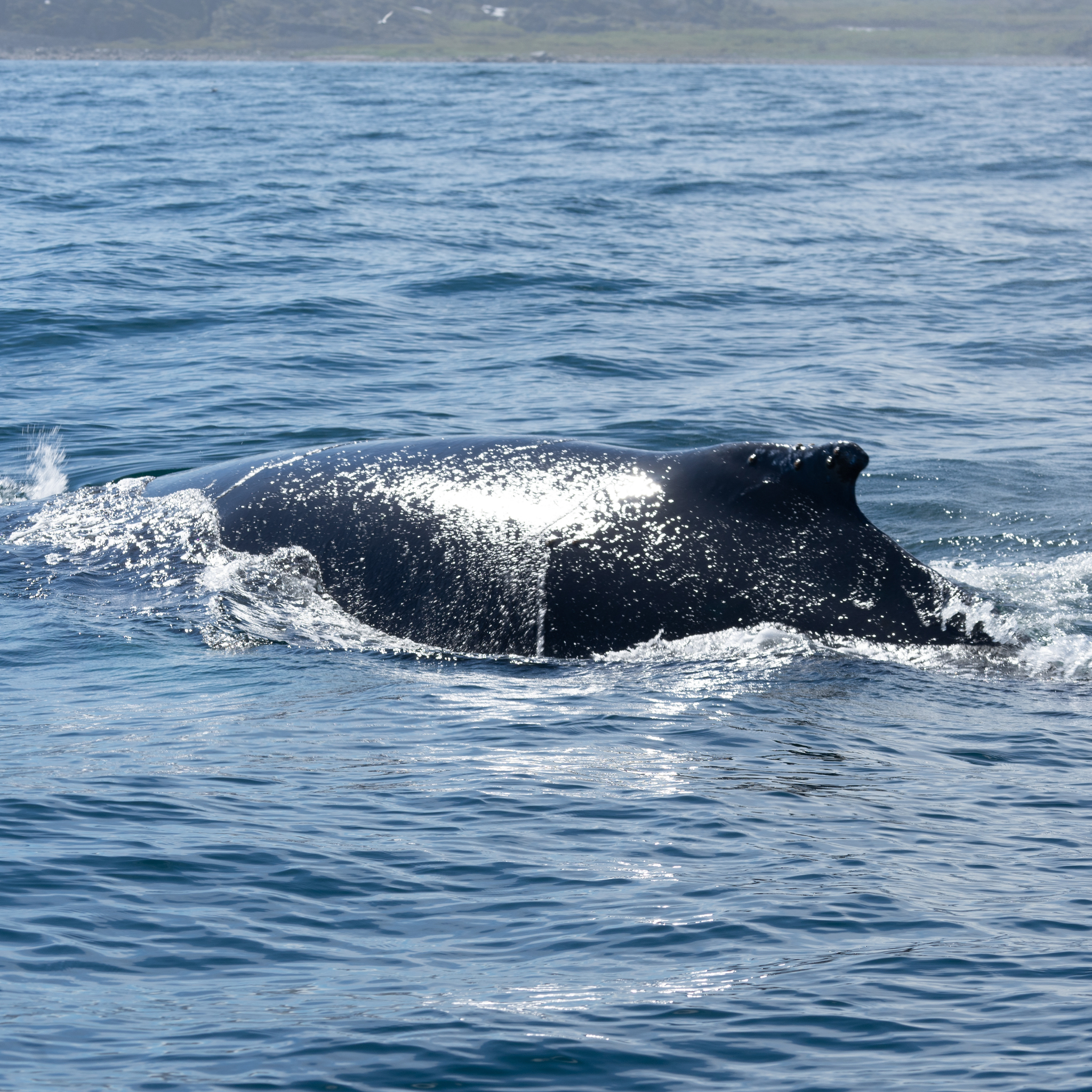
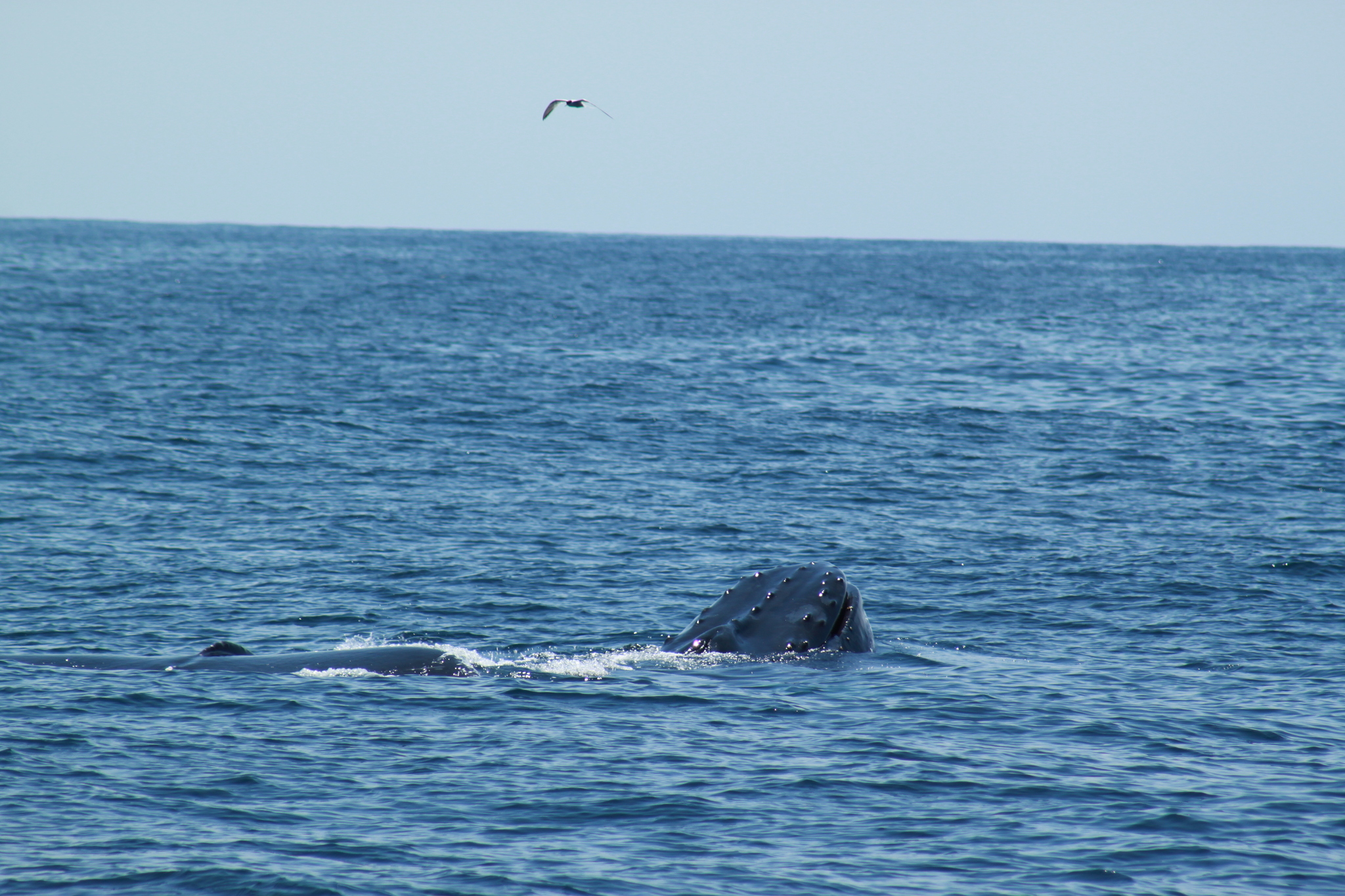
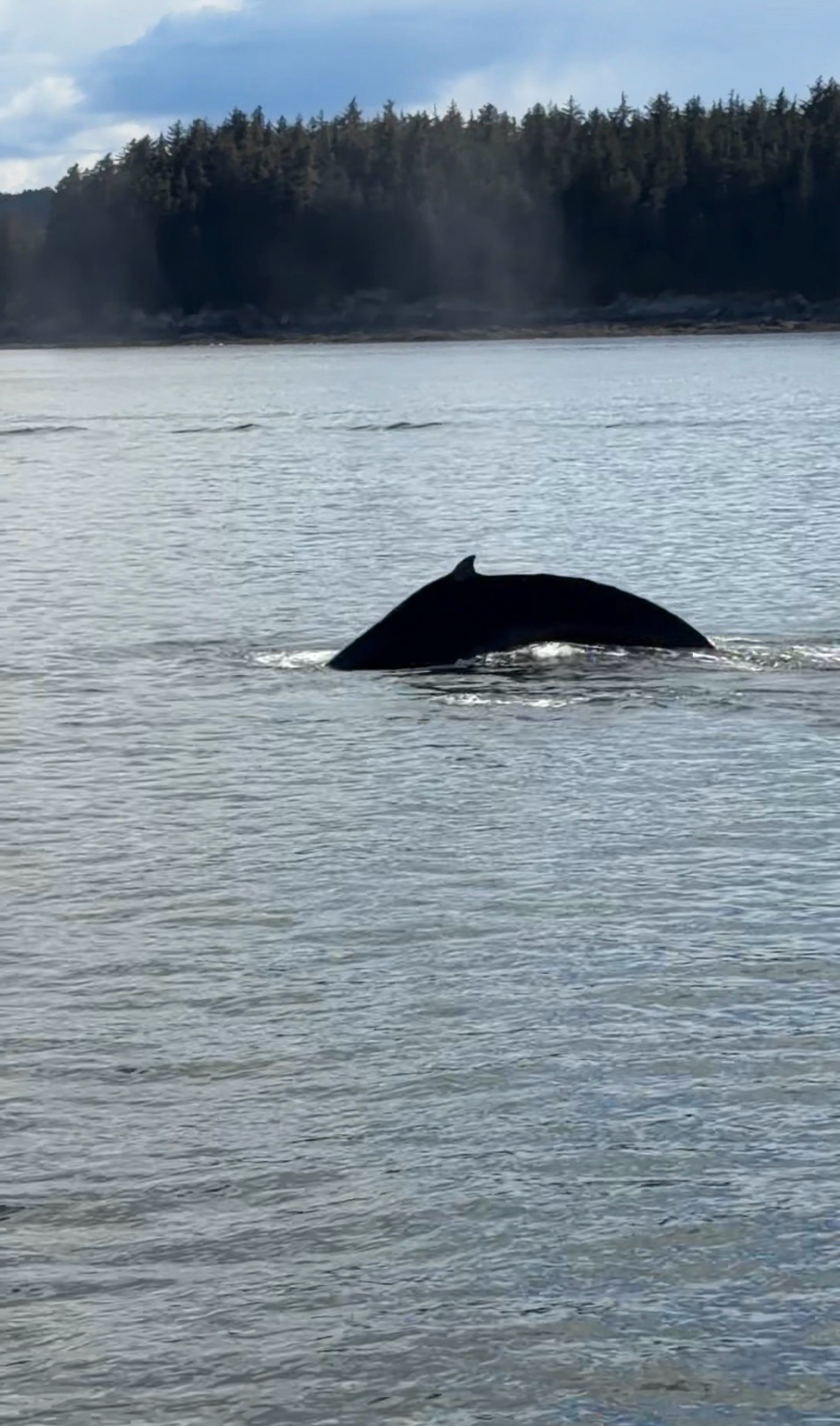
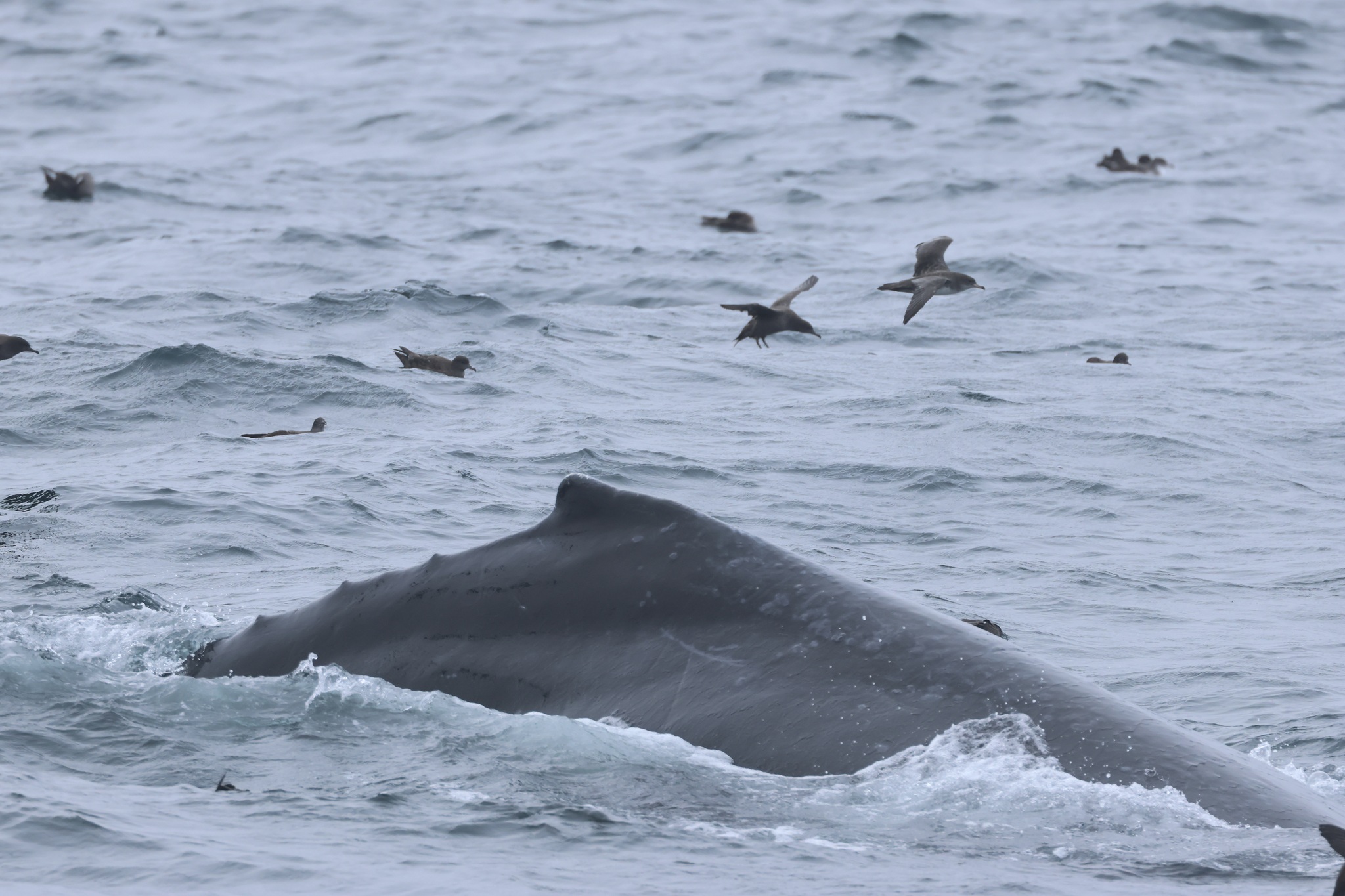
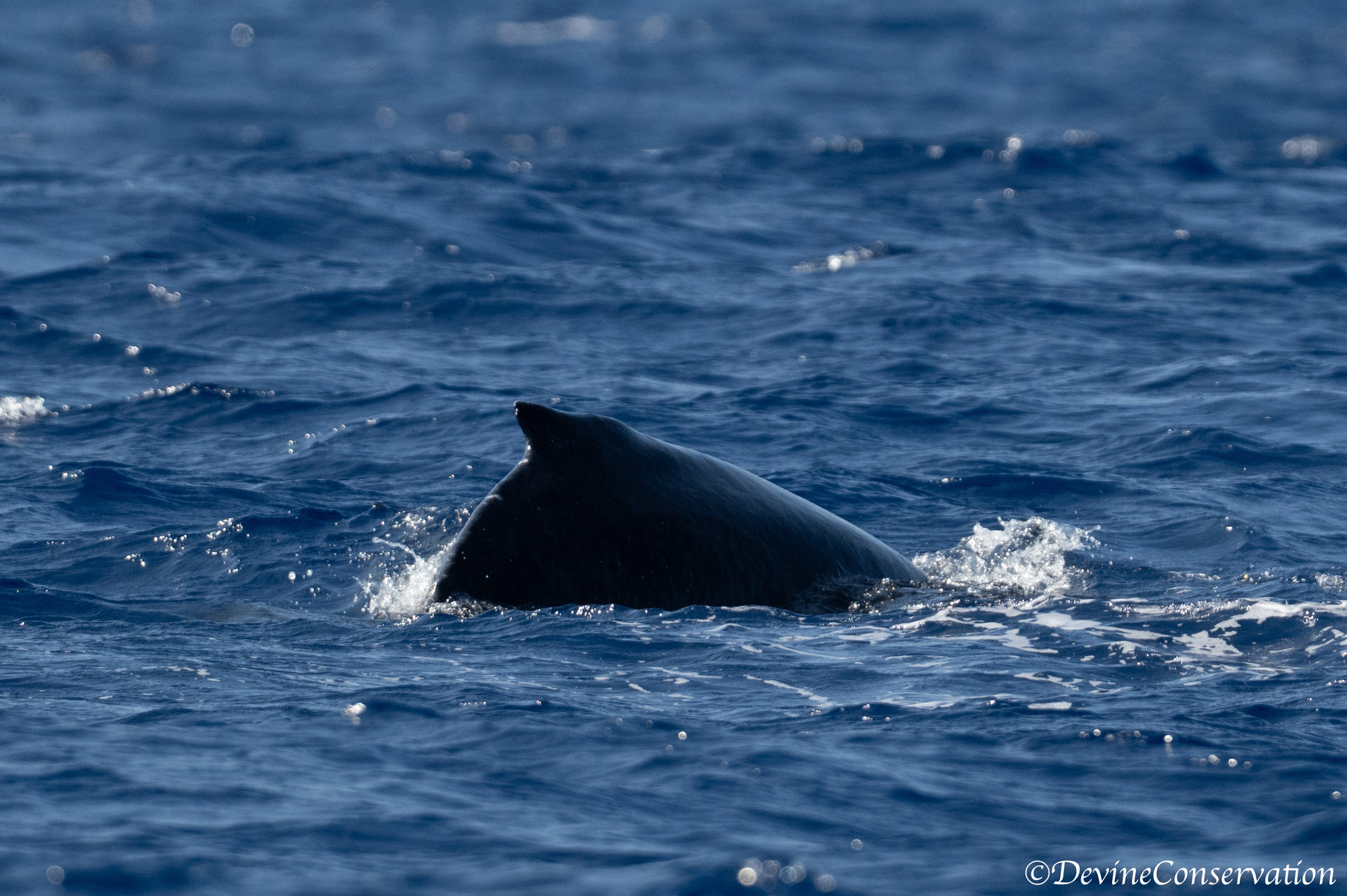
At 13 to 16 m for 25 to 40 tonnes, the humpback whale is a medium-sized rorqual with a stocky body, more massive than that of the other balaenopterids; females exceed males by 1 to 1.5 m and individuals of 17 to 18 m have been reported. Its surest signature remains its flippers: white or largely marked with white, they reach a third of the body length, often more than 4 m, and their leading edge is cut into a series of knobs. The head, broad and flattened, is studded with tubercles, protuberances 5 to 10 cm across projecting up to 6.5 cm, each topped by a sensory hair. A small dorsal fin sits on a fleshy swelling, the “hump” that gave the animal its name. The throat is marked by 14 to 35 ventral pleats, far fewer than in the other rorquals, and the mouth holds 540 to 800 black baleen plates.

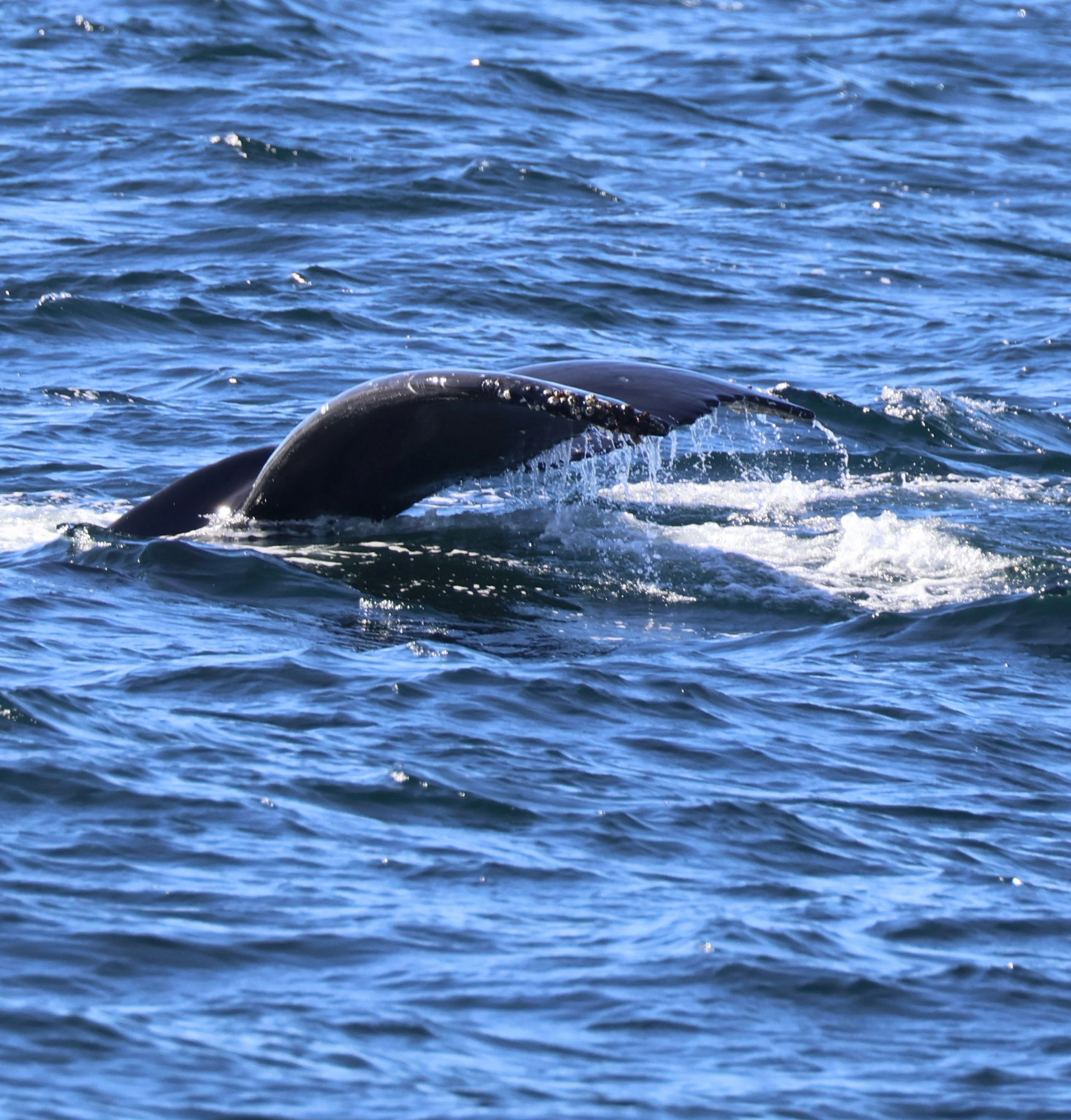
The back is black, the belly variably black and white, animals from the Southern Hemisphere generally being paler. The tail fluke, with its irregularly serrated trailing edge, carries on its underside a pigmentation pattern unique to each animal: this “barcode” is the foundation of population monitoring, from Réunion to New Caledonia.

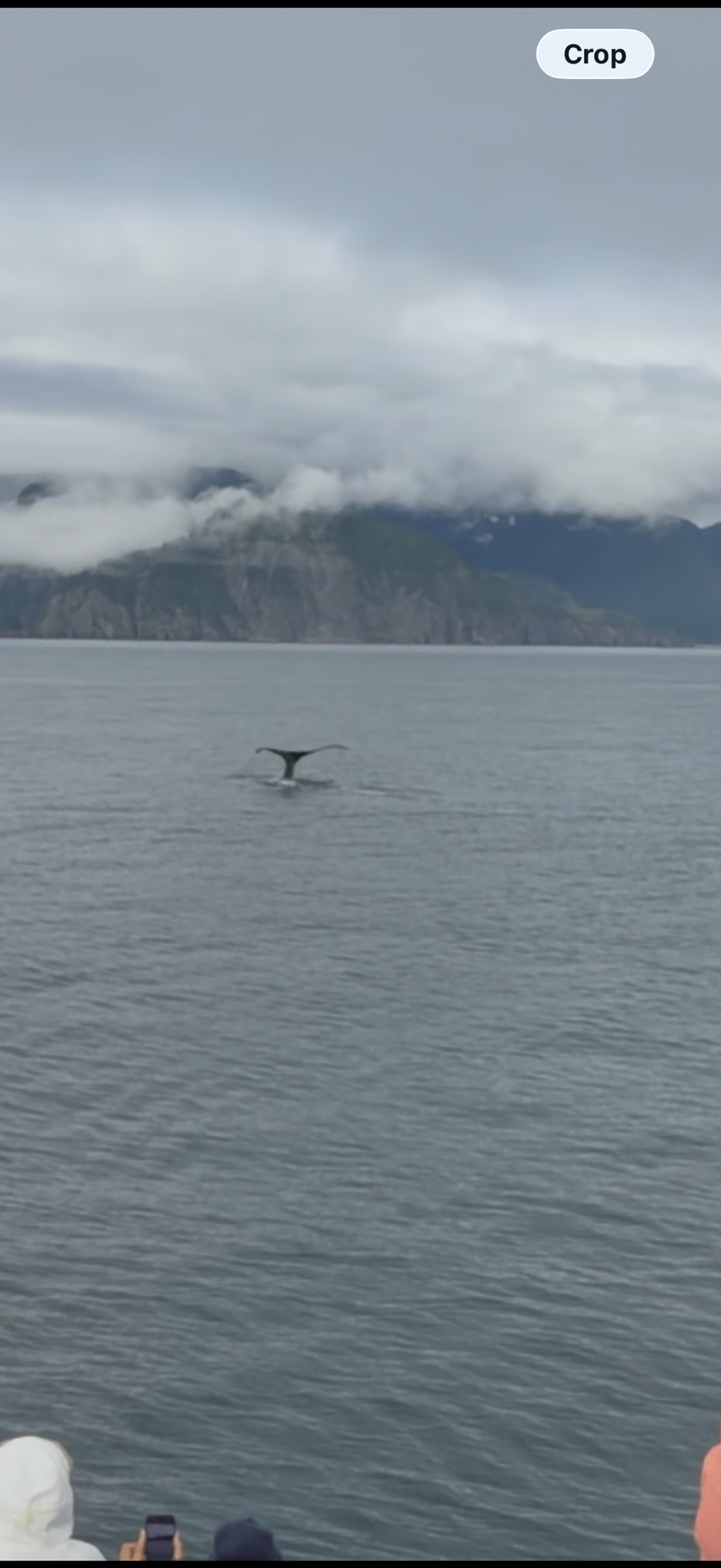
In the field, the short humped outline and the habit of raising the tail high before sounding separate it from the fin whale and the common minke whale, which have a tall falcate dorsal fin, a smooth head and short dark flippers. Right whales (genus Eubalaena), which lack both a dorsal fin and ventral pleats, are hardly a source of confusion. Finally, the exuberance at the surface, breaching, flipper slapping, lobtailing, is often enough to settle the matter.

Taxonomy

Described under the name Balaena novaeangliae by Georg Heinrich Borowski in 1781, the species was placed in 1846 by John Edward Gray in the genus Megaptera, of which it is the only living representative. The name means literally “great wing”, an allusion to the flippers, “of New England”. It belongs to the family Balaenopteridae, the rorquals. A 2014 genetic study recognises three subspecies: M. n. novaeangliae (North Atlantic), M. n. kuzira (North Pacific) and M. n. australis (Southern Hemisphere). The Arabian Sea population, isolated for about 70,000 years and non-migratory, could constitute a further entity.

Distribution and habitat

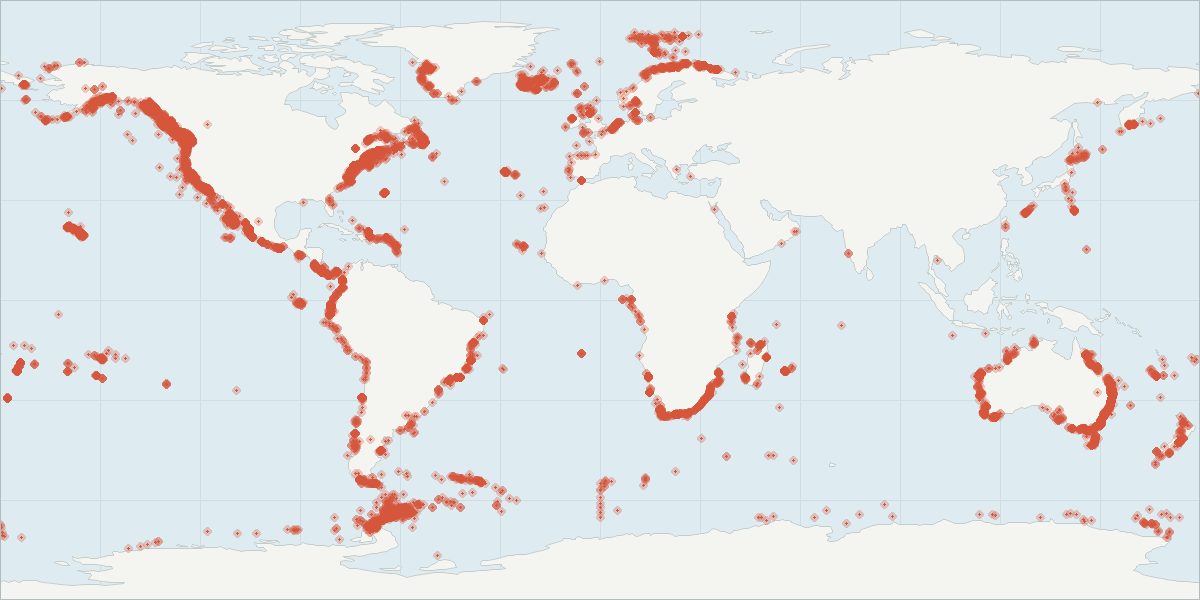
The humpback whale occurs in every ocean, from the tropics to the edge of the ice: it has been recorded as far as 81° N around Franz Josef Land, and the range commonly accepted extends from the 71st parallel north to the 60th parallel south. Absent from the central Arctic and from enclosed seas, it favours continental shelf waters. Its annual cycle is a round trip between cold feeding grounds, used in summer, and warm breeding grounds occupied in winter, up to 8,000 km one way. Photo-identification has revealed far longer journeys still: two individuals have been linked from the Abrolhos Bank (Brazil) to Hervey Bay (Australia), at least 15,100 km in a straight line (Royal Society Open Science, 2026). NOAA distinguishes 14 population segments worldwide.

In mainland France, the species remains rare but increasingly well documented: scattered sightings in the Bay of Biscay and in the English Channel, and seventeen strandings recorded since 1980 according to the Observatoire Pelagis. In the Mediterranean it is only a very occasional visitor, arising from Atlantic incursions into the north of the western basin, in particular in the Pelagos Sanctuary. It is overseas that the species is truly at home: the French Antilles (Agoa sanctuary, 143,256 km²), Réunion, Mayotte, New Caledonia and French Polynesia host breeding and calving grounds every year.

Biology and ecology

A lunge filter feeder, it inflates its ventral pleats then expels the water through its baleen. Its diet combines krill, Euphausia superba in the Southern Ocean, copepods and small schooling fish (herring, capelin, sand eel, mackerel). It has developed a unique cooperative technique, the bubble net: one or more animals swim in an ascending spiral while releasing air, enclosing the shoal of prey in a cylinder of bubbles before rising through it with the mouth open. Dives remain modest: 80 m most often (616 m as the documented maximum), less than 5 minutes in summer, 15 to 20 minutes in winter.

The song of the males is the best known trait of the species. Produced above all in the breeding season, it spans 100 Hz to 4 kHz, lasts from 4 to 33 minutes depending on the region, up to several hours in Hawaii, and is organised hierarchically into units, phrases and themes. All the males in a given area sing the same version, which changes over the seasons and spreads from population to population: a textbook case of animal culture. Its exact function remains debated.

Social life is fluid: outside the mother-calf pair, associations last a few days. In winter, females are followed by rival male escorts that clash with blows of the tail fluke and of the head. Gestation lasts about 11 to 11.5 months and produces a single calf of 4 to 5 m and 600 to 900 kg, suckled for up to a year but able to take solid prey from around six months. The interval between two births is 2 to 3 years and sexual maturity comes between 4 and 10 years, sometimes as late as 15 depending on the population.

Status and conservation

Industrial whaling came close to wiping out the species: more than 200,000 individuals killed in the Southern Hemisphere alone during the twentieth century, the North Atlantic falling to some 700 animals. The International Whaling Commission banned commercial hunting of it in 1966, when perhaps no more than 5,000 humpback whales remained; the USSR nevertheless continued clandestinely, declaring 2,820 catches between 1947 and 1972 against more than 48,000 actually taken.

The recovery has been spectacular. The IUCN reclassified the species from “Vulnerable” to “Least Concern” (LC) in 2008, a status confirmed by the 2018 assessment, which gives about 135,000 individuals, of which some 84,000 mature, and an increasing trend. Two subpopulations remain Endangered (EN): that of Oceania, which includes New Caledonia and French Polynesia, and the isolated, non-migratory one of the Arabian Sea (of the order of 80 individuals). In the United States, 4 of the 14 recognised population segments are still listed as “endangered” and one as “threatened”.

Current threats are entanglement in fishing gear, ship strikes, underwater noise, disturbance by boats and climate change, which redistributes prey. The species is listed in Appendix I of CITES and of the CMS (since 1979). In France it is fully protected by the order of 1 July 2011 as amended; it is listed as Vulnerable on the Red List of Réunion, Vulnerable in Martinique (2020) and Near Threatened in Guadeloupe (2022). Aboriginal subsistence quotas remain in West Greenland (10 animals a year, with possible carry-over of animals not taken) and at Bequia, in Saint Vincent and the Grenadines (4 a year at most, often none).

Watching this species

In mainland France, a sighting is a matter of chance: a few strays in the English Channel, one of which stayed in the Baie de Seine in March 2024, and in the Bay of Biscay, with an anecdotal presence in the Mediterranean.

It is overseas that the species can be watched reliably, always on its winter breeding grounds. In the Antilles (Agoa sanctuary: Guadeloupe, Martinique, Saint-Martin, Saint-Barthélemy), the season runs from December to May with a peak from January to March, the bank linking Saint-Martin, Anguilla and Saint-Barthélemy forming a key sector. In the Indian Ocean, Réunion receives the whales from June to October, above all off Saint-Gilles and Saint-Pierre, with highly variable numbers, from 13 to more than 1,100 individuals identified per season since 2004 according to Globice; the Mayotte lagoon serves as a nursery from July to November, with a peak in August and September. In the Pacific, New Caledonia receives them from mid-July to mid-September and French Polynesia from July to November.

Ethics are not optional. French regulations prohibit any intentional disturbance and any approach closer than 100 m within marine protected areas (order of 1 July 2011 as amended in 2020, applicable since 1 January 2021); in the Agoa sanctuary, a prefectoral order raises this distance to 300 m, at the surface, underwater and by drone, unless an exemption applies. In practice: a slow approach from the side, brief watching, absolute priority given to mother-calf pairs and the use of trained operators.

Frequently asked questions

What size does a humpback whale reach?

It generally measures 13 to 16 m for 25 to 40 tonnes, females being 1 to 1.5 m larger than males; individuals of 17 to 18 m have been reported. The newborn already measures 4 to 5 m for 600 to 900 kg depending on the source.

Can humpback whales be seen in France?

Yes, but essentially overseas: in the Antilles (Agoa sanctuary) from December to May, at Réunion from June to October, at Mayotte from July to November, in New Caledonia from mid-July to mid-September and in French Polynesia from July to November. In mainland France the species is rare: scattered sightings in the English Channel and in the Bay of Biscay, seventeen strandings recorded since 1980, and a very occasional presence in the Mediterranean.

Why do humpback whales sing?

Only the males sing, above all during the breeding season. The song, structured into units, phrases and themes between 100 Hz and 4 kHz, lasts from 4 to 33 minutes and can be repeated for hours. All the males in a given area share the same version, which changes over the seasons and spreads from one population to another. Its exact function, competition between males, attraction of females, social cohesion, remains debated.

Is the humpback whale still threatened?

Globally, it has been listed as Least Concern (LC) since 2008, with about 135,000 individuals and an increasing trend. But two subpopulations remain Endangered (EN): that of Oceania, which includes New Caledonia and French Polynesia, and that of the Arabian Sea, numbering about 80 animals. Entanglement in fishing gear, ship strikes, underwater noise and climate change remain the main pressures.

How long does a humpback whale live?

Sources diverge markedly: at least 50 years according to the classic syntheses, about 70 years according to NAMMCO, 80 to 90 years according to NOAA. The documented record is 95 years. Determining age in large cetaceans remains difficult, which explains these discrepancies.

How close may a humpback whale be approached in France?

The order of 1 July 2011 as amended prohibits any intentional disturbance and, since 1 January 2021, any approach closer than 100 m within marine protected areas. In the Agoa sanctuary (French Antilles), a prefectoral order raises this distance to 300 m, at the surface, underwater (divers) and by drone, except under an exemption granted to authorised operators.

Is humpback whaling still permitted?

Commercial whaling has been prohibited since 1966 by the International Whaling Commission. All that remain are aboriginal subsistence quotas, very tightly framed: 10 animals a year in West Greenland, with possible carry-over of animals not taken, and a maximum of 4 a year at Bequia, in Saint Vincent and the Grenadines, a ceiling often not reached.

Sources

Species account compiled from authoritative scientific sources (IUCN, NOAA Fisheries, specialist literature) and reviewed for factual accuracy.

Observed distribution

According to the open data of the GBIF, 30,511 georeferenced sightings of Megaptera novaeangliae are recorded in our photographic index.

Main countries of observation
CountryNotes
United States of America12,721
Canada4,952
Australia3,441
Antarctica1,872
Mexico1,819
Iceland1,118
South Africa482
Costa Rica330
Norway314
Netherlands297

Distribution map: Humpback whale (Megaptera novaeangliae)

Distribution map: Humpback whale (Megaptera novaeangliae), 30,511 georeferenced sightings from GBIF
30,511 georeferenced sightings of Megaptera novaeangliae. Base map Natural Earth, public domain. GBIF data.
🗺️ Open the interactive mapTo zoom and pan. It uses the OpenStreetMap/CARTO base maps and the GBIF occurrence densities: no data is sent to these services before you click.

Presence through the year

Monthly distribution of 30,629 dated sightings (all years combined): the maximum is reached in August.

52270janvier : 1757janfévrier : 1915febmars : 1611maravril : 1137avrmai : 1501maijuin : 3382juinjuillet : 5071juilaoût : 5227Augustseptembre : 3992sepoctobre : 2437octnovembre : 1276novdécembre : 1323dec
Sightings by month
MonthNotes
janvier1,757
February1,915
mars1,611
avril1,137
mai1,501
juin3,382
juillet5,071
August5,227
septembre3,992
octobre2,437
novembre1,276
December1,323

These figures reflect survey effort (more boaters and more surveys in summer) as much as the actual presence of the species: to be interpreted with caution.

En images

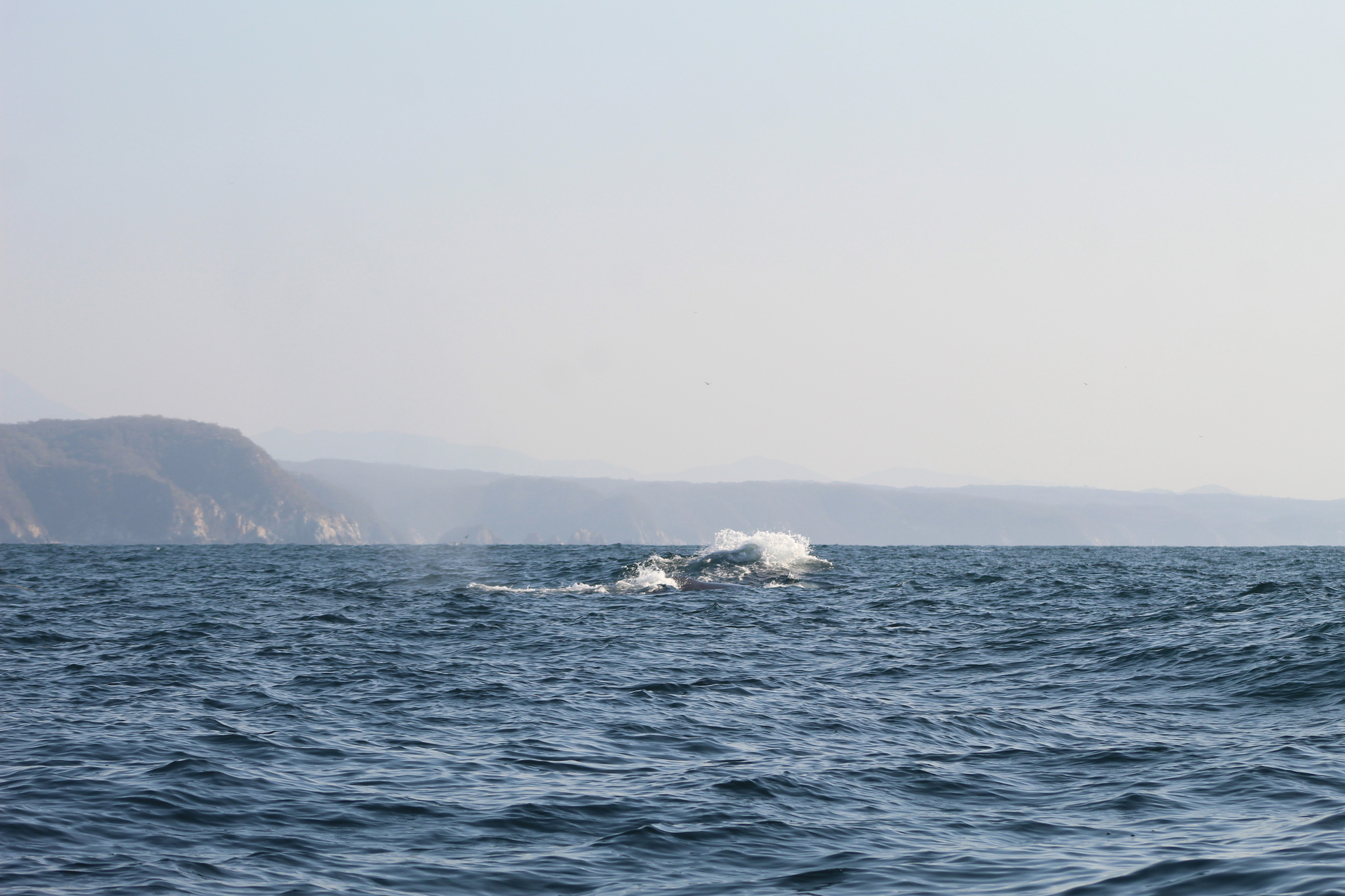
Megaptera novaeangliae
© ivanmirandaf, CC BY-NC, 2026
Megaptera novaeangliae
© narido, CC BY-NC, 2026
Megaptera novaeangliae
© turtleboy92, CC BY-NC, 2026
Megaptera novaeangliae
© bchamplin, CC BY-NC, 2026
Megaptera novaeangliae
© kusariqqu, CC BY-NC, 2026
Megaptera novaeangliae
© Jacob Zinn, CC BY-NC, 2026
Megaptera novaeangliae
© Ingvild Riska, CC BY, 2026
Megaptera novaeangliae
© R. Hoffman, CC BY-NC, 2026
Megaptera novaeangliae
© kareuhhh, CC BY-NC, 2026
Megaptera novaeangliae
© Mitch Van Dyke, CC BY, 2026
Megaptera novaeangliae
© er-birds, CC BY, 2026
Megaptera novaeangliae
© Alec Boyd-Devine, CC BY-NC, 2026

Photographs from GBIF under a Creative Commons licence. The author and the licence of each photograph are given; please respect them if you reuse them.

Scientific references

  1. Clapham P., Mead J. (1999) Megaptera novaeangliae, Mammalian Species
  2. Norris T. Effects of boat noise on the singing behavior of humpback whales (Megaptera novaeangliae)
  3. Helweg D. (1998) Automating the Acoustic Monitoring of New Zealand Waters for Migrating Humpback Whales (Megaptera novaeangliae)
  4. Clark C. Intra-annual changes in population parameters as indicators of humpback whale (Megaptera novaeangliae) migratory behavior
  5. Bisi T. Comportamento de filhotes de baleia jubarte, Megaptera novaeangliae, na região ao redor do Arquipélago dos Abrolhos, Bahia (Brasil)
  6. Saloma A. Humpback whales (Megaptera novaeangliae) mother-calf interactions
  7. THOMPSON T. TEMPORAL CHARACTERISTICS OF HUMPBACK WHALE (MEGAPTERA NOVAEANGLIAE) SONGS
  8. Groch K. Interação antropogênica e sanidade de baleias-jubarte (Megaptera novaeangliae) na costa brasileira

Automatic selection of the most cited works mentioning the species (source: Crossref).