| Scientific name | Mesoplodon stejnegeri True, 1885 |
|---|---|
| Other names | Stejneger's beaked whale, Bering Sea beaked whale, sabertooth whale (English); mésoplodon de Stejneger, baleine à bec de la mer de Béring, baleine à dents de sabre (French); zifio de Stejneger (Spanish); オウギハクジラ (ōgi-hakujira) in Japanese; remnezub Steinegera in Russian. |
| Size | Adults of about 5 to 5.7 m, with females slightly larger than males; sexual maturity reached at around 4.5 m; newborn of 2.1 to 2.4 m |
| Weight | Up to about 1,600 kg; newborn of about 80 kg |
| Longevity | At least 35 years |
| Diet | Teuthophagous: deep-water squid (Berryteuthis magister, Gonatus pyros, Gonatopsis okutanii, Taonius borealis), supplemented by deep-sea fish and tunicates, taken by suction |
| IUCN status | Near Threatened (NT), 2020 IUCN assessment (Pitman & Brownell). The species was previously listed as “Data Deficient” (DD); no subpopulation is assessed separately. |
Stejneger's beaked whale (Mesoplodon stejnegeri) is the northernmost mesoplodont beaked whale of the North Pacific: it occurs in cold temperate and subarctic waters, from the Bering Sea and the Aleutians to the Sea of Japan and California. A deep diver and extremely inconspicuous, it is almost never seen alive at sea and remains known above all from strandings. The IUCN has listed it as “Near Threatened” (NT) since its 2020 assessment.
Medium-sized for a mesoplodont, Stejneger's beaked whale has a spindle-shaped body, tapering at both ends, a relatively small head with a gently sloping forehead and a moderately developed beak. Adults most often measure between 5 and 5.7 m, for a mass that can approach 1,600 kg; as in most mesoplodonts, females are slightly larger than males (at least 5.5 m, against at least 5.25 m). The dorsal fin, small, triangular to slightly falcate, is set well back, at about two thirds of the body length; the flippers are short.
The coloration ranges from dark grey to blackish brown, with a paler belly, males generally being darker and growing darker with age. Two details help with recognition: a dark “cap” covers the top of the head from eye to eye, particularly marked in the adult male, while the lower jaw is white or pale grey; in females, the underside of the tail fluke bears a pale pattern that becomes more apparent with age. The most striking feature remains the dentition: a single pair of massive teeth, laterally flattened and tusk-shaped, set at the apex of a strongly arched mouthline. In the adult male these teeth emerge clearly and point forwards and inwards, remaining visible when the mouth is closed; in females and young animals they stay buried beneath the gum. Males consequently carry numerous paired linear scars, left by fights between rivals; healed jaw fractures have been observed on some specimens.
Within its range, the most likely confusion is with Hubbs's beaked whale (Mesoplodon carlhubbsi), of comparable size and present off Japan as well as off North America: the male of that species is distinguished by a very conspicuous white cap on a bulging melon and by a white-tipped beak, the reverse of the contrast shown by Stejneger's beaked whale (dark cap, pale jaw). Baird's beaked whale (Berardius bairdii), which shares the same waters, is markedly larger and of a different outline. Andrews's beaked whale (Mesoplodon bowdoini), morphologically close, belongs to the southern hemisphere and does not come into contact with the species. Nor is there any overlap with the mesoplodonts of the north-east Atlantic.
Stejneger's beaked whale belongs to the genus Mesoplodon, by far the richest in species among cetaceans, within the beaked whale family, designated Ziphiidae in most current taxonomic references, a name also written Hyperoodontidae in some classifications.
The species was described in 1885 by the American zoologist Frederick W. True, from a single sea-worn skull collected two years earlier, in 1883, by the Norwegian-born American naturalist Leonhard Hess Stejneger on Bering Island, in the Commander Islands. It is from this collector that both the specific epithet stejnegeri and the common name come; and it is from the type locality that the name “Bering Sea beaked whale” derives. The combination Mesoplodon stejnegeri True, 1885 is written without parentheses, the species never having changed genus. No subspecies is recognised. The standardised French name used by the national reference lists is “baleine à bec de Stejneger”.
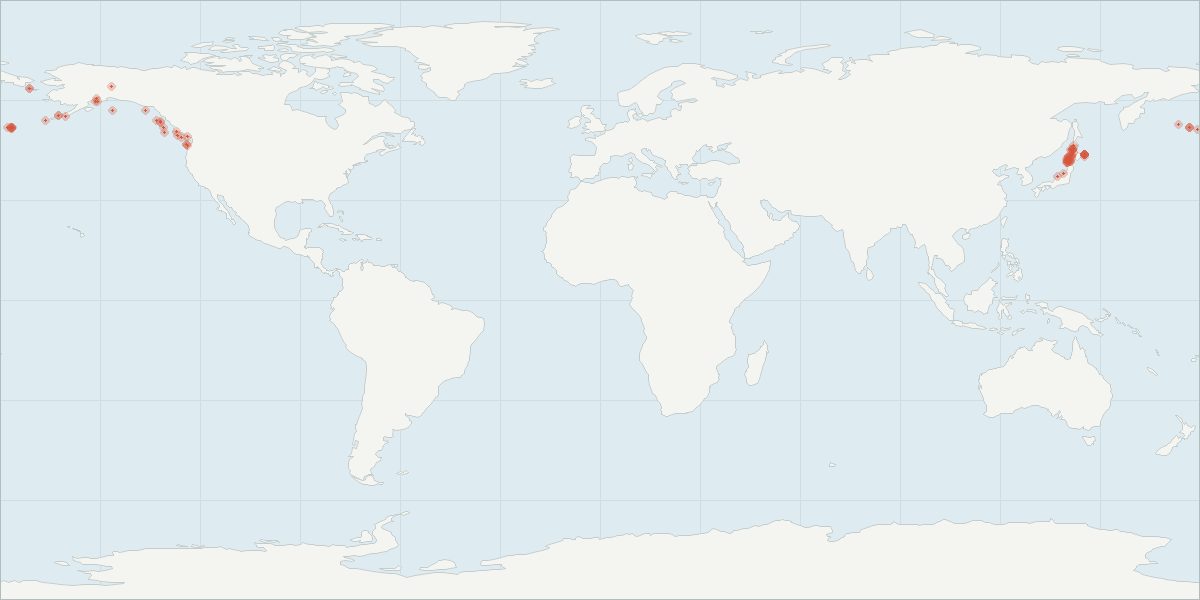
Endemic to the North Pacific, Stejneger's beaked whale is the northernmost mesoplodont of that ocean. Its distribution covers the south-west of the Bering Sea, the Aleutian Islands, the waters of Kamchatka, the Sea of Okhotsk and the Sea of Japan; on the Asian side, the southernmost records reach Miyagi Prefecture, on the Pacific seaboard of Honshū. On the American side, it is reported from British Columbia to Oregon and as far as southern California. It seeks out cold to cool temperate waters and could undertake southward movements in winter.
It is a resolutely offshore species, tied to the deep waters of the continental slope and beyond, generally at depths of the order of 760 to 1,500 m. It is very rarely encountered at sea, which explains the absence of any reliable abundance estimate. NOAA recognises a single stock in Alaskan waters, where the Aleutians account for all the recorded group strandings.
In France the species is absent: it is not among the cetaceans of French waters, neither in the English Channel, nor in the Bay of Biscay, nor in the Mediterranean. The mesoplodonts liable to be encountered there are Sowerby's (Mesoplodon bidens), Blainville's (M. densirostris), Gervais's (M. europaeus) and True's (M. mirus), alongside Cuvier's beaked whale and the northern bottlenose whale. No French overseas territory lies within the North Pacific range of Stejneger's beaked whale.
Like most beaked whales, the species is essentially teuthophagous. The stomach contents examined reveal deep-water squid, in particular the schoolmaster gonate squid (Berryteuthis magister), Gonatus pyros, Gonatopsis okutanii and Taonius borealis, to which are added deep-sea fish and tunicates; cases of predation on salmon have been documented off Japan. Prey is taken by suction: the animal abruptly retracts its tongue and expands its gular grooves, creating a drop in pressure that draws the prey in, the whole being guided by echolocation.
The dive pattern described consists of five to six short dives followed by a deep dive of ten to fifteen minutes, which can reach about 1,500 m. Swimming is slow, of the order of 5.5 to 7.5 km/h, with bursts close to 11 km/h. At the surface, the animals produce two to three synchronised blows before sounding together.
Social life is organised in tight groups, most often of two to six individuals, sometimes five to fifteen; segregation by age and sex is suspected. The groups swim in unison and are wary, very difficult to approach by boat.
Breeding remains poorly known. The female gives birth to a single calf, 2.1 to 2.4 m long and weighing about 80 kg, the calving season running from spring to early autumn. Sexual maturity is thought to be reached at around 4.5 m. Longevity is estimated at at least 35 years. Males engage in intense fights using their mandibular tusks, a behaviour attested by the paired linear scars characteristic of the genus.
The IUCN has listed Stejneger's beaked whale as “Near Threatened” (NT) since the 2020 assessment, carried out by R. L. Pitman and R. L. Brownell Jr. This change, which follows the “Data Deficient” (DD) status, stems mainly from the IUCN's revision of the rules for applying the DD category, several beaked whales were reclassified on that occasion, and therefore does not necessarily reflect a demonstrated deterioration in the state of the species. For want of sufficient sightings at sea, no abundance estimate and no population trend are available.
The main pressures identified are bycatch in driftnets and gillnets, in the Sea of Japan as well as off the north-west coast of North America; a directed hunt in a Japanese fishery targeting beaked whales; anthropogenic noise, in particular military active sonar and seismic survey campaigns, liable to disorientate these deep divers or to cause ascents so rapid that they may bring on fatal decompression injury; and finally the ingestion of plastic debris, bags and ropes having been found in stomachs.
The species is listed in Appendix II of CITES. In the United States it is protected throughout its range by the Marine Mammal Protection Act, without being listed as threatened or endangered under the Endangered Species Act.
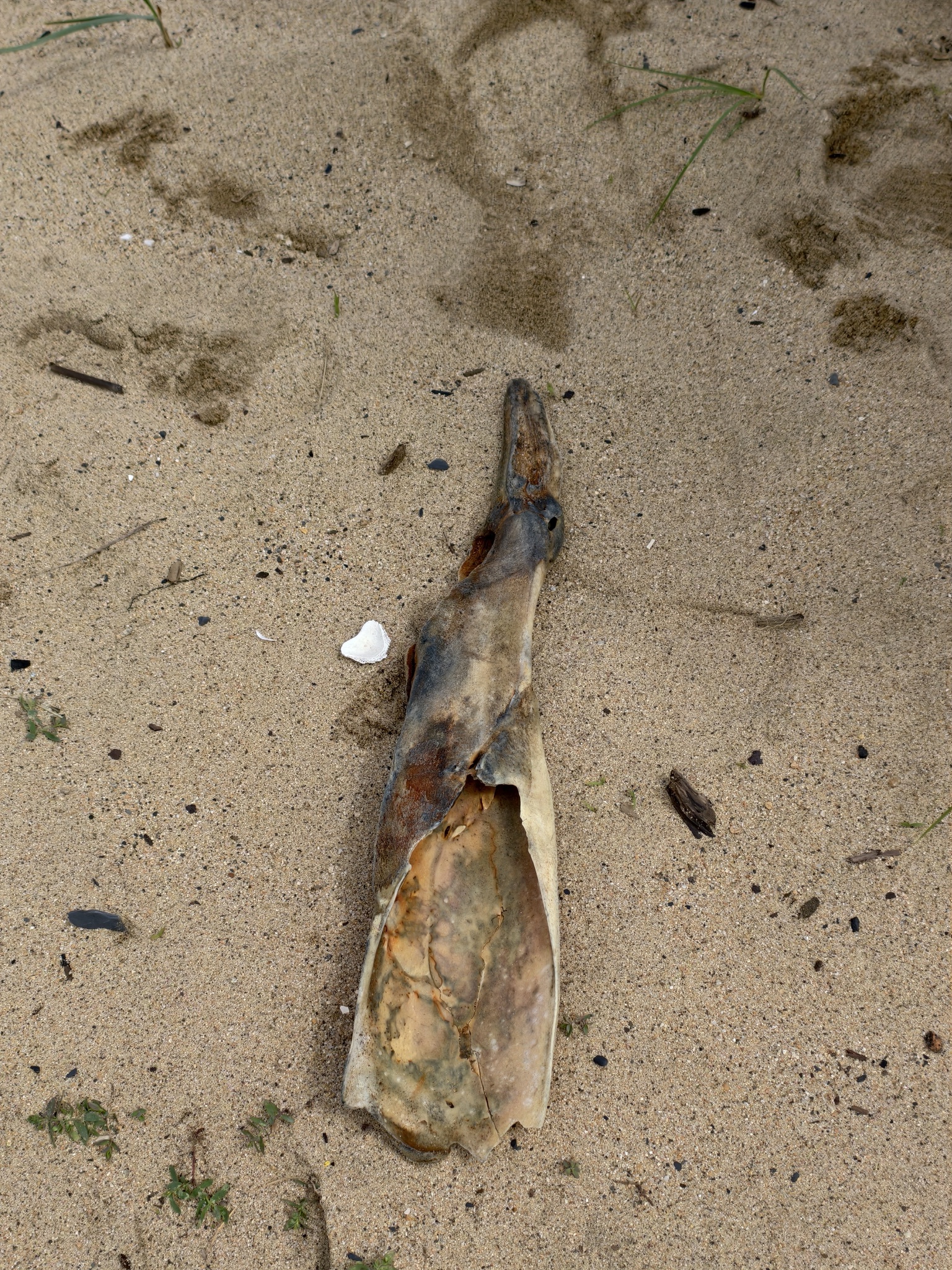
Strandings are the main source of data. In Alaska, at least 74 strandings of Stejneger's beaked whales, spread over 42 separate events, have been recorded since the species was discovered. Between 1995 and 2020, 35 beaked whales were reported stranded there in 16 events; seven of these events were group strandings, totalling 24 animals, all reported from the Aleutian Islands, which thus stand out as a hotspot for group strandings of the species. The known stranding range has extended northwards into the Bering Sea, with an adult female found near Gambell, on St Lawrence Island, in 2013. A clear sex bias is documented: of the 26 stranded carcasses since 1995 whose sex could be determined, 22 (85%) were females and 4 (15%) males. In August 2018, eight individuals, all adult females, stranded on Adak Island (Aleutians), one on 3 August at NavFac Beach, seven more found on 8 August at Palisades Point, about 2 km away: this is the largest known mass stranding for the species (four individuals had already stranded together in 2017 some 2.5 km from the same site). The state of decomposition of the carcasses did not allow the cause of death to be established; seismic activity of human origin, detected from 5 to 20 July 2018 some sixty kilometres north-west of the island by the USGS Alaska Volcano Observatory, remains a possible lead, fourteen days separate the last detection from the discovery of the first carcass, the US Navy having conducted no sonar or explosives exercise in Alaskan waters since May 2017.
There is no realistic prospect of watching this species on a tourist trip: it lives far from the coast, dives for long periods and flees vessels. The rare encounters are opportunistic and come mainly from scientific surveys in the Bering Sea, the Aleutians or the Sea of Japan, in flat calm conditions and good visibility.
The useful clues are a discreet, barely visible blow, a dark back, a small dorsal fin set far back, and a compact group of three to six animals that blow then sound in a synchronised way; in an adult male, the two tusks may show at the apex of the mandibular arch. Passive acoustic detection proves far more effective than visual observation for documenting its presence.
The ethics of approaching beaked whales require never pursuing a group, reducing speed and noise, keeping a substantial distance and not repeating passes. Any stranded animal, alive or dead, must be reported without delay to the competent stranding network, in Alaska the stranding response network coordinated by NOAA Fisheries, these reports being the main source of knowledge about the species.
Exclusively in the cold to temperate North Pacific: the south-west of the Bering Sea, the Aleutian Islands, Kamchatka, the Sea of Okhotsk and the Sea of Japan, the southernmost Japanese records reaching Miyagi Prefecture, on the Pacific seaboard of Honshū; on the American side, from British Columbia as far as southern California. It is the northernmost mesoplodont of the Pacific. It occurs in deep offshore waters, generally between 760 and 1,500 m of depth.
Adults most often measure between 5 and 5.7 m and can weigh up to about 1,600 kg, females being slightly larger than males. The newborn measures 2.1 to 2.4 m for close to 80 kg, and sexual maturity appears to be reached at around 4.5 m.
No. The species is strictly North Pacific and is not among the cetaceans of French waters, whether in the English Channel, the Bay of Biscay, the Mediterranean or the overseas territories. The beaked whales that can be seen in France are Cuvier's beaked whale, the northern bottlenose whale and the beaked whales of Sowerby, Blainville, Gervais and True.
Only in males does the single pair of mandibular teeth break through the gum. Massive, flattened and directed forwards and inwards, they remain visible when the mouth is closed and serve as weapons in fights between rivals: adult males are covered in paired linear scars, and healed jaw fractures have been observed. In females and young animals, these teeth stay buried.
“Near Threatened” (NT) on the IUCN Red List since the 2020 assessment. This listing follows a “Data Deficient” status and results above all from a revision of the rules for using that latter category, not from a demonstrated deterioration. The species is listed in Appendix II of CITES and is protected in the United States by the Marine Mammal Protection Act.
The Aleutians account for all the group strandings known in Alaska. Between 1995 and 2020, 35 beaked whales were reported stranded there in 16 events, including seven group strandings totalling 24 animals, all located in the Aleutian archipelago. In August 2018, eight adult females stranded on Adak Island: this is the largest mass stranding documented for the species. The carcasses were too degraded for any conclusion to be drawn, but seismic activity detected some sixty kilometres to the north-west, fourteen days before the discovery of the first carcass, remains a lead under study, beaked whales being particularly sensitive to intense noise. Note finally a strong sex bias: of the 26 stranded carcasses since 1995 whose sex could be determined, 85% were females.
Profile compiled from authoritative scientific sources (IUCN, NOAA Fisheries, specialist literature) and reviewed for factual accuracy.
According to the open data of the GBIF, 80 georeferenced sightings of Mesoplodon stejnegeri are recorded in our photographic index.
| Country | Notes |
|---|---|
| United States of America | 49 |
| Japan | 48 |
| Canada | 9 |
| Russian Federation | 3 |

Monthly distribution of 100 dated sightings (all years combined): the maximum is reached in August.
| Month | Notes |
|---|---|
| janvier | 7 |
| February | 5 |
| mars | 4 |
| avril | 11 |
| mai | 13 |
| juin | 7 |
| juillet | 13 |
| August | 21 |
| septembre | 5 |
| octobre | 7 |
| novembre | 3 |
| December | 4 |
These figures reflect survey effort (more boaters and more surveys in summer) as much as the actual presence of the species: to be interpreted with caution.


Photographs from GBIF under a Creative Commons licence. The author and the licence of each photograph are given; please respect them if you reuse them.
Automatic selection of the most cited works mentioning the species (source: Crossref).