Sato's beaked whale (Berardius minimus)

Key facts
Scientific name Berardius minimus Yamada, Kitamura, Abe, Tajima, Matsuda, Mead & Matsuishi, 2019
Other names Black beaked whale; kurotsuchikujira (クロツチクジラ, literally “black tsuchikujira”) in Japanese. In French: baleine à bec de Sato, bérardie de Sato, “bérardie noire”.
Size 6.3 to 6.9 m in physically mature individuals (4 males measured in the original description); maximum length accepted by Yamada et al. (2019): 6.9 m (male). An adult male of 7.3 m has also been reported by Morin et al. (2017). The only female specimen measured, physically immature, reached 6.21 m.
Weight Not documented: no body mass has been published for the species.
Longevity Unknown for the species. In Baird’s beaked whale, its closest relative, females of 54 years and males of 84 years have been documented.
Diet Deep-water fish and cephalopods of the mesopelagic and benthic zones, taken by suction.
IUCN status Near Threatened (NT), assessment published in 2020; no subpopulation assessed separately. The genus Berardius is listed in Appendix I of CITES.

In brief

Sato’s beaked whale is the smallest and the most recently described of the three members of the genus Berardius: its validity as a distinct species was established only in 2019, from stranded specimens from northern Japan and Alaska. This dark, stocky, short-beaked whale lives in the cold waters of the western and central North Pacific, around the Sea of Okhotsk, the Kuril Islands and the Aleutians. Extremely elusive, it was not observed alive at sea with certainty until 2021, and it appears on the IUCN Red List as Near Threatened.

Identification

Sato’s beaked whale is a toothed whale of medium size for a ziphiid, but clearly smaller than its congeners: physically mature individuals measure between 6.3 and 6.9 m, the greatest length recorded for an adult male in the original description being 6.9 m (an adult male of 7.3 m has since been reported by Morin et al., 2017). It is precisely this small size that inspired the specific epithet minimus, the smallest body size known in the genus. No body mass has been published for the species. The body is fusiform, more compact than that of Baird’s beaked whale, with a small dorsal fin set well back, at about 70% of the body length and accounting for only 3.7% of it; the flippers are likewise modest, around 11.4% of the body length.

The most immediately visible feature is the coloration: the body is almost uniformly dark, brown-black to black, with a paler, whitish tip to the rostrum. Against this dark background stand out strongly contrasting white oval scars about 5 cm across, left by the bites of cookiecutter sharks. Unlike Baird’s beaked whale, whose greyish skin is covered with a dense network of linear scratches, the skin of Sato’s beaked whale shows few linear scratches. The rostrum is proportionally short, about 4% of the body length, against close to 5.8% in B. bairdii. As in all Berardius, the lower jaw carries two pairs of visible teeth, the front pair being the more developed; the teeth erupt in both sexes, which sets the genus apart from most other beaked whales.

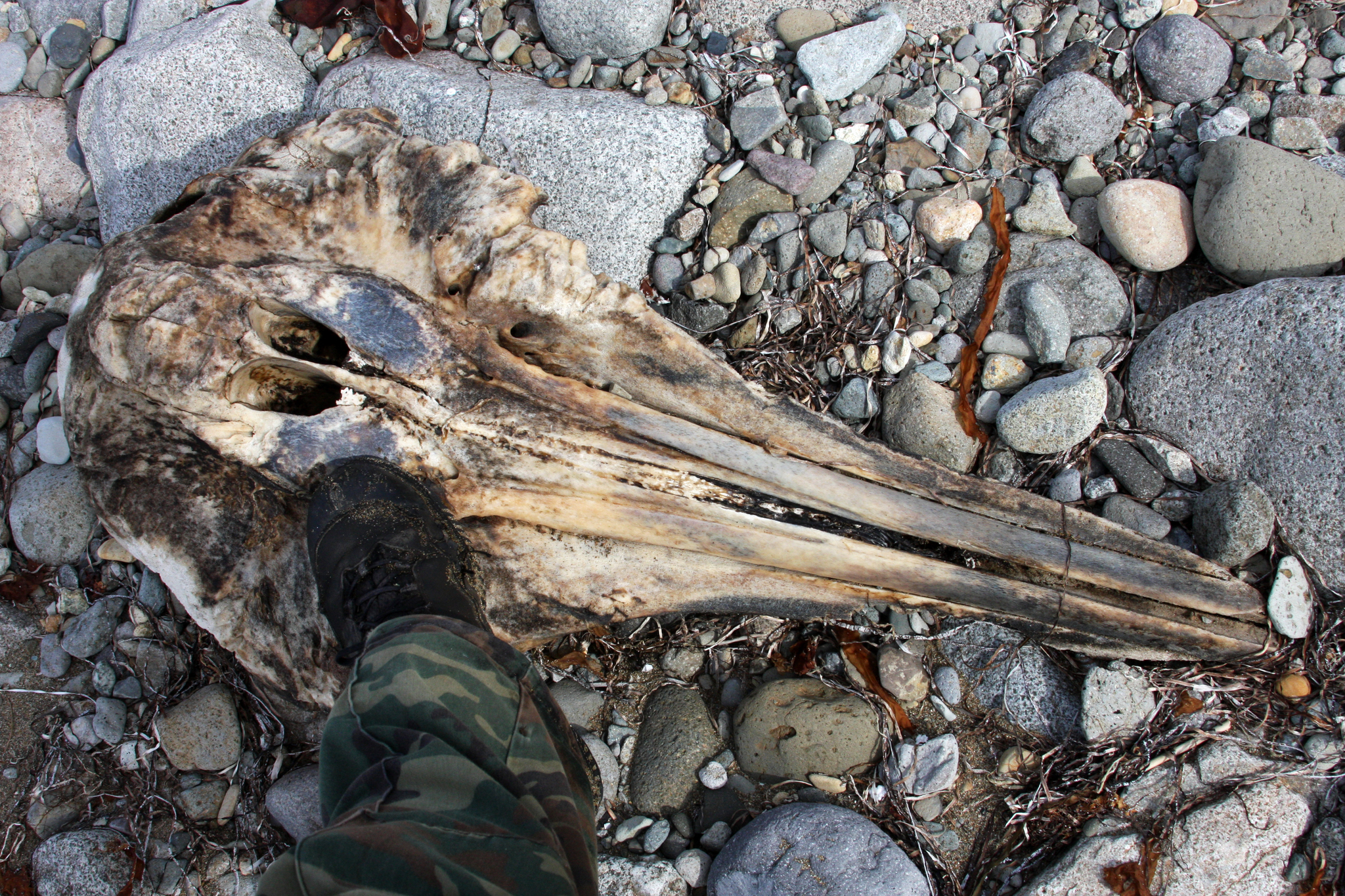
The possible confusions are few but real. In the field, the main risk concerns Baird’s beaked whale (Berardius bairdii), partly sympatric in the southern Sea of Okhotsk: it is much larger (about 9.1 to 11.1 m according to the mature specimens measured), paler, more heavily scratched and provided with a longer beak. Cranial measurements also separate the two species unambiguously, the condylobasal length of the skull being 935 to 1,042 mm in B. minimus against 1,343 to 1,524 mm in B. bairdii, with bone sutures strongly fused in adults. Arnoux’s beaked whale (Berardius arnuxii), the third species of the genus, does not compete geographically since it is confined to the southern hemisphere.

Taxonomy

Sato’s beaked whale belongs to the beaked whale family, most often designated by the name Ziphiidae, Hyperoodontidae being an alternative family name used in some classifications. It is the third recognised species of the genus Berardius, alongside Baird’s beaked whale (B. bairdii) of the North Pacific and Arnoux’s beaked whale (B. arnuxii) of the Southern Ocean.

The existence of a darker and smaller form had long been reported by Japanese whalers, who distinguished the ordinary tsuchikujira from the kurotsuchi, literally the “black tsuchikujira”. Another local name, karasu (“crow”), was also in circulation; the authors of the original description note that it is not established whether kuro-tsuchi and karasu refer to the same kind of whale or to different populations.

The formal description was published on 30 August 2019 in the journal Scientific Reports. It rests on six specimens, stranded or found drifting, collected on Hokkaido, Japan, to which is added a skull held in the collections of the National Museum of Natural History (Smithsonian) and collected in 1943 at Unalaska, in the Aleutians. External morphology and cranial osteometry were summarised from four of these individuals (three from Hokkaido and the Smithsonian specimen). The holotype is an adult male (NSMT-M35131) stranded on 4 June 2008 at Tokoro, in the city of Kitami (Hokkaido). The morphological analysis was coupled with genetics: mitochondrial DNA shows 18 to 22 nucleotide differences from B. bairdii, a gap greater than the 12 to 16 differences separating the two Berardius species known until then. The English common name honours Hal Sato, a researcher based on Hokkaido whose photographs helped to distinguish this whale from its congeners.

Range and habitat

Western and central North Pacific, between about 40°N and 60°N and between 140°E and 160°W: southern Sea of Okhotsk and northern Hokkaido, Sakhalin, the Kuril Islands (Kunashir), the Commander Islands, the Aleutians (Unalaska), the Bering Sea and the Alaska Peninsula. Deep-water habitat, continental slope and submarine canyons. Absent from French waters, both metropolitan and overseas.

Biology and ecology

A deep diver feeding by suction on deep-water fish and cephalopods; groups of 4 to 5 individuals observed; two pairs of teeth in the lower jaw, visible in both sexes; linear scratches (raking scars) few in number, unlike Baird’s beaked whale, but circular cookiecutter shark scars very marked; the appearance of adult females remains unknown; breeding and longevity not documented.

Status and conservation

Near Threatened (NT) on the IUCN Red List since the 2020 assessment; the genus listed in Appendix I of CITES; occasional catches by Japanese small-scale coastal whaling in the southern Sea of Okhotsk and bycatch in fishing gear; additional threats: underwater noise (sonar, seismic surveys), plastic ingestion, ship strikes; no estimate of abundance or of trend available.

Observing this species

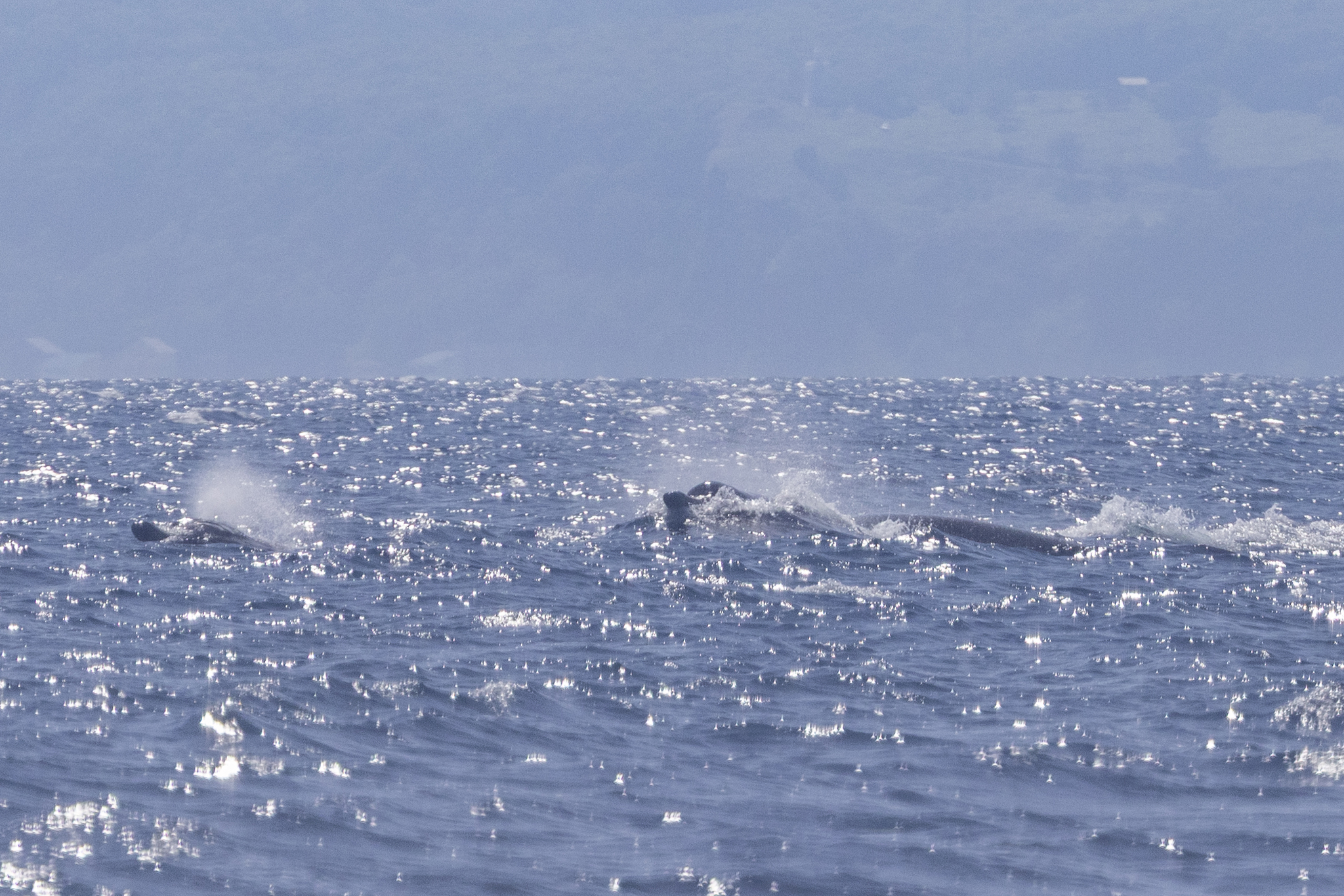
Exceptional encounters, limited to the southern Sea of Okhotsk, the southern Kuril Islands, the Aleutians and the Bering Sea; first confirmed sightings of live animals in 2021 off Kunashir, then drone observations above the Abashiri canyon in 2023. No possibility of observation in French waters.

Frequently asked questions

Since when has Sato’s beaked whale been recognised as a species in its own right?

Since 30 August 2019, the date of publication of its formal description in the journal Scientific Reports. Japanese whalers had nonetheless long distinguished a darker and smaller form, the kurotsuchi, from the ordinary Baird’s beaked whale. The separation was confirmed by skull morphology and by mitochondrial DNA, which shows 18 to 22 nucleotide differences from Berardius bairdii.

How can it be told from Baird’s beaked whale?

By size first: 6.3 to 6.9 m in physically mature individuals, against about 9.1 to 11.1 m in Baird’s beaked whale. Then by colour, almost uniformly black with a paler tip to the rostrum, whereas Baird’s beaked whale is greyish and covered with linear scratches. Lastly by the rostrum, which is shorter (about 4% of the body length against 5.8%).

Can it be encountered in France?

No. The species is strictly North Pacific and has never been reported in the Mediterranean, in the Bay of Biscay, in the English Channel or in French overseas waters. The beaked whales that can be observed in France belong to other genera, such as Ziphius, Mesoplodon or Hyperoodon in the north-east Atlantic.

What is its conservation status?

It is listed as Near Threatened (NT) on the IUCN Red List, according to the assessment published in 2020, because of presumed low numbers and a restricted range. The genus Berardius is also listed in Appendix I of CITES. No reliable estimate of abundance or of population trend is available.

Is it still hunted?

Individuals are sometimes killed in the course of the Japanese small-scale coastal whaling practised in the southern Sea of Okhotsk, off northern Hokkaido, a region where the species is also occasionally taken as bycatch. In United States waters, no human-caused mortality was reported between 2017 and 2021.

Have live animals ever been observed at sea?

Yes, but only very recently. The first confirmed sightings date from May-June 2021, off the western coast of Kunashir Island, with twenty-three encounters and fourteen individuals identified photographically, in groups of four to five animals. In 2023, three groups totalling at least nine individuals were filmed by drone above the Abashiri submarine canyon, on Hokkaido.

Sources

Species profile compiled from authoritative scientific sources (IUCN, NOAA Fisheries, specialist literature) and checked for factual accuracy.

Observed distribution

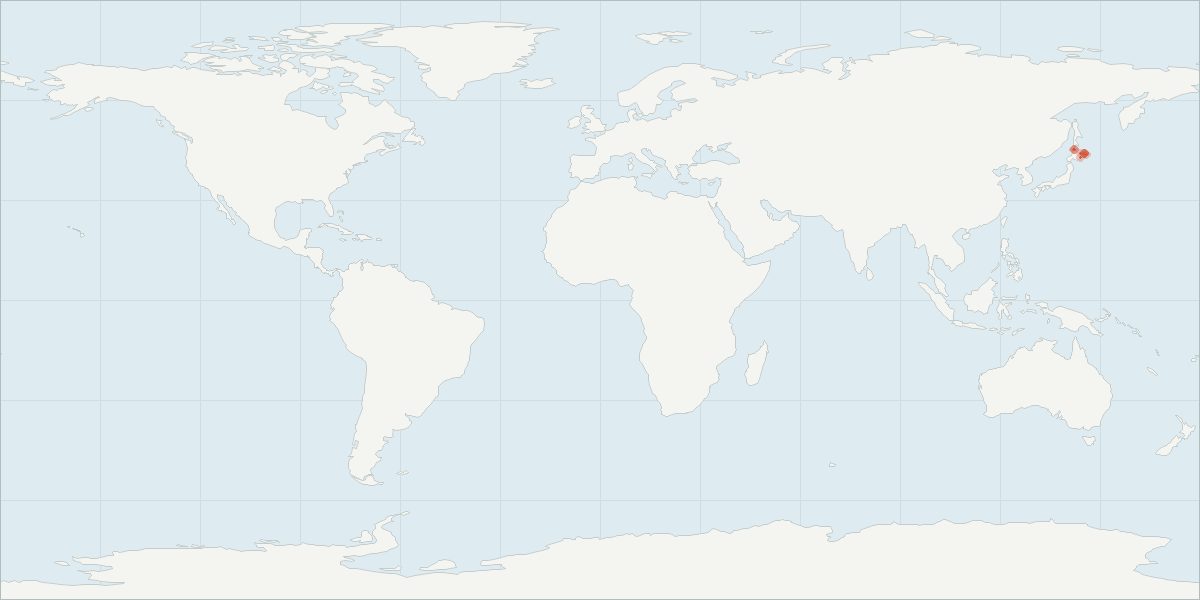
According to the open data of the GBIF, 12 georeferenced sightings of Berardius minimus are recorded in our photographic index.

Main countries of observation
CountryNotes
Japan14
Russian Federation1
United States of America1

Distribution map: Sato's beaked whale (Berardius minimus)

Distribution map: Sato's beaked whale (Berardius minimus), 12 georeferenced sightings from GBIF
12 georeferenced sightings of Berardius minimus. Base map Natural Earth, public domain. GBIF data.
🗺️ Open the interactive mapTo zoom and pan. It uses the OpenStreetMap/CARTO base maps and the GBIF occurrence densities: no data is sent to these services before you click.

Presence through the year

Monthly distribution of 15 dated sightings (all years combined): the maximum is reached in juin.

50janvier : 0janfévrier : 0febmars : 0maravril : 0avrmai : 2maijuin : 5juinjuillet : 3juilaoût : 1Augustseptembre : 1sepoctobre : 0octnovembre : 3novdécembre : 0dec
Sightings by month
MonthNotes
janvier0
February0
mars0
avril0
mai2
juin5
juillet3
August1
septembre1
octobre0
novembre3
December0

These figures reflect survey effort (more boaters and more surveys in summer) as much as the actual presence of the species: to be interpreted with caution.

En images

Berardius minimus
© あるたるふ, CC BY-NC, 2026
Berardius minimus
© auteur non précisé, CC BY, 2024
Berardius minimus
© auteur non précisé, CC BY, 2019
Berardius minimus
© auteur non précisé, CC BY, 2017
Berardius minimus
© Alexander Shienok, CC BY-NC, 2015
Berardius minimus
© auteur non précisé, CC BY, 2014
Berardius minimus
© Mead, James G., licence spécifique, 2012
Berardius minimus
© auteur non précisé, CC BY, 2012
Berardius minimus
© auteur non précisé, CC BY, 2012
Berardius minimus
© auteur non précisé, CC BY, 2009
Berardius minimus
© auteur non précisé, CC BY, 2009
Berardius minimus
© Mead, James G., licence spécifique, 2009

Photographs from GBIF under a Creative Commons licence. The author and the licence of each photograph are given; please respect them if you reuse them.

Scientific references

  1. Thewissen J. (2018) Berardius Beaked Whales, Encyclopedia of Marine Mammals
  2. Fedutin I., Filatova O., Meschersky I., Hoyt E. et al. (2022) First confirmed observations of living Sato's beaked whales Berardius minimus, Marine Mammal Science
  3. Kobayashi H., Ikuta S., Kobayashi M. (2023) First aerial observation of Sato's beaked whales (Berardius minimus) above the Abashiri Submarine Canyon, Hokkaido, Japan, Marine Mammal Science
  4. (2020) Berardius minimus: Brownell Jr., R.L., IUCN Red List of Threatened Species
  5. Flower W. (1872) On the recent ziphioid whales : with a description of the skeleton of Berardius arnouxi
  6. (2020) Berardius bairdii: Taylor, B.L. & Brownell Jr., R.L., IUCN Red List of Threatened Species
  7. Fedutin I., Filatova O., Hoyt E. (2026) Baird's, Arnoux's, and Sato's beaked whales Berardius bairdii Stejneger, 1883, B. arnuxii Duvernoy, 1851, and B. minimus Yamada et al., 2019, River Dolphins and Larger Toothed Whales
  8. Andrews R. (1912) Berardius Bairdii in Japan, Science

Automatic selection of the most cited works mentioning the species (source: Crossref).