| Scientific name | Mesoplodon perrini Dalebout, Mead, Baker, Baker & van Helden, 2002 |
|---|---|
| Other names | Perrin's mesoplodon; in French: baleine à bec de Perrin, mésoplodon de Perrin |
| Size | Adult female ≈ 4.4 m; adult male ≈ 3.9 m; juveniles 2.1 to 2.45 m |
| Weight | No reliable mass has been published: none of the known specimens was weighed. |
| Longevity | Unknown. The two adult type specimens were about 9 years old and already sexually mature. |
| Diet | Pelagic squid, in particular Octopoteuthis deletron; probably supplemented by mesopelagic fish. |
| IUCN status | Endangered (EN), assessment published in December 2020 and still in force in the 2025-2 edition of the Red List (October 2025). Population trend: decreasing. The species was previously classified as “Data Deficient” (DD). No subpopulation is distinguished. CITES Appendix II. |
Perrin's beaked whale (Mesoplodon perrini) is one of the most enigmatic large marine mammals on the planet. Described only in 2002, thanks to DNA, it is known from no more than six specimens stranded on the coast of California between 1975 and 2013 and has never been observed alive with certainty. This small ziphiid of about 4 metres, listed as Endangered by the IUCN, illustrates the scale of the gaps in our knowledge of deep-sea fauna.
Perrin's beaked whale is a small mesoplodont with a stocky build. Adult females measure about 4.4 m and males about 3.9 m; the juveniles examined were 2.1 to 2.45 m long. As no individual has ever been weighed, the mass of the species remains unknown. The outline is the readily recognisable one of the genus Mesoplodon: a relatively small head, an elongated thorax and abdomen, a thick caudal peduncle and a short tail, and a small triangular dorsal fin set two thirds of the way back along the body. The rostrum (the “beak”) is noticeably shorter than in most other mesoplodont beaked whales, which gives the animal a compact profile, and the melon is only weakly developed.
The coloration is dark grey on the back and lightens to white on the belly. Adult males carry a dark grey mask that extends from the corner of the mouth to the eye and then towards the rostrum, a pale patch around the umbilicus, and white streaks on the underside of the tail fluke. The clearest diagnostic character concerns the dentition: as in all mesoplodont beaked whales, only adult males have two functional teeth, but in M. perrini these massive teeth, triangular in profile, emerge right at the tip of the lower jaw and protrude by about 3 cm, whereas in most related species they are set in the middle or at the base of the mandible. The long, straight white scars that streak the flanks of males bear witness to fights between rivals, while oval marks betray the bites of the cookiecutter shark (Isistius brasiliensis).
Confusion is the rule rather than the exception. The first four Californian specimens were long attributed to Hector's beaked whale (Mesoplodon hectori), a southern hemisphere species they closely resemble morphologically; only analysis of mitochondrial DNA revealed that they were a distinct taxon. At sea, the species is in practice impossible to separate from the other mesoplodont beaked whales of the north-east Pacific. The vernacular names call for care as well: “baleine à bec de Perrin” is not to be confused with the pygmy beaked whale (M. peruvianus) or with Hector's beaked whale, French names that resemble one another all the more because the animals do.
Perrin's beaked whale belongs to the beaked whale family (Ziphiidae, also designated Hyperoodontidae in some classifications), and to the genus Mesoplodon, the richest in species of all the cetaceans. The genus name comes from the Greek meso- (middle), hopla (weapons) and odon (tooth), literally “armed with a tooth in the middle of the jaw”.
The species was described in 2002 by Merel Dalebout, James Mead, C. Scott Baker, Alan Baker and Anton van Helden, from specimens held in the collections of the Smithsonian (USNM) and the Natural History Museum of Los Angeles County (LACM). The holotype, USNM 504853, is an adult male stranded on 9 September 1978 on the Californian coast. The epithet perrini honours the American cetologist William F. Perrin.
Recognition of the species rests above all on genetics: substantial differences in the control region of mitochondrial DNA and in the cytochrome b gene underpinned the diagnosis, confirmed afterwards by cranial morphology. Remarkably, these molecular analyses place M. perrini as the sister species of the pygmy beaked whale (M. peruvianus) of the eastern Pacific, and not of M. hectori, of which it is nonetheless the anatomical lookalike, a textbook case of morphological convergence.
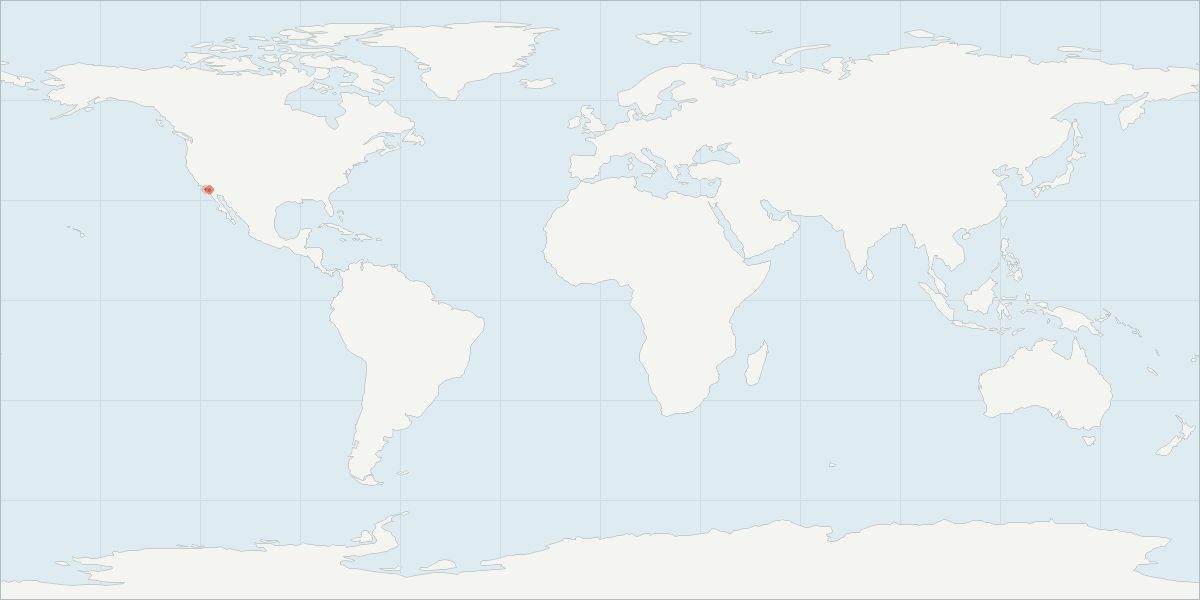
The known range of Perrin's beaked whale is limited to the North Pacific, off central and southern California. The six documented specimens stranded between Torrey Pines (32°55′ N, 117°15′ W), just north of San Diego, and Monterey (36°37′ N, 121°55′ W), a stretch of coast of about 600 km in a straight line (more if the shoreline is followed). Four of the first specimens were found less than 85 km apart, in southern California.
The presumed habitat is that of deep oceanic water offshore, beyond 1,000 m of depth. This hypothesis is supported by passive acoustics: a frequency-modulated echolocation signal designated BW43, attributed to this species, has been detected only off southern California, at sites 1,100 to 1,300 m deep.
The actual range is very probably wider than the documented one: ziphiids are typically distributed across large ocean basins, and there is nothing to indicate that M. perrini is strictly confined to Californian waters. The available data do not, however, make it possible to specify its limits.
The species is absent from France. No data link it to the Mediterranean, the Bay of Biscay, the English Channel or the French overseas territories: it is a cetacean of the temperate North Pacific. The issue it exemplifies, the vulnerability of ziphiids to military sonar, does on the other hand concern French waters directly, where Cuvier's beaked whale (Ziphius cavirostris) is the ziphiid most regularly encountered in the Mediterranean.
Almost everything known about the biology of M. perrini comes from the dissection of stranded carcasses. The stomach contents of the specimens have yielded the beaks of pelagic squid, among which the species Octopoteuthis deletron could be formally identified, as well as the remains of undetermined vertebrates. Like the other ziphiids, the animal is a deep diver that feeds by suction: lacking functional teeth with which to seize its prey, it draws them into its mouth after locating them by echolocation. Beaked whales are among the most accomplished breath-hold divers of all mammals: Cuvier's beaked whale holds the documented record for any mammal species, with a dive of 222 minutes (3 h 42) recorded off California, and dives of more than 2,000 m in depth.
Social life remains largely unknown. The few clues available suggest a solitary animal, or one living in small groups, less gregarious than most odontocetes. The linear scars of adult males indicate marked intrasexual competition: the teeth serve as weapons in clashes between males for access to females, behaviour typical of mesoplodont beaked whales.
Breeding is documented only in fragments. The two adult type specimens were about 9 years old and already sexually mature, which suggests that maturity is reached at that age or earlier. The juveniles of 2.1 to 2.45 m that were examined were estimated to be about a year old, and the analyses indicate that they were already feeding independently in summer. Gestation length, the interval between two births and maximum longevity remain unknown.
Several stranded animals bore the marks of their immediate environment: circular bites from the cookiecutter shark and, in the 1997 individual, a parasitic infestation associated with a state of advanced emaciation. Fragments of plastic have also been found in the digestive tract of stranded individuals.
Long classified as “Data Deficient”, Perrin's beaked whale was reassessed as “Endangered” (EN) in the IUCN Red List update published in December 2020, a status confirmed in the 2025-2 edition (October 2025). Its population trend is judged to be decreasing, and it is among the very small number of cetaceans for which an active decline is estimated.
This classification does not rest on a direct count of the species, which is impossible to carry out since the animal cannot be recognised at sea, but on the trends measured for all mesoplodont beaked whales of the California Current. The line-transect surveys conducted by the Southwest Fisheries Science Center between 1991 and 2008 estimated numbers of Mesoplodon spp. at 2,206 individuals in 1991 (CV = 0.46) against 811 in 2008 (CV = 0.65), with a probability of decline of 0.96 and a mean rate of about 7% a year. Later analyses suggest, on the contrary, a marked upturn: the mean of the estimates for Mesoplodon spp. rises from 1,230 individuals in 2001 to 3,439 in 2014 in the waters of the California Current, a level above the one estimated for 1991. These figures, aggregated at genus level, drawn from different series and different methods and carrying very wide confidence intervals, should be read with caution.
The threats identified are those that bear on all ziphiids, aggravated here by an extremely restricted known range that overlaps a major naval training area. Anthropogenic noise comes first: active military sonar and seismic surveys, to which beaked whales are notoriously sensitive. To these are added bycatch in deep-set gillnets, plastic ingestion, parasitic infestations and ecosystem changes affecting prey. The species has never been the object of directed hunting. It is listed in Appendix II of CITES and enjoys, in United States waters, the general protection of the Marine Mammal Protection Act.
Observing a Perrin's beaked whale is, on present knowledge, a statistical exception: no sighting of a living individual has ever been formally confirmed by scientists. Two at-sea sightings made off California at the end of the 1970s could relate to it, without certainty. The few reports of mesoplodont beaked whales in the area are concentrated between May and September, with a slightly higher probability of an encounter near the islands of Santa Catalina and San Clemente, over depths greater than 1,000 m.
In practice, ziphiids are picked out from discreet clues: a calm sea, a low and barely visible blow, a brief appearance of the back and the dorsal fin, then a long dive. The approach must remain passive. Crossing the animal's path, chasing it or accelerating nearby interrupts the breathing cycle that follows a deep dive, which is particularly damaging in these species. The rule is to keep a steady distance, to let the animal decide on the encounter and to limit engine noise.
The most useful contribution an observer can make to knowledge of these species remains the reporting of strandings. It is carcasses, and carcasses alone, that made it possible to describe M. perrini. Photographing the head, the lower jaw and the exact position of the teeth, then alerting the competent network immediately, is decisive: in France, every cetacean stranding must be reported to the Réseau national échouages, the national stranding network.
Six specimens only, all stranded on the coast of California between 22 May 1975 and 15 October 2013. They are held in the collections of the Smithsonian (USNM) and the Natural History Museum of Los Angeles County (LACM). The holotype, an adult male, stranded on 9 September 1978. The stranding sites range from Torrey Pines, just north of San Diego, to Monterey, over about 600 km of coast.
No sighting of a living animal has been confirmed with certainty. Two at-sea sightings made off California at the end of the 1970s could concern the species, but they have never been validated. The only indirect trace of living individuals is acoustic: a frequency-modulated echolocation signal, named BW43, detected at sites 1,100 to 1,300 m deep off southern California, is attributed to it.
Because the first four specimens had been wrongly identified as Hector's beaked whales (Mesoplodon hectori), a southern hemisphere species very close to it morphologically. It was the assembly of a database of mitochondrial DNA sequences for ziphiids that revealed they were a distinct taxon, described in 2002 by Dalebout, Mead, Baker, Baker and van Helden.
No. Perrin's beaked whale is known only from the North Pacific, off California. It is reported neither in the Mediterranean, nor in the Bay of Biscay, nor in the English Channel, nor in the French overseas territories. In the Mediterranean, the ziphiid most regularly encountered is Cuvier's beaked whale (Ziphius cavirostris).
The “Endangered” listing, adopted in December 2020, rests on the combination of a very restricted known range, of threats well identified within that area (military sonar, seismic surveys, deep-set gillnets) and of the trends measured for all mesoplodont beaked whales of the California Current, whose numbers went from about 2,200 individuals in 1991 to about 800 in 2008 according to the line-transect surveys. More recent series indicate, on the contrary, a marked upturn for the genus, up to about 3,400 individuals in 2014, but these aggregated estimates rest on different methods and still carry very wide confidence intervals. Before 2020, the species was classified as “Data Deficient”.
Examination of stomach contents has brought to light pelagic squid, among them Octopoteuthis deletron. Like the other beaked whales, it hunts on deep dives by suction: it locates its prey by echolocation and then draws them in, its teeth serving not for capture but, in males, for fights between rivals. These cetaceans are exceptional breath-hold divers: in Cuvier's beaked whale, a dive of 222 minutes (3 h 42) has been recorded off California, the documented record among mammals.
Profile compiled from authoritative scientific sources (IUCN, NOAA Fisheries, specialist literature) and reviewed for factual accuracy.
According to the open data of the GBIF, 4 georeferenced sightings of Mesoplodon perrini are recorded in our photographic index.
| Country | Notes |
|---|---|
| United States of America | 7 |

Monthly distribution of 7 dated sightings (all years combined): the maximum is reached in septembre.
| Month | Notes |
|---|---|
| janvier | 0 |
| February | 0 |
| mars | 0 |
| avril | 0 |
| mai | 2 |
| juin | 0 |
| juillet | 1 |
| August | 0 |
| septembre | 3 |
| octobre | 1 |
| novembre | 0 |
| December | 0 |
These figures reflect survey effort (more boaters and more surveys in summer) as much as the actual presence of the species: to be interpreted with caution.
Photographs from GBIF under a Creative Commons licence. The author and the licence of each photograph are given; please respect them if you reuse them.
Automatic selection of the most cited works mentioning the species (source: Crossref).