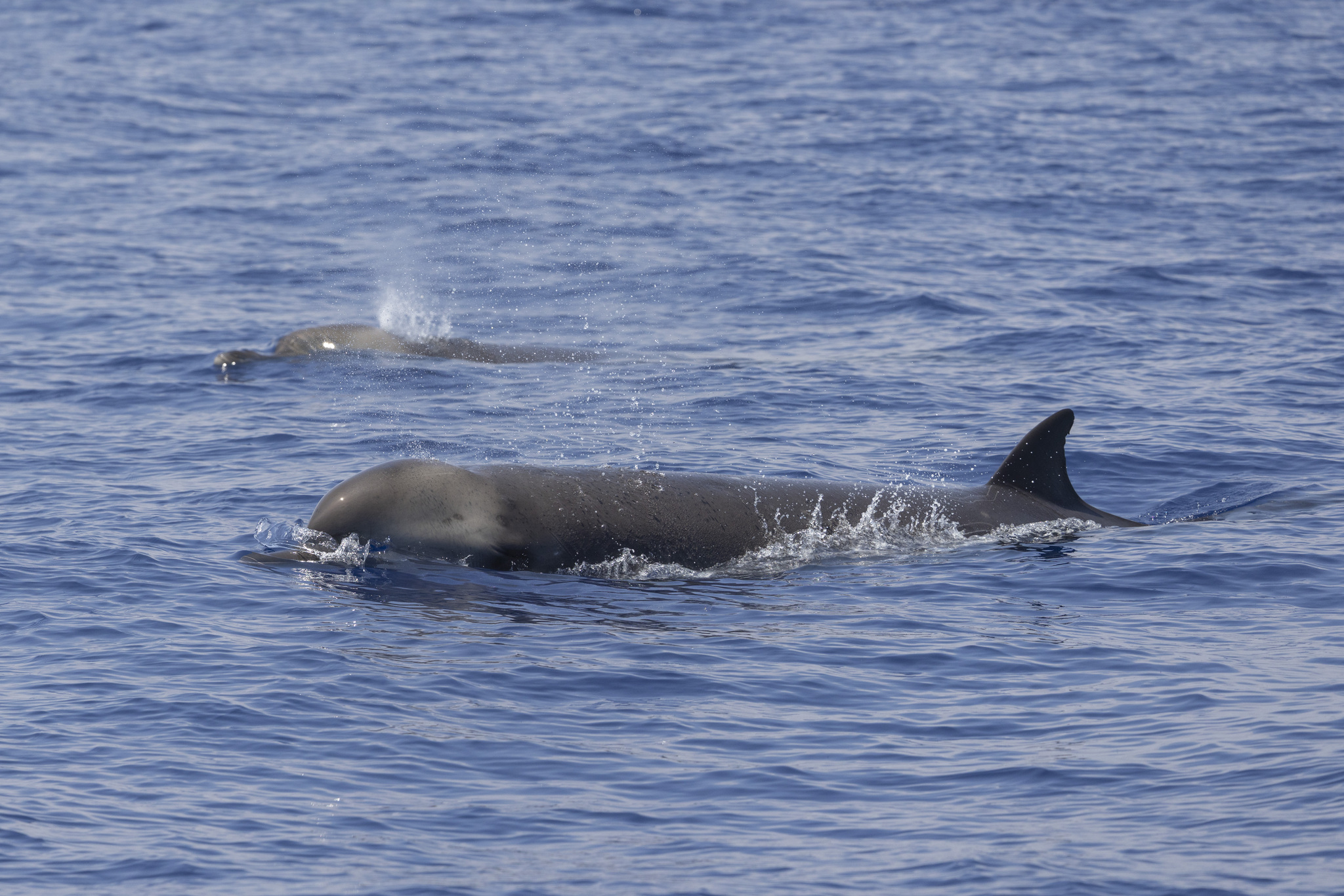
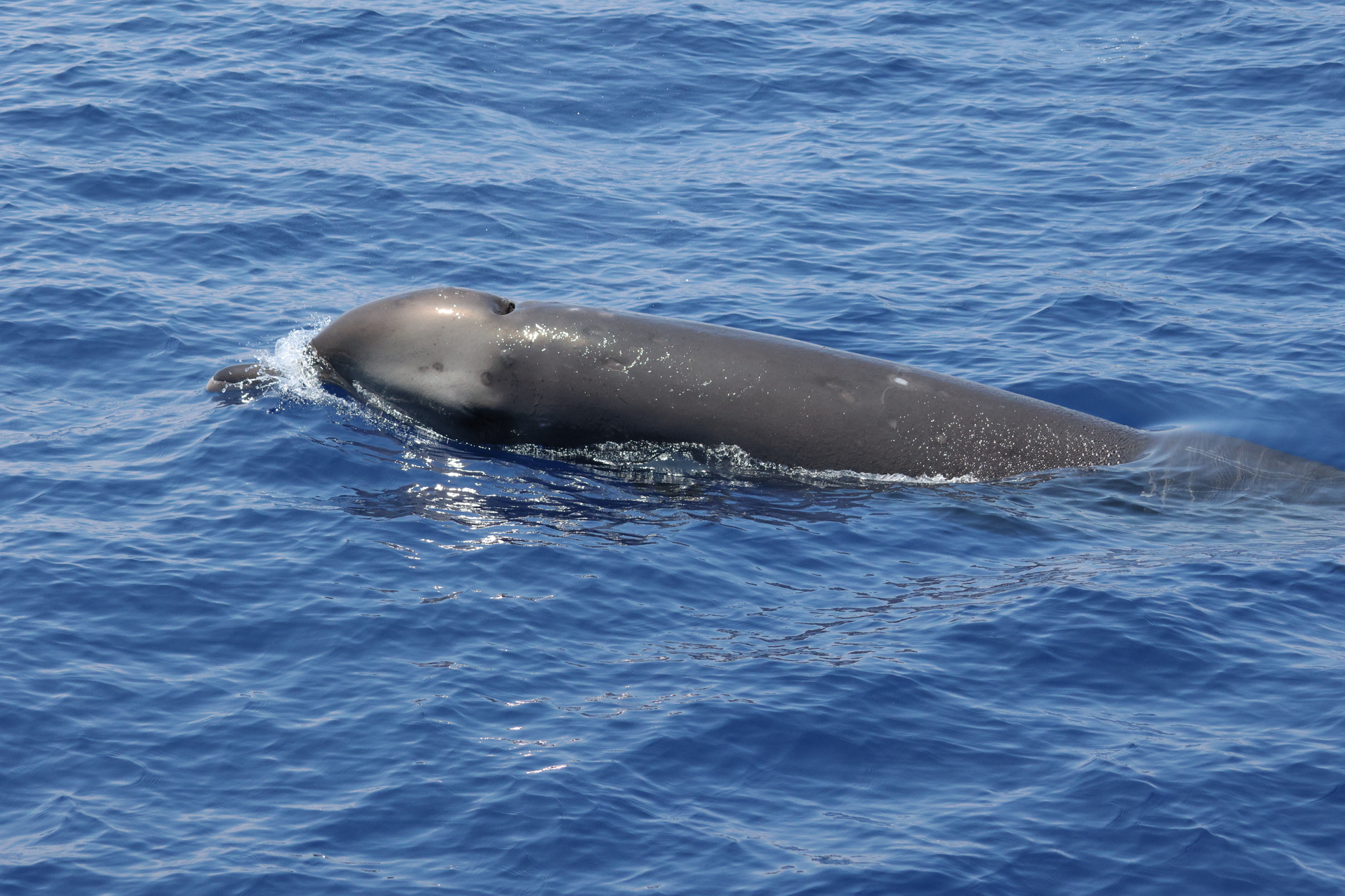
Longman's beaked whale (Indopacetus pacificus)

Key facts
Scientific name Indopacetus pacificus (Longman, 1926), genus Indopacetus Moore, 1968
Other names Longman's beaked whale; Indo-Pacific beaked whale; tropical bottlenose whale. In French: mésoplodon de Longman, baleine à bec indo-pacifique. In Spanish: zifio de Longman. In Japanese: タイヘイヨウアカボウモドキ.
Size 5.65 to 6.50 m measured on stranded animals, with females slightly larger than males; estimates made at sea, which are higher (7 to 9 m), remain uncertain. Newborn: 2.4 to 2.9 m.
Weight No reliable weighing is available: NOAA Fisheries gives the mass as unknown, while some reviews put forward an unconfirmed estimate of the order of 7 tonnes.
Longevity Poorly documented; the available data indicate that individuals reach at least about twenty years.
Diet Mainly midwater squid (Taonius pavo, Onychoteuthis borealijaponica, Chiroteuthis picteti, Histioteuthis inermis…), supplemented by a few fish; capture by suction.
IUCN status Least Concern (LC), assessed against the version 3.1 criteria, global assessment of 23 August 2020 by R. L. Pitman and R. L. Brownell Jr., published in 2020. Population trend unknown. No subpopulation is assessed separately. The species was previously listed as “Data Deficient” (DD), a status still relayed by many profiles.

In brief

The only representative of the genus Indopacetus, Longman's beaked whale was for a long time known from two skulls alone, which earned it the reputation of being the rarest cetacean in the world. It is now known to frequent the deep oceanic waters of the whole tropical Indo-Pacific, where it forms groups that are sometimes large. In France it concerns only the overseas territories: a mass stranding of seven individuals was documented in New Caledonia on 16 November 2013.

Identification

Medium-sized for a ziphiid, Longman's beaked whale has a robust, fusiform body. Individuals measured at stranding range from about 5.65 to 6.50 m. At the New Caledonia mass stranding, the two adult females reached 6.18 and 6.40 m against 5.90 m for the adult male, which suggests that females are slightly larger. Lengths estimated at a distance at sea, often greater, should be handled with caution, and no individual has been reliably weighed.

The outline is distinctive: a bulbous, steep melon, clearly set off from a long tubular rostrum by a marked crease; a tall, falcate dorsal fin, proportionally large for a beaked whale, set two thirds of the way back along the body. The coloration ranges from dark brown to slate grey, with a paler melon, beak and throat area, beige, light brown or whitish, which tend to lighten with age. As in most ziphiids, only adult males develop a pair of conical teeth at the tip of the lower jaw; their backs carry parallel linear scars left by fighting between males, to which are added the oval bites of cookiecutter sharks. A whale louse peculiar to the species, Isocyamus indopacetus, attaches itself in the folds and the scars.

Confusion is frequent. The blow, low but clearly visible and bushy, unusual in beaked whales, and the large dorsal fin long caused it to be taken for a bottlenose whale (Hyperoodon). At a distance a compact group can suggest short-finned pilot whales, with which the species does indeed associate. The long rostrum and the pale melon distinguish it from Cuvier's beaked whale (Ziphius cavirostris), which has a short beak, and from Blainville's beaked whale (Mesoplodon densirostris), which is smaller and has a strongly arched lower jaw.

Taxonomy

Described in 1926 by Heber A. Longman from a skull and a lower jaw collected in 1882 at Mackay (Queensland, Australia), the species was first named Mesoplodon pacificus. In 1968 Joseph C. Moore, working from a second skull found in 1955 near Danane, in Somalia, showed that it could not be placed among the mesoplodonts and erected the genus Indopacetus for it, which has remained monotypic. The valid authority is therefore written (Longman, 1926). The beaked whale family is most often referred to as the Ziphiidae, Hyperoodontidae being a replacement name retained by some classifications. For decades the large tropical ziphiids sighted at sea were reported under the provisional name of “tropical bottlenose whale”; genetic analyses published in 2003 established that these were indeed Indopacetus pacificus, moving the species from the status of an osteological puzzle to that of an animal identifiable at sea.

Distribution and habitat

The species is strictly Indo-Pacific and absent from the Atlantic. It occupies deep tropical and subtropical oceanic waters, under surface temperatures of between 21 and 31 °C, from eastern and southern Africa, the Arabian Sea, the Maldives, Sri Lanka and the Bay of Bengal to Japan, Taiwan, the Philippines and Australia. A few more easterly sightings, in the eastern Pacific (Mexico, Guadalupe Island, the Gulf of California), were made in 1992 and 1993 but are regarded as extralimital: they coincide with unusually warm waters linked to El Niño and do not reflect a regular presence. Hawaiian waters account for the majority of documented sightings. The IUCN Red List reports it in the epipelagic, mesopelagic and bathypelagic zones; in practice it frequents almost exclusively deep water, beyond 1,000 m.

In France the species is not present in the mainland: neither in the Mediterranean, nor in the Bay of Biscay, nor in the English Channel. It concerns only the overseas territories, the Office français de la biodiversité listing it for New Caledonia, Wallis and Futuna and the Indo-tropical islands; it also appears in the cetacean inventories of Réunion. The best documented French event remains the mass stranding of seven individuals that occurred on 16 November 2013 in the south of New Caledonia, studied in detail and published in 2016.

Biology and ecology

The diet, reconstructed from the stomach contents of stranded animals, is dominated by midwater cephalopods: the beaks of mesopelagic squid are abundant in them, with taxa such as Taonius pavo, Onychoteuthis borealijaponica, Chiroteuthis picteti or Histioteuthis inermis, a few fish making up the rest. Like other beaked whales, the species captures its prey by suction, helped by the two V-shaped throat grooves. Recorded dives most often last from 11 to 33 minutes, a single individual having been followed on a dive of at least 45 minutes. Its biosonar emits clicks around 15 kHz and 25 kHz, as well as frequency-modulated pulses, consistent with what is known of other ziphiids.

It is one of the most gregarious ziphiids. Mean group size varies from region to region, from 7.2 individuals in the western Indian Ocean to 29.2 in the western Pacific, with gatherings of between 1 and about a hundred animals. Groups are cohesive and often travel in tight formation; they associate with short-finned pilot whales, common bottlenose dolphins and spinner dolphins. Contrary to the unobtrusive image of beaked whales, the species breaches, porpoises at speed and sometimes shows curiosity towards vessels.

Breeding remains very poorly known. Newborns measure about 2.4 to 2.9 m; the juvenile stranded in New Caledonia, about 3 m long, was less than a year old. A 6 m female stranded in the Maldives was carrying a foetus of about 1 m. Neither the gestation period nor the age at sexual maturity has been established, and longevity is known only by default: the available data indicate at least about twenty years.

Status and conservation

Assessed on 23 August 2020 by R. L. Pitman and R. L. Brownell Jr., Longman's beaked whale is listed as “Least Concern” (LC) on the global IUCN Red List. This listing corrects an earlier assessment of “Data Deficient“: the species has proved locally fairly common over a very wide range, which makes it unlikely to belong in a threatened category. The population trend nevertheless remains unknown. Two abundance estimates are available: about 4,571 individuals (CV = 0.65) in Hawaiian waters and 291 individuals (CV = 100%) in the eastern tropical Pacific, very imprecise figures that reflect how rarely the species is encountered.

The threats identified are those of large pelagic divers: bycatch in drifting gillnets and on longlines, in particular in the northern Indian Ocean and off Sri Lanka; noise pollution of military (active sonar) and seismic origin; plastic ingestion; contaminants and collisions. The necropsies carried out in New Caledonia brought to light plastic debris in the stomachs of two animals, high concentrations of mercury, iron, selenium and zinc in the liver and of cadmium in the kidneys, as well as a case of morbillivirus that could have played a major part in that stranding. The species is listed in CITES Appendix II, covered by the memorandum of understanding on the conservation of cetaceans in the Pacific Islands region, and protected in French territory, where destruction, capture, intentional disturbance and possession are prohibited.

Observing this species

Encountering this species is a matter of luck: many specialists of tropical waters have never seen it. The most favourable areas are the deep waters off the Hawaiian Islands, the Maldives, Sri Lanka and the western Pacific, as well as New Caledonia. Look offshore, over depths greater than 1,000 m, in calm seas.

The useful clues are the low but clearly visible and bushy blow, the large falcate dorsal fin set well back, the pale melon contrasting with a dark back, and above all the group size, unusual for a beaked whale, sometimes several dozen animals, possibly mixed in with short-finned pilot whales.

The approach must remain cautious. Ziphiids are among the cetaceans most sensitive to disturbance and to underwater noise: never cut across the group's path, reduce speed, keep your distance and limit the length of the observation. Any sighting or stranding is worth reporting to the local networks, such as Opération Cétacés in New Caledonia or Globice in Réunion: every record counts for a species as little known as this one.

Frequently asked questions

Is Longman's beaked whale really the rarest cetacean in the world?

It long held that title, being known only from two skulls. Sightings at sea and the estimate of more than 4,500 individuals in Hawaiian waters alone show that it is above all unobtrusive. That title now goes to the spade-toothed whale (Mesoplodon traversii).

Why is it sometimes called the “tropical bottlenose whale”?

Its bulbous melon, its large dorsal fin and its clearly visible blow long caused it to be confused with a bottlenose whale (Hyperoodon) in the tropics. Genetic analyses published in 2003 showed that these sightings did indeed correspond to Indopacetus pacificus.

What is its current conservation status?

“Least Concern” (LC) on the IUCN Red List since the assessment of 23 August 2020, which replaces a former status of “Data Deficient“. The population trend remains unknown. The species is listed in CITES Appendix II and protected in France.

Can it be observed in French waters?

Only in the overseas territories. It is reported in New Caledonia, in Wallis and Futuna and in the Indo-tropical islands, and appears in the cetacean inventories of Réunion. It is absent from the Mediterranean, the Bay of Biscay and the English Channel.

What happened in New Caledonia in November 2013?

Seven individuals stranded together in the south of the territory on 16 November 2013: one adult male, two adult females, two subadult females, a juvenile and one individual of undetermined status. The necropsies revealed plastics, contaminants and a case of morbillivirus, with no indication of a link with sonar.

How long does it dive for, and what does it feed on?

Recorded dives generally last from 11 to 33 minutes, a single individual having been followed on a dive of at least 45 minutes. The species feeds above all on mesopelagic squid, which it draws in by powerful suction, only the males having a pair of visible teeth.

Sources

Profile compiled from authoritative scientific sources (IUCN, NOAA Fisheries, specialist literature) and reviewed for factual accuracy.

Observed distribution

According to the open data of the GBIF, 10 georeferenced sightings of Indopacetus pacificus are recorded in our photographic index.

Main countries of observation
CountryNotes
Australia3
Chinese Taipei3
United States of America3
Japan2
Philippines2
India1
New Caledonia1
Yemen1

Distribution map: Longman's beaked whale (Indopacetus pacificus)

Distribution map: Longman's beaked whale (Indopacetus pacificus), 10 georeferenced sightings from GBIF
10 georeferenced sightings of Indopacetus pacificus. Base map Natural Earth, public domain. GBIF data.
🗺️ Open the interactive mapTo zoom and pan. It uses the OpenStreetMap/CARTO base maps and the GBIF occurrence densities: no data is sent to these services before you click.

Presence through the year

Monthly distribution of 12 dated sightings (all years combined): the maximum is reached in juin.

20janvier : 1janfévrier : 0febmars : 1maravril : 0avrmai : 0maijuin : 2juinjuillet : 2juilaoût : 1Augustseptembre : 2sepoctobre : 1octnovembre : 2novdécembre : 0dec
Sightings by month
MonthNotes
janvier1
February0
mars1
avril0
mai0
juin2
juillet2
August1
septembre2
octobre1
novembre2
December0

These figures reflect survey effort (more boaters and more surveys in summer) as much as the actual presence of the species: to be interpreted with caution.

En images

Indopacetus pacificus
© Elson Chen, CC BY-NC, 2026
Indopacetus pacificus
© DiGua Su, CC BY-NC, 2026
Indopacetus pacificus
© Pierre van der Wielen, CC BY-NC-ND, 2022
Indopacetus pacificus
© Mead, James G., licence spécifique, 2018
Indopacetus pacificus
© Mead, James G., licence spécifique, 2017
Indopacetus pacificus
© Mead, James G., licence spécifique, 2013
Indopacetus pacificus
© John Ososky, CC0, 2010
Indopacetus pacificus
© Mead, James G., licence spécifique, 2010
Indopacetus pacificus
© auteur non précisé, CC BY, 2010
Indopacetus pacificus
© auteur non précisé, licence spécifique, 2009
Indopacetus pacificus
© Mead, James G., licence spécifique, 2005
Indopacetus pacificus
© Mead, James G., licence spécifique, 2004

Photographs from GBIF under a Creative Commons licence. The author and the licence of each photograph are given; please respect them if you reuse them.

Scientific references

  1. Rankin S., Baumann-Pickering S., Yack T., Barlow J. et al. (2011) Description of sounds recorded from Longman’s beaked whale, Indopacetus pacificus, The Journal of the Acoustical Society of America
  2. Pitman R., Palacios D., Brennan P., Brennan B. et al. (1999) SIGHTINGS AND POSSIBLE IDENTITY OF A BOTTLENOSE WHALE IN THE TROPICAL INDO‐PACIFIC: INDOPACETUS PACIFICUS?, Marine Mammal Science
  3. Landrau-Giovannetti N., Subramaniam K., Brown M., Ng T. et al. (2020) Genomic characterization of a novel circovirus from a stranded Longman’s beaked whale (Indopacetus pacificus), Virus Research
  4. Anderson R., Clark R., Madsen P., Johnson C. et al. (2006) Observations of Longman's Beaked Whale (Indopacetus pacificus) in the Western Indian Ocean, Aquatic Mammals
  5. P. K., P. K. A., K. M., H. M. B. et al. (2014) Plastic debris in the stomach of a Longman’s Beaked Whale, Indopacetus pacificus (Longman, 1926) stranded off Sutrapada, Veraval, Saurashtra coast, India, Journal of the Marine Biological Association of India
  6. Watson A., Kuo T., Yang W., Yao C. et al. (2007) Distinctive osteology of distal flipper bones of tropical bottlenose whales, Indopacetus pacificus, from Taiwan: Mother and calf, calf with polydactyly, Marine Mammal Science
  7. Kobayashi N., Tokutake K., Yoshida H., Okabe H. et al. (2021) The First Stranding Record of Longman’s Beaked Whale (Indopacetus pacificus) in Okinawa, Japan, Aquatic Mammals
  8. Yatabe A., Kubo N., Otsuka M., Shima S. et al. (2010) Stomach Contents and Structure of a Longman's Beaked Whale (Indopacetus pacificus) Stranded in Kyushu, Japan, Aquatic Mammals

Automatic selection of the most cited works mentioning the species (source: Crossref).