| Scientific name | Mesoplodon carlhubbsi Moore, 1963 |
|---|---|
| Other names | Arch-beaked whale; also written Hubbs’ beaked whale. In French: baleine à bec de Hubbs, mésoplodon de Hubbs, baleine à bec arquée. In Spanish: zifio de Hubbs. |
| Size | Adults around 5 m, maximum documented about 5.3 m (some compilations widen the range to 4.3 to 6.2 m); newborn estimated at about 2.5 m; physical maturity reached at around 4.9-5 m. |
| Weight | About 1,000 to 1,500 kg. |
| Longevity | Not documented: no ageing study has been published for the species. |
| Diet | Mesopelagic squid and deep-water fish, taken by suction during deep dives. |
| IUCN status | Data Deficient (DD), assessment published in 2020 (date of assessment: 13 August 2020; assessors R. L. Pitman and R. L. Brownell Jr.). Population trend unknown, no abundance estimate available. No distinct subpopulation is recognised. The species is listed in Appendix II of CITES. |
Hubbs’s beaked whale (Mesoplodon carlhubbsi) is a medium-sized beaked whale, about 5 metres long, endemic to the cold temperate waters of the North Pacific. It is known almost exclusively from strandings, more than sixty of them recorded on both sides of the ocean, and has been seen alive at sea only a handful of times: the first photographs of free-ranging animals date from 2015 and 2016 off Vancouver Island, and the first genetic confirmation of living animals was obtained in 2021 off Oregon. The IUCN classifies it as “Data Deficient” (DD).
Like all mesoplodont beaked whales, Hubbs’s beaked whale has a spindle-shaped, hydrodynamic outline: a relatively small head extended by a short, stout beak, a slightly domed melon, a small falcate dorsal fin set well back on the body, broad tail flukes and narrow flippers that fold into discreet lateral depressions, the “flipper pockets”. This pared-down profile, combined with a low and barely visible blow, goes a long way towards explaining why the species almost always passes unnoticed at sea.
The adult male is the most striking animal, but it is not the only one that can be identified on sight. In adults, male and female alike, the rostrum is pure white above as well as below, a character no other mesoplodont of the North Pacific possesses, and one that made it possible to identify animals from photographs alone off Vancouver Island in March 2015 and in July 2016. The adult male adds to this a very dark grey to black body and a sharply defined white cap over the melon, a characteristic “bonnet”. On either side of the lower jaw it carries a pair of laterally flattened, tusk-like teeth, which emerge at the top of a raised ridge of the mandible and remain visible when the mouth is closed: it is this mandibular arch that gives the species its English name, arch-beaked whale. The body of males is covered with long paired linear scars left by the teeth of their rivals, to which are added the oval bites of cookiecutter sharks (Isistius). The adult female is likewise very dark, almost blackish like the old male, and her beak can be as white as the male’s; she differs from him in the top of the melon, which stays dark (no white “bonnet”), and in her teeth, which do not emerge from the gum. Juveniles are medium grey, with a pale face contrasting with a dark eye patch and a dark band running back from the blowhole; their lips and the tip of the beak begin to whiten before the rest of the rostrum.
The scope for confusion is considerable. In the North Pacific, Stejneger’s beaked whale (Mesoplodon stejnegeri) and Blainville’s beaked whale share part of the range and a very similar body plan; in the southern hemisphere, Andrews’ beaked whale (M. bowdoini) resembles it so closely that the very first known specimen of M. carlhubbsi was assigned to it. The World Register of Marine Species still carries the trace of these historical misidentifications. In practice it is the young and the immature animals, rather than adult females, that cannot be told apart from other mesoplodonts at sea on visual criteria: during the 2021 encounter off Oregon, only DNA analysis of a biopsy made it possible to name the two juveniles observed.
The species was described in 1963 by the American zoologist Joseph Curtis Moore, who dedicated it to the ichthyologist Carl Leavitt Hubbs. The story of that discovery is a singular one: in 1945 a beaked whale stranded at La Jolla, California, a few steps from the buildings of the Scripps Institution of Oceanography where Hubbs worked. He identified it at the time as an Andrews’ beaked whale, a southern hemisphere species. It was only eighteen years later that Moore recognised in this material a species new to science. The holotype comes from La Jolla and its skeleton is held at the National Museum of Natural History (Smithsonian Institution), in Washington.
Mesoplodon carlhubbsi belongs to the genus Mesoplodon, by far the richest in species among the cetaceans, and to the family Ziphiidae, the name retained by current taxonomic references, even though some classifications use the name Hyperoodontidae for the same group. Recent databases place the species more precisely in the subfamily Hyperoodontinae. Together with Andrews’ beaked whale and Stejneger’s beaked whale it forms a group of morphologically very close species, whose separation rests on the shape of the teeth, the geometry of the mandibular arch and, today, on genetics.
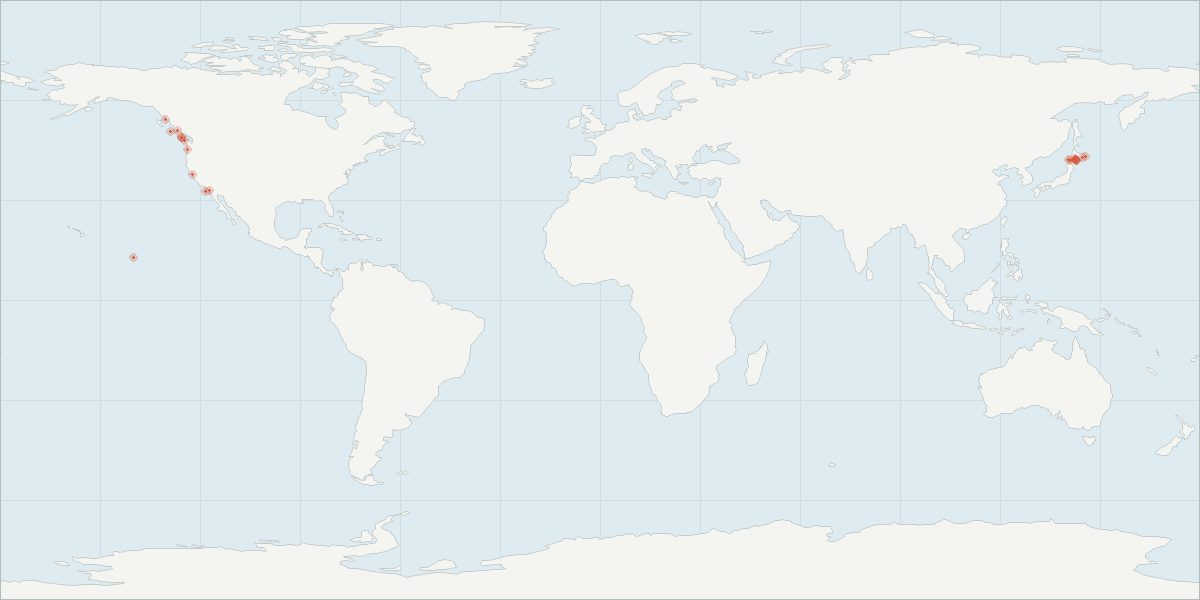
Hubbs’s beaked whale is endemic to the cold temperate waters of the North Pacific, where it occupies the deep oceanic domain, well beyond the continental slope, within the subarctic current system. On the American seaboard, records extend from Ensenada, in Baja California, Mexico, a stranding of June 2011 and the southernmost known record, to British Columbia, the northern limit lying at Prince Rupert. To these are added two sightings at sea off Vancouver Island: a group of five to seven animals on 4 March 2015 and a pair on 12 July 2016, which provided the first photographs of the species alive in the wild. On the Asian seaboard, the species is documented along the Pacific coast of Japan, in particular off north-eastern Honshū, and in the Sea of Japan; several strandings have been reported from Ayukawa. The available data suggest a continuous range across the North Pacific, including the abyssal plains of the open ocean, but sightings remain too few for its precise outline to be drawn.
The encounter documented in September 2021 illustrates this offshore habitat well: it took place about 350 km off the mouth of the Columbia River (Oregon), in 2,509 m of water, at 45°56′N and 128°34′W.
The species is entirely absent from French waters. It has never been reported in the Mediterranean, in the Bay of Biscay or in the English Channel, and its strictly cold temperate North Pacific range also excludes the French overseas territories, all of which lie in the tropics or in the southern hemisphere. The beaked whales seen in French waters belong to other species of the same family.
Examination of stomach contents shows a typically mesopelagic to bathypelagic diet, dominated by cephalopods. Squid of the genus Gonatus have been identified there, along with Octopoteuthis deletron, Onychoteuthis borealijaponica and Stigmatoteuthis dofleini, as well as deep-water fish: the Pacific viperfish (Chauliodus macouni), the medusafish (Icichthys lockingtoni), Poromitra crassiceps and the lanternfish Lampanyctus regalis. Like other ziphiids, the species is considered a deep diver that takes its prey by suction: by abruptly retracting the tongue and expanding the gular grooves, it creates a pressure drop that draws the prey into the mouth, a technique that makes the teeth useless for feeding and explains why they have been retained, in males, only as weapons for fighting.
Echolocation is the main means of detecting the species. A stereotyped pulsed signal named BW37V, characterised by a marked notch in the frequency spectrum around 37-39 kHz, is now attributed to it: the genetic identification of the animals recorded in 2021 made it possible to confirm this association, which had long remained provisional. The blow is low and inconspicuous, which, added to long dives and an undemonstrative surface behaviour, makes sightings exceptional.
Social life remains very poorly known. The animals appear to travel in small groups of two to seven individuals. In 2021, two juveniles with no accompanying adult stayed near the research vessel for close to two hours, approaching to within ten metres and passing under the bow, a curious behaviour unexpected in a mesoplodont. Only one of the two could be biopsied: genetic analysis identified it as a female, the sex of its companion remaining unknown. Such pairs of unaccompanied young have also been reported in other ziphiids. In adults, the heavy scarring of males points to intense competition, probably in the form of jousts in which the tusks gash the opponent; this pattern is suggestive of a polygynous mating system.
Breeding is documented only indirectly, from stranded foetuses and newborns. Gestation is estimated at about twelve months and births are thought to be concentrated in late spring and summer, for a newborn of about 2.5 m. A single calf is born at a time. The available data allow neither an estimate of longevity nor a figure for the age at sexual maturity, physical maturity being associated only with a size of about 4.9 to 5 m. Two animals stranded alive, held in a tank for 16 and 25 days respectively, provided most of the few direct behavioural and acoustic observations made on the species.
Hubbs’s beaked whale is classified as “Data Deficient” (DD) on the IUCN Red List. The assessment in force was carried out on 13 August 2020 and published the same year by R. L. Pitman and R. L. Brownell Jr. In the December 2020 revision, which covered twenty-two cetacean assessments and moved many ziphiids into the “Least Concern” category, this species remained DD: there is no abundance estimate, very few confirmed sightings at sea, and the population trend is described as unknown.
The threats identified are those that bear on offshore beaked whales as a whole. Bycatch is the most directly documented risk: animals have been taken in drift gillnets off California, and interactions with longlines are reported. In Japan, small-scale opportunistic hunting has existed and meat attributed to the species has appeared occasionally on markets, without there ever having been a directed commercial fishery. Next come noise impacts: ziphiids are among the cetaceans most sensitive to intense anthropogenic sound, in particular mid-frequency active military sonar and seismic survey campaigns, associated elsewhere in the world with atypical mass strandings. To these are added pollution, with plastic ingestion recorded in one stranded animal and tissue contamination by organochlorines, and the expected effects of climate change on offshore food webs. The species is listed in Appendix II of CITES, as are all cetaceans not listed in Appendix I.
Recent research does, however, qualify the picture of an intrinsically rare species: the apparently continuous distribution across the abyssal plains of the North Pacific and the acoustic detections suggest that a far from negligible offshore population could exist, simply out of reach of conventional survey methods. The wider use of passive acoustic monitoring, now coupled with photographic identification of adults by their white rostrum, is the most promising route to taking this species out of the “Data Deficient” category.
There is no whale-watching activity for this species, and it would be unrealistic to hope for one: Hubbs’s beaked whale lives several hundred kilometres offshore, over depths of more than 2,000 m, dives for long periods and surfaces without a visible blow. The few documented encounters have been made from oceanographic vessels engaged in surveys dedicated to ziphiids, combining a visual watch team and a towed hydrophone array. That is how the first genetic confirmation of living animals was obtained, in September 2021 off Oregon; the first photographs of free-ranging animals, for their part, had been taken off Vancouver Island in 2015 and 2016.
Passive acoustic detection is the reference tool: the BW37V signature, with its spectral notch around 37-39 kHz, now makes it possible to identify the species without seeing it, from autonomous recorders deployed in the open ocean. For the few sailors who might come across a beaked whale on the high seas, good practice is simple: never chase the animal, hold a constant course and speed, switch off any echo sounders and sonars that are not essential, and keep to photographs of the head and the back, the only genuinely diagnostic features. A sharp picture of the beak is particularly valuable: in the adult, its pure white is enough to tell the species from every other mesoplodont of the North Pacific. Finally, any beaked whale stranding should be reported without delay to the competent national network: these dead animals remain, even today, a major source of knowledge about the species, and a properly documented and sampled carcass is worth several years of observation at sea.
No. This species is endemic to the cold temperate waters of the North Pacific, between Japan and the west coast of North America. It has never been reported in the Mediterranean, in the Bay of Biscay or in the English Channel, and its range also excludes the French overseas territories. The beaked whales encountered in French waters belong to other species of the family Ziphiidae.
It combines every trait that makes a cetacean all but invisible: an offshore habitat over depths of several thousand metres, long deep dives, a low and inconspicuous blow, a modest size and an undemonstrative surface behaviour. The result: most of what is known comes from stranded animals, more than sixty of them recorded on both sides of the North Pacific, and sightings of living animals at sea can be counted on the fingers of one hand, the first photographs dating only from 2015.
In the adult, male and female alike, the rostrum is entirely white, above and below: it is the only mesoplodont of the North Pacific in this case, and that single criterion allows an identification from a photograph. The adult male adds to this a very dark grey to black body, a sharply defined white cap over the melon and a pair of tusk-like teeth emerging at the top of a raised ridge of the lower jaw, visible when the mouth is closed; its body is streaked with paired linear scars, the marks of fights between males. The adult female, just as dark, has neither a white “bonnet”, the top of her melon staying dark, nor visible teeth. It is the young, grey and with a beak that has barely begun to whiten, that cannot be told apart from other mesoplodonts without genetic analysis.
The IUCN classifies it as “Data Deficient” (DD), on the basis of an assessment dated 13 August 2020 and published the same year. No abundance estimate exists and the population trend is unknown. In the December 2020 revision, several ziphiids moved to “Least Concern”, but Hubbs’s beaked whale remained DD for want of data. It is listed in Appendix II of CITES.
Its diet is dominated by mesopelagic squid (Gonatus, Octopoteuthis deletron, Onychoteuthis borealijaponica, Stigmatoteuthis dofleini) and supplemented by deep-water fish such as the Pacific viperfish, the medusafish or lanternfishes. It locates its prey by echolocation, then draws them in: by retracting the tongue and expanding the gular grooves, it creates a pressure drop inside the mouth. Its teeth therefore play no part in feeding, serving only, in males, for fights between rivals.
Beaked whales are among the species most sensitive to intense anthropogenic sound, and the IUCN assessment explicitly retains active military sonar and seismic surveying among the threats bearing on this species. No mass stranding event has been attributed specifically to it, but its biology as a deep diver places it in the same category of vulnerability as the ziphiids involved elsewhere in episodes of this kind. Bycatch in driftnets, and plastic and chemical pollution, complete the picture of identified pressures.
Profile compiled from authoritative scientific sources (IUCN, NOAA Fisheries, specialist literature) and reviewed for factual accuracy.
According to the open data of the GBIF, 24 georeferenced sightings of Mesoplodon carlhubbsi are recorded in our photographic index.
| Country | Notes |
|---|---|
| Japan | 12 |
| United States of America | 11 |
| Canada | 6 |

Monthly distribution of 27 dated sightings (all years combined): the maximum is reached in juillet.
| Month | Notes |
|---|---|
| janvier | 1 |
| February | 1 |
| mars | 1 |
| avril | 3 |
| mai | 2 |
| juin | 3 |
| juillet | 5 |
| August | 5 |
| septembre | 0 |
| octobre | 2 |
| novembre | 1 |
| December | 3 |
These figures reflect survey effort (more boaters and more surveys in summer) as much as the actual presence of the species: to be interpreted with caution.


Photographs from GBIF under a Creative Commons licence. The author and the licence of each photograph are given; please respect them if you reuse them.
Automatic selection of the most cited works mentioning the species (source: Crossref).