| Scientific name | Mesoplodon europaeus (Gervais, 1855) |
|---|---|
| Other names | Gervais's beaked whale, Antillean beaked whale, Gulf Stream beaked whale, European beaked whale; protonym Dioplodon europaeus Gervais, 1855; in French: baleine à bec de Gervais, mésoplodon de Gervais, mésoplodon d'Europe, mésoplodon des Antilles. |
| Size | Males about 4.5 m; females up to 5.2 m (reports of up to 5.4 m); newborn about 2.1 m. |
| Weight | More than 1,200 kg in large females, the maximum mass retained by the reference sources (NOAA, WDC). A 4.6 m female stranded in Martinique in October 2021 was estimated on site at about 2 tonnes, a figure well above the published values and to be taken as an unweighed field estimate. Newborn: about 80 kg. |
| Longevity | At least 27 years; one stranded individual was estimated at about 48 years. |
| Diet | Deep-water squid (Octopoteuthis, Mastigoteuthis, Taonius), mesopelagic fish (viperfish, black gemfish, Lampadena) and a few crustaceans, including a large red mysid. Prey taken by suction, without biting. |
| IUCN status | Least Concern (LC), global assessment of 2020 (Pitman & Brownell Jr.), which replaced an earlier status of “Data Deficient” (DD). Population trend unknown. No Mediterranean subpopulation: the species is strictly Atlantic. In the French Antilles, the regional status is “Data Deficient”. |
Gervais's beaked whale is a pelagic ziphiid of the warm waters of the Atlantic, and one of the least observed large cetaceans in the world: the first confirmed sighting at sea dates only from 1998, off Tenerife. At 4.5 to 5.2 m long, it remains known above all from strandings, frequent on the east coast of the United States and exceptional in mainland France.
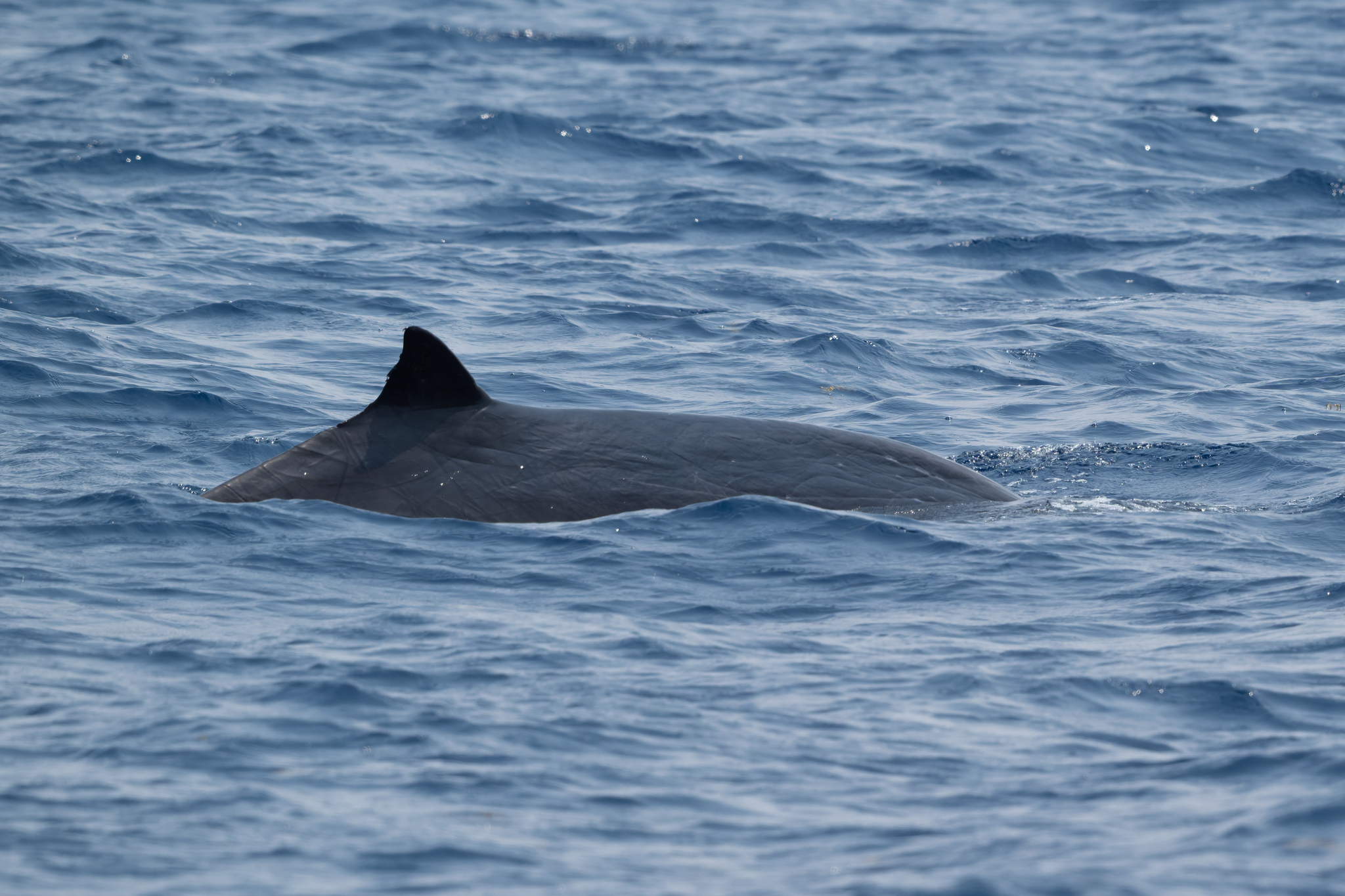
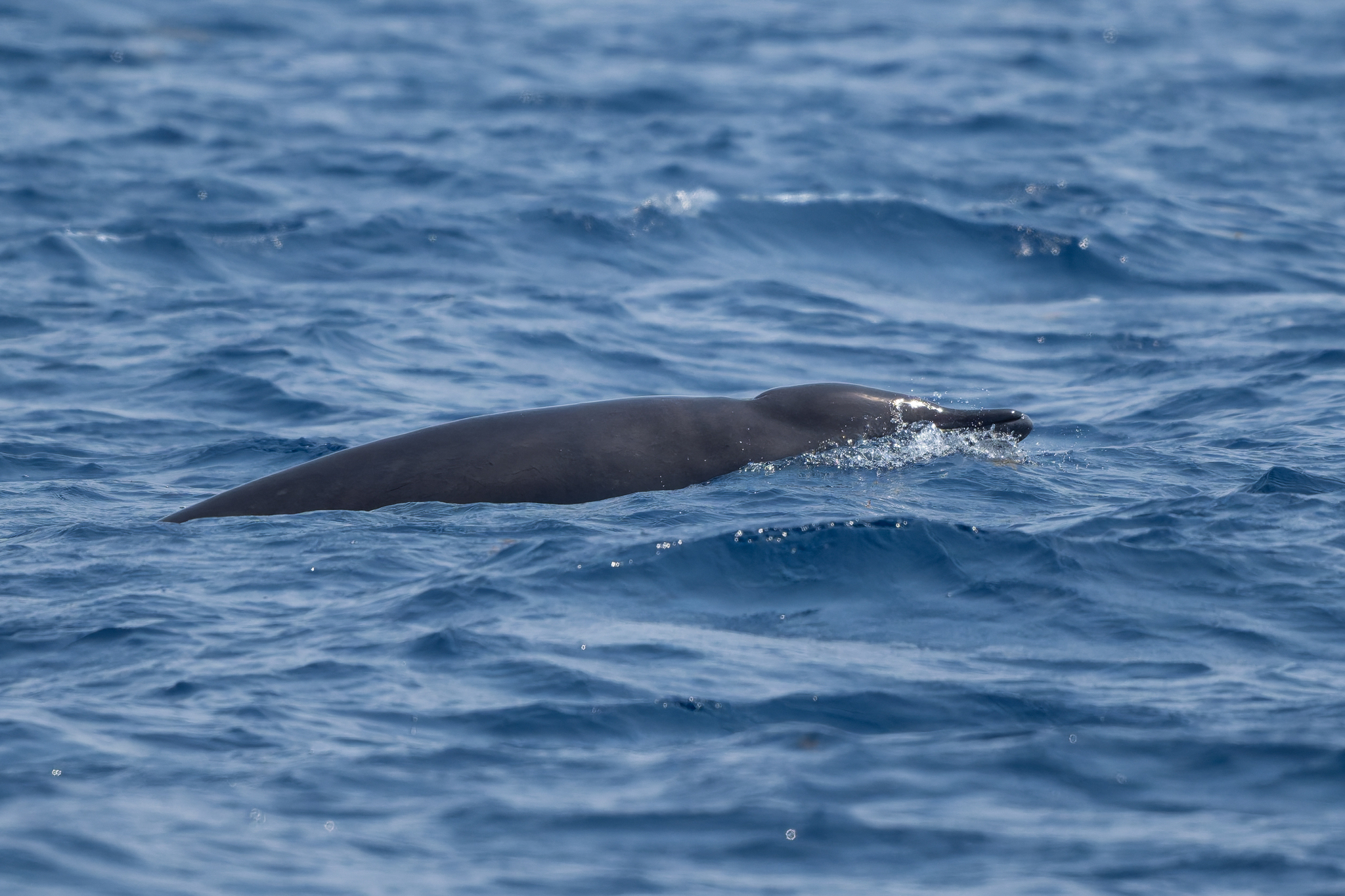
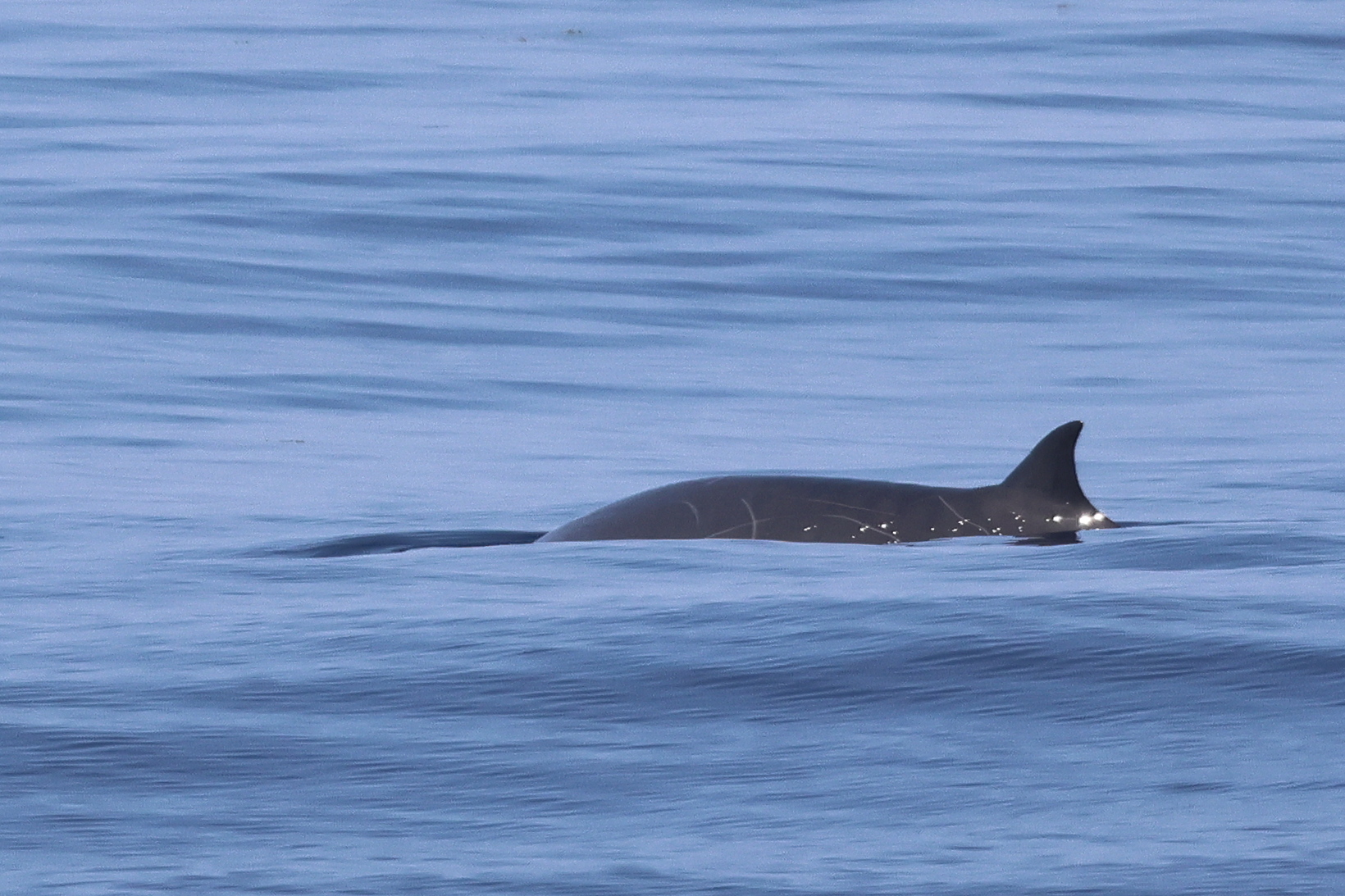
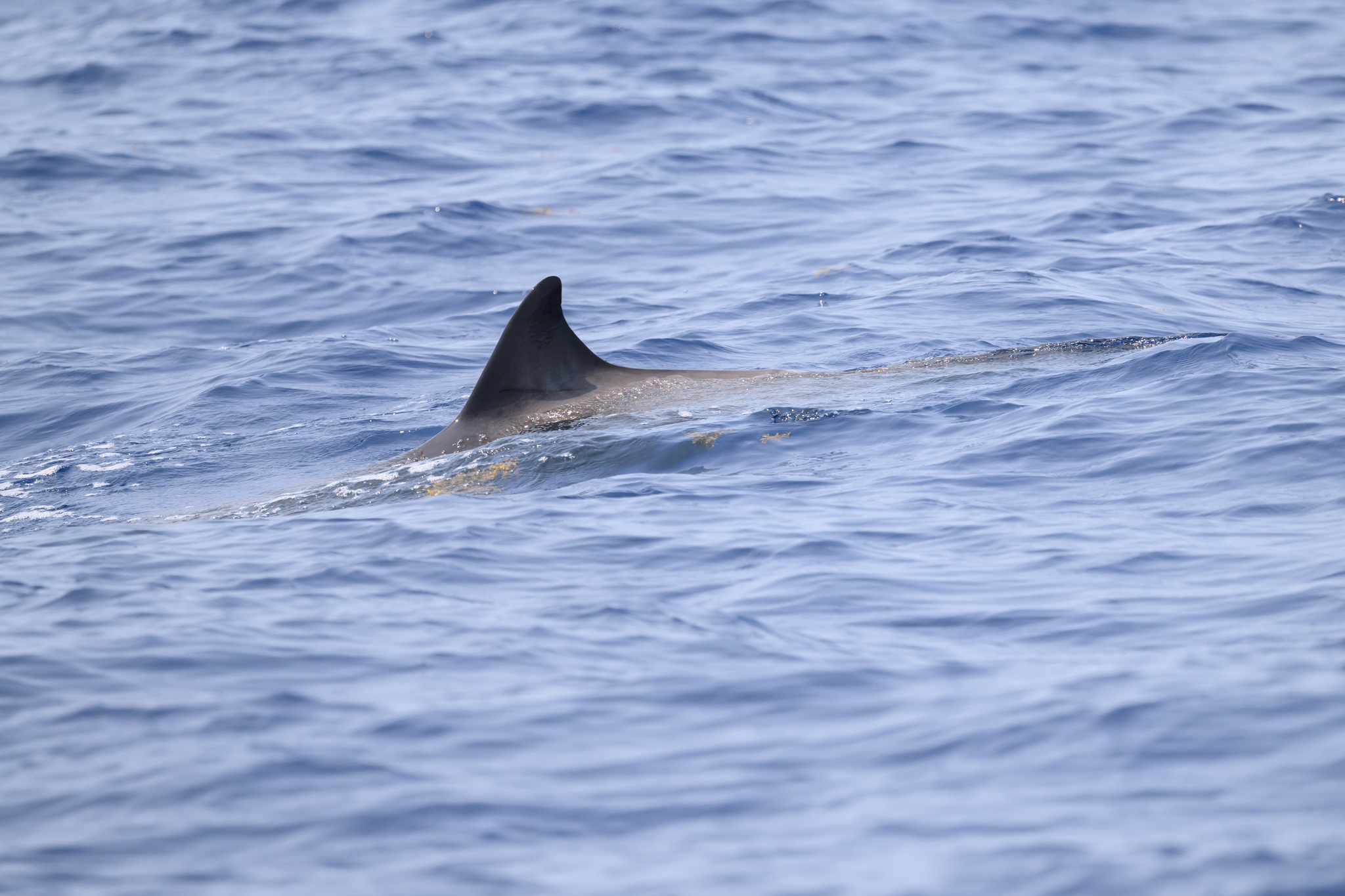
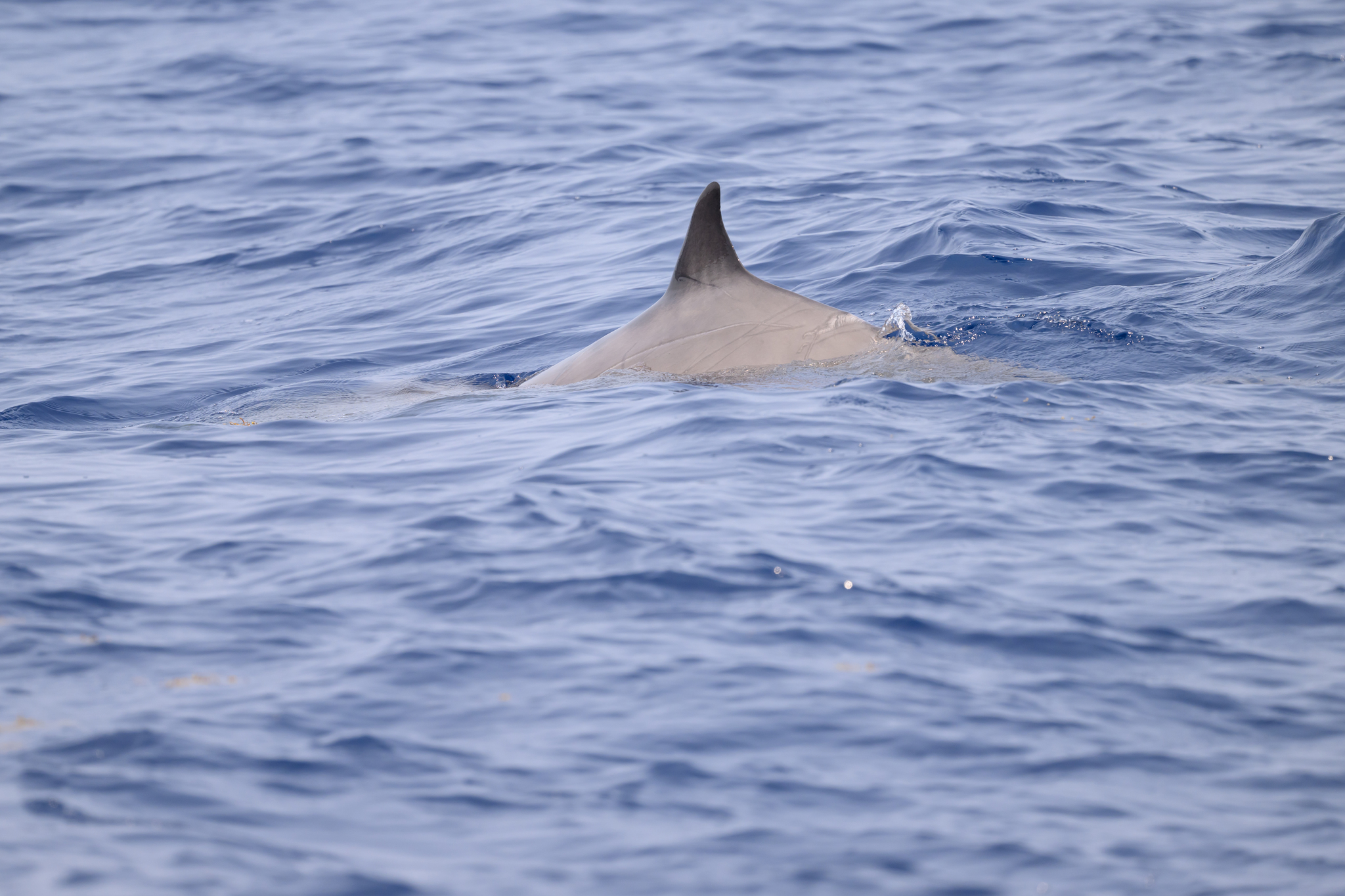
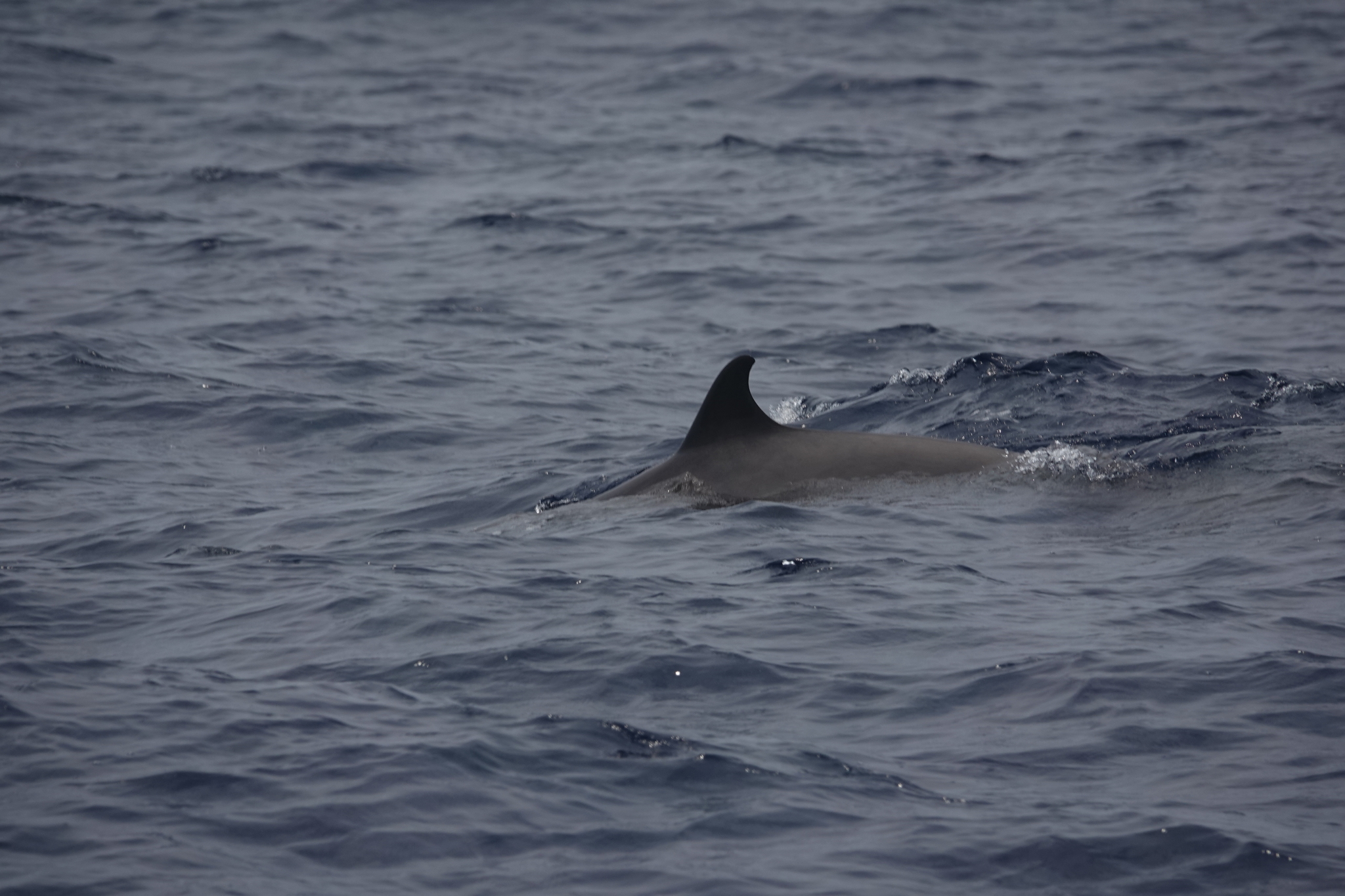
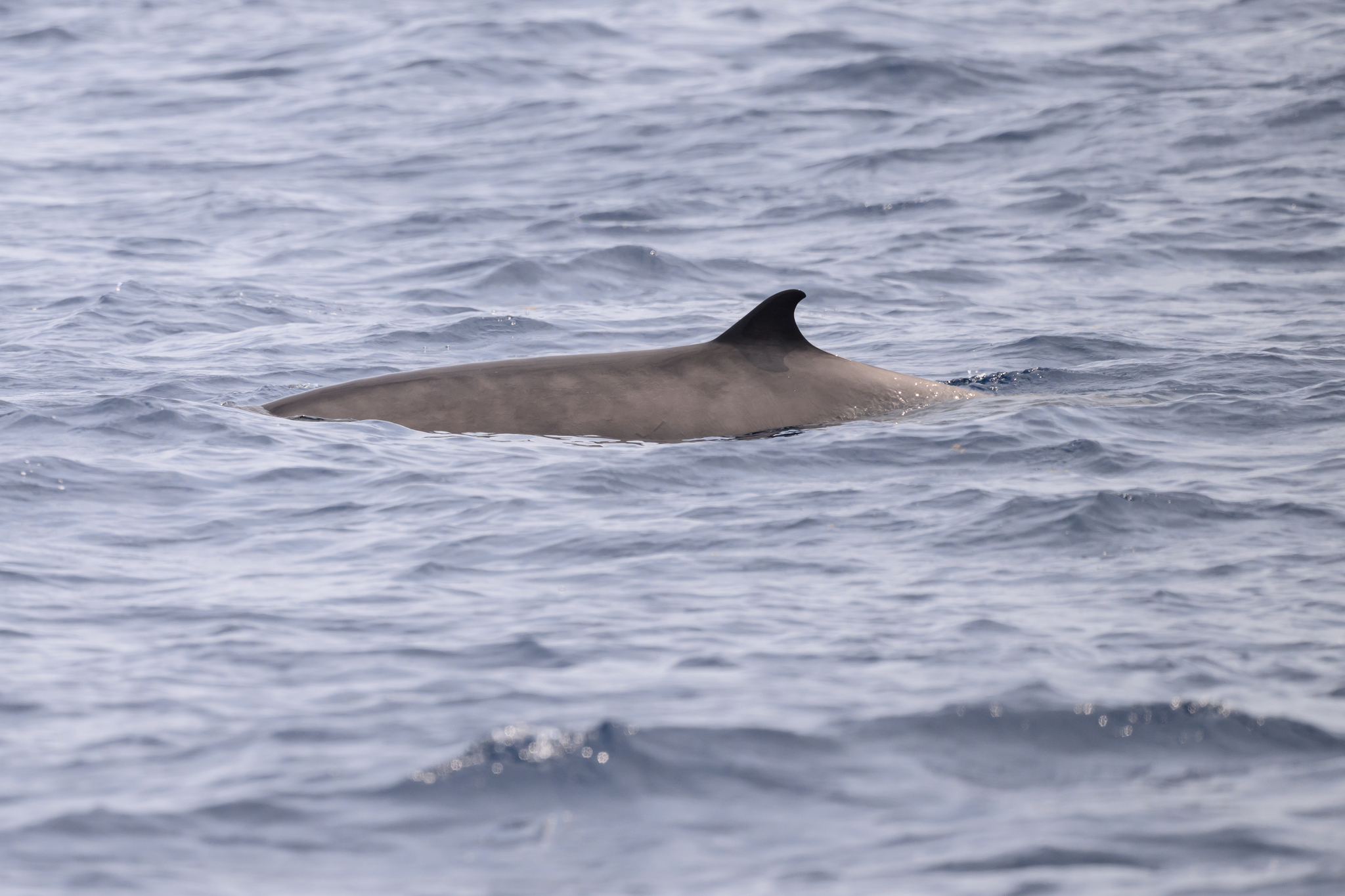
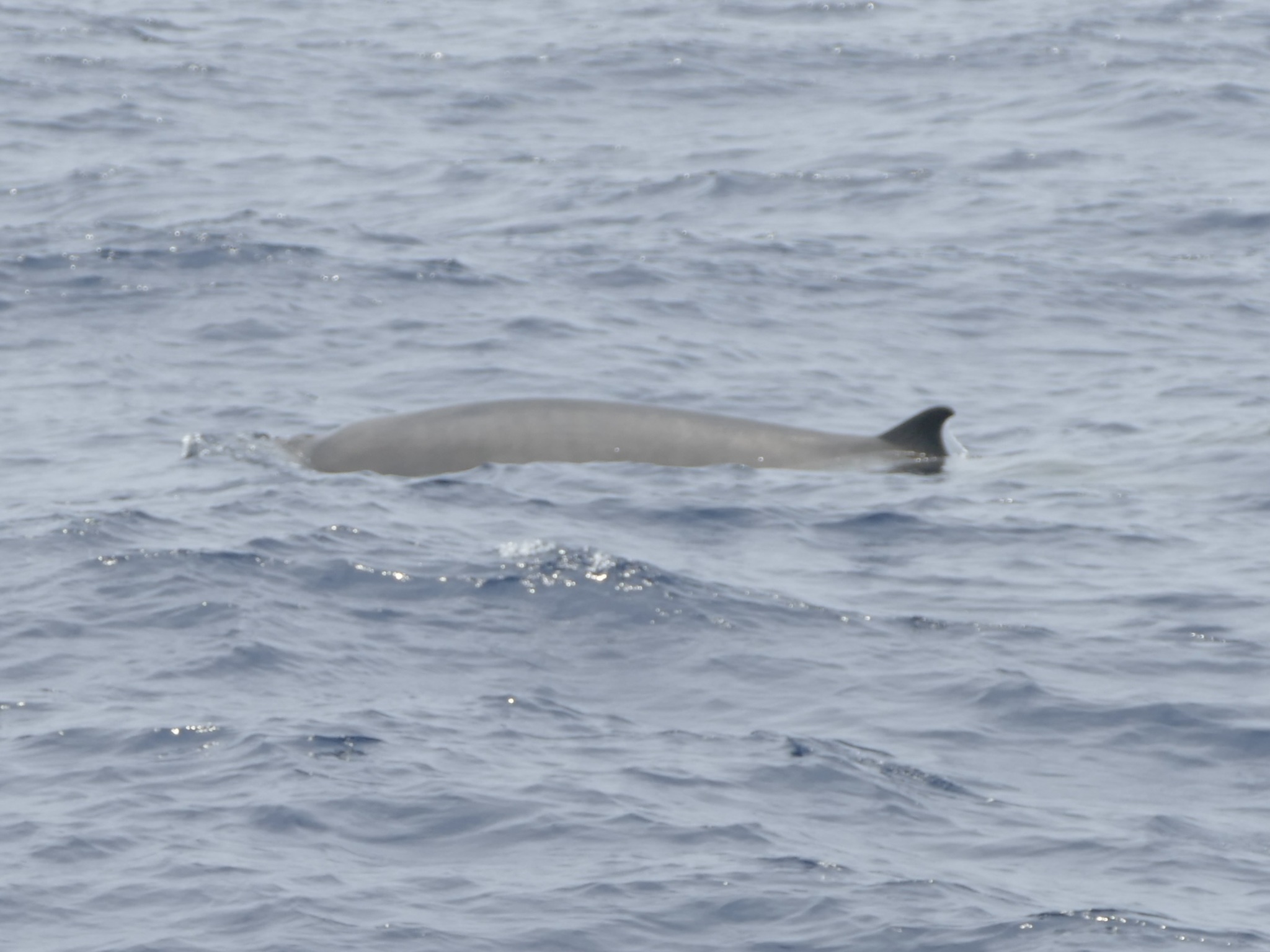
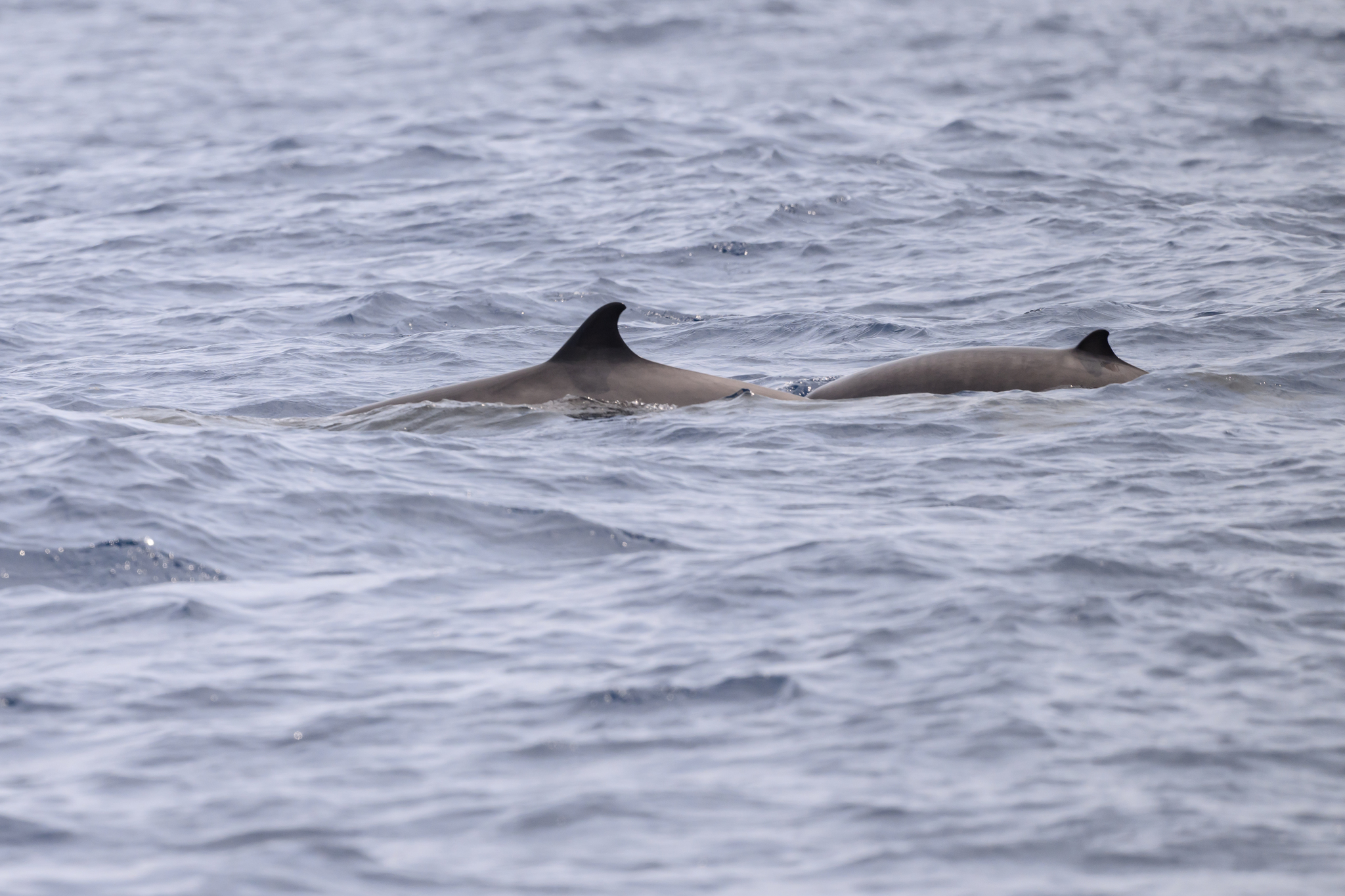
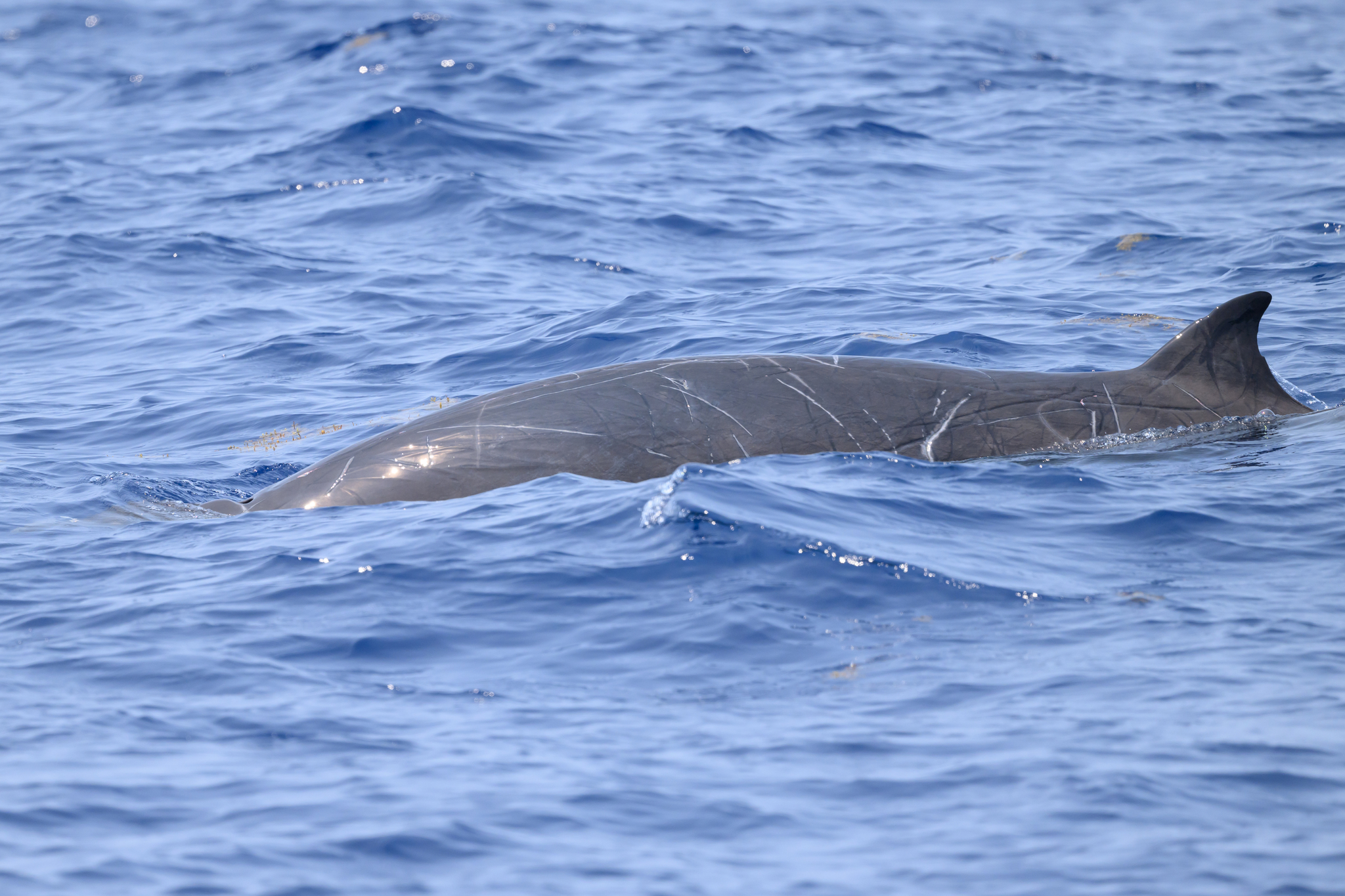
Gervais's beaked whale is among the largest mesoplodont beaked whales, without being the largest of the genus, a title that goes to the strap-toothed whale (Mesoplodon layardii, up to 6.2 m), and it is also one of the most slender: a streamlined body, elongated and laterally compressed, a small tapering head, a barely domed melon continuing into a narrow rostrum of medium length. The dorsal fin, small and triangular, is set far back, on the last third of the back. Adults measure about 4.5 m in the male and up to 5.2 m in the female, which is slightly larger; individuals of 5.4 m have been reported. Weight exceeds 1,200 kg in large females, the maximum mass retained by the reference sources; a 4.6 m female stranded in Martinique was estimated on site at about 2 tonnes, a figure well above the published values and to be taken as a field estimate, without weighing. Newborns measure close to 2.1 m for about 80 kg.
The coloration is dark grey on the back and paler on the belly; it darkens with age, young animals being born paler. A black ring around the eye is characteristic. Females often carry pale blotches on the face and a whitish area around the genital region. As in all mesoplodonts, only adult males show teeth: a single pair, small and triangular, set on the anterior third of each lower jaw and so little protruding that it easily goes unnoticed. In the female, the teeth remain buried in the gum.
Confusion here is the rule rather than the exception: at sea, mesoplodonts are practically impossible to tell apart, and scientific surveys often record them at genus level only. The most reliable criterion remains the position of the teeth in the male. In True's beaked whale they are set right at the tip of the lower jaws; in Sowerby's beaked whale, at mid-length of the rostrum; in Gervais's beaked whale, at the anterior third. The line of the mouth, remarkably straight even in males, further separates the species from mesoplodonts with a strongly arched lower jaw.
The species belongs to the genus Mesoplodon, by far the richest among living cetaceans, within the beaked whale family, the Ziphiidae, also designated under the name Hyperoodontidae. Its history is a singular one. Between 1836 and 1841, the captain of a ship belonging to the French shipowner Abel Vautier came across a large floating animal covered in gulls at the entrance to the English Channel; he cut off its head and brought it back to Caen, where it was handed to Vautier and then to the anatomist Deslongchamps. The specimen finally reached Paul Gervais, who described the species in 1855 under the name Dioplodon europaeus, hence the epithet “europaeus”. For decades this single skull was disputed, some seeing in it an aberrant Sowerby's beaked whale. The validity of the species was established only with two animals from New Jersey: an immature male caught near Atlantic City in 1889 and an adult female stranded at North Long Branch in 1905.
The species is strictly Atlantic. It frequents deep tropical, subtropical and warm temperate waters, and occasionally enters cooler seas. In the west, it is present from Cape Cod to Florida, in the Gulf of Mexico and throughout the Caribbean; it is the mesoplodont that strands most often on the Atlantic coast of the United States, and probably the species of the genus most frequently sighted in those waters. In the east, records exist in Ireland, in the Canary Islands, along West Africa, at Ascension Island and as far as Brazil, where an animal found in the state of São Paulo in August 2001 is the southernmost record known. This is an offshore species: sightings and strandings are tied to continental slopes, canyons and oceanic depths, generally beyond 500 m depth.
In France, occurrence is established but very rare. The type specimen comes from the entrance to the English Channel; in mainland France, the first modern stranding was recorded in the Landes in 1999, and the second only on 5 March 2023, at Capbreton, also in the Landes, where the Observatoire Pelagis examined a young male of 4.30 m. Both finds are tied to the Bay of Biscay and its submarine canyons, where no sighting of the species at sea has been confirmed. It is in the French Antilles that the species is best represented, with around ten strandings recorded since the 2000s, including a pregnant female of 4.6 m stranded on 23 October 2021 on the beach at Le Diamant, Martinique. No population is established in the French Mediterranean.
A deep diver, Gervais's beaked whale feeds in the deep water column by suction: by abruptly retracting the tongue and expanding the gular grooves, it creates a drop in pressure inside the mouth that draws the prey in without it needing to seize it. Stomach contents reveal above all deep-water squid of the genera Octopoteuthis, Mastigoteuthis and Taonius, mesopelagic fish such as viperfish, black gemfish or Lampadena, as well as a few crustaceans, including a large red mysid. Documented dives last about an hour and are separated by brief periods at the surface, with a low and barely visible blow; mesoplodonts in general descend beyond 1,000 m depth.
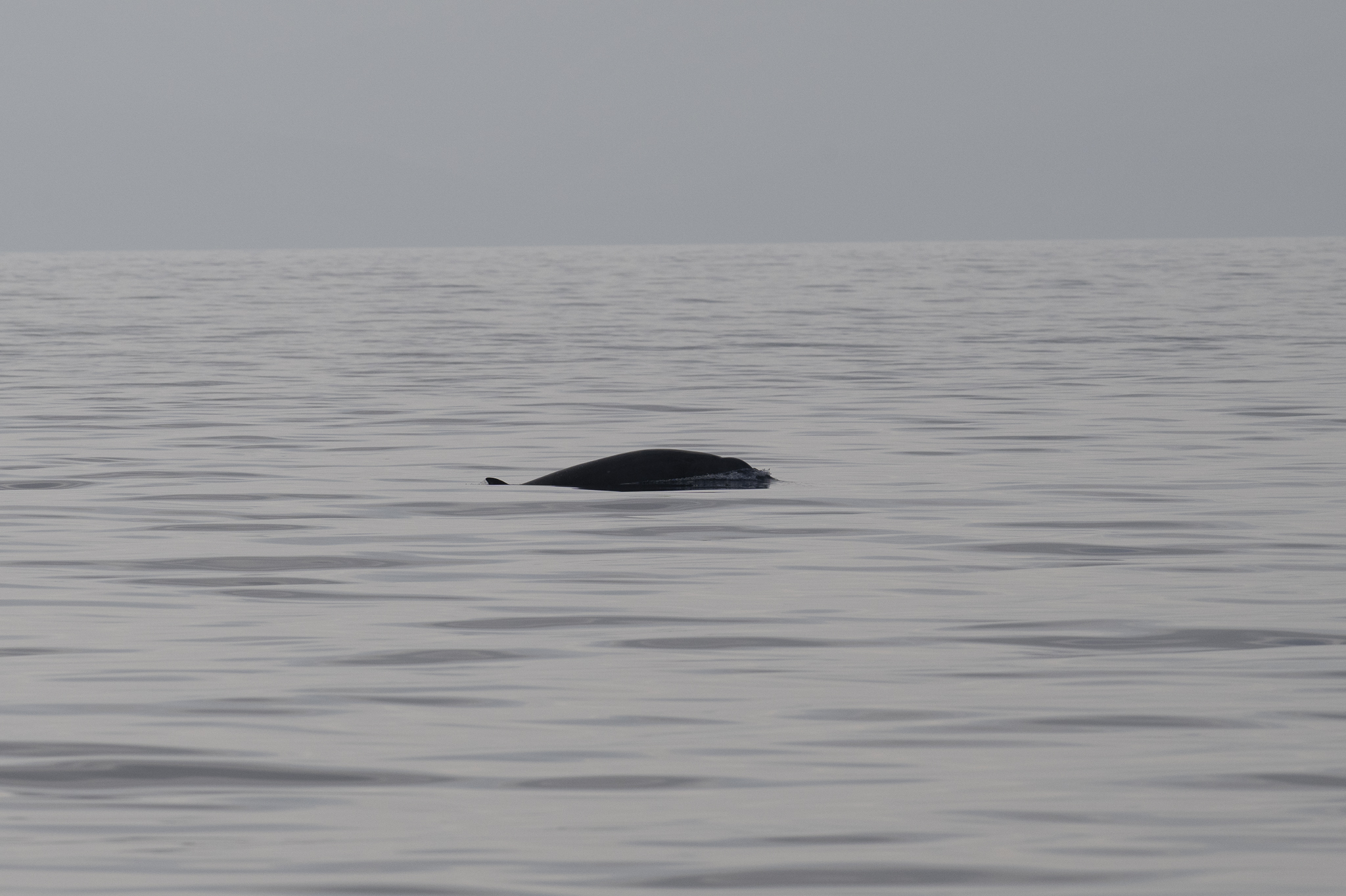
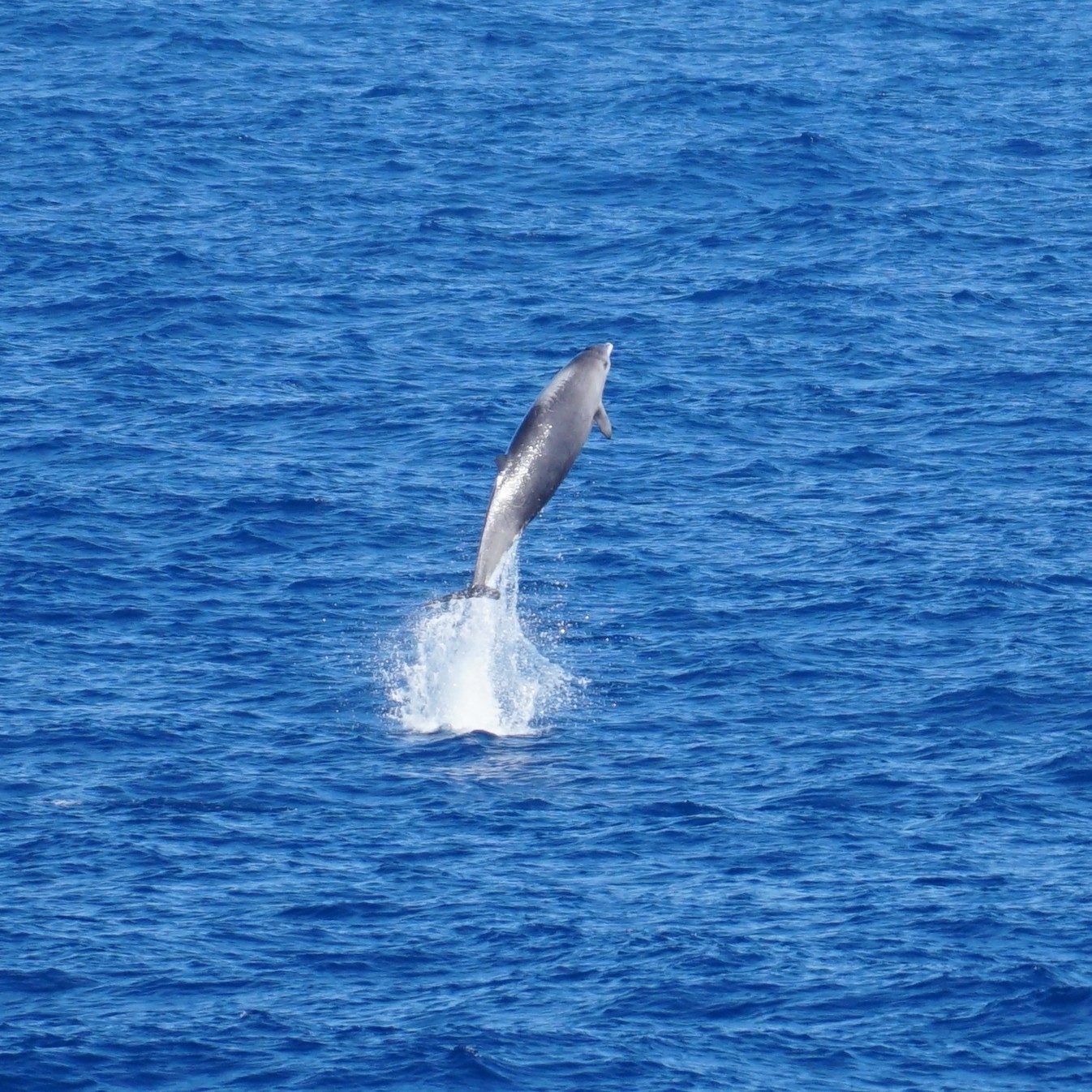
The species lives alone or in small close-knit groups of a few individuals, far from the coast. Its unobtrusiveness is extreme: a low silhouette, rare aerial behaviour, unpredictable resurfacing kilometres from the point of the dive. Breaches have nonetheless been photographed north-east of Lanzarote in September 2008.
Breeding remains poorly known. The female appears to reach sexual maturity at around 4.5 to 4.6 m and gives birth to a single calf, perhaps about every three years. Longevity is estimated to be at least 27 years, one stranded individual having perhaps reached 48 years.
The IUCN Red List has classified the species as “Least Concern” (LC) since its 2020 assessment, which replaced an earlier status of “Data Deficient”. This reclassification, shared by most of the beaked whales reassessed the same year, stems above all from a revision of the rules governing use of the “Data Deficient” category rather than from a demonstrated improvement in the situation: the population trend remains unknown. At the scale of the French Antilles, the species is still assessed as “Data Deficient”.
The north-west Atlantic stock was estimated at 8,595 individuals (CV = 0.24) during the summer 2021 survey at sea, between central Florida and the Bay of Fundy. The potential biological removal calculated by NOAA stands at 70 animals per year and no fishery-related mortality was observed between 2017 and 2021, the permanent closure of the pelagic drift gillnet fishery having removed the main known source of bycatch.
Current threats have above all to do with underwater noise: ziphiids are particularly sensitive to mid-frequency military sonar, which has been associated with several mass strandings in the North Atlantic. Plastic ingestion is documented as well, from a juvenile found in Puerto Rico in May 2011 with its stomach full of plastic bags to the fragments recovered from the digestive tract of the Capbreton male. The species is listed in Appendix II of CITES, falls under the CMS Memorandum of Understanding on the Conservation of the Manatee and Small Cetaceans of Western Africa and Macaronesia, and is covered by the ASCOBANS agreement, whose area of application includes the Bay of Biscay. The mention of ACCOBAMS, sometimes repeated, has no real bearing: the species is absent from the Mediterranean and the Black Sea. Like all cetaceans, it is fully protected in French waters.
Seeing a Gervais's beaked whale is a rare privilege. The species was identified with certainty at sea only in 1998, when three animals were followed west of Tenerife over depths of 1,500 m; other encounters have taken place south of Gran Canaria, and the deep waters of the Canary Islands remain the most favourable area. Elsewhere, the chances are concentrated offshore of the Antilles, on deep-water survey trips in very calm weather, watching for a low blow and a grey back that rolls briefly before an hour-long dive. In the Bay of Biscay, on the other hand, the species has never been the subject of a confirmed sighting at sea: it is known there only from two strandings, and the mesoplodonts observed alive above the canyons and the abyssal plain are True's beaked whales (Mesoplodon mirus).
Approach ethics are here more than a formality, for these animals are sensitive to acoustic disturbance: switch off the sonar, reduce speed, keep your distance and let the animal choose its own course. The most useful contribution from the public, however, remains reporting. Any stranded cetacean, dead or alive, must be reported without being handled: in mainland France to the Réseau national échouages, the national stranding network coordinated by the Observatoire Pelagis, and in the Antilles to the local network relayed by the Agoa sanctuary. These strandings provide the essentials of what is known about the species.
Because the type specimen is European: between 1836 and 1841, the head of a cetacean floating at the entrance to the English Channel was brought back to Caen, then passed on to Paul Gervais, who described the species in 1855. Most of the sightings and strandings have since been recorded in the western Atlantic.
Yes, but very rarely. Only two strandings are recorded in mainland France, both in the Landes: the first in 1999, the second on 5 March 2023 at Capbreton, a young male of 4.30 m examined by the Observatoire Pelagis. In the French Antilles, around ten strandings have been recorded since the 2000s, including a pregnant female of 4.6 m at Le Diamant, Martinique, on 23 October 2021. No population is established in the French Mediterranean.
By the position of the teeth in the male: at the anterior third of each lower jaw in Gervais's beaked whale, right at the tip of the beak in True's beaked whale, at mid-length of the rostrum in Sowerby's beaked whale. The line of the mouth, remarkably straight, also helps. At sea, the distinction remains so difficult that scientific surveys often record these animals at genus level.
The dives observed last about an hour, broken by short periods at the surface. The species frequents depths generally greater than 500 m, and mesoplodonts in general descend beyond 1,000 m to hunt squid and mesopelagic fish.
No. At 4.5 m in the male and up to 5.2 m in the female, Gervais's beaked whale is among the largest representatives of the genus, but the record goes to the strap-toothed whale (Mesoplodon layardii), which reaches 6.2 m. In the Atlantic, Sowerby's beaked whale and True's beaked whale also equal or exceed its dimensions. It is, on the other hand, the largest mesoplodont to strand regularly on the North American Atlantic coast.
It has been classified as Least Concern (LC) by the IUCN since 2020, but the trend of its population remains unknown. The main pressures are underwater noise, in particular mid-frequency military sonar, plastic ingestion and, more marginally today, bycatch.
Do not handle it, keep dogs and the public at a distance and alert the competent network immediately: in mainland France the Réseau national échouages coordinated by the Observatoire Pelagis, in the Antilles the local network relayed by the Agoa sanctuary. These reports provide the essentials of what is known about the species.
Species account compiled from authoritative scientific sources (IUCN, NOAA Fisheries, specialist literature) and reviewed for factual accuracy.
According to the open data of the GBIF, 116 georeferenced sightings of Mesoplodon europaeus are recorded in our photographic index.
| Country | Notes |
|---|---|
| United States of America | 108 |
| unknown or invalid | 11 |
| Spain | 7 |
| Portugal | 6 |
| Cabo Verde | 3 |
| Brazil | 2 |
| Bahamas | 1 |
| Cayman Islands | 1 |
| Dominica | 1 |
| France | 1 |

Monthly distribution of 142 dated sightings (all years combined): the maximum is reached in juin.
| Month | Notes |
|---|---|
| janvier | 9 |
| February | 4 |
| mars | 5 |
| avril | 12 |
| mai | 24 |
| juin | 36 |
| juillet | 6 |
| August | 12 |
| septembre | 7 |
| octobre | 7 |
| novembre | 10 |
| December | 10 |
These figures reflect survey effort (more boaters and more surveys in summer) as much as the actual presence of the species: to be interpreted with caution.


Photographs from GBIF under a Creative Commons licence. The author and the licence of each photograph are given; please respect them if you reuse them.
Automatic selection of the most cited works mentioning the species (source: Crossref).