
A killer whale known as Toñi, nicknamed La Abuela, the grandmother, was photographed on 12 August 2026 in the Strait of Gibraltar with about ten impact marks on her dorsal fin, consistent with a shot from a hunting shotgun. She is the oldest known animal in a population that now numbers no more than 37 individuals.
The seriousness of this event does not rest on the brutality of the act alone. It rests on the identity of the animal targeted, and on one precise demographic parameter that research has just brought to light.
What the photographs show
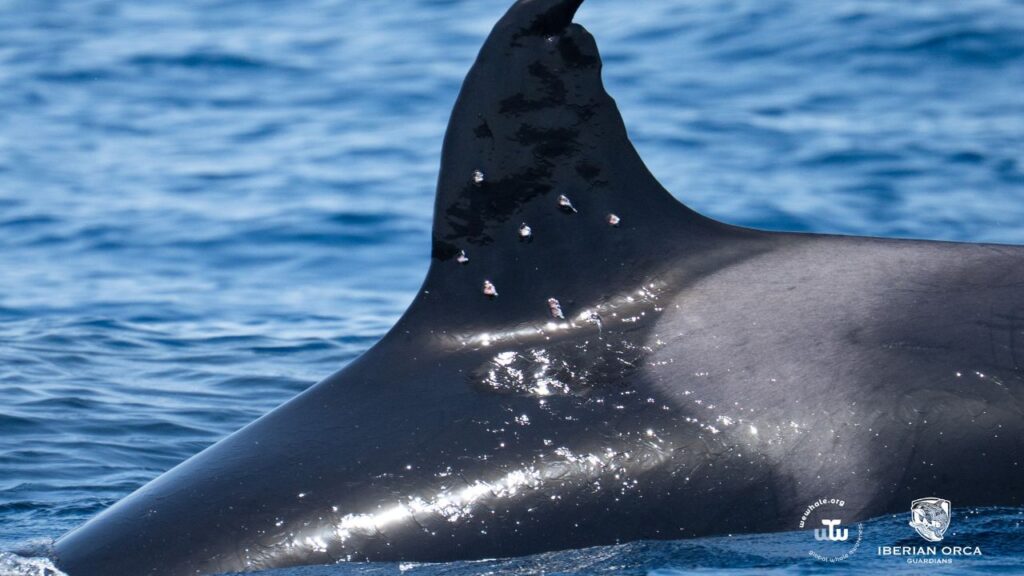
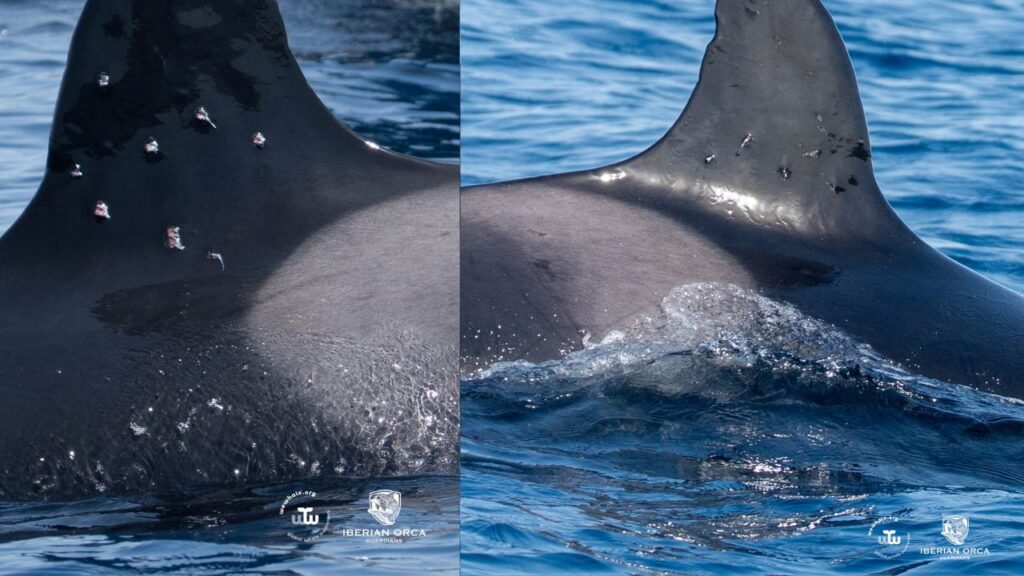
The account comes from a statement issued on 12 August 2026 from Cádiz by the association WeWhale and the foundation Iberian Orca Guardians, as part of their Save The Iberian Orca campaign. The images were collected under a permit from the Spanish Ministry for the Ecological Transition and the Demographic Challenge, reference SGBTM/BDM/AUTSPP/41/2026.
The observers describe multiple impact marks spread over the dorsal fin and the back, about ten on the lower edge of the fin alone. Two or three projectiles appear to have passed through it, the others appear to be lodged inside.
It is the dating that gives the case its strength. The same team has been following Toñi for a long time and had photographed her a few weeks earlier: her dorsal fin then bore none of these marks. The organisations state that they are keeping the original photographs and the observation notes, which gives them evidential value.
The statement itself is restrained: the team concludes that this was a shotgun blast “from the appearance, the number and the distribution of the wounds”. A more detailed ballistic analysis has, on the other hand, circulated in the Spanish press, and deserves to be reported with due caution. The injuries are said to correspond to lead balls of about 9 millimetres, buckshot of the type used for wild boar hunting. A cartridge of this calibre holds nine balls arranged in three layers of three, which fits the number of impact marks observed. The shot is said to have been fired from a 12/70 gauge shotgun, at less than fifteen metres.
At this stage, no authority has confirmed the origin of the wounds. The reading is that of the team that photographed the animal, and the wording used in the Spanish press is that of injuries “consistent with” lead shot. Sea Shepherd France has announced a reward of 10,000 euros for any information leading to the identification of whoever fired.
Why a wound to the dorsal fin matters
The dorsal fin of a killer whale is more than a simple blade of tissue. It is heavily vascularised and plays a part in thermoregulation: it is one of the surfaces through which the animal sheds heat, by modulating the blood flow that supplies it.
Three possible consequences add up. The immediate tissue damage, the inflammation, and above all the risk of infection, markedly raised when foreign bodies remain in the flesh. In the worst case, septicaemia may set in. In an animal that the observers estimate to be around sixty years old, the margin is thin.
To date, the team has noted no obvious abnormality in swimming or in hunting, and is continuing to monitor her.
Thirty-seven individuals, and a female survival rate in decline
This is where the case takes on its full dimension. A study published on 22 October 2025 in Marine Mammal Science by Ruth Esteban and colleagues reassessed the demographic parameters of this subpopulation between 2011 and 2023, from 18,554 photo-identification images and 26 strandings.
| Population in 2023 | 37 individuals |
|---|---|
| Annual growth | 0.46%, that is, an apparently stable population |
| Interval between two births | 8.3 years |
| Juvenile survival | up on the period before 2011 |
| Adult survival | down, particularly among females |
The last row is the one that counts. In a population of 37 animals where a female gives birth only once every eight years on average, the parameter that is deteriorating is precisely the survival of adult females. Each older female represents both reproductive potential and, in killer whales, a store of knowledge: it is the matriarchs who lead the groups towards resources.
In other words, the shot did not strike a random animal within an abundant population. It struck the oldest member of a group of thirty-seven, in the age and sex class whose loss weighs heaviest. Our pages on cetacean demographics and conservation status set out these orders of magnitude.
A subpopulation Critically Endangered since 2019
The IUCN classified the Iberian killer whales as Critically Endangered in 2019, on two criteria. The first concerns numbers: far fewer than fifty mature individuals. The second concerns their diet: they depend closely on Atlantic bluefin tuna, which they hunt in the strait in spring, a prey species itself classified as threatened at the time of the assessment.
The 2025 study confirms that this classification stands. In Spanish law, the population of the Strait of Gibraltar and the Gulf of Cádiz is listed in the national catalogue of threatened species with the status of Vulnerable. The two designations do not contradict each other: they belong to two distinct frameworks, one scientific and international, the other legal and national. See our page on the international legal framework.
In both cases the consequence is the same: these animals are legally protected, and shooting at them is an offence.
The context, without making it an excuse
It would be dishonest to pass over in silence what has been going on in these waters for six years. Since 2020, these killer whales have been interacting with the rudders of sailing boats: the Atlantic Orca Working Group has recorded more than 700 interactions, from a simple push to sessions lasting several hours, with boats left disabled and a few sinkings. The phenomenon is real, costly, and at times frightening for the crews.
Two things must nevertheless be said clearly.
First, nothing establishes a link between this shooting and those interactions. No investigation has been made public, and whoever fired has not been identified. To present the shooting as a response to the interactions would be speculation.
Second, and this is the position defended by Janek Andre, founder and president of both organisations: “shooting these animals can never be an acceptable response”. Whatever view one takes of these interactions, shooting a protected animal is admissible neither in law nor in practice. On grounds of effectiveness alone, wounding one individual in a population of thirty-seven changes no collective behaviour: it simply removes one matriarch from a group that has only a few.
Three unknowns
Three unknowns remain. The exact origin of the wounds, which no authority has confirmed at this stage. The course of Toñi’s condition, which will depend on what becomes of the projectiles left in the tissues, and which observation from a distance cannot settle. And the legal consequences, which would require a boat to be identified.
The photo-identification campaign now under way, run until the end of the year by WeWhale, the Iberian Orca Guardians and Sea Shepherd France, should make it possible to follow the animal. That is also what this kind of programme allows: individual monitoring over decades, without which no one could have stated that these wounds were a few weeks old. Our page how to act for cetaceans lists the ways of supporting this work.
Sources: press release from the WeWhale association and the Iberian Orca Guardians foundation, issued on 12 August 2026 from Cádiz, images collected under permit SGBTM/BDM/AUTSPP/41/2026 from the Spanish Ministry for the Ecological Transition. Press coverage of 13 August 2026: The Olive Press, Diario Área, Portal de Cádiz and Ecoticias; reward announced by Sea Shepherd France. Demographic data: Esteban R., Gauffier P., López A. et al., “Demographic Parameters of Iberian Killer Whales Between 2011 and 2023”, Marine Mammal Science, 22 October 2025. IUCN status: assessment of the Strait of Gibraltar subpopulation, 2019. Interactions with boats: Atlantic Orca Working Group (GTOA).
Photo credits: The images were collected with the authorisation of the Ministerio para la Transición Ecológica y el Reto Demográfico . Permit reference: SGBTM/BDM/AUTSPP/41/2026
Did you find this article useful?
Add L'info des Cétacés to your preferred sources on Google. Our stories will be suggested to you more often, and the choice can be undone as easily as it is done.
 Follow us on Google
This preference is saved in your Google account and can be changed at any time. It is neither a certification nor a recommendation from Google.
Leave a review