
On Tuesday 28 July 2026, off Kingscliff, on the north coast of New South Wales, a drone pilot filmed what almost nobody had yet seen: the very first seconds in the life of a humpback calf. The footage, captured for the Australian association ORRCA, shows a cloud of blood beneath a female that had fallen behind the migratory stream, then the newborn rising to take its first breath.
What the footage shows
Alexander Forrest, who shot the footage, was following the annual migration of humpback whales along the coast, the corridor Australians call the “humpback highway”. One female was swimming markedly more slowly than the others and was keeping close to shore. Then the water took on a red tinge. The pilot first thought of a predator attack before realising that he was watching a birth.
The drone stayed more than 100 metres away, the minimum distance required in New South Wales for a remotely piloted aircraft around a marine mammal, horizontally as well as vertically. Local regulations in fact raise that margin to 300 metres as soon as a calf is present.
Why a whale birth is so rarely seen
A humpback whale gives birth at sea, often far from the coast, and the event lasts a few minutes. The scientific literature holds very few records of it. A review published in 2021 in Marine Mammal Science by Ransome and colleagues listed nine well-documented cases worldwide, of which only three had been the subject of a publication, and concluded that no complete birth had at that point been directly observed.
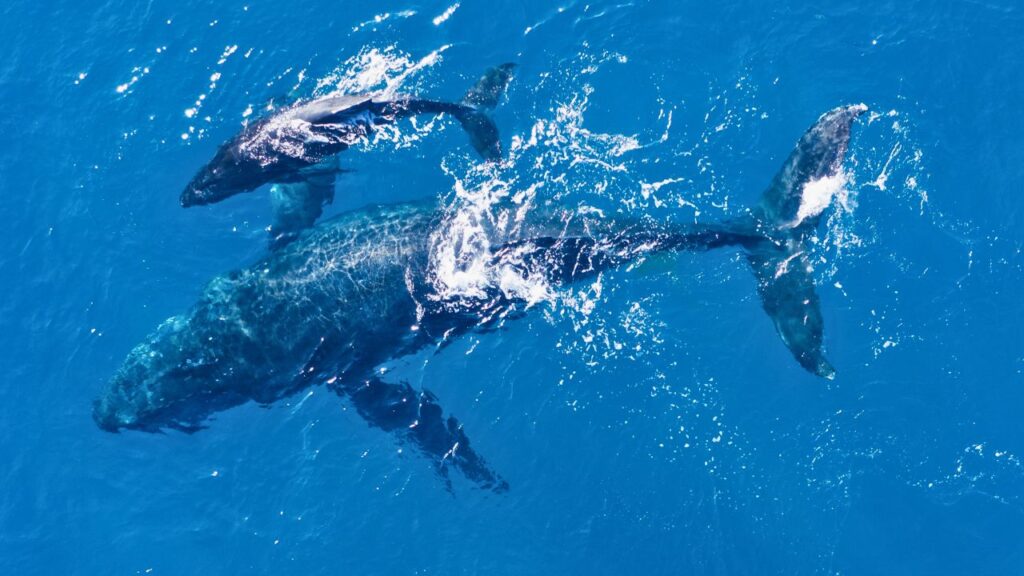
ORRCA therefore presents this footage as the fourth complete birth ever filmed, and the first captured from the air. That count should be taken for what it is: a claim by the association, relayed by the press, with no public reference list allowing it to be checked. Annie Post, head of research at ORRCA, for her part refers to three observations published to date, which matches the 2021 review.
A birth along the way, not an anomaly
Kingscliff lies at about 28 degrees south, whereas the recognised breeding grounds of this population extend rather between 16 and 24 degrees. It would nonetheless be going too far to read this as a stray birth. A study published in 2025 in Frontiers in Marine Science, co-signed by the biologist Vanessa Pirotta of Macquarie University, shows precisely that females give birth in temperate waters and then continue their migration with their newborn, in Australia as in New Zealand.
The phenomenon is documented elsewhere on the continent: births have been demonstrated in the south-west of Western Australia, more than 1,500 kilometres south of the historical grounds of the Kimberley. In other words, calving is not confined to a few warm bays: it also happens along the route. Our pages on annual migrations and on mysticetes set out this calendar.
What this footage could teach
Seen from the air, a birth and the minutes that follow yield information that no observation from a boat gives: the exact position of the newborn relative to its mother, the possible presence of an attendant, the behaviour of the other animals around. The 2021 review noted precisely an escorting individual in two cases out of three, and brief movements of the calf away from the mother.
ORRCA has announced that it intends to analyse these recordings and prepare a peer-reviewed publication. To date, no study has been published: we checked, and there is no paper, no preprint and no journal announced. What is circulating is a video record, not yet a scientific result.
What to take away?
That a drone held at a proper distance can document a moment that two centuries of observation at sea had almost never caught, and that the unobtrusiveness of the aircraft is here the very condition of the observation. That humpback whales calve further south, and more often along the way, than was thought. And that what is filmed should be distinguished from what is demonstrated: between a remarkable video and a validated scientific datum, a publication remains to be written. If you come across a female accompanied by a young animal yourself, the rule is the same everywhere: do not approach, do not pursue, and let her pass. Our advice on preparing a trip and on spotting accredited operators applies to drones too.
Sources: ScienceAlert, Science & Vie, 20 Minutes and Géo. Scientific references: Ransome et al., Marine Mammal Science, 2021 (10.1111/mms.12864); McPhee-Frew et al., Frontiers in Marine Science, 2025 (10.3389/fmars.2025.1545526); Jolliffe et al., Discover Animals, 2024 (10.1007/s44338-024-00012-3).
Did you find this article useful?
Add L'info des Cétacés to your preferred sources on Google. Our stories will be suggested to you more often, and the choice can be undone as easily as it is done.
 Follow us on Google
This preference is saved in your Google account and can be changed at any time. It is neither a certification nor a recommendation from Google.
Leave a review