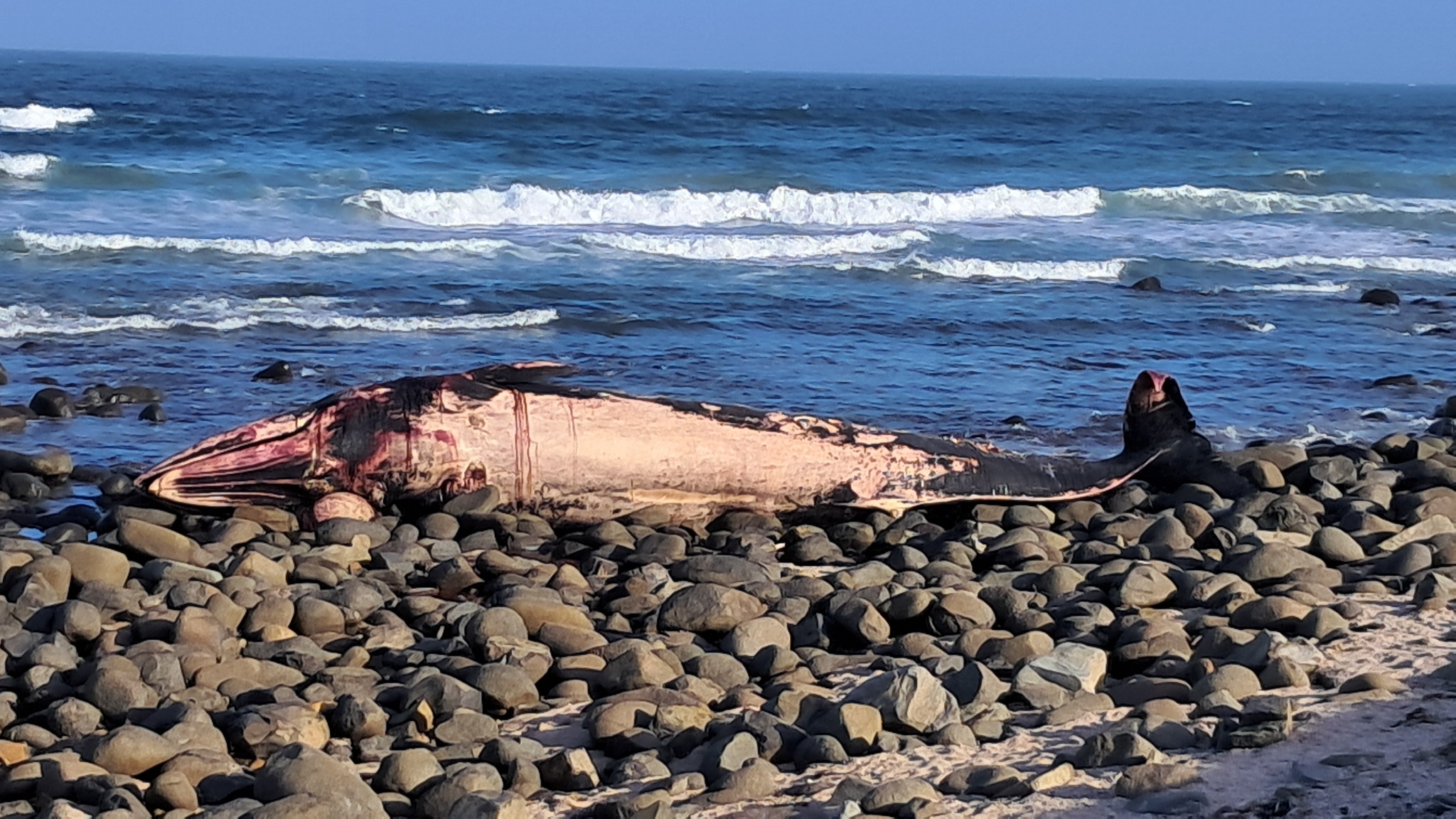
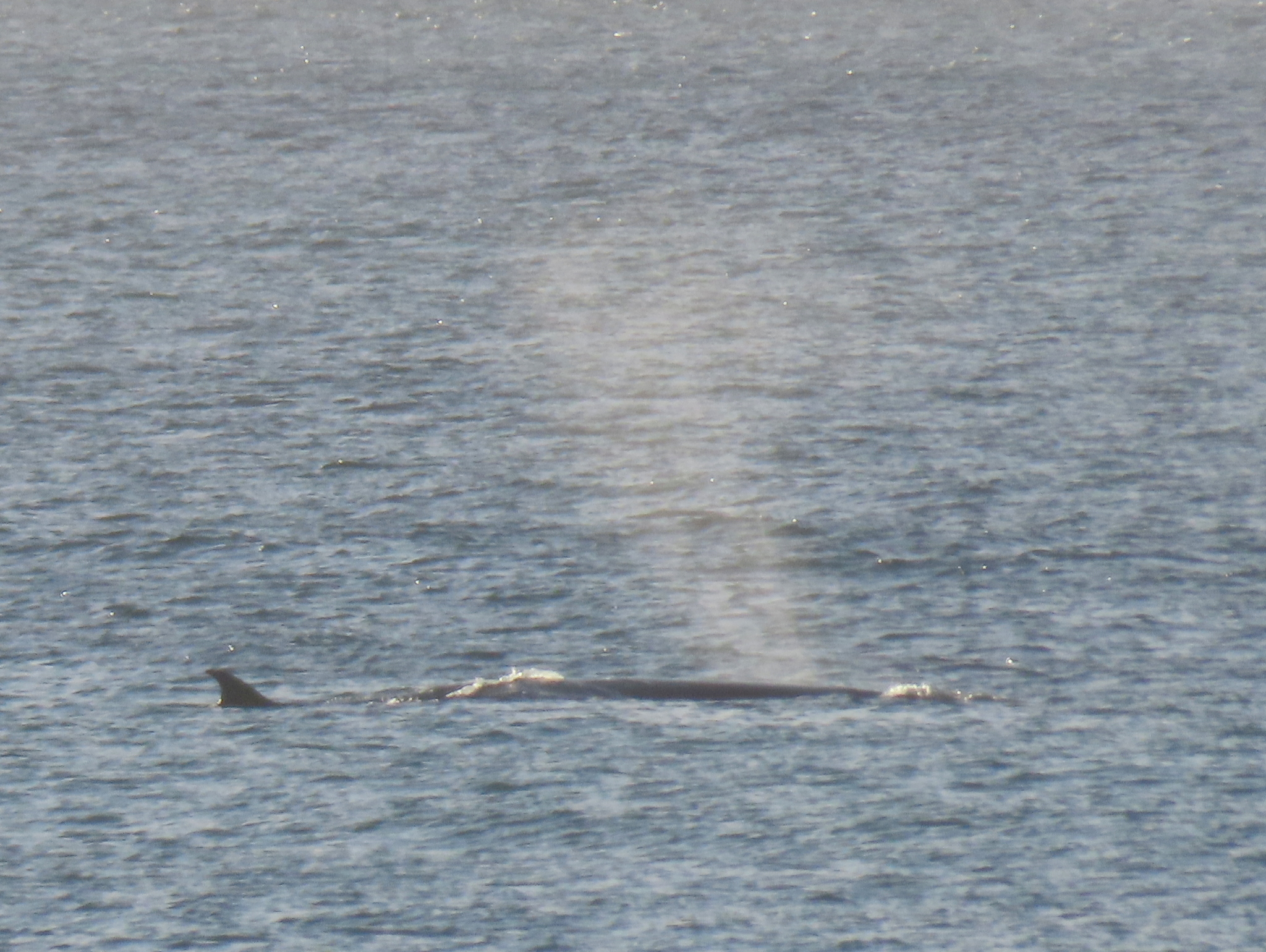
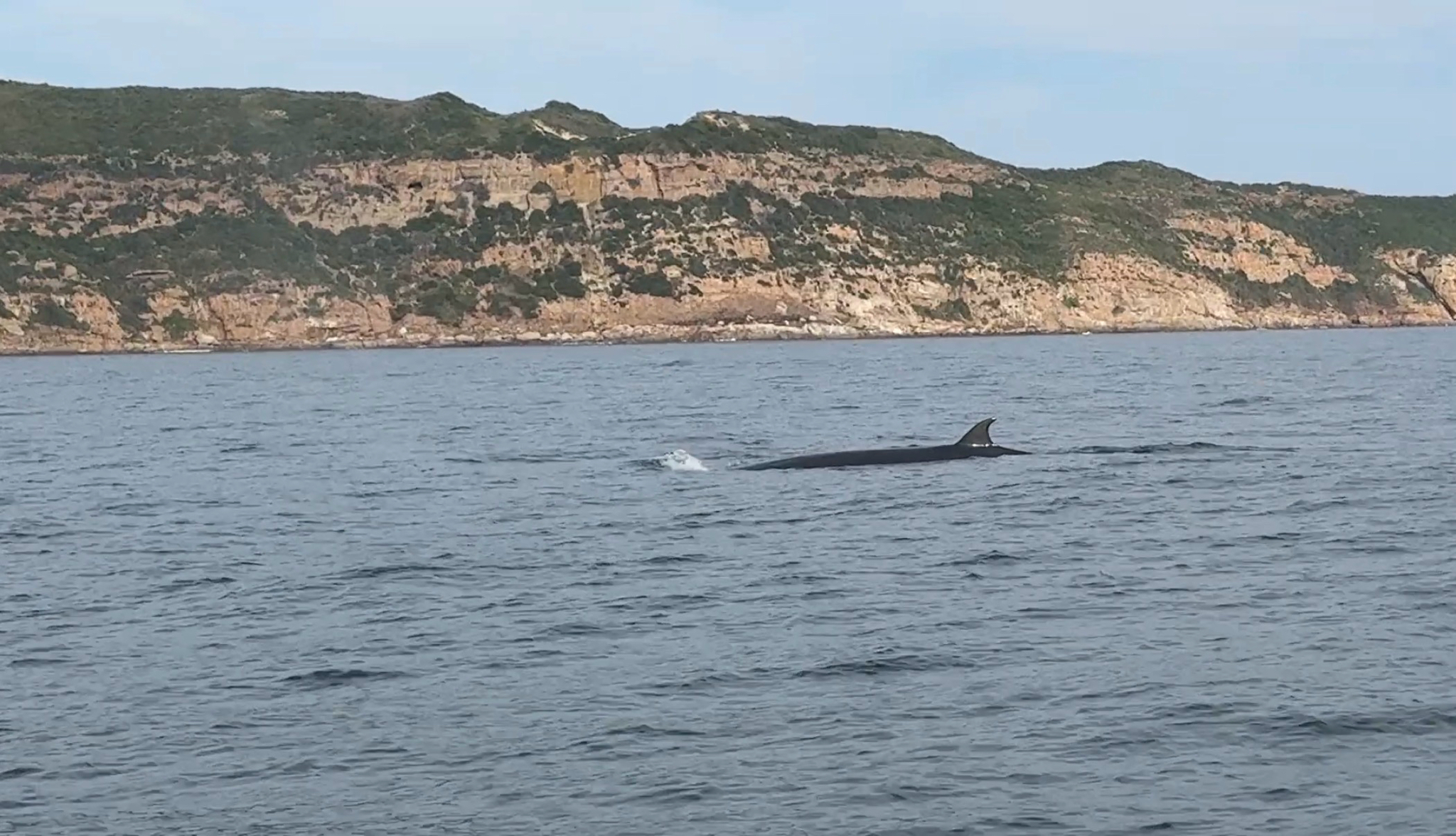
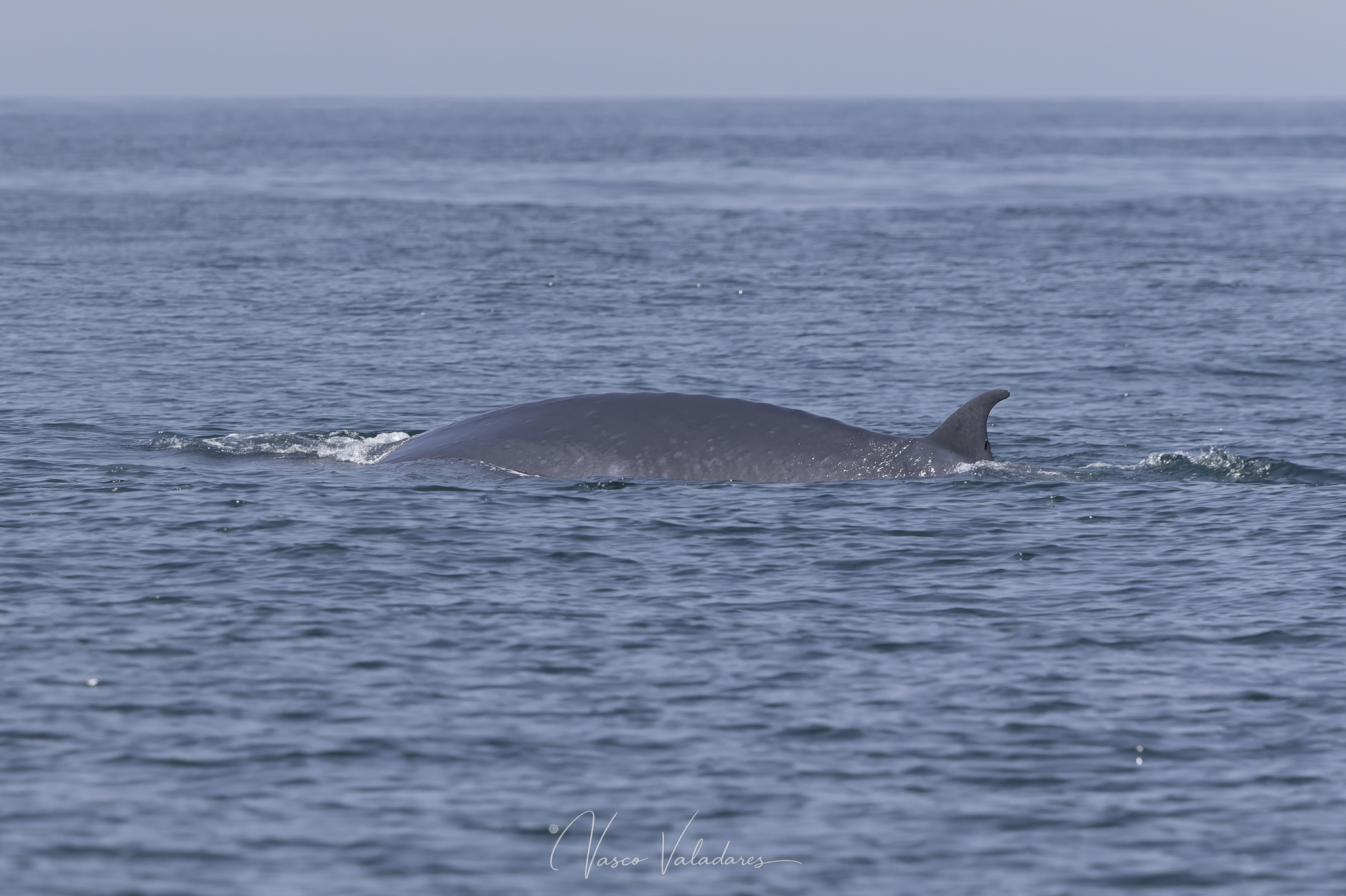
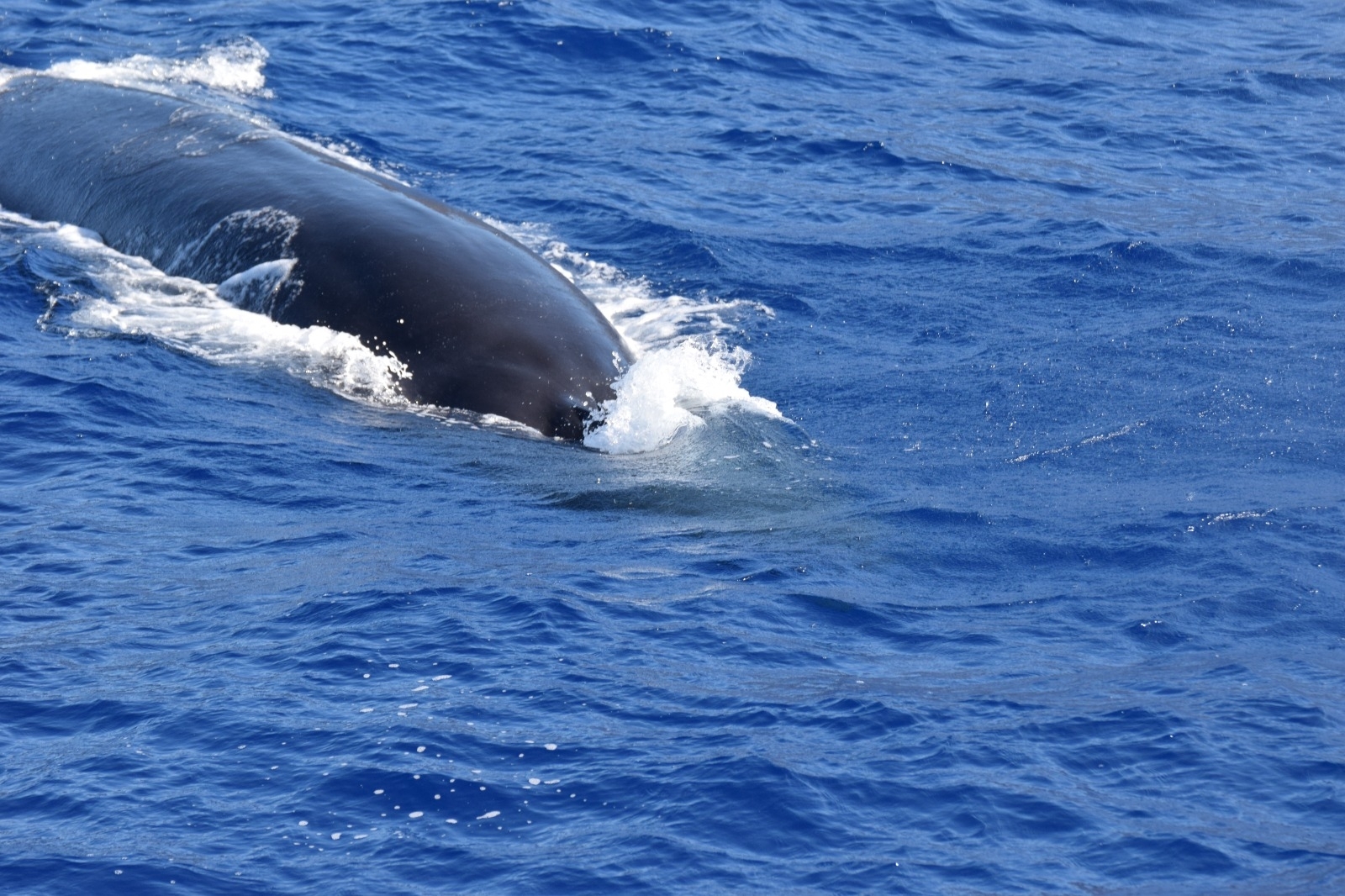
Bryde's whale (Balaenoptera edeni)

Key facts
Scientific name Balaenoptera edeni Anderson, 1878 (some taxonomic references give 1879)
Other names Bryde’s whale (after the Norwegian Johan Bryde), Eden’s whale for the coastal form; French: rorqual tropical, rorqual d’Eden, baleine de Bryde, baleinoptère de Bryde.
Size 11 to 16.5 m; most often 12 to 15.5 m. Females exceed males by a few tens of centimetres. Newborn: 3.4 to 4.15 m.
Weight Generally 12 to 25 tonnes, up to about 40 tonnes in the largest individuals. Newborn: 900 to 1,000 kg.
Longevity Poorly documented. Current estimates place longevity between 50 and 70 years; the oldest individual aged was 72 years old.
Diet Schooling fish (anchovies, sardines, pilchards, mackerel, herring, horse mackerel), krill and copepods, pelagic crabs, shrimp and cephalopods. Consumption estimated at 600-660 kg per day.
IUCN status Least Concern (LC). Assessment by Cooke & Brownell published in the 2018 IUCN Red List (identifier T2476A50349178), which moved the species from “Data Deficient” (DD) to LC; status confirmed in later editions of the Red List, including the 2025-2 edition. The data do not allow a reliable global trend to be established. Some populations fall under far more alarming national statuses: the New Zealand population, about 200 individuals of which some 140 frequent the Hauraki Gulf, is classified as “Nationally Critical”, and the South African coastal form is Vulnerable on the national red list. Rice’s whale (Balaenoptera ricei), long treated as part of Bryde’s whale, is today a distinct species assessed as Critically Endangered (CR).

In brief

Bryde’s whale is the only large rorqual to spend the whole year in warm waters, between 40° north and 40° south: it never travels down to feed in polar seas. From 11 to 16.5 metres long, it is recognised by the three parallel ridges running along the top of its snout, whereas all the other large rorquals carry only one; only Rice’s whale, a very close species confined to the Gulf of Mexico, shares this feature. Listed as Least Concern by the IUCN since 2018, it remains locally very vulnerable to ship strikes and is still the subject of commercial whaling.

Identification

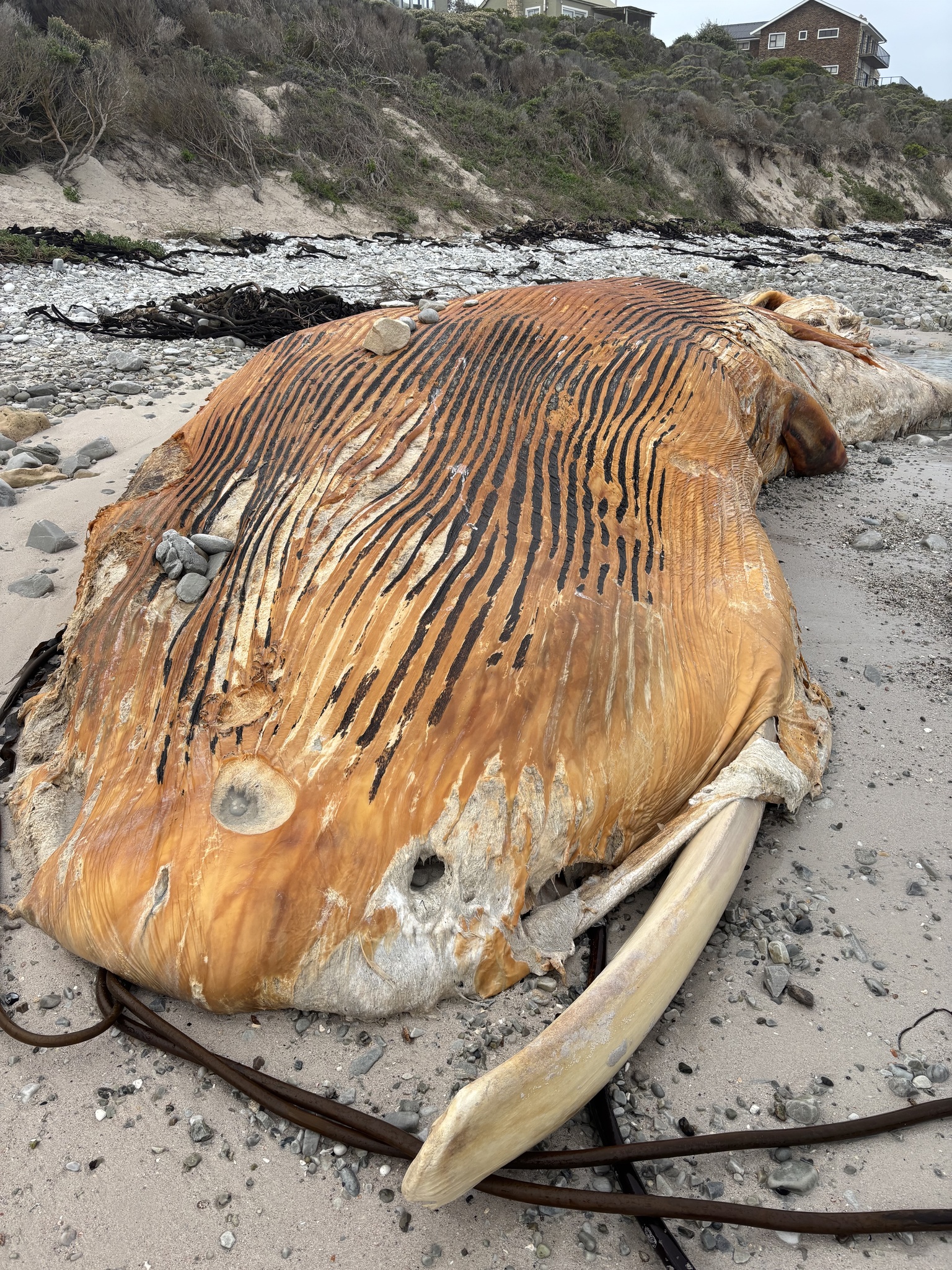
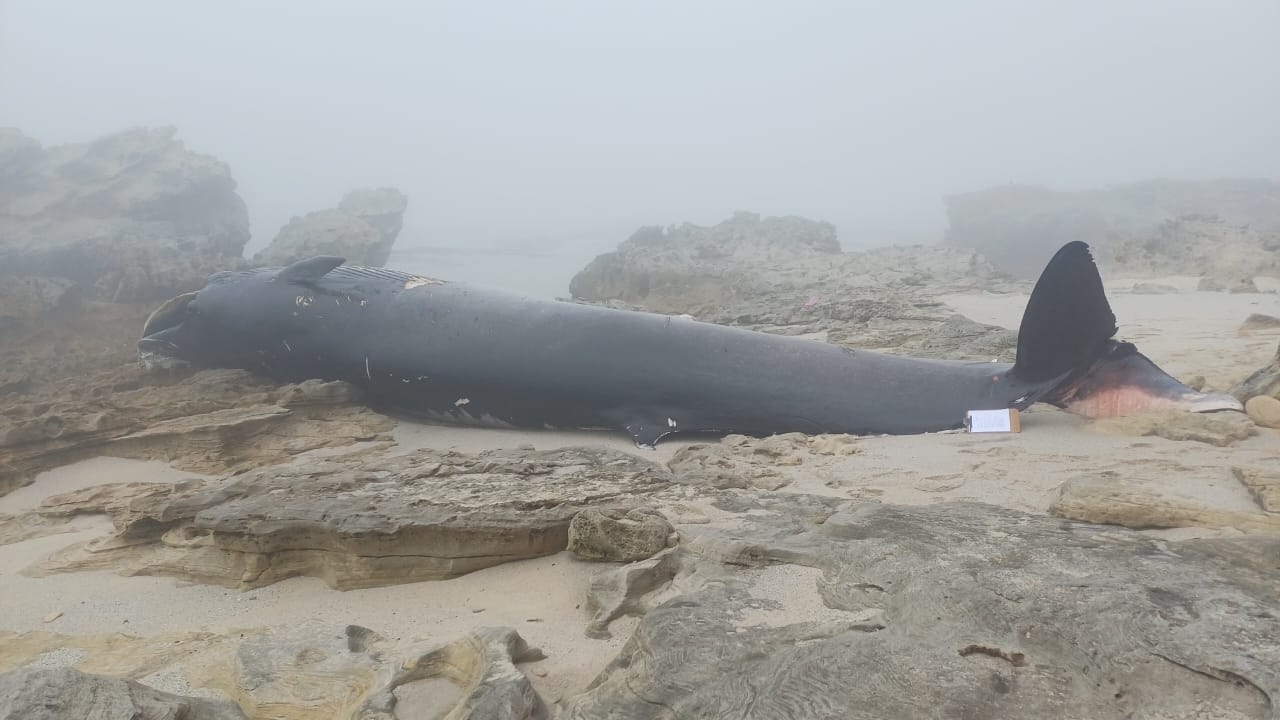
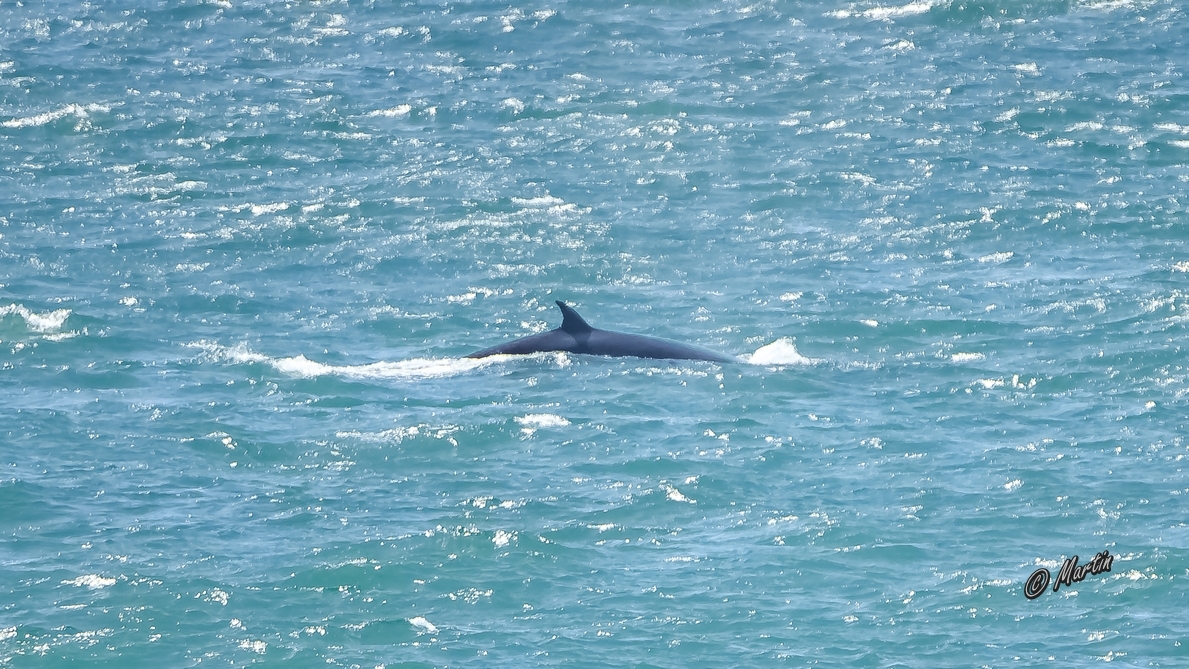
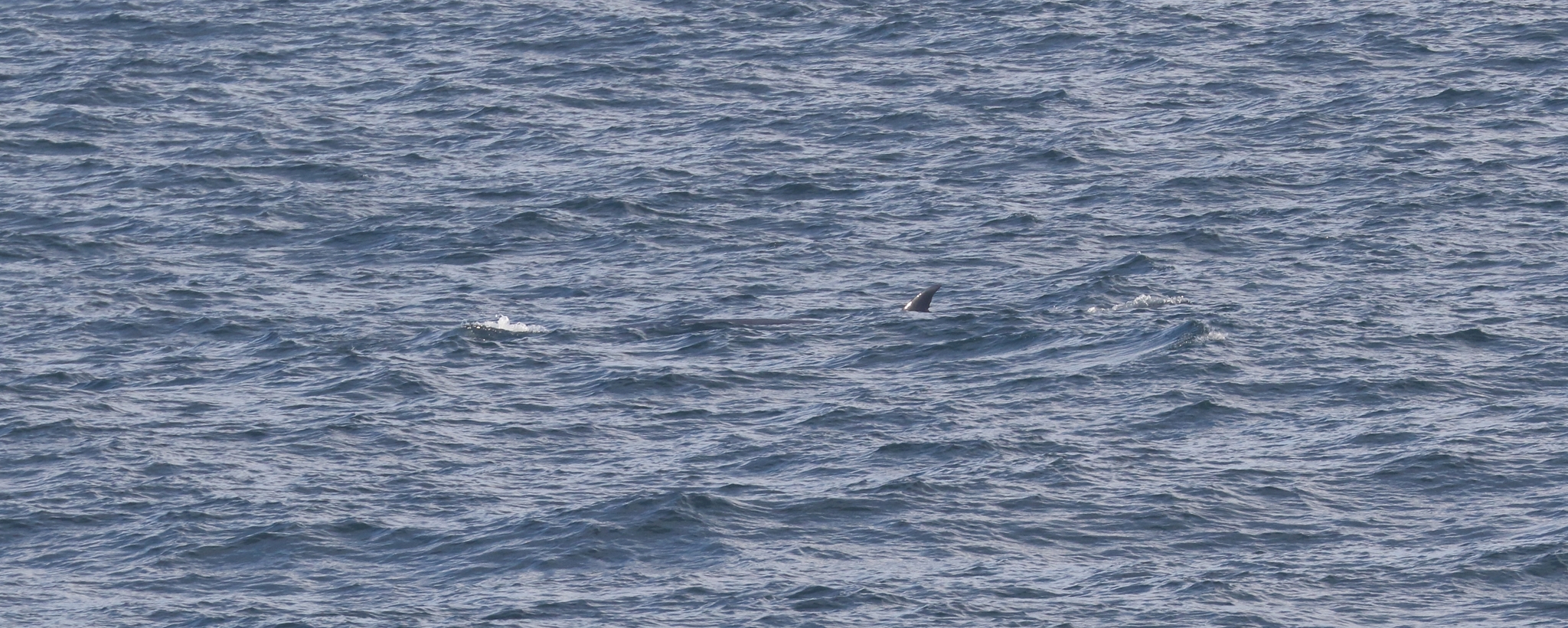
Bryde’s whale has the slender outline typical of the balaenopterids: a streamlined body, a pointed V-shaped head taking up about a quarter of the total length, a dark grey to slate grey back and a white to yellowish-white underside, sometimes marked with pale or pinkish patches. The throat and belly bear 40 to 70 expandable pleats that unfold during lunge feeding; the mouth holds 250 to 400 pairs of slate grey baleen plates, short and with coarse bristles. The dorsal fin, set two thirds of the way back along the body, measures thirty to forty centimetres, is distinctly falcate and very often nicked or frayed, which makes photo-identification of individuals easier. The blow forms a narrow or slightly bushy column 3 to 4 metres high. When diving, the animal arches its back strongly but never lifts its tail fluke out of the water.

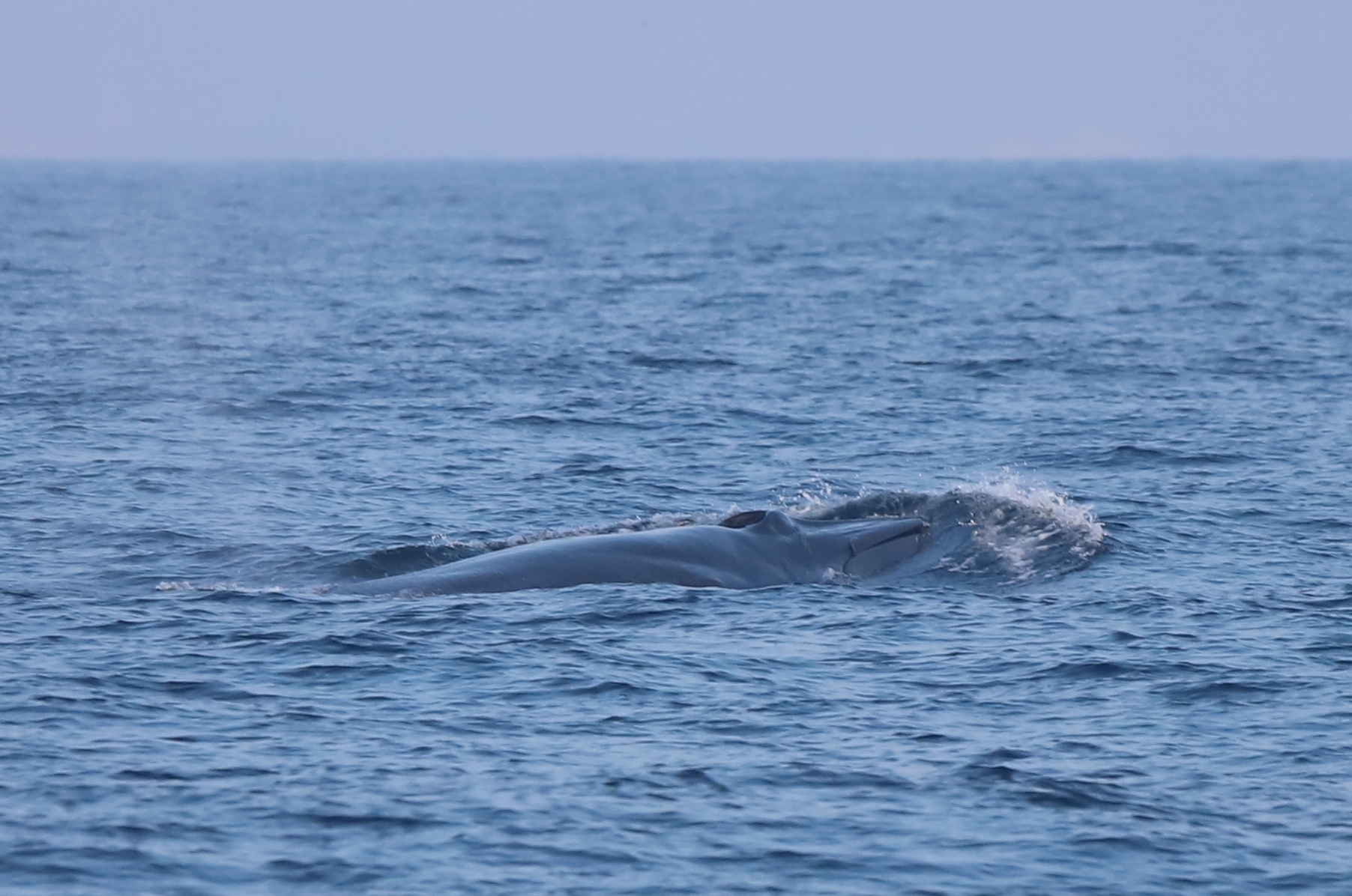
The decisive field character comes down to three lines: Bryde’s whale has three parallel longitudinal ridges between the tip of the snout and the blowholes, where the sei whale, the fin whale, the humpback whale and the common minke whale show only one, in the middle. Only Rice’s whale, a sibling species confined to the Gulf of Mexico, shows the same arrangement. When the animal surfaces with its head out of the water, these ridges are visible and remove the ambiguity on their own.

Confusion nevertheless remains frequent, to the point that the scientific literature and the old whaling registers contain many instances of it. The sei whale (Balaenoptera borealis), of similar size, has only one rostral ridge, a more distinctly arched snout and a “flatter” surfacing profile, without marked arching of the back. The fin whale (Balaenoptera physalus) is far larger and gives itself away by the asymmetry of the pigmentation of its jaw, white on the right. Omura’s whale (Balaenoptera omurai), smaller (9 to 11 m), shows a dominant median ridge, barely marked lateral ridges, a pale chevron on the back and 80 to 90 ventral pleats. Lastly, Rice’s whale (Balaenoptera ricei), morphologically very close and carrying the same three rostral ridges, occurs only in the Gulf of Mexico: outside that sea, geography alone rules out the confusion.

Taxonomy

Family Balaenopteridae, genus Balaenoptera. Bryde’s whale is less a clear-cut species than a taxonomic complex whose untangling is still under way. The Taxonomy Committee of the Society for Marine Mammalogy and the International Whaling Commission today recognise a single species, Balaenoptera edeni, divided into two subspecies: B. e. edeni, the small coastal form of the Indian Ocean and the western Pacific (the “Eden’s whale”, whose type locality is the Gulf of Martaban, in Burma), and B. e. brydei, the larger oceanic form, described by Olsen in 1913 and widespread in all three oceans. Other authors continue to treat B. brydei as a species in its own right.

Two taxa long placed under the “Bryde’s whale” label have been removed from it: Omura’s whale (Balaenoptera omurai), described in 2003, and Rice’s whale (Balaenoptera ricei), described in 2021 by Rosel, Wilcox, Yamada and Mullin on genetic, morphological and ecological grounds. This last separation carries considerable practical weight: the small Gulf of Mexico population, numbering only about fifty individuals, therefore does not belong to Balaenoptera edeni.

Distribution and habitat

The species occupies the tropical, subtropical and warm temperate waters of the Atlantic, Indian and Pacific oceans, roughly between 40° N and 40° S. Its distribution is first of all thermal: it seeks out water masses above 16°C, with an optimum often around 20°C. This is what earns it its French alternative name of rorqual tropical, the tropical rorqual, and what sets it radically apart from the other large rorquals, which alternate between breeding in warm waters and feeding in cold ones.

The two forms do not occupy the same spaces. The oceanic form frequents the open sea, while the coastal form keeps to neritic habitats, often over continental slopes in 100 to 1,000 m of water, where some populations are resident all year round. The Gulf of Thailand, the Bay of Bengal, South African waters, the Gulf of California and the Hauraki Gulf thus hold resident groups; other populations make seasonal movements between warmer and cooler waters.

In the north-east Atlantic, the species regularly reaches Madeira and the Canaries, from late spring to autumn (mainly from June to November at Madeira), and appears only occasionally further north, in the Azores, where it was first reported only in 2004. It is not part of the regular fauna of metropolitan French waters: the English Channel, the Bay of Biscay and the Mediterranean lie outside its range, the Mediterranean having yielded only very rare records, in its south-eastern basin. Bryde’s whale is, on the other hand, documented in the French tropical maritime areas. In the Caribbean it may be encountered throughout the region but remains rare in the Antillean arc, and the Agoa Sanctuary, which covers the French Antilles, holds only very few sightings; genetic and morphological analyses of individuals stranded at Aruba assign the Caribbean form to B. e. brydei. The species is also present in the French tropical waters of the Indian Ocean.

Biology and ecology

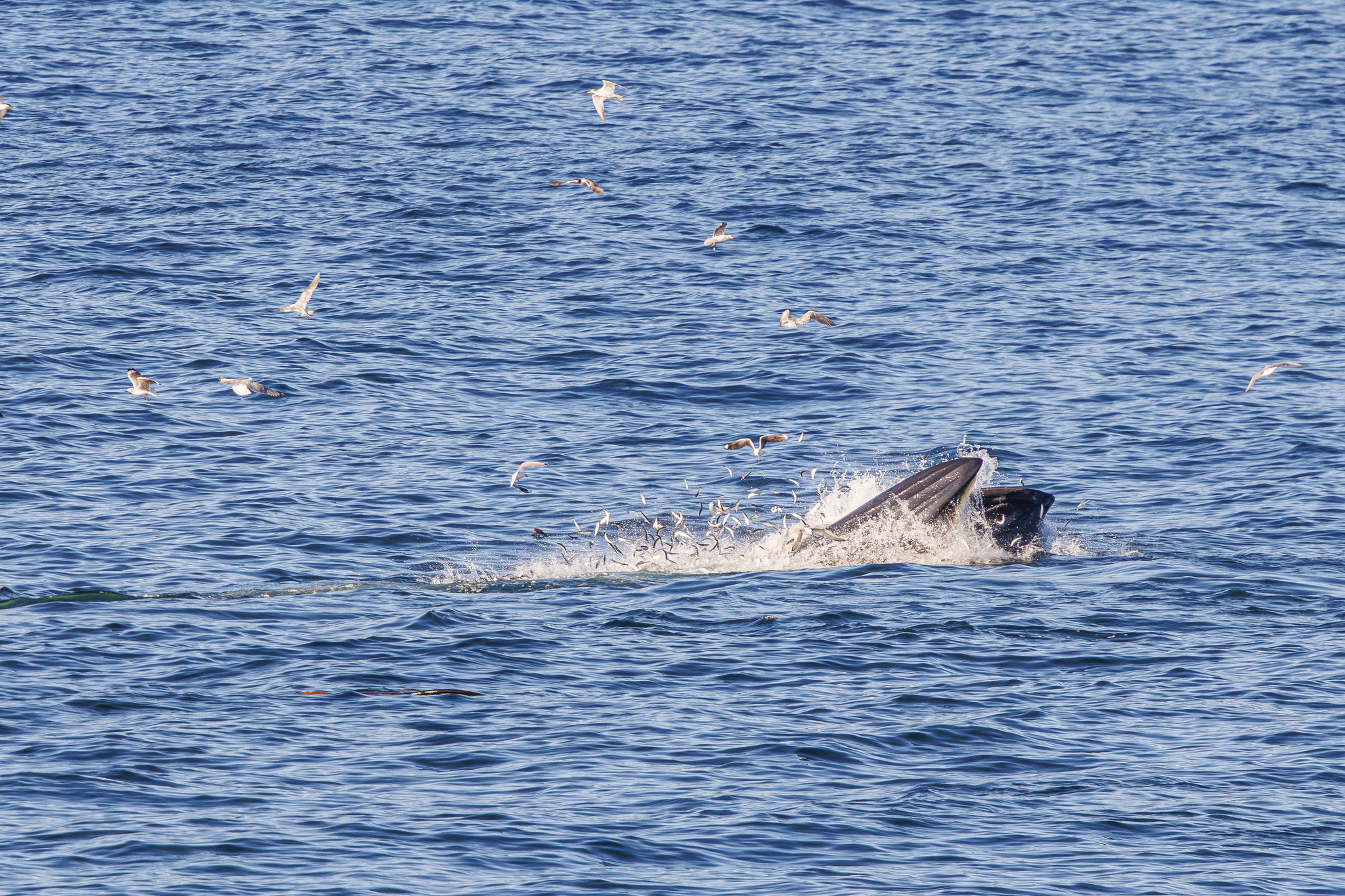
An opportunistic hunter, Bryde’s whale adapts its diet to local resources: Japanese anchovy and euphausiids dominate in the north-west Pacific, anchovies and pilchards off South Africa, sardines and thread herring in the Gulf of California. It lunges through shoals, skim feeds at the surface and uses the bubble net; in the Gulf of Thailand it deploys a spectacular technique of holding its mouth open vertically at the surface, with panicked fish throwing themselves into it of their own accord. It feeds mainly between the surface and a few hundred metres, frequently in the company of seabirds and tunas.

It is not a very gregarious animal: it is seen alone or in pairs, more rarely in loose aggregations of 10 to 20 individuals on feeding grounds. It spends most of the day in the first fifteen metres of water, cruises at 2-6 km/h and can reach bursts of 20-25 km/h. Dives typically last 5 to 15 minutes, exceptionally 20, to depths reaching about 300 m. Its vocal repertoire includes brief low-frequency moans; it is to this species that the “biotwang”, an enigmatic North Pacific sound detected in 2014, has been attributed.

Breeding has no strict season, with an autumn peak frequently reported. Gestation lasts 10 to 12 months, lactation 6 to 12 months, and females give birth to a single calf every two to three years. Sexual maturity is reached between 8 and 13 years depending on the population, at around 12 m in length. The killer whale is among its documented natural predators.

Status and conservation

The IUCN has listed Bryde’s whale as Least Concern since the 2018 assessment, which replaced an earlier status of “Data Deficient”. The world population is estimated at the order of 90,000 to 100,000 individuals, about two thirds of them in the Northern Hemisphere, but uncertainty remains high and no reliable global trend has been established.

Whaling weighed heavily on the species: more than 30,000 Bryde’s whales were taken between 1911 and 1987, catches peaking in the mid-1970s at more than 1,800 animals a year. After its withdrawal from the International Whaling Commission in 2019, Japan resumed commercial whaling within its exclusive economic zone, Bryde’s whale being among the targeted species with announced quotas of more than 150 individuals a year. Catches also occur in Indonesia and the Philippines.

Ship strikes are today the best-documented threat: the species is the third most frequently struck cetacean in the Southern Hemisphere. The Hauraki Gulf, in New Zealand, offers the textbook case: about 140 animals, out of the some 200 that make up the New Zealand population, frequent the marine park; 85% of recorded deaths were attributable to ship strikes and 2.4 whales were dying each year. A voluntary protocol reducing speed to 10 knots, which brings the probability of death down from about 70% to 26%, has put an end to these deaths: no ship strike fatality has been recorded there since 2014.

To these are added noise pollution, which masks low-frequency vocalisations, bycatch in fishing gear, and plastic and chemical pollution. The species is listed in Appendix I of CITES, Appendix II of the CMS and Annex II of the SPAW Protocol for the Caribbean. In France it has full protection: killing, capture and intentional disturbance are prohibited, on pain of three years’ imprisonment and a fine of 150,000 euros.

Watching this species

Bryde’s whale lends itself well to watching where resident coastal groups exist: the Hauraki Gulf in New Zealand, the upper Gulf of Thailand, the South African coast, the Gulf of California, Sri Lanka, or again Madeira and the Canaries from late spring to autumn, with a peak from June to November at Madeira. In the French Antilles the species remains rare and encounters in the Agoa Sanctuary are exceptional; it keeps rather to the waters over the slopes, in 100 to 1,000 m of water.

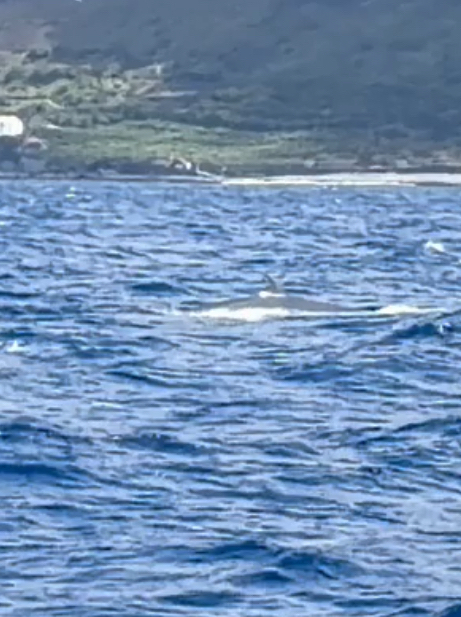
On the water, what is spotted first is the narrow blow of 3 to 4 m, then a dark back that arches distinctly before the dive, never showing the tail fluke. A calm sea and low-angled light make it possible to pick out the three ridges of the snout when the animal comes up to breathe. Its unpredictable tracks, its frequent changes of course and its habit of staying near the surface make it particularly exposed to vessels.

The ethics of approach follow directly from that risk. French regulations prohibit any intentional disturbance, pursuit or harassment. In practice: reduce and steady speed well before the encounter, approach from behind and to the side without ever cutting across the animal’s path, limit the length of the watch, do not separate a mother from her calf, refrain from entering the water. Photographs of the dorsal fins, which are highly recognisable, can usefully be passed on to local naturalist networks.

Frequently asked questions

Why is Bryde’s whale known in French as the “rorqual tropical”?

Because it is the only large rorqual to live all year round in warm waters, above 16°C, between 40° north and 40° south. Unlike the fin whale, the sei whale or the humpback whale, it undertakes no long migration towards polar feeding grounds: some populations are even entirely sedentary.

How can it be told apart from the sei whale, with which it is often confused?

By the ridges on the snout. Bryde’s whale has three parallel longitudinal ridges between the tip of the rostrum and the blowholes; the sei whale, like the other large rorquals, has only one, in the middle. The sei whale also shows a more arched snout and arches its back distinctly less when diving. This confusion long distorted the whaling statistics.

Is Bryde’s whale a threatened species?

On a global scale, no: the IUCN has listed it as Least Concern since 2018, with a population estimated at the order of 90,000 to 100,000 individuals. That global status nevertheless conceals critical local situations, such as the New Zealand population, classified as “Nationally Critical” with about 200 individuals, some 140 of which frequent the Hauraki Gulf, or the South African coastal form, considered Vulnerable at national level.

Can it be seen in French waters?

Not in metropolitan France: the English Channel, the Bay of Biscay and the Mediterranean lie outside its range. The species is, however, documented in the French tropical maritime areas. In the French Antilles, covered by the Agoa Sanctuary, it is present but rare, with very few sightings recorded, and is encountered rather along the slopes.

What is the difference between Bryde’s whale and Rice’s whale?

Rice’s whale (Balaenoptera ricei) was regarded as a population of Bryde’s whale until its description as a distinct species in 2021, on the basis of genetic, morphological and ecological data. The two species are morphologically very close and share the three rostral ridges. Endemic to the Gulf of Mexico and reduced to about fifty individuals, Rice’s whale is listed as Critically Endangered, whereas Bryde’s whale in the strict sense is Least Concern.

What does Bryde’s whale eat and how does it hunt?

Its diet is highly plastic: small schooling fish (anchovies, sardines, mackerel, herring), krill, copepods, pelagic crabs and cephalopods, for about 600 to 660 kg a day. It alternates between lunging through shoals, skim feeding at the surface and the bubble net. In the Gulf of Thailand it uses a remarkable technique of holding its mouth open vertically at the surface to let the fish rush into it.

Sources

Profile compiled from authoritative scientific sources (IUCN, NOAA Fisheries, specialist literature) and reviewed for factual accuracy.

Observed distribution

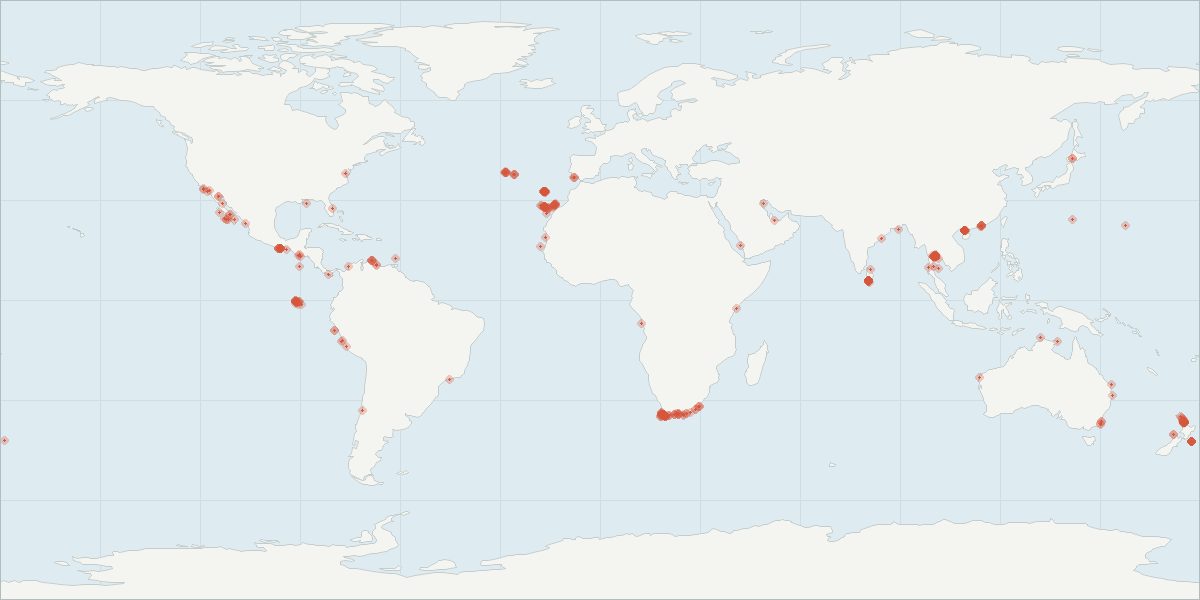
According to the open data of the GBIF, 435 georeferenced sightings of Balaenoptera edeni are recorded in our photographic index.

Main countries of observation
CountryNotes
South Africa95
Thailand87
New Zealand39
Portugal38
Spain35
Mexico29
China23
Ecuador21
Sri Lanka20
United States of America11

Distribution map: Bryde's whale (Balaenoptera edeni)

Distribution map: Bryde's whale (Balaenoptera edeni), 435 georeferenced sightings from GBIF
435 georeferenced sightings of Balaenoptera edeni. Base map Natural Earth, public domain. GBIF data.
🗺️ Open the interactive mapTo zoom and pan. It uses the OpenStreetMap/CARTO base maps and the GBIF occurrence densities: no data is sent to these services before you click.

Presence through the year

Monthly distribution of 455 dated sightings (all years combined): the maximum is reached in novembre.

550janvier : 47janfévrier : 28febmars : 45maravril : 36avrmai : 39maijuin : 29juinjuillet : 37juilaoût : 40Augustseptembre : 32sepoctobre : 41octnovembre : 55novdécembre : 26dec
Sightings by month
MonthNotes
janvier47
February28
mars45
avril36
mai39
juin29
juillet37
August40
septembre32
octobre41
novembre55
December26

These figures reflect survey effort (more boaters and more surveys in summer) as much as the actual presence of the species: to be interpreted with caution.

En images

Balaenoptera edeni
© A. Davis, CC BY-NC, 2026
Balaenoptera edeni
© Caroline Voget, CC BY, 2026
Balaenoptera edeni
© ML Fransen, CC BY-NC, 2026
Balaenoptera edeni
© Sherri Church, CC BY-NC, 2026
Balaenoptera edeni
© Gigi Laidler, CC BY-NC, 2026
Balaenoptera edeni
© Mark Brown, CC BY-NC, 2026
Balaenoptera edeni
© Vasco Valadares, CC BY-NC, 2026
Balaenoptera edeni
© Martin Etsebeth, CC BY-NC, 2026
Balaenoptera edeni
© Alan Manson, CC BY, 2026
Balaenoptera edeni
© russ_sibbald, CC BY-NC, 2026
Balaenoptera edeni
© Luca Boscain, CC BY-NC, 2026
Balaenoptera edeni
© Paula, CC BY-NC, 2026

Photographs from GBIF under a Creative Commons licence. The author and the licence of each photograph are given; please respect them if you reuse them.

Scientific references

  1. Figueiredo L. (2014) Bryde’s Whale (Balaenoptera edeni) Vocalizations from Southeast Brazil, Aquatic Mammals
  2. Watkins W. (1981) Reaction of three species of whales Balaenoptera physalus, Megaptera novaeangliae, and Balaenoptera edeni to implanted radio tags, Deep Sea Research Part A. Oceanographic Research Papers
  3. Alava J. (2013) Short Note: Observations of Killer Whale (Orcinus orca) Attacks on Bryde’s Whales (Balaenoptera edeni) in the Galápagos Islands, Aquatic Mammals
  4. (2017) Balaenoptera edeni: Cooke, J.G. & Brownell Jr., R.L., IUCN Red List of Threatened Species
  5. Dong L., Liu M., Lin W., Li S. et al. (2022) First Suction Cup Tagging on a Small and Coastal Form Bryde’s Whale (Balaenoptera edeni edeni) in China to Investigate Its Dive Profiles and Foraging Behaviours, Journal of Marine Science and Engineering
  6. Smultea M. (2012) Short Note: Bryde’s Whale (Balaenoptera brydei/edeni) Sightings in the Southern California Bight, Aquatic Mammals
  7. Ren X., Ma X., Allen E., Fang Y. et al. (2022) DNA Barcoding Technology Used to Successfully Sub-Classify a Museum Whale Specimen as Balaenoptera edeni edeni, Frontiers in Ecology and Evolution
  8. Tanaka Y., Taruno H. (2017) Balaenoptera edeni skull from the Holocene (Quaternary) of Osaka City, Japan, Palaeontologia Electronica

Automatic selection of the most cited works mentioning the species (source: Crossref).