Pygmy sperm whale (Kogia breviceps)

Key facts
Scientific name Kogia breviceps (de Blainville, 1838)
Other names Cachalot pygmée (French); capodoglio pigmeo (Italian); cachalote pigmeo (Spanish); formerly described under the name Physeter breviceps. Not to be confused with the dwarf sperm whale (Kogia sima) or with the sperm whale (Physeter macrocephalus).
Size Adults: about 2.7 to 3.8 m (sexual maturity reached at around 2.6 to 3 m); maximum documented length around 4.25 m. Newborn: about 1.2 m.
Weight Adults: about 315 to 450 kg. Newborn: about 55 kg.
Longevity Up to about 23 years.
Diet Cephalopods in very large majority (mesopelagic squid, cuttlefish, octopus; at least some fifty species recorded), supplemented by fish and crustaceans taken at depth.
IUCN status Least Concern (LC), global assessment of 2020 (Kiszka & Braulik), population trend unknown. No subpopulation is assessed separately. In mainland France, the species is listed as “Data Deficient” (DD) on the national Red List.

In brief

The pygmy sperm whale is a small odontocete of deep tropical and warm temperate waters, rarely exceeding 3.8 m and 450 kg. Extremely inconspicuous at the surface, it is known in practice only from strandings and from a few fleeting sightings in a calm sea. Classed as “Least Concern” by the IUCN since 2020, it remains one of the most poorly known cetaceans on the planet.

Identification

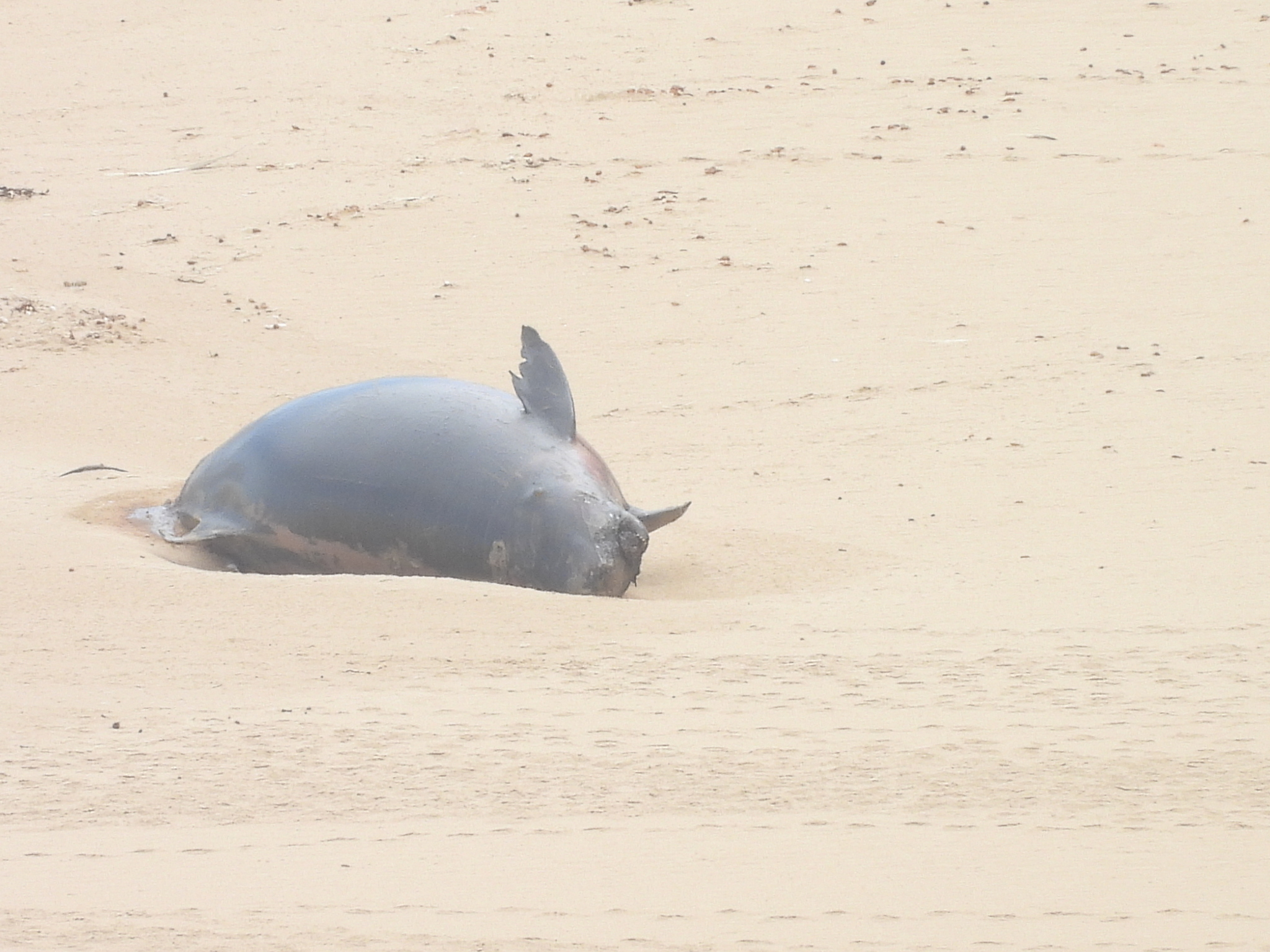
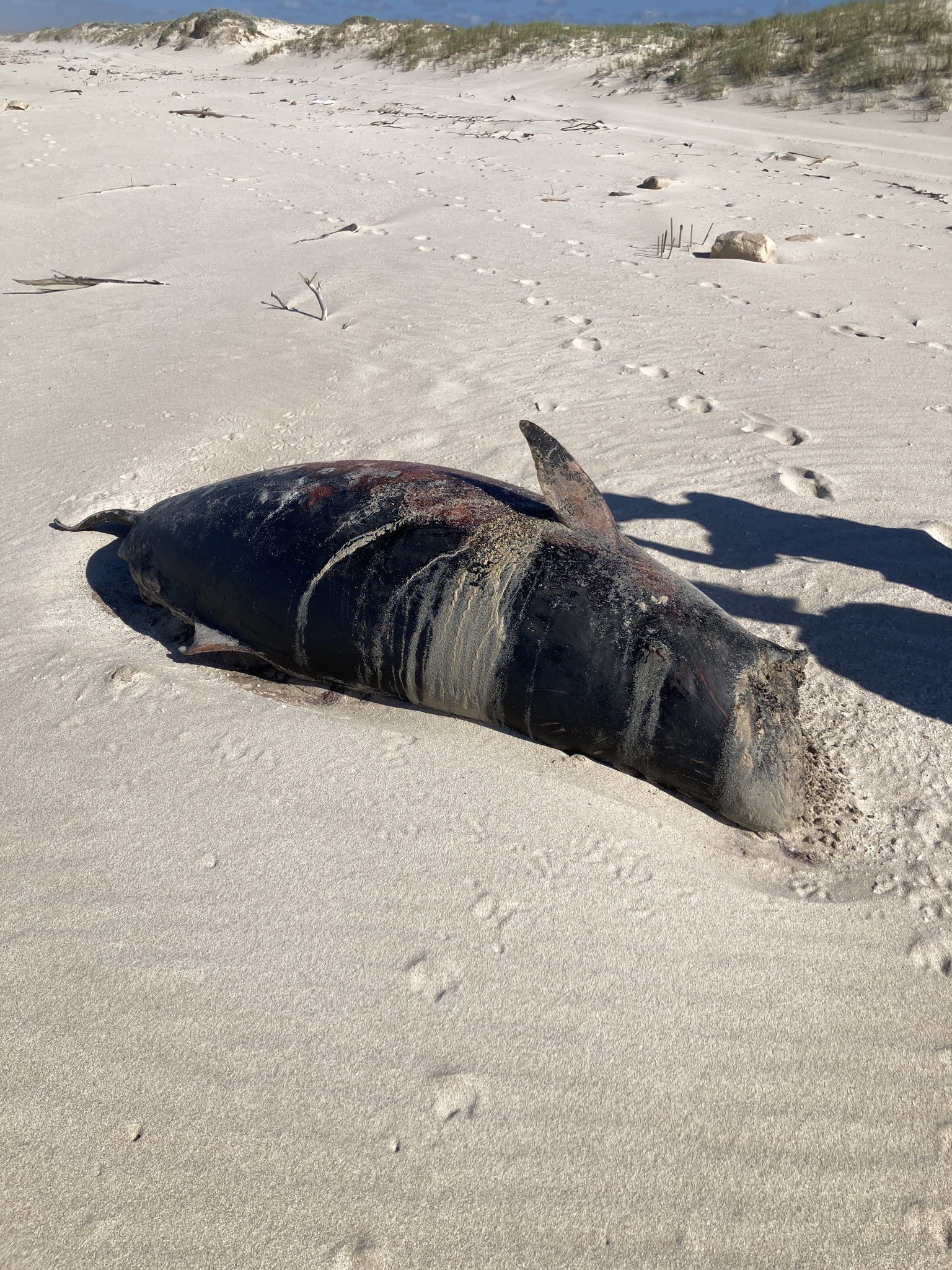
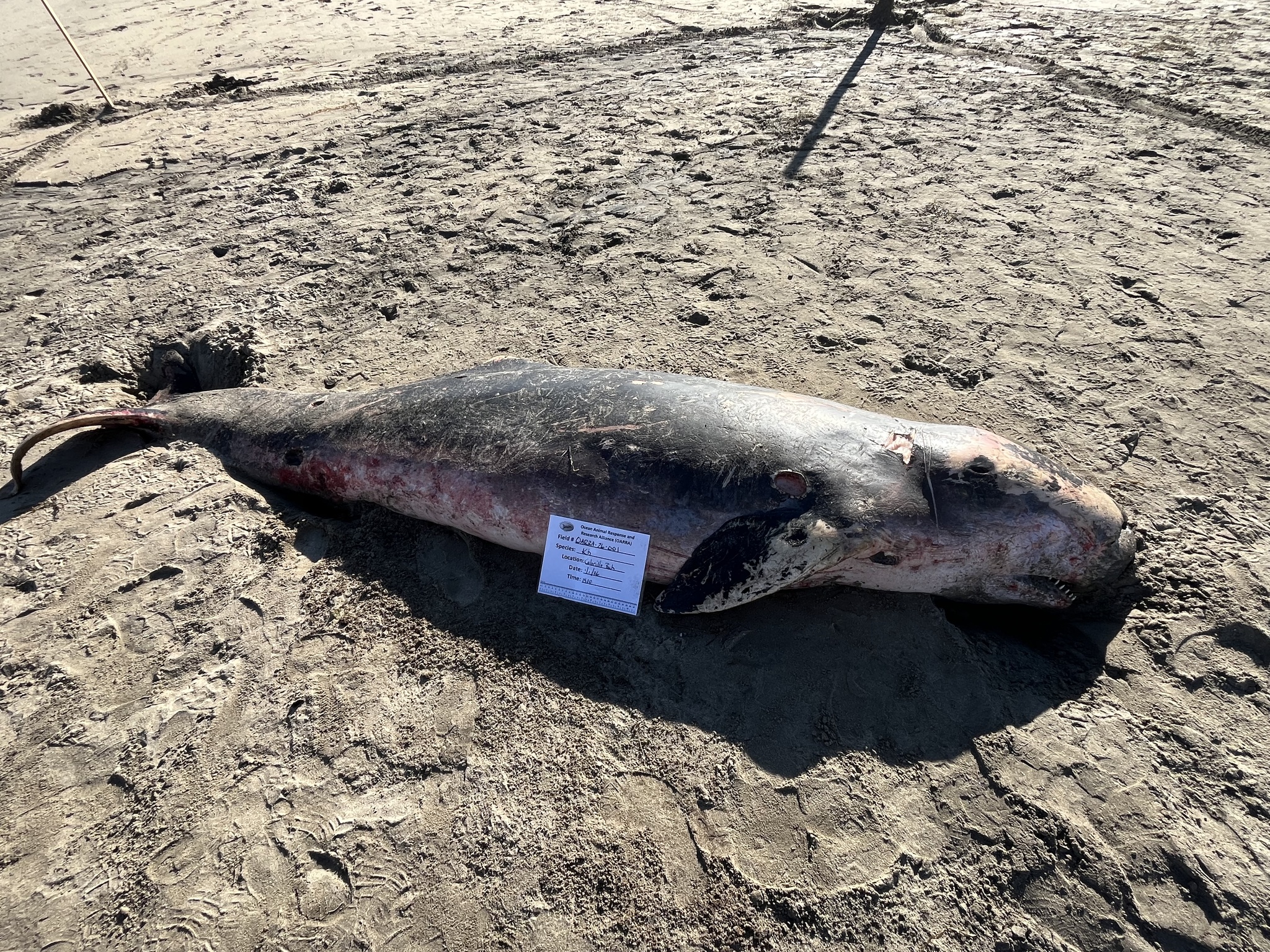
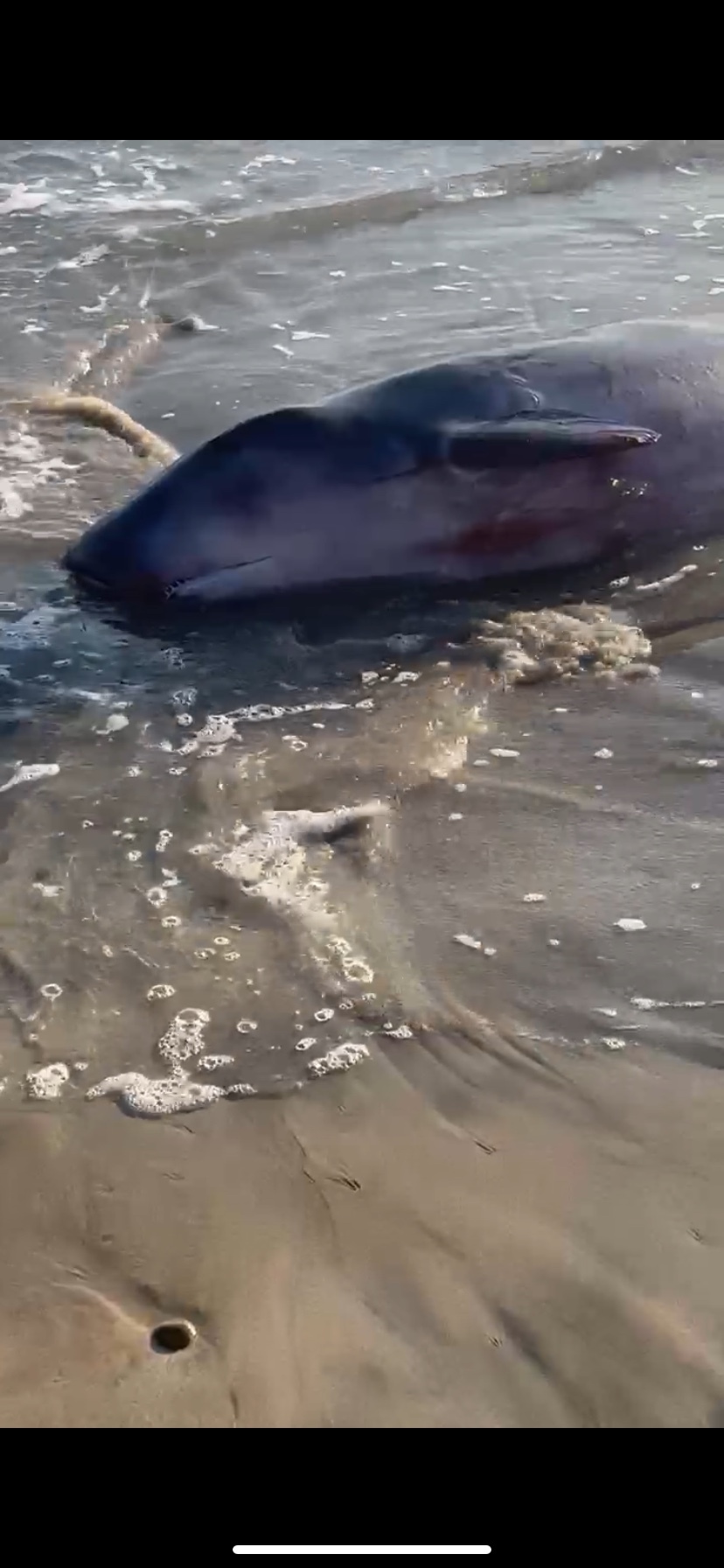
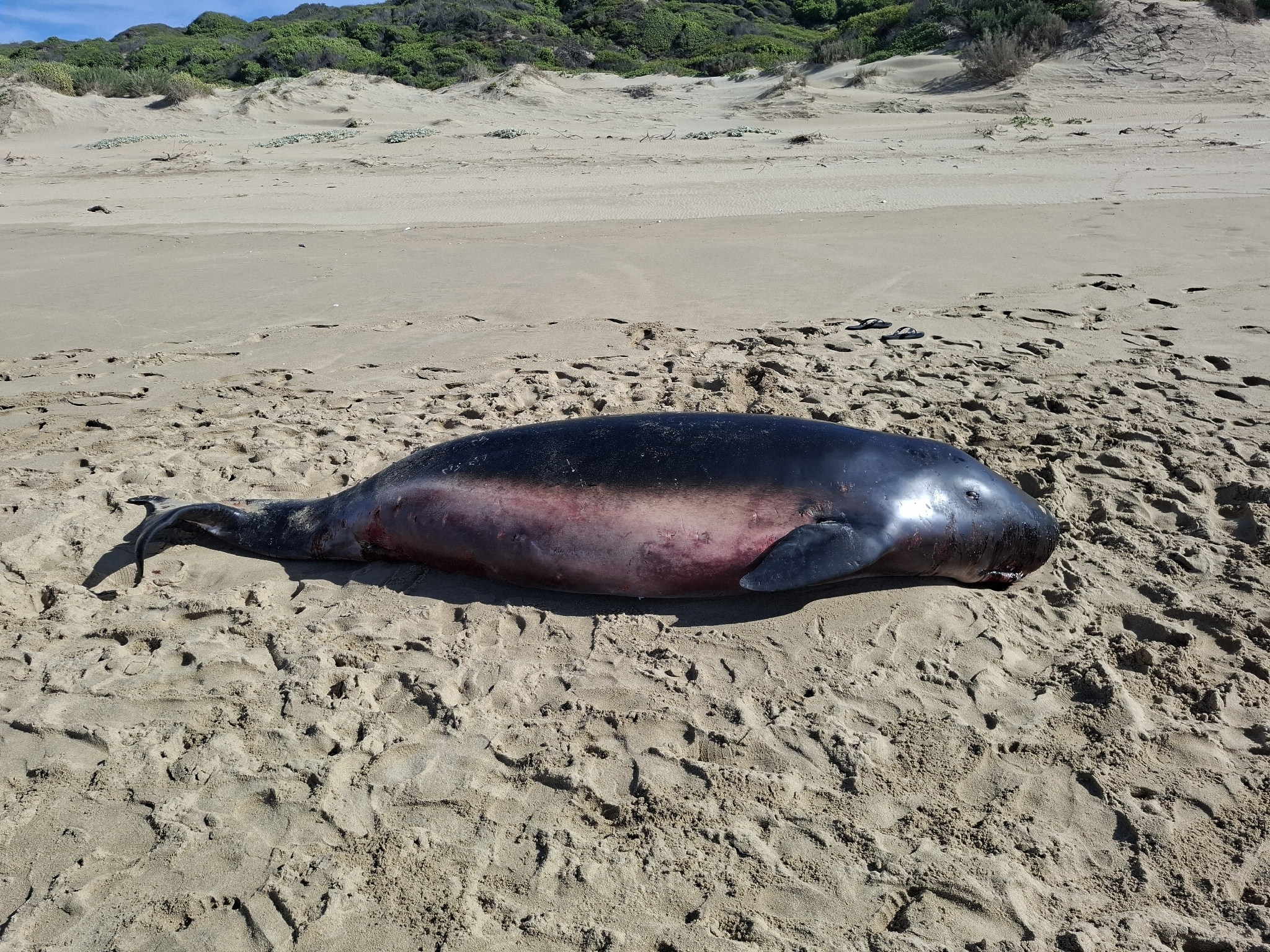
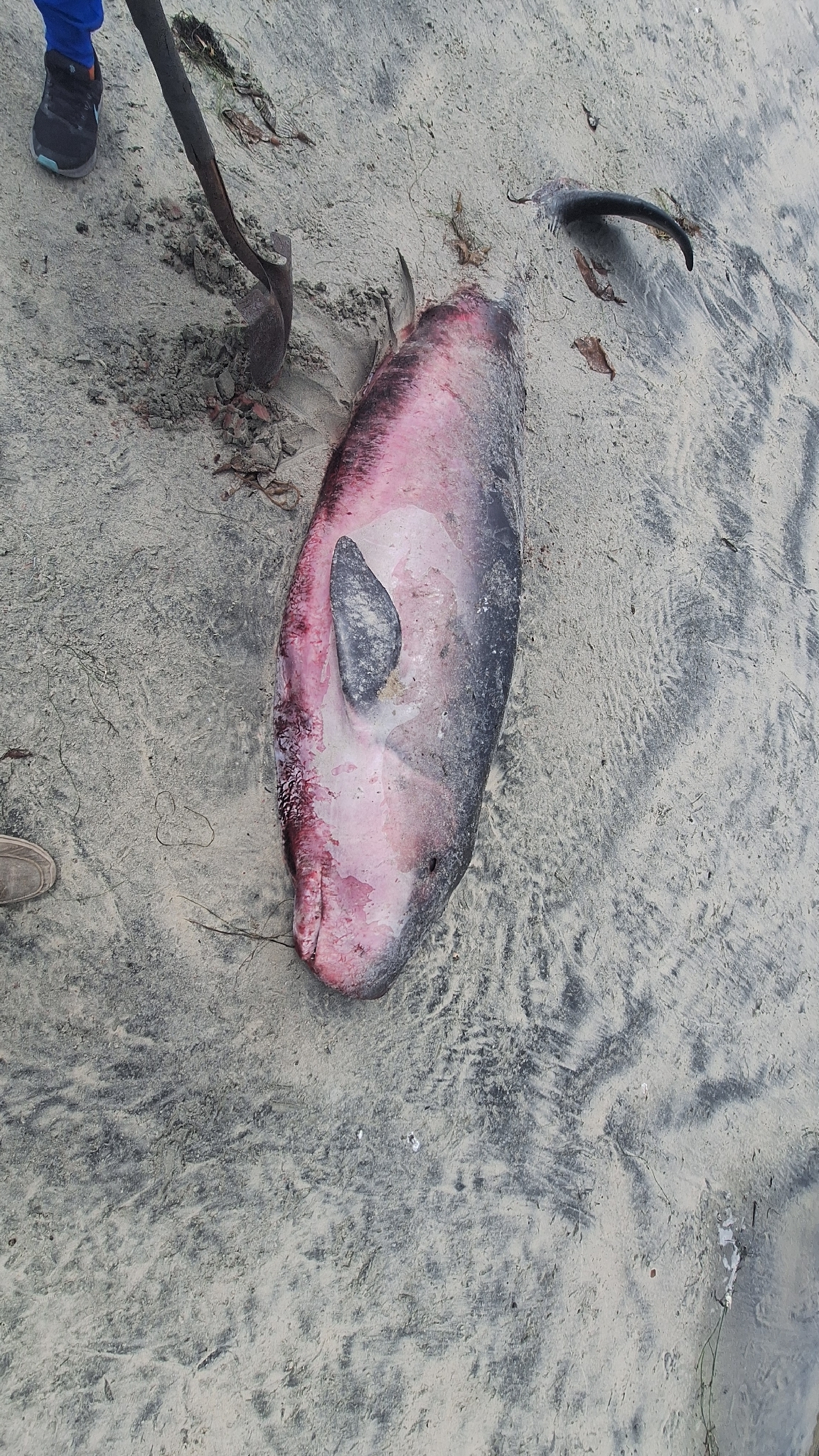
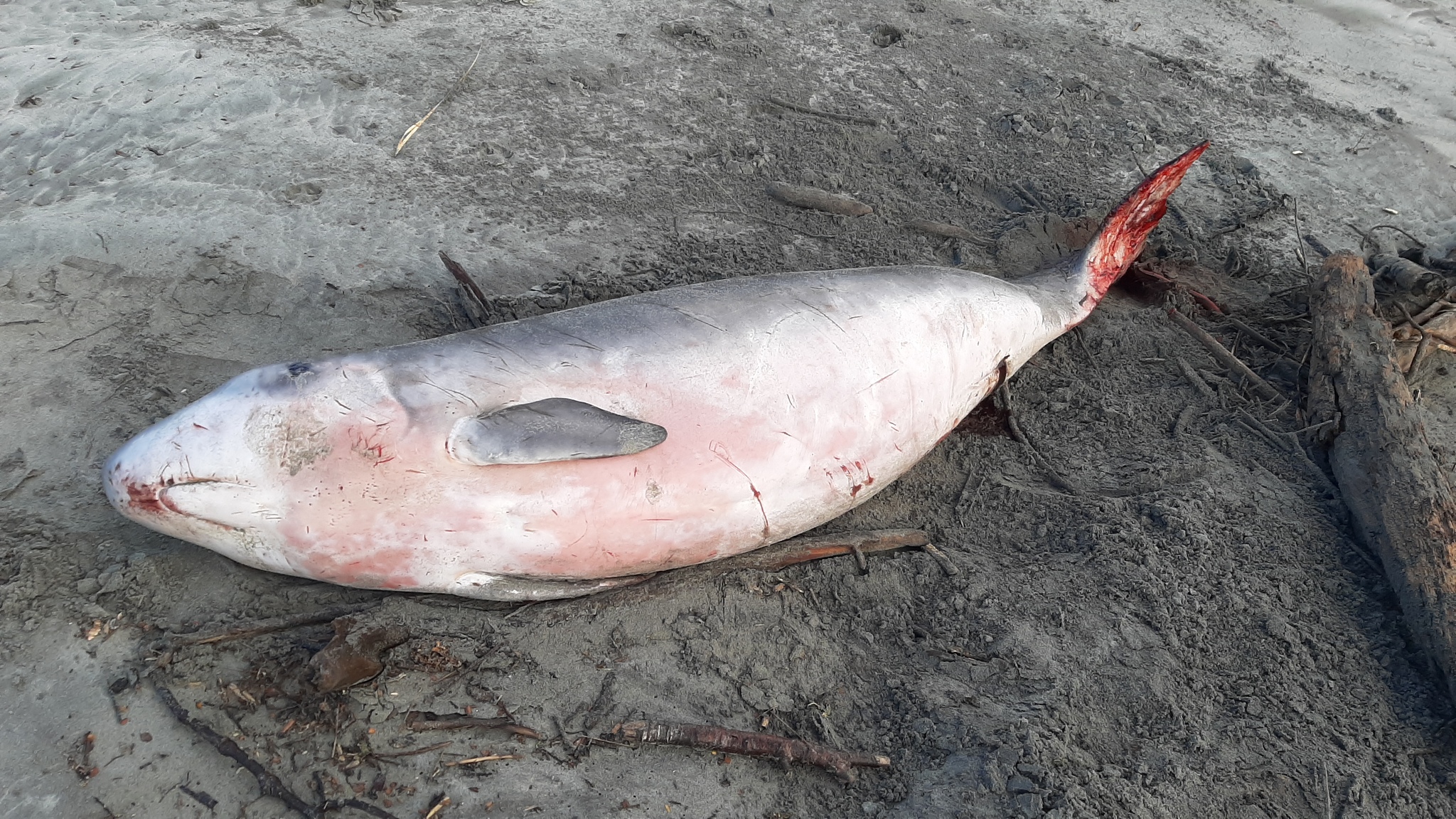
The pygmy sperm whale has a stocky, compact outline, far removed from the classic image of the sperm whale. The head is short, almost square in profile, with a blunt snout and a markedly underslung lower jaw, which gives the animal a shark-like look when it is seen stranded. Behind each eye runs a pale crescent-shaped mark, the “false gill” (or “false ear”), which further reinforces this resemblance. The back is slate grey to blue-grey, sometimes brownish, the skin finely wrinkled, while the underside lightens to creamy white or pink. The flippers are short and broad, shaped like a laurel leaf. The blowhole is offset to the left of the top of the skull.

The dorsal fin is the best field character: small, low, falcate, it is set well behind the midpoint of the back. On a stranded animal, the diagnostic measurement is the distance between the tip of the snout and the front insertion of the dorsal fin, greater than 50% of total length in the pygmy sperm whale. The teeth are confined to the lower jaw, with 10 to 16 pairs of fine, curved teeth (that is, 20 to 32 teeth), lacking enamel; the upper jaw bears none. Like its larger cousin, the animal has a spermaceti organ in the head, involved in producing and focusing sounds.

The most frequent confusion is with the dwarf sperm whale (Kogia sima), a sister species with an almost identical coloration pattern. The dwarf sperm whale is smaller, has a taller dorsal fin set further forward on the back, has shorter and more slender teeth and may show up to three pairs of small teeth in the upper jaw. At sea the distinction is often impossible, and observers then settle for the entry “Kogia sp.”. Confusion with the sperm whale does not arise: the sizes are not of the same order. A fresh carcass, on the other hand, can be taken from a distance for a small shark or a porpoise, and an animal lying motionless at the surface is regularly mistaken for floating debris.

Taxonomy

The pygmy sperm whale belongs to the family Kogiidae, within the superfamily Physeteroidea, which also includes the Physeteridae (sperm whale). The genus Kogia was erected by John Edward Gray in 1846 and contains only two living species, the pygmy sperm whale (K. breviceps) and the dwarf sperm whale (K. sima), long confused as a single one. The fossil record of the genus goes back to the Late Miocene and includes in particular Kogia pusilla, from the Middle Pliocene of Italy, and Kogia danomurai, from the latest Miocene of the Pisco Formation in Peru.

The species was described in 1838 by Henri Marie Ducrotay de Blainville, first under the name Physeter breviceps. The type material is French: the head of an individual stranded at Audierne, in Finistère, in 1784, held at the Muséum d'histoire naturelle. The epithet breviceps comes from Latin and means “short-headed”.

Range and habitat

The species is cosmopolitan in the tropical and warm temperate waters of the Atlantic, Pacific and Indian oceans, broadly between 45° N and 45° S, with extralimital records further north, up to 54° N, and a stranding documented in September 2013 at Banff, in Scottish Aberdeenshire, at 57°40′ N. The increase in records in the north-east Atlantic since the late 1980s, in parallel with that of other warm-water cetaceans, has been linked to the warming of surface waters. The pygmy sperm whale is a deep-water species: it frequents the edge and the foot of the continental slope as well as the open sea, and when in good health it approaches the coast only exceptionally.

In mainland France, the species is rare but regular. The national stranding network, coordinated by the Observatoire Pelagis, recorded 38 reports of pygmy sperm whale between 1990 and 2023, for the most part on the Atlantic seaboard, with a marked concentration in the south of the Bay of Biscay and an autumn to winter seasonality; records further north exist, such as an individual in Morbihan in 2022. In November 2025, two individuals stranded alive on Les Bourdaines beach at Seignosse, in the Landes, and neither could be saved. In the overseas territories, the species is present in the French Antilles, in the Agoa Sanctuary, in French Polynesia and in New Caledonia; the first confirmed record in Guadeloupe dates from November 2022, at Petit-Bourg, followed by a second in 2023.

The Mediterranean is a particular case: long held to lie outside the range, for want of a confirmed sighting at sea, it has yielded a stranding on the Algerian coast in June 2001, then molecular traces. Environmental DNA analyses carried out during the LIFE Conceptu Maris programme, between October 2022 and October 2024, detected the species in ten samples corresponding to at least five independent presence events, from the Tyrrhenian Sea to the Strait of Gibraltar. These results, published in 2026, suggest a discreet but lasting presence rather than simple wandering.

Biology and ecology

The pygmy sperm whale is a deep diver. It hunts mainly mesopelagic cephalopods, often bioluminescent, glass squid, lycoteuthids, ommastrephids, taken by suction, and rounds out its diet with fish and crustaceans. Stomach content analyses have brought to light prey belonging to four orders of cephalopods, twenty-three families and at least fifty species. Dives commonly reach several hundred metres, generally described as between 300 and 600 m, with feeding events reported down to more than 1,000 m; their mean duration is close to 11 minutes, the longest dive reported reaching 45 minutes.

To locate its prey in the dark, the animal emits echolocation clicks described as narrow-band high-frequency (NBHF), with a peak frequency around 125 to 130 kHz, highly directional and inaudible to most predators. It also has a spectacular defensive display: a sac in the terminal part of the intestine holds up to a dozen litres of a reddish-brown fluid that the animal expels when threatened, creating an opaque cloud comparable to a cephalopod's ink. The known predators are the great white shark and the killer whale.

Social life is limited: individuals are solitary or gathered in small groups of two to six or seven animals, with no documented social structure. Sexual maturity is reached at around 4 to 5 years. Gestation lasts 9 to 11 months and gives birth to a single calf of about 1.2 m, suckled for close to a year; females can breed every year. In the Northern Hemisphere, matings peak between March and August. The maximum known longevity is about 23 years.

Status and conservation

The IUCN Red List has classed the pygmy sperm whale as “Least Concern” (LC) since its assessment of 2020. That classification rests on a very wide global range, the existence of known areas of concentration and the absence of any major identified threat over most of the range; the population trend, for its part, is unknown. There is no global abundance estimate: the very furtive surface behaviour, the long dives and the cryptic character of the species make sighting surveys inefficient. At the regional scale, the western North Atlantic stock of Kogia spp. was estimated at 9,474 individuals (CV = 0.36) during the 2021 surveys, with no statistically detectable trend relative to the estimates of 2011 and 2016.

The main pressures identified are bycatch in fishing gear, in particular gillnets and seines, the ingestion of plastic waste, a cause of death documented on several occasions in kogiids, ship strikes, favoured by the habit of drifting motionless at the surface, and underwater noise of human origin. Localised, small-scale coastal hunts have existed or still exist in Indonesia, Japan and the Lesser Antilles.

The species is listed in Appendix II of CITES and in Annex II of the SPAW Protocol for the Caribbean. In France, it has full protection under the order of 1 July 2011 setting the list of marine mammals protected on national territory, and falls under Annex IV of the Habitats Directive. In the United States, it is protected by the Marine Mammal Protection Act. The researchers who brought its presence in the Mediterranean to light argue for its formal inclusion in the regional protection instruments, among them ACCOBAMS.

Observing this species

Seeing a pygmy sperm whale is a matter of pure luck. The animal shows itself only in a glassy sea with no wind: it rises slowly, without a splash, exposes a grey back and a small rear-set dorsal fin, blows almost invisibly, then lies still at the surface or sinks without rolling. In Japan this behaviour once earned it the nickname of “floating whale”. It flees approaching vessels, which makes photography particularly difficult. The best chances lie over the continental slope and the deep sea, in tropical and warm temperate areas; in mainland France, no whale-watching trip can reasonably target it.

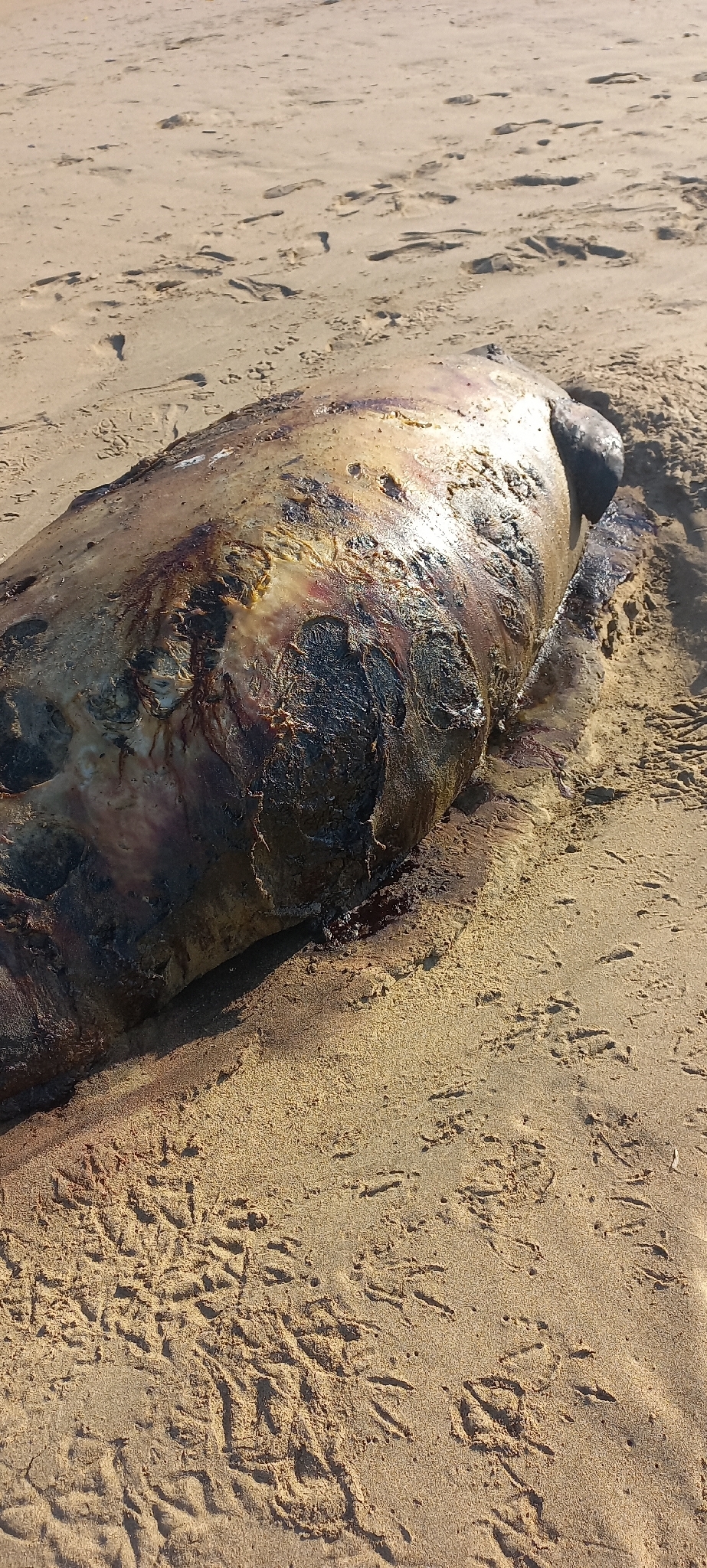
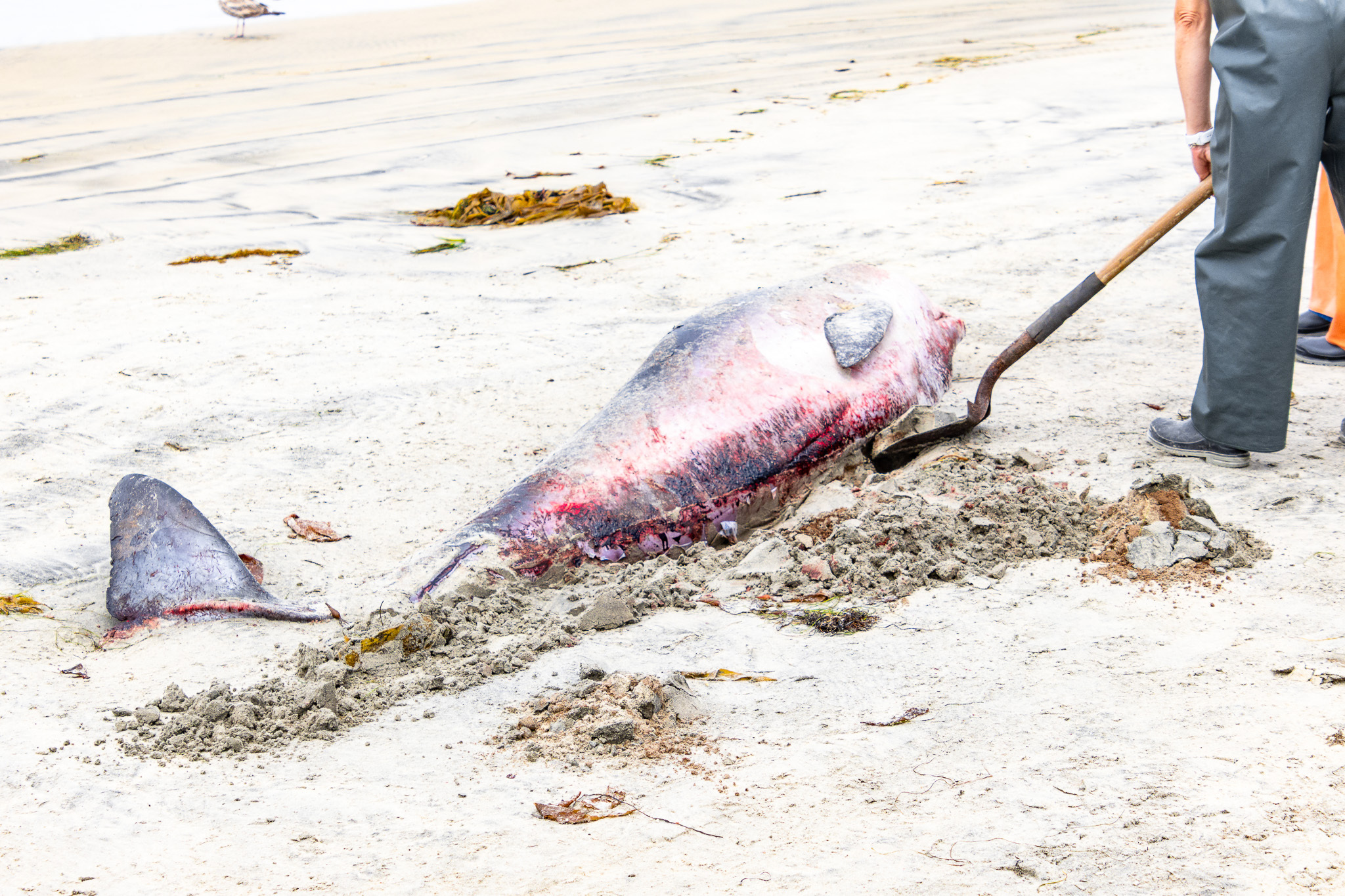
Most of what is known therefore comes from strandings, which are frequent worldwide, it is one of the most often stranded cetaceans on the coasts of Florida. Faced with a stranded animal, alive or dead, what to do is simple: do not touch it, do not try to put it back in the water, keep people and dogs at a distance, and alert the national stranding network or the emergency services immediately. A pygmy sperm whale that reaches the beach is almost always sick or exhausted, and an improvised return to the water only prolongs its death throes while destroying valuable scientific data.

Frequently asked questions

Is the pygmy sperm whale a baby sperm whale?

No. It is a species in its own right, belonging to a different family (the Kogiidae) from the sperm whale (Physeteridae). An adult pygmy sperm whale measures about 2.7 to 3.8 m and weighs 315 to 450 kg, and a newborn is already 1.2 m long.

How can the pygmy sperm whale be told from the dwarf sperm whale?

By the dorsal fin, above all: small, low and set well behind the midpoint of the back in the pygmy sperm whale, taller and more central in the dwarf sperm whale. The pygmy sperm whale is also larger and its teeth are longer and thicker. At sea, the distinction often remains impossible.

Why is it said to produce ink like a squid?

It has a sac in the terminal part of the intestine containing up to a dozen litres of a reddish-brown fluid. Threatened by a killer whale or a shark, it expels it to form an opaque cloud behind which it escapes. This behaviour is unique among cetaceans.

How deep and for how long does it dive?

Its dives generally take place between 300 and 600 m, with feeding events reported down to more than 1,000 m. Their mean duration is close to 11 minutes, the longest dive reported reaching 45 minutes.

Can it be seen in France?

Only with great difficulty. It is known from the Atlantic seaboard through strandings, 38 reports between 1990 and 2023, above all in the south of the Bay of Biscay, in autumn and early winter. It is also present in the French Antilles, in French Polynesia and in New Caledonia.

Is it present in the Mediterranean?

The species was considered absent there for want of a confirmed sighting. A stranding was nevertheless recorded on the Algerian coast in June 2001, and environmental DNA analyses carried out between 2022 and 2024 detected its presence on at least five occasions, from the Tyrrhenian Sea to the Strait of Gibraltar.

Is the species threatened?

The IUCN has classed it as “Least Concern” since 2020, on account of its very wide range, but the population trend is unknown and there is no global abundance estimate. Bycatch, the ingestion of plastics, ship strikes and underwater noise are the main pressures.

Sources

Species account compiled from authoritative scientific sources (IUCN, NOAA Fisheries, specialist literature) and reviewed for factual accuracy.

Observed distribution

According to the open data of the GBIF, 225 georeferenced sightings of Kogia breviceps are recorded in our photographic index.

Main countries of observation
CountryNotes
United States of America154
New Zealand21
South Africa18
Australia17
Mexico9
Portugal8
Spain8
Japan6
Chinese Taipei4
Indonesia3

Distribution map: Pygmy sperm whale (Kogia breviceps)

Distribution map: Pygmy sperm whale (Kogia breviceps), 225 georeferenced sightings from GBIF
225 georeferenced sightings of Kogia breviceps. Base map Natural Earth, public domain. GBIF data.
🗺️ Open the interactive mapTo zoom and pan. It uses the OpenStreetMap/CARTO base maps and the GBIF occurrence densities: no data is sent to these services before you click.

Presence through the year

Monthly distribution of 247 dated sightings (all years combined): the maximum is reached in juillet.

310janvier : 14janfévrier : 19febmars : 21maravril : 16avrmai : 22maijuin : 15juinjuillet : 31juilaoût : 22Augustseptembre : 25sepoctobre : 19octnovembre : 22novdécembre : 21dec
Sightings by month
MonthNotes
janvier14
February19
mars21
avril16
mai22
juin15
juillet31
August22
septembre25
octobre19
novembre22
December21

These figures reflect survey effort (more boaters and more surveys in summer) as much as the actual presence of the species: to be interpreted with caution.

En images

Kogia breviceps
© PampaSorro, CC BY, 2026
Kogia breviceps
© arnoldmuller, CC BY-NC, 2026
Kogia breviceps
© MauraBarry, CC BY-NC, 2026
Kogia breviceps
© christie_roux, CC BY-NC, 2026
Kogia breviceps
© Malik Vest-Walton, CC BY-NC, 2026
Kogia breviceps
© sfarhang, CC BY-NC, 2026
Kogia breviceps
© mcprins, CC BY-NC, 2026
Kogia breviceps
© kyle_morales, CC BY-NC, 2026
Kogia breviceps
© DiGua Su, CC BY-NC, 2026
Kogia breviceps
© Jim Carretta, CC BY-NC, 2026
Kogia breviceps
© beachlover2025, CC BY-NC, 2025
Kogia breviceps
© Yann Coatanéa, CC BY-NC-ND, 2025

Photographs from GBIF under a Creative Commons licence. The author and the licence of each photograph are given; please respect them if you reuse them.

Scientific references

  1. Bloodworth B., Odell D. (2008) Kogia Breviceps (Cetacea: Kogiidae), Mammalian Species
  2. Baird R. (2005) Sightings of Dwarf ( Kogia sima ) and Pygmy ( K. breviceps ) Sperm Whales from the Main Hawaiian Islands, Pacific Science
  3. Brentano R., Petry M. (2020) Marine debris ingestion and human impacts on the Pygmy sperm whale (Kogia breviceps) in southern Brazil, Marine Pollution Bulletin
  4. Plön S., Best P., Duignan P., Lavery S. et al. (2023) Population structure of pygmy (Kogia breviceps) and dwarf (Kogia sima) sperm whales in the Southern Hemisphere may reflect foraging ecology and dispersal patterns, Advances in Marine Biology
  5. Denison E., Rhodes R., McLellan W., Pabst D. et al. (2020) Host phylogeny and life history stage shape the gut microbiome in dwarf (Kogia sima) and pygmy (Kogia breviceps) sperm whales, Scientific Reports
  6. (2019) Kogia breviceps: Kiszka, J. & Braulik, G., IUCN Red List of Threatened Species
  7. Rice D., Wolman A. (1990) The Stomach of Kogia breviceps, Journal of Mammalogy
  8. Hückstädt L., Antezana T. (2001) AN OBSERVATION OF PARTURITION IN A STRANDEDKOGIA BREVICEPS, Marine Mammal Science

Automatic selection of the most cited works mentioning the species (source: Crossref).