Hector's beaked whale (Mesoplodon hectori)

Key facts
Scientific name Mesoplodon hectori (Gray, 1871)
Other names Hector’s beaked whale; mésoplodon d’Hector, baleine à bec d’Hector (French). Scientific synonyms: Berardius hectori Gray, 1871 (basionym), Mesoplodon knoxi Hector, 1873, Paikea hectori Oliver, 1922.
Size About 4.2 to 4.4 m in adults (largest stranded male measured: 4.3 m; largest female: 4.43 m). Newborn: about 1.9 to 2.0 m.
Weight Poorly documented: no individual has been the subject of a published weighing. The weight of an adult is estimated at around one tonne, a value consistent with that of other mesoplodonts of comparable size. The figure of 1,840 kg sometimes quoted for a female is not corroborated by any other source and appears to be an overestimate.
Longevity Not documented: no age study has been published for the species. In other mesoplodonts, longevity reaches at least some thirty years.
Diet Deep-water cephalopods (squid), probably supplemented by mesopelagic fish; capture by suction during deep dives.
IUCN status Data Deficient (DD), global assessment of 2020, a status still in force in the most recent edition of the Red List. No subpopulation is assessed separately. In New Zealand, the national threat classification has likewise placed it in “Data Deficient” (2005 list).

In brief

Hector’s beaked whale (Mesoplodon hectori) is one of the smallest ziphiids in the world: of the order of 4.2 to 4.4 m for a weight estimated at around one tonne, no weighing ever having been published. It occurs in the cold and temperate oceanic waters of the southern hemisphere, approximately between 35° and 55° south, where its distribution appears to be circumpolar. It has been the subject of only one certain sighting of a living animal at sea: essentially everything known about it rests on a handful of strandings, which is what earns it the IUCN’s “Data Deficient” classification.

Identification

The outline is the highly characteristic one of the beaked whales: a spindle-shaped fusiform body, a small rounded to triangular dorsal fin set far back on the body, reduced flippers and a broad tail fluke with an almost straight trailing edge. The rostrum is short but clearly drawn, often pale grey or whitish, and joins a melon that falls away on a fairly steep slope. The blowhole is crescent-shaped. The classic coloration combines a dark grey-brown back with paler flanks and belly, frequently with dark patches around the eyes and a pale lower jaw. This livery remains variable: a female examined in Argentina was light grey on the back and distinctly white on the belly.

Sexual dimorphism is read first of all in the dentition. As in all mesoplodonts, only adult males carry visible functional teeth: a pair of flattened teeth, triangular in outline, set near the tip of the mandible and not at mid-length as in several related species. In females these teeth do not normally pierce the gum, although a female stranded at Waitpinga Beach, in South Australia, examined in March 2016, showed a pair of unusual large teeth, probably vestigial. Adult males are moreover covered in pale to whitish linear scars, the record of the fights in which they cut into each other’s skin with these two teeth.

Confusion is the rule rather than the exception. At sea, the species is practically impossible to tell apart from True’s beaked whale (Mesoplodon mirus) without genetic analysis, and the mesoplodonts of the southern hemisphere, Gray’s beaked whale, Andrews’ beaked whale, all closely resemble one another. The risk of confusion applies to the names as well: Hector’s dolphin (Cephalorhynchus hectori), a small coastal delphinid of New Zealand, is an unrelated species, simply dedicated to the same naturalist. In the northern hemisphere, finally, the animals long attributed to M. hectori in fact belonged to another species.

Taxonomy

The species was described by the British zoologist John Edward Gray in 1871, under the name Berardius hectori, from a New Zealand specimen whose type locality is Titai Bay, in Cook Strait. It was subsequently transferred to the genus Mesoplodon by William Henry Flower. The species name honours Sir James Hector, one of the founders of the Colonial Museum in Wellington. Several names placed in synonymy have circulated, among them Mesoplodon knoxi Hector, 1873 and Paikea hectori Oliver, 1922.

It belongs to the family Ziphiidae (also designated Hyperoodontidae in some classifications) and to the genus Mesoplodon, by far the richest genus of cetaceans in species. Its validity was long disputed: in 1962, some authors saw in it no more than a juvenile Arnoux’s beaked whale (Berardius arnuxii), before adult males examined in the 1970s and 1980s confirmed that it stands on its own.

A major taxonomic episode came by way of genetics. Five animals stranded in southern California between 1975 and 1997, referred to M. hectori, turned out, after sequencing of mitochondrial DNA, to belong to a distinct and as yet undescribed species, Perrin’s beaked whale (Mesoplodon perrini). The supposed records of M. hectori in the north-east Pacific must therefore be set aside: the species is indeed confined to the southern hemisphere.

Distribution and habitat

Hector’s beaked whale occupies the deep, cold to temperate oceanic waters of the southern hemisphere, in a band lying approximately between 35° and 55° south. Its distribution there is regarded as circumpolar, even if the actual map comes down to a scatter of stranding points.

New Zealand provides the majority of the records, in particular on the east coast of the South Island. Elsewhere, stranded animals have been recorded in Argentina (Buenos Aires Province), in southern Brazil, in Chile and Tierra del Fuego, in the Falkland Islands, in South Africa, in Tasmania, and in South Australia and Western Australia. The only confirmed sighting at sea to date concerns a young animal spotted off Western Australia, whose identification was validated by DNA analysis of fragments of sloughed skin. The seasonal rhythm of the New Zealand strandings, concentrated from December to April, suggests that the animals move closer to the coast at that time of year.

In France, the species is absent from metropolitan waters: neither the Mediterranean and the Pelagos sanctuary, nor the Bay of Biscay, nor the English Channel falls within its strictly austral range. The band of latitudes it frequents does, on the other hand, cross the French Southern and Antarctic Lands, Amsterdam and Saint-Paul, Crozet, Kerguelen, but no confirmed record is documented there to date. The mesoplodonts seen or stranded on those archipelagos belong to other species.

Biology and ecology

Like all ziphiids, Hector’s beaked whale is a deep diver that hunts by echolocation in the water column or close to the bottom. Lacking any true row of grasping teeth, it captures its prey by suction: a pair of gular grooves allows the mouth cavity to be expanded abruptly while the tongue retracts, creating a drop in pressure that draws in the target animal. Mesoplodonts typically feed at several hundred metres’ depth, sometimes beyond 1,000 m. The stomach, divided into four chambers (proximal main stomach, distal stomach, connecting stomachs, pyloric stomach), is that of a predator of cephalopods.

The diet is known only in fragments: analysis of the stomach contents of one adult yielded squid as the dominant prey, and it is assumed that small deep-water fish, lanternfish in particular, complete the menu. The two animals stranded alive in August and September 2002 in Buenos Aires Province, about a hundred kilometres apart, a male of 3.94 m and a female of 3.84 m, both adults, had empty stomachs but hosted an abundant parasite fauna: larvae of Anisakis sp. in both, Sarcocystis, Tetrabothrius and Bolbosoma in the female, Braunina cordiformis in the male. The female showed parasitic lung lesions and chronic pneumonia. These two strandings are among the very few occasions on which the species has been examined in detail, but the data available do not allow a general picture of its biology to be drawn from them.

Social life appears to be unobtrusive: the few indications point to solitary animals or pairs rather than to structured groups. Reproduction has never been studied directly; by analogy with the other mesoplodonts, a gestation of about twelve months is assumed, a single calf measuring close to 2 m at birth, an interval of several years between two births and late sexual maturity. The scarring of the males indicates marked intrasexual competition.

Status and conservation

The species is classed as “Data Deficient” (DD) on the global IUCN Red List, a status arising from the 2020 assessment and carried over into the most recent edition of the Red List. No abundance estimate and no population trend exists: fewer than some thirty individuals have been documented in all, almost all of them dead. It is impossible to say whether the species is genuinely rare or merely unobtrusive and poorly detected across an immense and little-surveyed stretch of ocean.

It has never been the target of directed hunting and no bycatch has been formally documented. The pressures identified therefore remain theoretical, but plausible: entanglement in drifting or gillnet high-seas fishing gear, chemical and plastic pollution, oil spills, and noise pollution. This last point deserves attention, because ziphiids are among the cetaceans most sensitive to intense anthropogenic noise, in particular to low and mid frequency active sonars.

On the regulatory side, Mesoplodon hectori is listed on Appendix II of CITES, which governs international trade in specimens and their parts, and falls under the Memorandum of Understanding for the Conservation of Cetaceans and their Habitats in the Pacific Islands Region. The conservation priority, for want of a clearly quantified threat, remains the acquisition of knowledge: systematic documentation of strandings, genetic sampling and work on museum collections.

Watching this species

This species is not observable under ordinary conditions. With a single confirmed sighting at sea to date, no watching trip can reasonably target it, and no whale-watching activity is devoted to it. Ziphiids in general announce themselves by slender clues, a low and barely visible blow, a dark back that rolls briefly at the surface, dive sequences that can exceed half an hour, and they generally move away from vessels.

It is therefore through strandings that science advances. Within the austral range of the species, any stranded animal must be reported to the competent authorities: in New Zealand, the Department of Conservation; in Australia, the wildlife services of the state concerned. In France, where the species is not present, the same rule applies to any stranded cetacean: alert the national stranding network without delay, the only body authorised to intervene, which centralises reports in mainland France as well as overseas and coordinates the examinations.

What to do is simple: do not touch the animal, do not try to put it back in the water, keep dogs and the public at a distance, note the position and the time precisely, and photograph the head in profile, the lower jaw and any teeth as well as the complete livery. It is these photographs, together with a sample of skin or muscle for DNA analysis, that allow a reliable determination: in mesoplodonts, visual identification alone remains uncertain, and several historical errors have been corrected only by genetics.

Frequently asked questions

Can Hector’s beaked whale be seen in France?

No. The species is strictly austral, confined between about 35° and 55° south. It is absent from the Mediterranean, from the Bay of Biscay and from the English Channel. The band of latitudes it occupies crosses the French Southern and Antarctic Lands (Crozet, Kerguelen, Amsterdam and Saint-Paul), but no confirmed record has been documented there.

What size and weight does it reach?

It measures about 4.2 to 4.4 m in adults: the largest stranded male measured reached 4.3 m and the largest female 4.43 m. Weight has never been the subject of a published weighing; it is estimated at around one tonne, as in the other mesoplodonts of comparable size. It is one of the smallest ziphiids, generally regarded as the second smallest of the genus after the pygmy beaked whale (Mesoplodon peruvianus).

Why is it classed as “Data Deficient” by the IUCN?

Because the information needed to estimate an abundance, a trend or a level of threat is lacking. Fewer than some thirty individuals have been documented, almost exclusively stranded animals, and a single sighting at sea is confirmed. This status, arising from the 2020 assessment, means that the risk of extinction cannot be assessed, not that the species is doing well.

Do only males have visible teeth?

Yes, in the great majority of cases. Adult males carry a pair of flattened, triangular teeth near the tip of the lower jaw, which they use in fights between rivals, hence their many pale scars. In females these teeth do not normally pierce the gum; a female stranded in South Australia in 2016 was an exception, with unusual teeth that were probably vestigial.

What does it eat, and how does it hunt?

Its diet rests mainly on deep-water squid, probably supplemented by small mesopelagic fish. For want of grasping teeth, it hunts by suction: its gular grooves allow it to expand the mouth cavity while retracting the tongue, which draws the prey in. Location is by echolocation, during deep dives.

How is it told apart from Hector’s dolphin?

They are two species with no close relationship. Hector’s dolphin (Cephalorhynchus hectori) is a small coastal delphinid endemic to New Zealand, threatened and well known to the public. Hector’s beaked whale is an offshore ziphiid of more than four metres. The two names simply honour the same naturalist, Sir James Hector.

Sources

Profile compiled from authoritative scientific sources (IUCN, NOAA Fisheries, specialist literature) and reviewed for factual accuracy.

Observed distribution

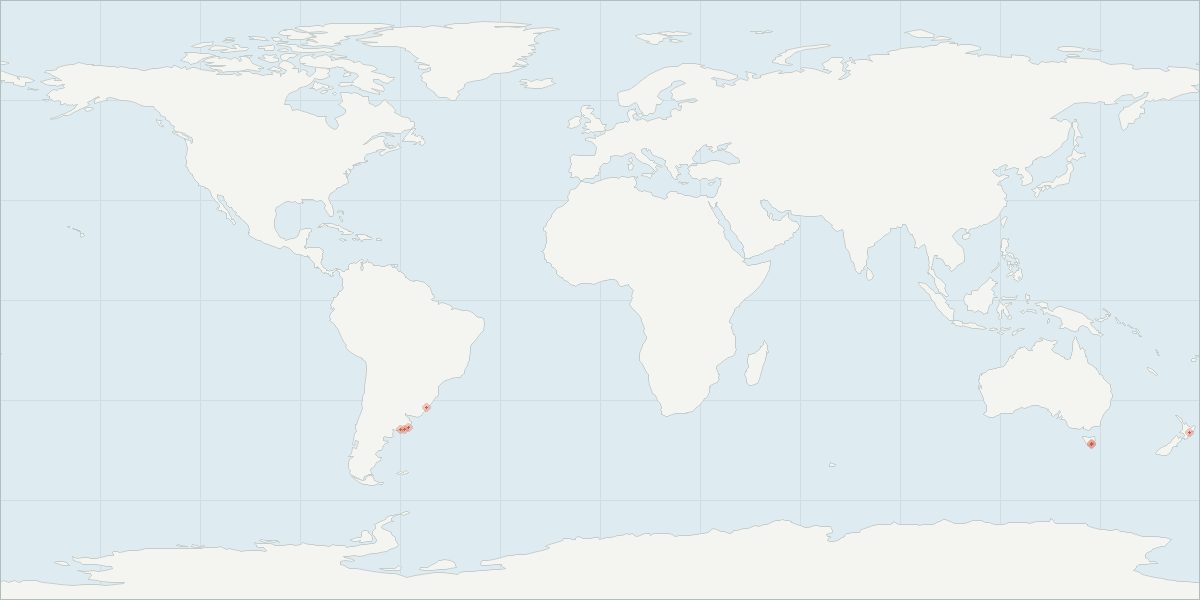
According to the open data of the GBIF, 7 georeferenced sightings of Mesoplodon hectori are recorded in our photographic index.

Main countries of observation
CountryNotes
Argentina4
Australia3
Brazil1
Chile1
Falkland Islands (Malvinas)1
New Zealand1

Distribution map: Hector's beaked whale (Mesoplodon hectori)

Distribution map: Hector's beaked whale (Mesoplodon hectori), 7 georeferenced sightings from GBIF
7 georeferenced sightings of Mesoplodon hectori. Base map Natural Earth, public domain. GBIF data.
🗺️ Open the interactive mapTo zoom and pan. It uses the OpenStreetMap/CARTO base maps and the GBIF occurrence densities: no data is sent to these services before you click.

Presence through the year

Monthly distribution of 8 dated sightings (all years combined): the maximum is reached in janvier.

40janvier : 4janfévrier : 0febmars : 1maravril : 0avrmai : 0maijuin : 0juinjuillet : 0juilaoût : 1Augustseptembre : 1sepoctobre : 0octnovembre : 0novdécembre : 1dec
Sightings by month
MonthNotes
janvier4
February0
mars1
avril0
mai0
juin0
juillet0
August1
septembre1
octobre0
novembre0
December1

These figures reflect survey effort (more boaters and more surveys in summer) as much as the actual presence of the species: to be interpreted with caution.

En images

Mesoplodon hectori
© Mead, James G., licence spécifique, 2016
Mesoplodon hectori
© Mead, James G., licence spécifique, 2002
Mesoplodon hectori
© Mead, James G., licence spécifique, 2002
Mesoplodon hectori
© Mead, James G., licence spécifique, 1997
Mesoplodon hectori
© Mead, James G., licence spécifique, 1994
Mesoplodon hectori
© Mead, James G., licence spécifique, 1985
Mesoplodon hectori
© Mead, James G., licence spécifique, 1979
Mesoplodon hectori
© Mead, James G., licence spécifique, 1977
Mesoplodon hectori
© Mead, James G., licence spécifique, 1975
Mesoplodon hectori
© The Trustees of the Natural History Museum, London, CC BY, 1972
Mesoplodon hectori
© Mead, James G., licence spécifique, 1966
Mesoplodon hectori
© The Trustees of the Natural History Museum, London, CC BY

Photographs from GBIF under a Creative Commons licence. The author and the licence of each photograph are given; please respect them if you reuse them.

Scientific references

  1. Mead J. (1981) First Records of Mesoplodon hectori (Ziphiidae) from the Northern Hemisphere and a Description of the Adult Male, Journal of Mammalogy
  2. Mead J., Baker A. (1987) Notes on the rare beaked whale, Mesoplodon hectori (Gray), Journal of the Royal Society of New Zealand
  3. Pitman R. (2018) Mesoplodon Beaked Whales, Encyclopedia of Marine Mammals
  4. Cappozzo H., Negri M., Mahler B., Lia V. et al. (2005) Biological data on two Hector's beaked whales, Mesoplodon hectori, stranded in Buenos Aires province, Argentina, Latin American Journal of Aquatic Mammals
  5. Gales N., Dalebout M., Bannister J. (2002) GENETIC IDENTIFICATION AND BIOLOGICAL OBSERVATION OF TWO FREE‐SWIMMING BEAKED WHALES: HECTOR'S BEAKED WHALE (MESOPLODON HECTORI, GRAY, 1871), AND GRAY'S BEAKED WHALE (MESOPLODON GRAYI, VON HAAST, 1876), Marine Mammal Science
  6. Nikolov P., Cappozzo H., Berón-Vera B., Crespo E. et al. (2010) Cestodes from Hector's Beaked Whale (Mesoplodon hectori) and Spectacled Porpoise (Phocoena dioptrica) from Argentinean Waters, Journal of Parasitology
  7. Baker A., Duignan P., Norman R., van Helden A. et al. (2001) A JUVENILE HECTOR'S BEAKED WHALE, MESOPLODON HECTORI (GRAY 1871), WITHOUT FUNCTIONAL THROAT GROOVES, PLUS NOTES ON ENDOPARASITES (CETACEA: ZIPHIIDAE), Marine Mammal Science
  8. Fraser F. (1950) NOTE ON A SKULL OF HECTOR'S BEAKED WHALE MESOPLODON HECTORI (Gray) FROM THE FALKLAND ISLANDS, Proceedings of the Linnean Society of London

Automatic selection of the most cited works mentioning the species (source: Crossref).