
A tusk that is far more than ornamental
The narwhal (Monodon monoceros) long remained an ethological puzzle. Living in remote parts of the Arctic, this cetacean, equipped with a spiralled tusk that can reach 3 metres and present mainly in males, has remained difficult to observe under natural conditions. Until recently, its main function was assumed to be linked to mating rituals and to the assessment of dominance.
But thanks to the use of drones by researchers from the FAU Harbor Branch Oceanographic Institute and Fisheries and Oceans Canada, in partnership with the Inuit communities of Nunavut, new behaviours have been documented: the narwhal uses its tusk as a genuine behavioural tool, with multiple functions including exploration, prey capture and play.
A sensory and motor apparatus of great precision
The aerial sequences collected show a fine-grained use of the tusk in the active manipulation of fish, in particular Arctic char (Salvelinus alpinus). The narwhal is able to orient its tusk precisely in order to interact with its prey. It makes rapid, targeted movements, with dynamic adjustments according to the trajectory of the fish.
Brief contact with the tip of the tusk generally provokes a reaction in the fish. In some cases, the force applied appears sufficient to stun or incapacitate the prey. These observations mark a turning point in the functional interpretation of this elongated dental structure.
Social behaviours and shared learning
Seventeen distinct types of behaviour have been documented, some of them social or exploratory in nature. These are not only feeding interactions. The researchers observed probable forms of exploratory play with objects, which is a first in this species.
Some sequences suggest the possibility of social transmission: a narwhal could learn by watching a conspecific, or even teach certain behaviours. Differences between individuals were also noted, which would suggest the existence of distinct personalities.
Interspecific interaction: between competition and food parasitism
The study also reports the first observations of three-way interactions between narwhals, fish and seabirds. Glaucous gulls (Larus hyperboreus) were seen attempting to steal prey immobilised by narwhals, a behaviour known as kleptoparasitism.
Alongside this, scenes of competition between narwhals were recorded: some individuals block others from reaching a prey item, without showing overt aggression. These scenes could reflect both competitive behaviour and a system of within-species social communication more subtle than was supposed.
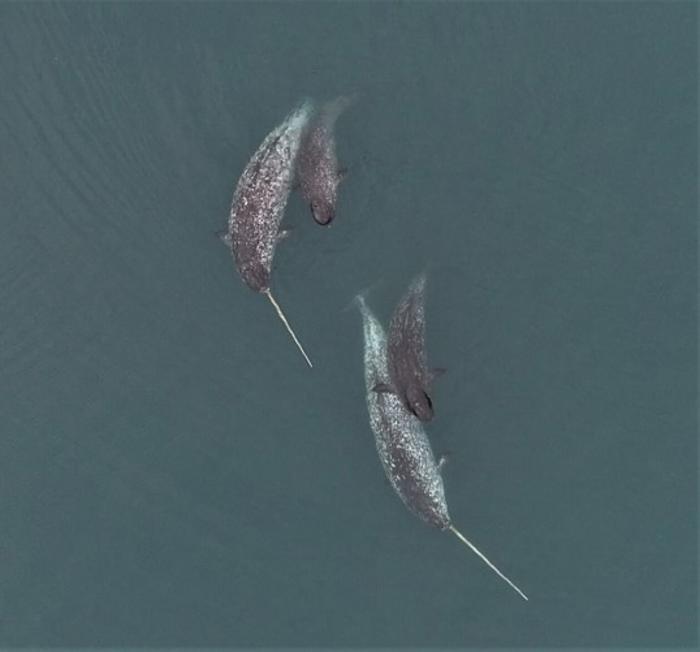
Tusking rituals seen in a new light
The well-known behaviour of “tusking”, in which several narwhals cross their tusks vertically above the water, had until now been interpreted as a ritual of assessment or display between males. These new data suggest that the tusk is not only a symbolic object but also a functional instrument.
Greg O’Corry-Crowe, lead author of the study, notes that the uses identified: foraging, manipulation, play redefine the role of this emblematic organ in the behavioural ecology of the narwhal.

Observing without disturbing: the ethological drone revolution
The methodology used, continuous aerial observation from an isolated field camp, illustrates the power of non-invasive tools for the ethology of Arctic species. Drones give a synoptic, real-time view of behaviours that would otherwise be inaccessible.
Cortney Watt, co-author and researcher at Fisheries and Oceans Canada, stresses how new these data are: after more than a decade studying the narwhal, this is the first time that these behavioural uses of the tusk have been documented in situ.
An ecological context changing fast
This work forms part of a wider effort to understand the impact of Arctic change on emblematic species. Climate change is altering prey availability, sea ice configurations and interspecific interactions. For narwhals, a gregarious and locally endemic species, adaptive behaviour could be influenced by social plasticity.
The study underlines the importance of continuing these observations in order to anticipate the effects of anthropogenic and environmental pressures on the emerging behaviours of Arctic megafauna.
Source of the article: http://dx.doi.org/10.3389/fmars.2025.1518605
Photo credit: O’Corry-Crowe, FAU/Watt, DFO
Did you find this article useful?
Add L'info des Cétacés to your preferred sources on Google. Our stories will be suggested to you more often, and the choice can be undone as easily as it is done.
 Follow us on Google
This preference is saved in your Google account and can be changed at any time. It is neither a certification nor a recommendation from Google.
Leave a review