
Odontocete cetaceans, at the top of the marine food chain, are exposed to slow, continuous chemical bioaccumulation throughout their lives.
Their longevity and their fish-based diet make them particularly sensitive to the accumulation of organohalogen compounds, including persistent organic pollutants (POPs) such as polychlorinated biphenyls (PCBs).
313 compounds detected: a chemical map across species
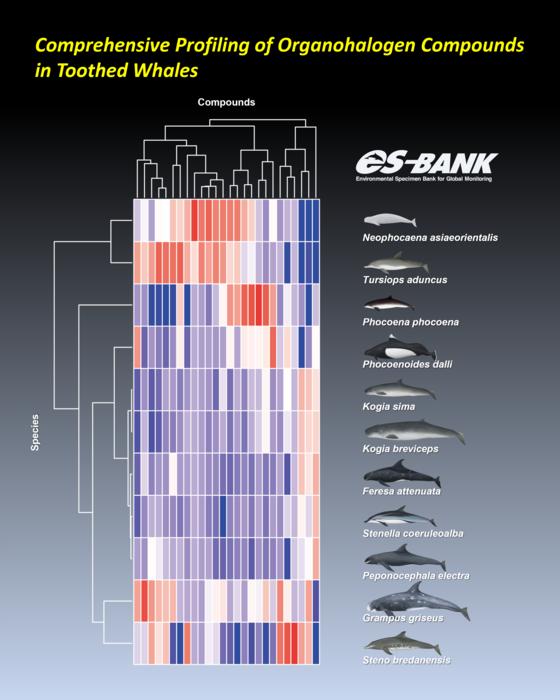
Analysis of the fatty tissue of 11 toothed whale species, taken from the environmental biobank of Ehime University (es-BANK), has revealed the presence of
313 organohalogen compounds. These compounds include:
- Industrial pollutants (PCBs, dioxins, etc.)
- Naturally occurring marine substances of comparable toxicity
- Compounds of unknown origin
The analytical approach rests on gas chromatography coupled with mass spectrometry (GC/MS), which allows precise and comprehensive screening.
The profiles obtained do more than draw up a chemical inventory. They bring out clear differences
between species, both in concentration and in the types of compound accumulated.
Chemical signatures linked to habitat and migration
The results bring out a clear correlation between accumulation profiles and the ecological characteristics of each species:
- Habitat depth
- Migration regions
- Diet
Species living in deep areas show profiles distinct from those occupying coastal habitats.
Certain chemical combinations appear characteristic of a specific territory or migratory route,
which makes these data particularly useful for reconstructing past or present distribution ranges.
An analytical tool for environmental biomonitoring
This study opens the way to a wider use of GC/MS methods for the ecological monitoring of marine mammals.
By identifying chemical habitat biomarkers, researchers now have a tool with which to:
- Map exposure to contaminants
- Assess the ecological health of a population
- Trace the historical movements of the cetaceans studied

A chemical biodiversity still largely unexplored
The fact that some of the compounds detected are of unknown origin underlines a gap in knowledge about marine chemical diversity.
These results suggest the existence of complex chemical interactions between marine organisms, the environment and human activities,
whose mechanisms remain to be elucidated.
A step towards an analytical ecology of large marine predators
By combining the approaches of analytical chemistry, environmental biobanking and behavioural ecology,
this study inaugurates an emerging discipline: the chemical ecology of marine mammals, evidence-based and reproducible.
Cetaceans thus become not only sentinels of marine pollution,
but also dynamic chemical indicators of the state of their habitats.
Did you find this article useful?
Add L'info des Cétacés to your preferred sources on Google. Our stories will be suggested to you more often, and the choice can be undone as easily as it is done.
 Follow us on Google
This preference is saved in your Google account and can be changed at any time. It is neither a certification nor a recommendation from Google.
Leave a review